


Imagine stepping out of bed only to be met with a sharp, restrictive tug at your heel that makes those first few steps feel like a marathon. For many residents in Middletown, back of ankle pain is much more than a minor inconvenience; it's a persistent barrier that turns a simple flight of stairs into a daunting challenge and creates a valid fear of long-term tendon damage. You've likely experienced the frustration of morning stiffness that lingers long after your first cup of coffee, or swelling that dictates which shoes you're able to wear for the day.
We believe that every patient deserves a clear name for their condition and a sophisticated plan for recovery. This article will guide you from a state of uncertainty to a path of lasting relief by identifying the specific mechanical causes of your posterior discomfort. You'll gain practical insights into reducing inflammation and discover how our specialized diagnostic methodology provides the foundation for effective ankle pain relief. We'll preview the most modern, outpatient-focused treatments available right here in our community, ensuring you have the confidence to pursue a future free from physical limitations through expert, compassionate care.
Key Takeaways
- Gain clarity on how the interaction between the Achilles tendon and retrocalcaneal bursa contributes to localized posterior discomfort.
- Distinguish between the symptoms of chronic overuse and acute ruptures to accurately identify the severity of your back of ankle pain.
- Discover why sophisticated imaging techniques like MRI and Ultrasound are superior to standard X-rays for visualizing soft tissue inflammation.
- Explore how non-invasive laser therapy accelerates healing in the tendon's watershed zone by stimulating blood flow and cellular repair.
- Understand the methodical diagnostic process used to transition from initial conservative measures toward advanced, long-term relief.
Understanding the Anatomy of Posterior Ankle Pain
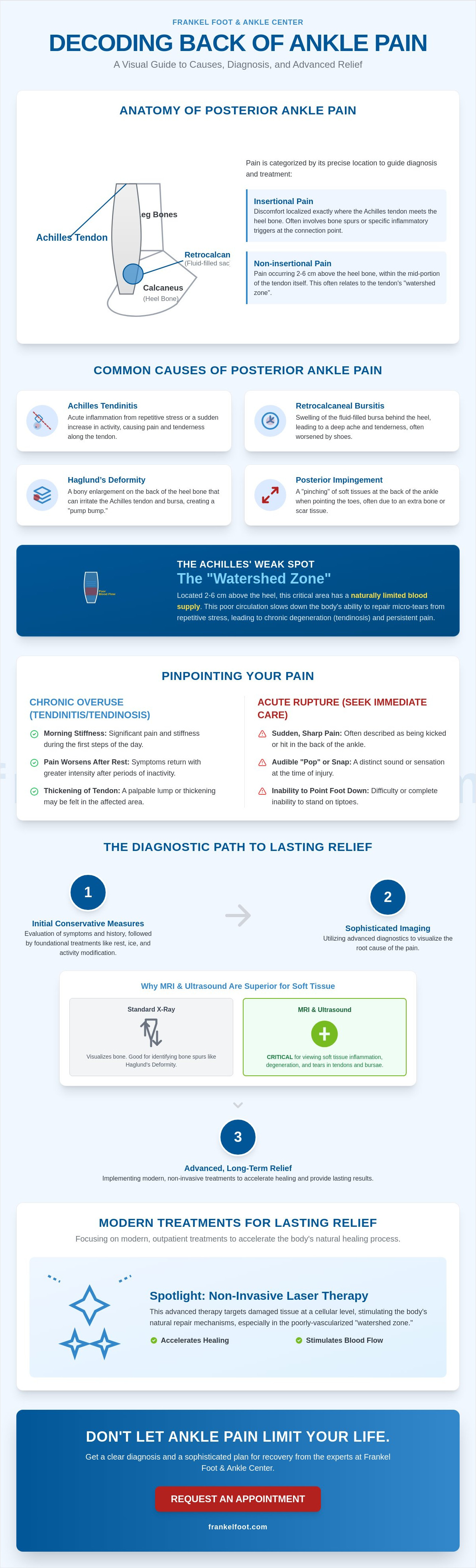
The posterior ankle serves as a high-performance junction where the lower leg's power is translated into movement. This area represents a complex meeting point between the calcaneus, or heel bone, and the talus. While many people attribute any discomfort in this region to a single cause, back of ankle pain often stems from the intricate interplay between these skeletal structures and the soft tissues that support them. The true ankle joint and the subtalar joint work in tandem to provide necessary stability for uneven terrain, yet this mechanical complexity makes the area vulnerable to specific injuries.
Diagnostic precision begins with identifying the exact location of the distress. We categorize these issues into two primary groups to guide our clinical approach:
- Insertional: Pain localized exactly where the soft tissue meets the heel bone, often involving bone spurs or specific inflammatory triggers.
- Non-insertional: Discomfort occurring several centimeters above the heel bone, typically involving the mid-portion of the tendon.
The Role of the Achilles Tendon
As the most robust tendon in the human body, the Achilles tendon is designed to withstand immense physiological loads. It frequently handles forces up to ten times your body weight during high-impact activities like running or jumping. However, its strength is countered by a biological vulnerability known as the "watershed zone." This specific segment, located about two to six centimeters above the insertion point, suffers from a naturally limited blood supply. Because of this poor circulation, the body often struggles to repair the micro-tears that occur during repetitive stress. Over time, a healthy tendon can transition into a state of Achilles tendinitis or chronic degeneration. In these cases, the tissue loses its organized structure and becomes thickened and painful.
Bursae and Cushioning at the Heel
Nesting between the heel bone and the tendon is the retrocalcaneal bursa, a small, fluid-filled sac that acts as a vital lubricant. Its primary function is to reduce friction during plantar flexion, which is the motion of pointing your toes downward. When this sac becomes inflamed, it can mimic the symptoms of tendon injuries. It's vital to distinguish between the two. Bursitis often presents as a deep ache felt within the heel itself, whereas tendon issues usually feel more like surface tenderness. Understanding this distinction is a critical step toward achieving effective back of ankle pain relief, as treating an inflamed bursa requires a different clinical strategy than managing a damaged tendon.
Common Causes of Pain in the Back of the Ankle
Identifying the precise source of back of ankle pain requires looking beyond simple muscle strain. While the anatomy of the heel is complex, the clinical causes of discomfort often fall into specific categories related to mechanical stress, footwear choices, or structural abnormalities. Understanding these triggers is the first step toward reclaiming your mobility and preventing long-term damage to the delicate connective tissues.
The clinical landscape of posterior ankle pain includes several distinct conditions:
- Achilles Tendinitis: Acute inflammation caused by repetitive stress or sudden increases in activity levels.
- Retrocalcaneal Bursitis: Swelling of the fluid-filled sac behind the heel bone, often exacerbated by external pressure.
- Haglund’s Deformity: A bony prominence on the calcaneus that creates a painful "bump" and irritates surrounding tissue.
- Posterior Ankle Impingement: A "pinched" sensation at the back of the joint, frequently involving an accessory bone.
Achilles Tendinopathy: Beyond Simple Inflammation
It's vital to distinguish between acute tendinitis and chronic tendinosis. While tendinitis involves active inflammation, tendinosis represents a degenerative state where the tendon's collagen fibers lose their organized structure. Patients typically describe a hallmark symptom of morning stiffness that seems to "warm up" and improve with initial movement, only to return with greater intensity after a period of rest or intense exercise. These symptoms are often triggered by a sudden change in training intensity, such as adding hill sprints or increasing weekly mileage too quickly.
Haglund’s Deformity and 'Pump Bump'
Haglund’s Deformity is a structural enlargement of the bone on the back of the heel. This condition is often nicknamed "pump bump" because the rigid backs of high-heeled shoes or stiff work boots can create a persistent pressure point against the protrusion. This constant friction doesn't just hurt the bone; it frequently leads to secondary bursitis or chronic tendon irritation. If you find that specific shoes have become unbearable due to localized swelling, seeking professional ankle pain relief can help address both the underlying bone growth and the resulting soft tissue distress.
Posterior Impingement Syndrome
This condition creates a "nutcracker" effect, where soft tissue or bone is compressed at the back of the ankle joint during downward foot pointing. It's particularly common among ballet dancers, soccer players, and individuals born with an extra bone called an os trigonum. You might feel a sharp, stabbing pain when standing on tiptoes or during the push-off phase of your stride. This mechanical blockage requires a specialized diagnostic approach to ensure the correct structures are targeted for treatment.
Is it a Rupture? Sudden vs. Chronic Posterior Pain
When discomfort in the heel transitions from a dull ache to a sudden, catastrophic event, the clinical priority shifts immediately. While chronic back of ankle pain typically develops over weeks or months of repetitive stress, a tendon rupture is an immediate and debilitating trauma. Many patients describe the exact moment of injury as feeling like they were struck by a heavy object or kicked in the back of the leg. This sensation is a hallmark of an acute Achilles event and signifies a failure of the connective tissue under load.
It's a common misconception that the ability to point your toes downward rules out a serious injury. In cases of a partial tear, secondary muscles like the posterior tibialis may still allow for some movement, though it will be remarkably weak and painful. A physical examination often reveals a visible or palpable "gap" in the tendon where the fibers have separated. Swelling and bruising are expected, often appearing quickly and becoming more pronounced as gravity pulls the fluid down toward the heel and toes.
- Sensation: Chronic pain is a slow build; a rupture feels like a sudden blow.
- Continuity: A healthy tendon feels like a tight cord; a ruptured one may have a noticeable "dip."
- Function: Chronic issues cause stiffness; a rupture causes a profound loss of power.
Red Flags: When to Seek Emergency Care
The most critical indicator of a major tendon event is an audible "pop" sound followed by an inability to perform a single-leg heel raise. If you cannot rise onto your toes while standing on the affected leg, it suggests a loss of structural continuity that requires an immediate orthopedic evaluation. You should also look for significant bruising that appears to "drain" down toward the ankle bones or toes. This discoloration indicates internal bleeding from the torn tissue and should never be ignored.
The Dangers of 'Walking It Off'
The instinct to "walk it off" can be dangerous for your long-term mobility. Continuing to bear weight on a partial tear significantly increases the risk of a complete rupture, which is much more difficult to treat. Beyond the immediate pain, delayed intervention can lead to permanent tendon lengthening. This condition weakens your "push-off" strength forever, impacting your gait and your ability to climb stairs or run. Early intervention in Middletown is essential to stabilize the tissue and prevent the need for invasive surgical reconstruction. We prioritize quick diagnostics to ensure your back of ankle pain is managed before it becomes a permanent disability.
Diagnostic Steps and Conservative Treatments
The journey toward recovery from persistent back of ankle pain begins with a methodical clinical evaluation to pinpoint the exact epicenter of your distress. During a physical examination, we employ specific diagnostic maneuvers such as the Thompson test, where squeezing the calf muscle allows us to confirm if the tendon is still intact and capable of initiating movement. Palpation is equally critical; by carefully feeling the structures mentioned in previous sections, we can determine if the pain is localized at the bone insertion or higher up in the watershed zone. While the RICE method (Rest, Ice, Compression, and Elevation) serves as an essential temporary bridge to manage acute swelling, it's not a long-term cure for structural damage.
Physical therapy plays a pivotal role in the rebuilding phase, specifically through eccentric loading exercises. These movements focus on strengthening the tendon while it's lengthening, which has been shown to stimulate the production of healthy collagen fibers and remodel the tissue's internal architecture. This progressive loading is essential for returning to high-impact activities without risking a recurrence of the injury.
Advanced Imaging for Precision Diagnosis
Dr. Frankel utilizes high-resolution imaging to visualize the internal structure of the Achilles tendon with exceptional clarity. While a standard X-ray is effective for identifying bony abnormalities like Haglund’s deformity, it often fails to reveal the soft tissue inflammation or micro-tears that characterize chronic tendinosis. Utilizing MRI or diagnostic Ultrasound allows us to see the unseen and differentiate between bursitis and deep-seated tendon degeneration. A precise diagnosis prevents the frustration of failed treatments that often occur when the true source of the pain is misidentified.
Orthotics and Mechanical Support
Mechanical intervention often provides the necessary environment for healing to occur without constant re-injury. Heel lifts are frequently used to temporarily shorten the Achilles tendon, thereby taking the immediate tension off the inflamed area during daily activities. For those with structural issues, custom orthotics are essential for correcting overpronation, a common gait abnormality that places excessive rotational stress on the posterior ankle. It's important to understand that store-bought inserts often fail to address the specific angles and unique pressures associated with chronic back of ankle pain. If you are ready to move past temporary fixes and secure a personalized recovery plan, we invite you to schedule a consultation for professional ankle pain relief today.
Advanced Relief: The Frankel Foot & Ankle Approach
Dr. Marc Frankel leads a practice where advanced clinical science meets individual care. While initial treatments often focus on stabilization, our methodology moves beyond symptom management to address the biological root of your discomfort. We recognize that back of ankle pain often persists because the body requires a specific catalyst for cellular repair. Our center offers a progressive spectrum of care, from sophisticated non-invasive therapies to precision surgical techniques designed to restore your quality of life. Each plan is meticulously tailored to the lifestyle of Middletown residents, ensuring that whether you're a competitive athlete or a senior focused on daily mobility, your recovery is both predictable and lasting.
For structural issues like Haglund’s deformity that don't respond to conservative measures, we prioritize minimally invasive surgical options. These advanced techniques are designed to achieve "scarless" results, minimizing tissue trauma and accelerating the post-operative healing phase. By combining surgical skill with a forward-thinking approach to medicine, we provide a path to relief that respects both your physical health and your aesthetic concerns.
Laser Therapy for Achilles and Tendon Pain
One of the most effective tools in our arsenal is specialized Laser Therapy. This technology targets the "watershed zone" of the Achilles tendon, where blood flow is naturally restricted and healing often stalls. By utilizing specific wavelengths of light, we induce a biostimulation effect that accelerates the body's natural repair of micro-tears. Unlike oral medications that can cause systemic side effects, laser treatments reduce inflammation locally and safely. It's a painless, in-office procedure that requires no downtime, allowing you to return to your daily routine immediately after the session.
Compassionate Care in Middletown, NY
The Frankel Foot & Ankle Center is built on a foundation of patient-centered warmth and clinical professionalism. We believe that a successful recovery starts with a structured consultation where you feel heard and supported. Our team takes the time to explain every detail of your condition, ensuring you have total confidence in your treatment pathway. We are dedicated to the craft of healing and committed to achieving the best possible health outcomes for our neighbors. Don't let chronic discomfort dictate your mobility or your lifestyle. You can schedule your appointment with Dr. Frankel today for ankle pain relief and take the first step toward a future defined by movement rather than back of ankle pain.
Step Into a Future Free From Discomfort
We've explored how the complex interaction of the Achilles tendon and retrocalcaneal bursa can lead to persistent back of ankle pain. You now understand the critical difference between chronic degeneration and acute ruptures, as well as the role of precision imaging in establishing a correct diagnosis. This knowledge is the first step toward a recovery that moves you from a state of physical limitation to one of complete mobility.
Dr. Marc Frankel and his dedicated team in Middletown, NY, are committed to providing care that transitions you from restrictive pain to lasting restoration. By utilizing specialized laser therapy for non-invasive healing and prioritizing scarless, painless recovery outcomes, we ensure your journey back to health is as comfortable as possible. We invite you to schedule a consultation at Frankel Foot & Ankle Center for expert ankle relief today. Your path to recovery is a collaborative effort, and we're here to guide every step with precision, skill, and genuine care.
Frequently Asked Questions
Why does the back of my ankle hurt when I first wake up?
Morning stiffness is a hallmark symptom of Achilles tendinopathy. While you sleep, your foot often rests in a position that allows the tendon to shorten. When you take your first steps out of bed, the tissue is suddenly stretched under your body weight, causing back of ankle pain that typically "warms up" after several minutes of movement.
Can tight calves cause pain in the back of my ankle?
Yes, tight calf muscles are a primary contributor to posterior discomfort. The gastrocnemius and soleus muscles connect directly to the Achilles tendon. If these muscles are chronically tight, they place excessive tension on the tendon's insertion point at the heel, which increases the risk of micro-tears and inflammatory responses during daily activities.
How do I tell the difference between bursitis and Achilles tendinitis?
Location and sensation are the primary indicators for distinguishing these two conditions. Bursitis often feels like a deep, throbbing ache directly behind the heel bone, while tendinitis is usually characterized by surface tenderness or a "crunchy" sensation a few centimeters higher. We utilize diagnostic ultrasound to confirm the exact structure involved and ensure a precise treatment plan.
Is it safe to run with pain in the back of my ankle?
Running through significant pain is generally discouraged because it can transform a minor strain into a debilitating rupture. If your discomfort persists after a warm-up or causes you to limp, you should stop immediately. Continuing to load a damaged tendon can lead to permanent structural thickening and a significantly longer recovery timeline.
What shoes are best for someone with Haglund’s deformity?
Shoes with soft, flexible backs or open-back designs are the most effective for managing Haglund's deformity. Rigid footwear creates persistent friction against the bony protrusion, which frequently leads to secondary inflammation. We often recommend footwear with a slight heel lift to reduce the mechanical strain placed on the posterior connective tissues.
How long does it take for posterior ankle pain to go away with treatment?
Recovery timelines depend heavily on the severity of the tissue damage. Acute inflammatory issues may resolve within four to six weeks of conservative care. However, chronic degenerative conditions often require three to six months of dedicated physical therapy and advanced treatments like laser therapy to achieve full structural restoration and lasting relief.
Does Dr. Frankel offer non-surgical treatments for heel bumps?
Yes, we prioritize sophisticated non-surgical interventions for heel bumps and associated distress. Our clinical approach includes the use of custom orthotics to correct underlying gait mechanics and specialized laser therapy to reduce inflammation in the surrounding soft tissues. These methods focus on achieving back of ankle pain relief through progressive, non-invasive methodology.
Can back of ankle pain be caused by a problem in my lower back?
Yes, a condition known as referred pain can occur if the S1 nerve root in your lower spine is compressed or irritated. While the source of the problem is neurological and located in the back, the symptoms are frequently felt in the heel or calf. A comprehensive evaluation is necessary to determine if your pain is a local orthopedic issue or a result of nerve impingement.


