


What if your persistent discomfort isn't just a sign of overexertion, but a precise diagnostic roadmap your body uses to signal a specific structural failure? With an estimated 7.4 million ankle sprains treated in U.S. emergency departments between 2010 and 2024, it's clear that you aren't alone in your struggle to stay mobile. When your ankle hurts when walking, the uncertainty can often feel more paralyzing than the physical sensation itself. You might find yourself caught between conflicting online advice and a deep-seated fear that the only path to relief involves invasive surgery and months of recovery.
We understand that your priority is a return to an active, pain-free lifestyle without the burden of long downtimes. This guide will help you discover the precise reasons behind your walking-related ankle pain and illustrate how advanced podiatric care can restore your full range of motion. We'll explore everything from ligament instability to modern diagnostic methodologies, providing a clear preview of the minimally invasive treatment options that prioritize your long-term health. By moving from initial diagnosis to targeted relief, we can help you regain the confidence to move freely again.
Key Takeaways
- Identify the underlying mechanical failures in the ankle joint complex that transform a simple step into a source of persistent discomfort.
- Learn a professional two-step self-assessment to evaluate the severity of your condition when your ankle hurts when walking.
- Distinguish between the symptoms of chronic lateral instability and Achilles tendonitis to better understand your body’s specific needs.
- Evaluate the effectiveness of different relief strategies, from the limitations of the RICE method to the precision of custom-molded orthotics.
- Discover how specialized, minimally invasive podiatric techniques can restore your mobility while significantly reducing your recovery time.
Understanding Why Your Ankle Hurts When Walking
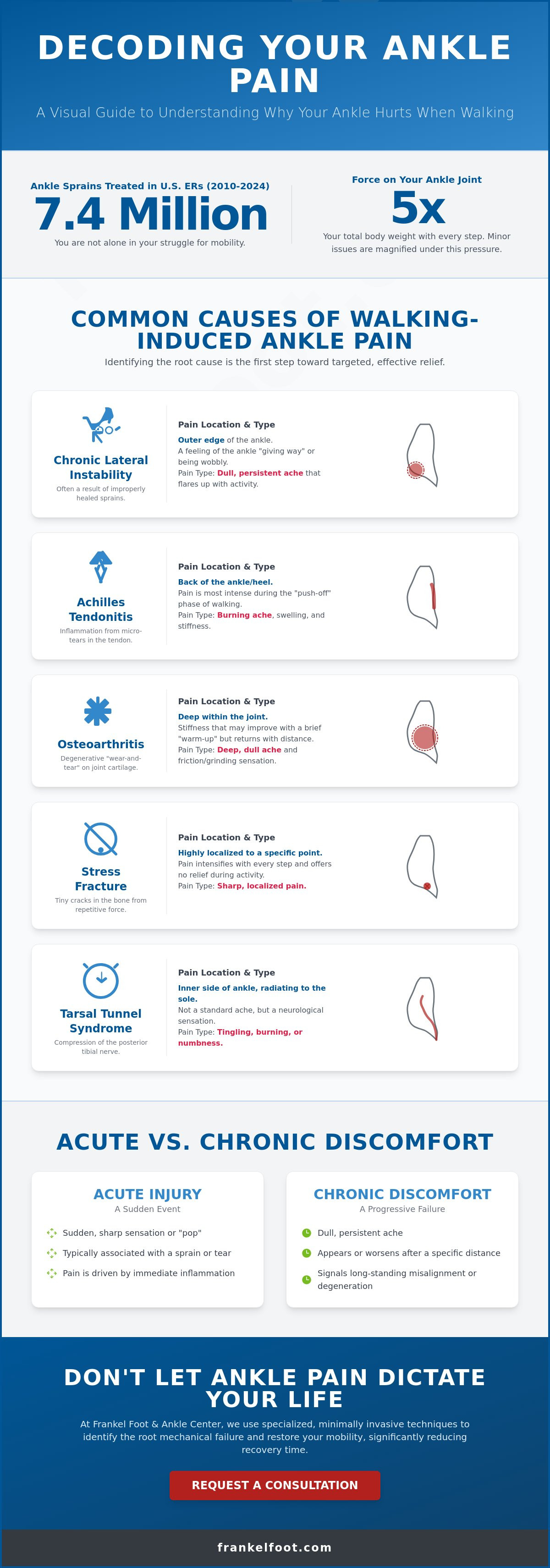
When your ankle hurts when walking, your body is communicating a specific message about its structural integrity. This discomfort isn't merely an inconvenience of aging or overactivity; it's a critical signal of mechanical or structural dysfunction within a highly specialized system. The ankle joint complex is a marvel of biological engineering, comprising the tibia, fibula, and talus bones. These components must work in perfect synchronicity to facilitate movement while absorbing the immense forces generated by every step you take. During a standard gait, the ankle joint can support a load equivalent to five times your total body weight, making it one of the most heavily taxed structures in the human frame. If the alignment is slightly off or a component is compromised, this magnified pressure quickly transforms from a functional load into a source of progressive damage.
Attempting to "push through the pain" is a common but risky strategy that often results in a cascade of secondary issues. Because the body naturally seeks to avoid discomfort, you'll likely alter your gait without realizing it, shifting weight to other joints to compensate for the failing ankle. This compensation pattern places unnatural stress on the kinetic chain, frequently leading to secondary injuries in the knee, hip, or lower back. Our clinical approach moves from addressing these immediate symptoms to identifying the root mechanical failure, ensuring that your recovery is both comprehensive and lasting.
The Anatomy of a Step: How Your Ankle Functions
Dynamic stability during walking is provided by a complex network of tendons and ligaments that guide your foot through various terrains. While the subtalar joint is primarily responsible for handling side-to-side movement and inversion, the surrounding soft tissues provide the necessary tension to keep the joint centered under pressure. The true ankle joint, also known as the talocrural joint, is a hinge joint formed by the tibia, fibula, and talus that primarily facilitates the up-and-down movements of dorsiflexion and plantarflexion. When these structures are healthy, they work together to provide a smooth, fluid transition from heel-strike to toe-off.
Acute vs. Chronic Ankle Discomfort
Distinguishing between the types of pain you experience is the first step toward an accurate diagnosis. An acute injury often presents as a sudden, sharp sensation or a "pop" typically associated with a sprained ankle or a sudden ligament tear. In contrast, chronic discomfort often manifests as a dull, persistent ache that may only appear after a specific distance. If your ankle hurts when walking only after you've covered a mile, it's a specific red flag indicating that your joint's mechanical endurance is failing. While acute pain is often driven by immediate inflammation, chronic aching usually signals structural degeneration or a long-standing misalignment that requires a more sophisticated, progressive methodology to resolve.
Common Causes of Walking-Induced Ankle Discomfort
Identifying why your ankle hurts when walking requires a methodical look at how your symptoms manifest during different phases of movement. The various causes of ankle pain range from soft tissue inflammation to bone-on-bone friction, each presenting with unique clinical markers. If you experience lateral ankle pain, or discomfort on the outer edge, it's often a lingering consequence of an improperly healed sprain. These old injuries can leave the ligaments lax, leading to chronic instability that flares up with every step. In contrast, if your pain is concentrated at the back of the ankle during the heel-lift or push-off phase, you're likely dealing with Achilles Tendonitis. This condition involves micro-tears in the tendon that struggle to heal under the constant tension of a standard gait.
Structural and neurological issues also play a significant role in walking-induced distress. Osteoarthritis typically presents as a deep, dull ache accompanied by stiffness that might improve slightly after a short "warm-up" period, only to return with increased intensity as you cover more distance. Stress fractures, however, offer no such reprieve. These tiny cracks in the bone cause sharp, localized pain that intensifies with every single step. For those who feel tingling or burning sensations rather than a standard ache, Tarsal Tunnel Syndrome may be the culprit. This occurs when the posterior tibial nerve is compressed, similar to carpal tunnel in the wrist. Securing professional ankle pain relief is the most effective way to prevent these mechanical stressors from becoming permanent disabilities.
Tendonitis and Ligament Strains
The posterior tibial tendon is a critical structure that supports your foot arch and provides stability during the mid-stance of your gait. When this tendon is overworked, the arch can begin to collapse, placing immense strain on the entire ankle complex. In our Middletown clinic, we frequently observe that improper footwear choices for our variable climate can exacerbate this strain by failing to provide adequate lateral support. Additionally, Peroneal Tendonitis can cause significant discomfort along the outside of the ankle bone, particularly on uneven surfaces where the tendons must work harder to keep the foot level.
Structural Issues: Arthritis and Bone Spurs
Physical obstructions within the joint, such as osteophytes or bone spurs, can physically block your natural range of motion. These bony growths often develop as a response to long-term wear or post-traumatic arthritis, which is a common consequence of old sports injuries. Whether you have naturally flat feet or high arches, these gait abnormalities accelerate joint wear by distributing weight unevenly. This misalignment creates high-pressure zones within the ankle that eventually lead to the degradation of protective cartilage and the onset of chronic pain.
Diagnostic Indicators: When Is Ankle Pain Serious?
While many hope that discomfort will resolve on its own, understanding when your ankle hurts when walking becomes a clinical priority is essential for preventing long-term disability. Transitioning from home-based care to a professional evaluation requires an objective look at your symptoms. Because there are many Common causes of ankle pain, ranging from simple strains to complex mechanical failures, you should follow this structured self-assessment to determine the severity of your condition.
To evaluate your mobility and joint health, consider these five diagnostic steps:
- Step 1: Assess your ability to bear weight immediately upon waking. If the first few steps of the day are excruciating or impossible, it indicates significant inflammation or structural stress.
- Step 2: Check for visible swelling or "pitting" edema around the malleolus, the bony prominence of the ankle. If pressing your finger into the swollen area leaves a temporary indentation, you're likely dealing with substantial fluid retention or tissue damage.
- Step 3: Monitor for "locking" or "giving way" sensations. Feeling like your ankle might collapse during a turn suggests ligamentous laxity or loose bodies within the joint.
- Step 4: Evaluate if the pain persists after 48 hours of dedicated rest. Pain that doesn't diminish with reduced activity is a sign that the underlying issue isn't just simple fatigue.
- Step 5: Seek professional digital imaging. This is the only definitive way to rule out occult fractures or deep-seated structural misalignments that aren't visible to the naked eye.
The "Red Flag" Symptoms Checklist
Certain symptoms demand immediate clinical attention to prevent permanent damage. If you're unable to take four steps without a significant limp, the structural integrity of your ankle is likely compromised. You should also be vigilant for any numbness or coldness in the foot; these sensations can indicate vascular or nerve compression that requires urgent intervention. Finally, if your pain keeps you awake at night regardless of your activity level during the day, it's a clear signal that the inflammatory process has become chronic and requires a more progressive methodology for relief.
Professional Diagnostic Tools in Middletown
At our Middletown facility, we move beyond the generic advice of rest and ice by utilizing advanced diagnostic technology. Digital X-rays provide our team with immediate clarity on bone alignment and joint spacing, while diagnostic ultrasound allows for real-time visualization of tendon tears and soft tissue inflammation. We believe a comprehensive gait analysis is far superior to a simple physical exam. By observing how your ankle hurts when walking in a controlled environment, we can pinpoint the exact moment of mechanical failure and develop a treatment plan that addresses the root cause of your discomfort.
Effective Strategies for Relieving Ankle Pain
While the RICE method (Rest, Ice, Compression, Elevation) is a standard first response for acute injuries, its effectiveness is limited when addressing chronic mechanical issues. If your ankle hurts when walking due to structural misalignment or degenerative changes, simply resting the joint doesn't correct the underlying dysfunction. True recovery requires a transition from temporary symptom management to a comprehensive plan that restores the joint's natural architecture. Precision-molded custom orthotics are often the cornerstone of this transition. Unlike over-the-counter inserts that offer generic cushioning, custom orthotics are engineered to redistribute pressure and realign the subtalar joint, effectively preventing the micro-trauma that occurs with every step.
Physical therapy protocols must also evolve beyond simple strengthening. Modern rehabilitation focuses on proprioception and balance training to retrain the neural pathways that stabilize the ankle during complex movements. Current clinical practice guidelines, such as those released by the Academy of Orthopaedic Physical Therapy in 2021, emphasize that an active rehabilitation approach is far superior to prolonged immobilization for long-term joint health. For those seeking non-invasive options, advanced laser therapy provides a progressive solution for deep-tissue healing. This technology utilizes specific wavelengths of light to reduce inflammation at the cellular level, which accelerates the recovery of damaged tendons and ligaments without the need for surgical intervention.
At-Home Care and Immediate Relief
Effective at-home care starts with proper icing techniques; always use a protective barrier between the ice pack and your skin to prevent thermal injury while targeting deep inflammation. Gentle stretching exercises can help maintain your range of motion, but they should never be forced to the point of pain. Additionally, perform a regular footwear audit. Most high-quality walking shoes lose their structural integrity after approximately 300 to 500 miles. If you notice uneven wear on the outsoles or a loss of midsole compression, it's time to retire them to prevent unnecessary ankle strain.
Clinical Interventions for Lasting Results
At our practice, we utilize Multi-wave Locked System (MLS) Laser Therapy to achieve rapid pain reduction and tissue repair. This clinical intervention is particularly effective for chronic conditions like Achilles Tendonitis where traditional methods have failed. We also offer regenerative medicine options that stimulate your body's innate ability to repair damaged cartilage and tendons. By moving from a philosophy of "managing" discomfort to one of "correcting" the mechanical cause, we provide a path toward permanent ankle pain relief that allows you to return to the activities you love.
Advanced Ankle Care at Frankel Foot & Ankle Center
At Frankel Foot & Ankle Center, we believe your journey toward recovery should be defined by both clinical precision and genuine empathy. Dr. Marc Frankel has cultivated a practice philosophy that places the individual's needs at the center of every clinical interaction. When your ankle hurts when walking, you deserve a diagnostic process that moves beyond surface-level symptoms to identify the exact mechanical failure within your joint. Our team is dedicated to providing high-level expertise that restores your mobility while maintaining a supportive, welcoming atmosphere for every patient we serve.
We specialize in modern, minimally invasive techniques specifically designed to reduce post-operative discomfort and accelerate your return to daily activity. This "Scarless and Painless" approach is a hallmark of our practice, applied with meticulous care to complex foot and ankle corrections. By utilizing progressive methodologies, we ensure that the Middletown community has access to sophisticated surgical options that prioritize long-term health outcomes. Our commitment to excellence means we stay at the forefront of medical advancements, ensuring your care is always grounded in the latest evidence-based practices.
Why Choose a Specialist Over General Urgent Care?
Selecting a specialist over a general urgent care facility is a critical step in securing a permanent resolution for your discomfort. While general practitioners offer valuable broad-spectrum care, they often lack the board-certified podiatric surgical expertise necessary to treat intricate ankle pathologies. A specialized clinic provides much more precise diagnostics, moving from basic physical assessments to advanced digital imaging and comprehensive gait analysis. Furthermore, our facility offers direct access to advanced treatments like Multi-wave Locked System (MLS) laser therapy and custom-molded bracing, providing a level of specialization that general medical environments simply cannot match.
Your Path to Pain-Free Walking in Middletown
Your experience at our Middletown office begins with a thorough initial consultation where we listen to your history and perform a detailed biomechanical evaluation. We're deeply committed to exploring every conservative treatment option, from custom orthotics to regenerative medicine, before recommending any surgical intervention. This patient-centered approach ensures that your treatment plan is tailored specifically to your lifestyle and recovery goals. We invite you to take the first step toward lasting ankle pain relief by visiting our expert team.
Schedule your ankle evaluation at Frankel Foot & Ankle Center
Restore Your Mobility and Confidence
Persistent discomfort is more than a physical burden; it's a signal from your body that your structural foundation requires expert attention. We've examined how the ankle joint complex manages immense mechanical loads and why identifying the precise reason your ankle hurts when walking is essential for long-term health. By moving from generic home remedies to specialized clinical diagnostics, you can address the root cause of your pain rather than just masking the symptoms. Our approach integrates advanced technology with a deep commitment to patient-centered care.
Dr. Marc Frankel offers board-certified surgical expertise with a focus on scarless and minimally invasive procedures that minimize downtime. Our Middletown office provides convenient, local access to the progressive treatments discussed in this guide. Whether you're dealing with chronic instability or a recent injury, our goal is to provide a clear diagnosis and an effective path toward recovery. You don't have to navigate this journey alone or settle for a lifestyle limited by pain.
Relieve your ankle pain and walk with confidence again. Book your consultation today.
Your path to a pain-free future starts with a single, informed step toward professional care. We look forward to helping you regain the freedom of movement you deserve.
Frequently Asked Questions
Why does my ankle hurt when I walk but there is no swelling?
Pain without visible inflammation often signals a mechanical or neurological issue rather than a recent acute injury. Conditions such as Tarsal Tunnel Syndrome or early-stage cartilage wear may cause significant distress without the fluid accumulation typical of a sprain. If your ankle hurts when walking despite a normal appearance, it's vital to assess your gait for subtle misalignments that may be taxing the joint's internal structures.
Can bad shoes cause my ankle to hurt when I walk?
Inadequate footwear is a primary contributor to mechanical strain and joint fatigue during daily activity. Shoes that lack proper arch support or have worn-out midsoles fail to absorb the impact forces that can reach five times your body weight. This lack of stability forces the tendons and ligaments to work harder to maintain balance, leading to chronic discomfort and potential long-term damage to the ankle joint complex.
How do I know if my ankle pain is a stress fracture or tendonitis?
Distinguishing between these conditions requires a close look at the nature and location of the pain. Stress fractures typically present as sharp, localized pain that intensifies with every single step and may persist even at rest. Tendonitis often manifests as a duller ache that might improve slightly after a short "warm-up" period but is accompanied by tenderness along the specific path of the affected tendon.
Should I keep walking if my ankle hurts?
You should avoid pushing through sharp or persistent pain, as it often leads to compensatory injuries in the knee, hip, or lower back. While light movement can be beneficial for simple stiffness, walking on a compromised joint can turn a minor strain into a significant structural failure. If you're limping or your gait is noticeably altered, it's a clear sign that the joint requires immediate rest and a professional evaluation.
What is the fastest way to relieve ankle pain from walking?
The fastest way to achieve lasting relief involves transitioning from temporary at-home care to advanced clinical interventions like Multi-wave Locked System (MLS) Laser Therapy. While icing and elevation can provide immediate, short-term comfort for acute inflammation, laser therapy targets the cellular level to accelerate tissue repair and reduce pain rapidly. Addressing the mechanical root cause with custom orthotics is also essential for preventing the pain from returning during future activity.
When should I see a podiatrist in Middletown for my ankle pain?
You should schedule a consultation if your pain persists for more than 48 hours despite rest or if you're unable to walk without a significant limp. "Red flag" symptoms like night pain, numbness, or a sensation of the joint "giving way" require the expertise of a board-certified specialist. Seeking care in Middletown ensures you receive a specialized diagnosis and access to minimally invasive treatments that general urgent care facilities may not provide.
Is it normal for ankles to hurt after walking on uneven surfaces?
While uneven terrain naturally places more demand on your stabilizing muscles, persistent pain after walking on such surfaces is often a sign of chronic ligament laxity. This instability is frequently the result of previous, improperly healed sprains that have left the joint vulnerable to repetitive strain. If your ankle feels weak or painful during these activities, it indicates a need for proprioceptive training or improved structural support to prevent further injury.
Can a bunion cause my ankle to hurt while walking?
A bunion can cause secondary ankle pain by forcing you to shift your weight unnaturally during your gait. When the big toe joint is misaligned, you may roll your foot outward or inward to avoid pressure, which places excessive, uneven strain on the ankle joint complex. Addressing the bunion through our scarless and painless surgical techniques can often resolve the associated ankle discomfort by restoring a natural, balanced walking pattern.


