


Did you know that runners have a 40% to 52% chance of sustaining an Achilles tendon injury during their lifetime? That sharp, searing pain during your first steps in the morning isn't just a minor inconvenience; it's often the hallmark of Achilles tendonitis. We understand how frustrating it is when you can't play tennis or go for a run without enduring hours of subsequent throbbing. You may even worry that a sudden movement could lead to a devastating tendon rupture. It's a heavy burden to carry when your primary goal is simply to move through your day without restriction.
We agree that living with chronic heel pain is exhausting, especially when traditional rest fails to provide lasting relief. This article promises to illuminate your path from persistent discomfort to restored mobility by offering expert insights into modern diagnostic and treatment strategies. We provide a clear preview of the journey from initial diagnosis to active recovery, helping you distinguish between a minor strain and a serious tear. By understanding the latest clinical guidelines, you can move toward a future of pain-free morning walks and a confident return to the tennis court or running trail in Middletown, Katonah, and Milford.
Key Takeaways
- Identify the specific nature of your discomfort by distinguishing between insertional and non-insertional tendon degeneration.
- Understand why traditional home remedies may be insufficient and how modern clinical intervention effectively treats Achilles tendonitis.
- Learn how sophisticated tools like digital imaging and gait analysis pinpoint the exact structural causes of your pain.
- Discover the advantages of a compassionate, expert-led treatment plan designed to return you to running and daily activities.
- Find convenient access to specialized foot and ankle care across our local offices in Middletown, Katonah, and Milford.
Understanding Achilles Tendonitis: From Morning Stiffness to Chronic Inflammation
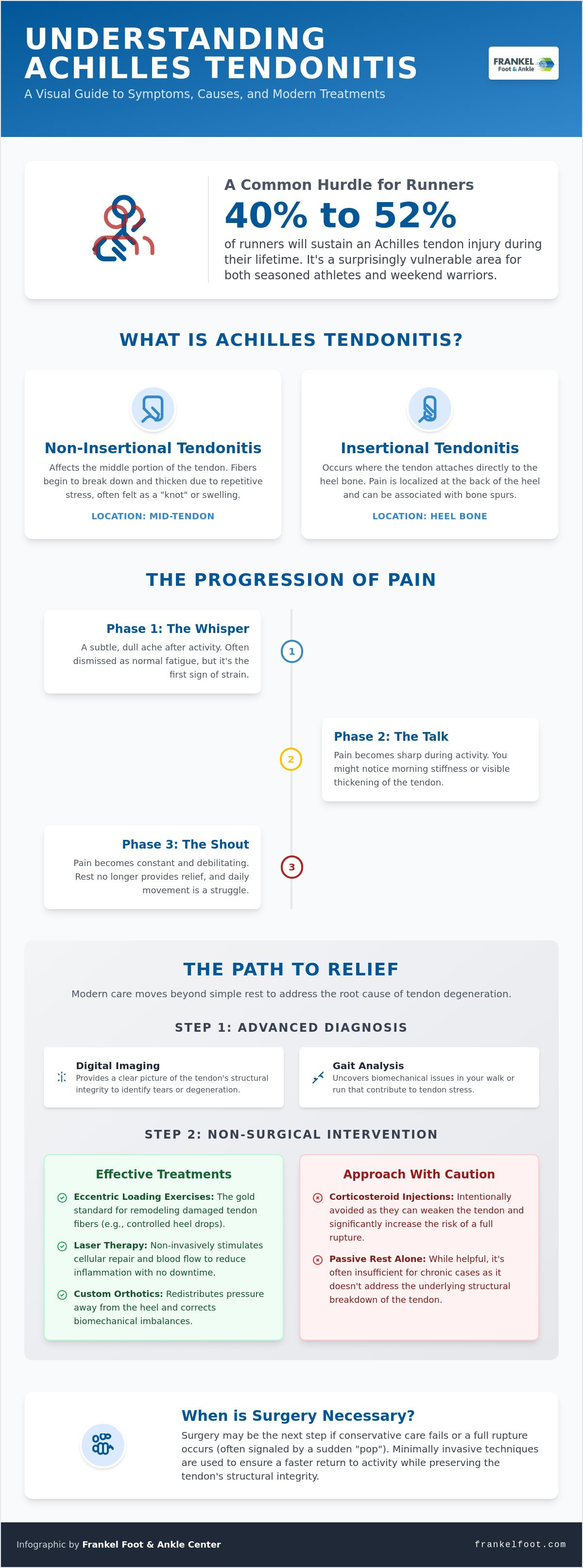
The Achilles tendon is the strongest and thickest tendon in the human body, yet it's surprisingly vulnerable to injury. When we discuss Achilles tendinitis, we're describing a condition of inflammation or progressive degeneration that affects this vital band of tissue connecting your calf muscles to your heel bone. It generally presents in two distinct forms. Insertional Achilles tendonitis occurs at the point where the tendon attaches directly to the heel bone. In contrast, non-insertional tendonitis involves the middle portion of the tendon, where fibers may begin to break down or thicken due to repetitive stress.
Many patients describe a frustrating "morning stiffness" that makes the first few steps out of bed feel nearly impossible. During sleep, the tendon remains in a shortened position and cools down; once you start moving, the sudden stretch on these inflamed tissues causes sharp, localized pain. It's also vital to distinguish between acute tendonitis, which is a sudden inflammatory response to injury, and chronic tendinosis. Tendinosis represents a deeper cellular breakdown over time where the body's natural repair mechanisms can't keep up with the damage, leading to a weakened tendon structure.
Common Warning Signs and Progression
The progression of Achilles tendonitis is often subtle but relentless. It typically begins as a dull ache after a long walk or a session on the court, which many people dismiss as standard fatigue. Over time, this transforms into a sharp pain during physical activity that limits your range of motion. You might notice visible "knots" or a distinct thickening along the back of your leg as the tissue attempts to heal itself unsuccessfully. Eventually, the tendon reaches a "shouting" phase where the pain becomes a constant, debilitating presence that rest alone no longer resolves.
Risk Factors for Middletown Athletes and Seniors
We frequently see "weekend warrior" syndrome among local residents participating in basketball or tennis leagues in Middletown and surrounding areas. A sudden increase in exercise intensity or duration without proper conditioning often places more stress on the tendon than it's prepared to handle. Poor footwear choices, such as worn-out sneakers or shoes lacking proper arch support, further exacerbate these structural issues. Whether you're a competitive athlete or a senior enjoying local walking trails, these biomechanical stresses can lead to significant injury if the root cause isn't addressed by a professional.
Advanced Diagnostic and Treatment Pathways for Achilles Relief
While RICE (Rest, Ice, Compression, Elevation) is a common starting point, it's often insufficient for chronic Achilles Tendon Injuries. Passive rest doesn't address the structural breakdown of the tissue. At Frankel Foot & Ankle Center, we utilize digital imaging and gait analysis to uncover the specific mechanics causing your Achilles tendonitis. This allows us to create a precise map for your recovery that moves beyond simple symptom management.
Custom orthotics are frequently prescribed to redistribute pressure away from the heel bone. This mechanical adjustment is often combined with medical-grade laser therapy. Laser technology provides a non-invasive way to stimulate cellular repair and blood flow, which is vital for healing stubborn tendon tissue. It's a sophisticated bridge between basic home care and more invasive procedures.
Non-Surgical Interventions That Work
Our clinical focus remains on non-surgical interventions that promote long-term stability. Eccentric loading exercises, such as controlled heel drops, are the gold standard for remodeling damaged fibers. We intentionally avoid corticosteroid injections because they can weaken the tendon and increase rupture risks. Instead, we offer laser therapy as a safe, effective method to reduce inflammation without any downtime. This is a primary pathway for those seeking effective foot pain relief.
When Surgery Becomes Necessary
When clinical markers indicate a full rupture or if conservative care for Achilles tendonitis doesn't yield results, surgery may be the next step. A sudden "pop" or the inability to push off the foot often signals a serious injury. We utilize minimally invasive techniques that align with our commitment to a scarless, patient-centered approach. These methods ensure a faster return to activity while maintaining the structural integrity of the repair. For a broader look at these options, you can read about Comprehensive Ankle Pain Relief at our center.
Specialized Care at Frankel Foot & Ankle Center: Serving NY and PA
At Frankel Foot & Ankle Center, Dr. Marc Frankel leads a practice dedicated to the intersection of advanced surgical precision and compassionate, patient-centered care. When you visit our offices in Middletown, NY, Katonah, NY, or Milford, PA, you aren't just another appointment on a calendar. We conduct a structured consultation that examines every nuance of your movement, from the way your foot strikes the ground to the specific strain placed on your lower limbs. This methodical approach ensures that your Achilles tendonitis is treated with a plan tailored to your unique anatomy and lifestyle goals.
Our primary objective is to facilitate a seamless transition from chronic discomfort to full mobility. By utilizing state-of-the-art diagnostics and progressive methodologies, we help you reclaim your active life. Understanding Achilles tendinitis symptoms and causes is the first step toward recovery, but clinical expertise is what ensures you stay on the path to long-term health. We remain deeply committed to achieving lasting improvements, allowing you to walk, run, and play without the heavy burden of persistent pain.
Why Choose a Specialist for Achilles Pain?
General urgent care centers often provide a temporary fix, such as bracing or anti-inflammatory medication, without addressing why the injury occurred. In contrast, specialized podiatric care at Frankel Foot & Ankle Center focuses on the mechanical root of the problem. Localized expertise in our tri-state offices leads to significantly faster recovery timelines and lower recurrence rates. We bridge the gap between basic symptom management and comprehensive structural repair, providing the sophisticated care necessary for complex Achilles tendonitis cases.
Your Path to Recovery in Middletown
Scheduling an evaluation at any of our three locations is a straightforward process designed with your convenience in mind. Whether you are seeking Foot Pain Relief or a second opinion on a chronic condition, our team is ready to guide you. We combine high-level medical expertise with a supportive atmosphere where no detail is overlooked. Your journey toward a pain-free life starts with a single consultation where your well-being is our only priority.
Reclaiming Your Active Lifestyle with Expert Care
Recovery from Achilles tendonitis requires a shift from passive rest to a targeted, clinical strategy. We've explored how identifying the root cause through gait analysis and digital imaging provides a foundation for lasting relief. Whether your journey involves custom orthotics or advanced laser therapy, the focus remains on restoring your mobility without the need for prolonged downtime. Our commitment to scarless and minimally invasive techniques ensures that even complex cases are met with the highest level of surgical precision and care.
Led by Dr. Marc Frankel, our team provides a supportive environment where your specific health outcomes are the priority. With convenient locations in Middletown, Katonah, and Milford, specialized podiatric expertise is always within reach. It's time to move past the fear of injury and return to the activities you love most. We invite you to schedule your Achilles evaluation at Frankel Foot & Ankle Center to begin your personalized path toward a pain-free future. You don't have to manage this journey alone; we're here to guide you every step of the way.
Frequently Asked Questions
How can I tell the difference between Achilles tendonitis and a rupture?
The primary difference lies in the onset and severity of the physical sensation. While Achilles tendonitis typically develops as a gradual ache or stiffness that worsens over time, a rupture is a sudden, traumatic event often described as a sharp "pop" or the sensation of being kicked in the back of the leg. If you're unable to point your toes downward or push off your foot while walking, it's a strong clinical indicator of a rupture that requires immediate specialist attention.
Is it okay to walk with Achilles tendonitis?
Walking is generally encouraged as long as the activity stays within your specific pain tolerance. Updated 2024 clinical guidelines suggest a shift away from complete immobilization, favoring active recovery to maintain tendon strength. However, if walking causes sharp pain or forces you to limp, you should reduce your activity level. Continuing to walk on a severely degenerated tendon without professional guidance can lead to further structural breakdown or a potential tear.
How long does it typically take for Achilles tendonitis to heal?
Recovery timelines depend heavily on whether the condition is acute inflammation or chronic degeneration. Mild cases often resolve within two to three months with a structured program of eccentric exercises and proper footwear. Chronic cases, where the tendon tissue has undergone cellular changes, may require six months or longer to achieve full remodeling and a return to high-impact sports. Consistency with your prescribed treatment plan is the most significant factor in accelerating this process.
What are the best shoes for someone with chronic Achilles pain?
The best footwear for managing chronic tendon pain includes shoes with a slight heel lift and a firm, supportive heel counter. A slight elevation of the heel reduces the direct tension placed on the Achilles during every step you take. You should avoid completely flat shoes, such as certain sandals or thin racing flats, as they force the tendon to stretch further than it's prepared to handle. Selecting shoes with robust arch support also helps stabilize your gait and prevents the repetitive strain that leads to inflammation.


