


Why should the first minute of your day feel like a walk across shards of glass when the rest of your body is ready to move? If you're experiencing that sharp, localized ache, you're likely one of the 2 million Americans diagnosed with plantar fasciitis annually. It's exhausting to start every morning in a state of physical defense, wondering if your feet will ever feel reliable again. You might find yourself questioning if the pain is a temporary inflammation or a structural issue like a heel spur, especially when every mile walked feels like a gamble with your mobility.
We're here to offer a clear, methodical path toward relief that transitions from initial home-based care to sophisticated clinical interventions. You'll gain a deeper understanding of how mechanical stress impacts your gait and discover a recovery plan designed to prevent long-term disability. This overview explores everything from essential stretching protocols to modern advancements like extracorporeal shockwave therapy (ESWT), ensuring you have the expertise needed to step out of bed with confidence and return to the activities you love in Middletown and Katonah.
Key Takeaways
- Understand the "shock absorber" mechanism of the foot and how repetitive micro-tears in the connective tissue lead to the chronic pain you experience.
- Gain clarity on your diagnosis by distinguishing between heel spurs and plantar fasciitis, allowing for a more precise and effective treatment strategy.
- Implement a methodical home-care routine utilizing the RICE protocol and targeted stretches to alleviate acute discomfort and improve structural flexibility.
- Learn how custom-molded orthotics address the root mechanical causes of your pain, providing the stability needed for every step of your day.
- Discover a progression of care from foundational stretching to advanced regenerative solutions, ensuring your path to recovery is both thorough and enduring.
What is Plantar Fasciitis? The Science Behind Your Heel Pain
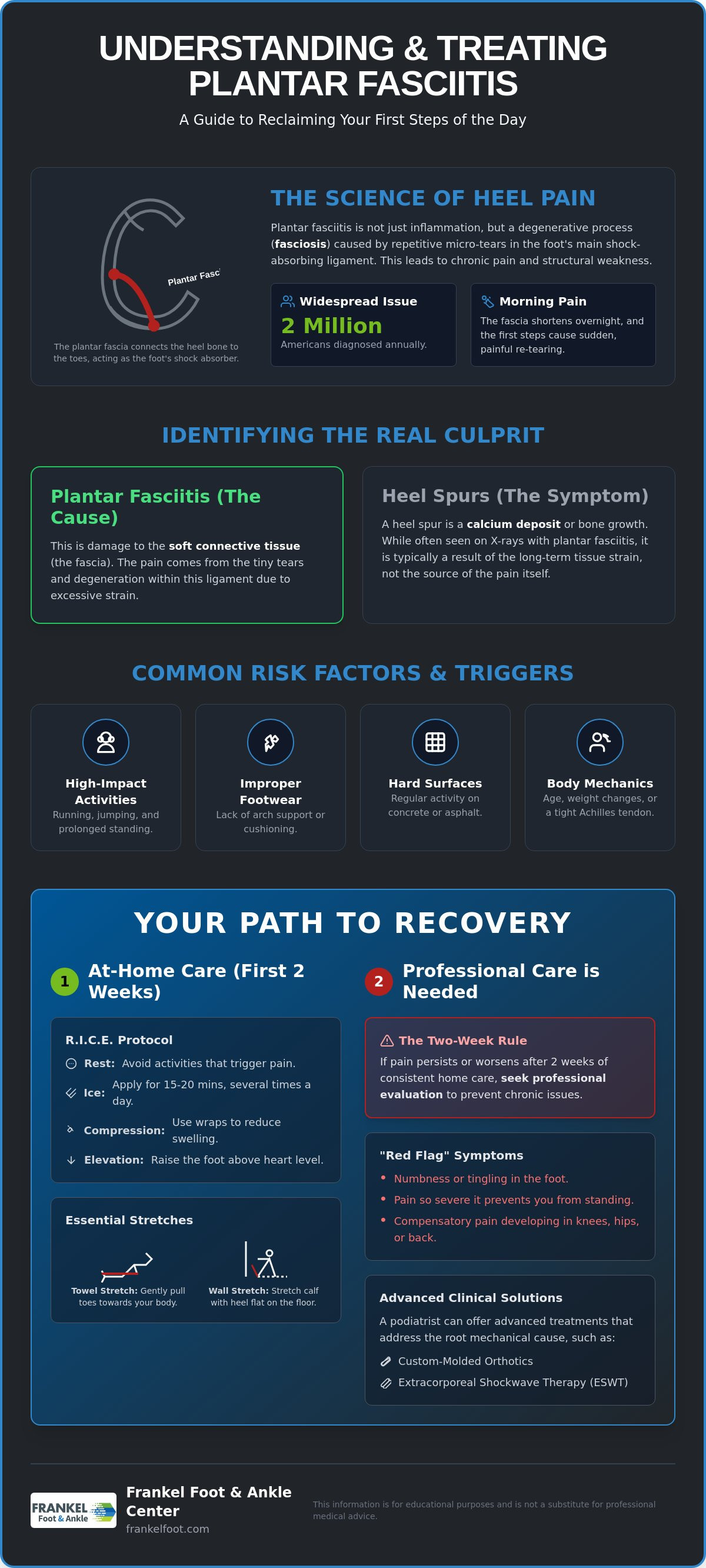
To understand why your heel feels tender, we must look at the plantar fascia. This is a thick, fibrous band of connective tissue that runs along the bottom of your foot, connecting your heel bone to your toes. Its primary role is to support the arch and act as a mechanical shock absorber every time your foot strikes the ground. When you ask, What is Plantar Fasciitis?, you're essentially looking at a failure of this shock-absorbing system. While many believe the pain stems solely from acute inflammation, modern clinical consensus points toward fasciosis, a degenerative process where the tissue's structural integrity begins to fail.
Repetitive strain creates tiny micro-tears in the fascia. Over time, these tears exceed the body's ability to repair them, leading to chronic pain. It's common for patients to confuse this with heel spurs. While bone spurs are calcium deposits that often appear on X-rays alongside plantar fasciitis, they're rarely the source of the pain itself. The real culprit is the damaged soft tissue struggling to manage the weight of your body.
Common Risk Factors and Mechanical Triggers
Certain lifestyle factors and physical attributes accelerate this wear. High-impact activities like long-distance running or jumping place immense stress on the fascia. This stress is compounded by factors that disrupt healthy foot mechanics, such as:
- Improper footwear that lacks adequate arch support or cushioning.
- Consistent activity on hard, unforgiving surfaces like concrete.
- Natural changes in age or weight that reduce the elasticity of connective tissues.
At Frankel Foot & Ankle Center, we focus on identifying these underlying mechanical triggers to ensure your recovery plan addresses the cause, not just the symptoms. Addressing these triggers early is essential for preventing long-term mobility issues.
The Morning Pain Phenomenon Explained
The hallmark of plantar fasciitis is the intense, stabbing pain experienced during your first few steps after waking. This happens because the fascia attempts to heal while you sleep. In a relaxed, non-weight-bearing position, the tissue contracts and shortens. When you stand up, you force that shortened, partially healed tissue to stretch abruptly. This results in sudden re-tearing and sharp discomfort that often subsides once the foot warms up, though the cycle repeats the next day without proper intervention.
Effective Home Remedies and When to Seek Professional Care
Managing plantar fasciitis begins with stabilizing the affected area to allow the natural healing process to take hold. We recommend a structured application of the RICE method: Rest, Ice, Compression, and Elevation. This involves resting the foot, icing for 15 to 20 minutes several times a day, using compression wraps, and elevating the limb to reduce swelling. While over-the-counter anti-inflammatories can provide temporary relief during acute flare-ups, they don't address the underlying mechanical dysfunction. They're a tool for comfort, not a permanent cure.
We establish a strict "Two-Week Rule" for our patients. If your pain persists or intensifies despite consistent home care, professional intervention is necessary. Ignoring the pain beyond this window increases the risk of the condition becoming a chronic, degenerative issue that is much harder to treat.
Daily Stretches for Long-Term Relief
Consistent flexibility exercises are vital for recovery. The "towel stretch" involves sitting with your legs extended and using a towel to gently pull your toes toward your body. For the "wall stretch," place your hands against a wall and extend one leg back with the heel flat. These movements focus on stretching the Achilles tendon. This is crucial because a tight calf pulls directly on the heel, which significantly increases the tension on your fascia throughout the day.
Identifying the Need for a Podiatric Consultation
Certain "red flag" symptoms indicate that home remedies are insufficient. If you experience numbness, tingling, or pain so severe it prevents you from standing, you should seek an expert evaluation. Chronic, untreated plantar fasciitis often leads to compensatory injuries in the knees, hips, and back as your body naturally changes its gait to avoid discomfort. During a consultation, we utilize physical examinations and advanced imaging to confirm the symptoms and diagnosis of plantar fasciitis. If you're struggling to find lasting comfort, exploring professional foot pain relief options can help you regain your mobility and avoid long-term disability.
Advanced Clinical Treatments for Chronic Plantar Fasciitis
When the "Two-Week Rule" passes without significant improvement, your recovery requires a transition from symptom management to mechanical correction. Persistent plantar fasciitis often signals that the underlying structural strain is too great for home remedies alone. At this stage, we utilize advanced clinical options that range from targeted corticosteroid injections for immediate relief to regenerative therapies that stimulate the body's natural healing response. We also offer specialized laser therapy, a non-invasive technology that penetrates deep into the tissue to reduce inflammation and accelerate cellular repair without the need for downtime.
It's vital to understand the causes and risk factors of plantar fasciitis to appreciate why these clinical interventions are necessary. While some providers might move quickly toward surgical options, our progressive approach ensures that surgery is rarely required. We focus on restoring the integrity of the fascia through modern, evidence-based techniques that prioritize your long-term mobility and comfort.
Custom Orthotics vs. Over-the-Counter Inserts
Many patients initially try generic store-bought inserts, but these lack the precision needed to correct specific gait abnormalities. Custom-molded orthotics are designed from a detailed 3D scan of your foot, providing tailored support that aligns your skeletal structure. This mechanical correction offers several advantages over temporary cushioning:
- Reduces the constant pull on the heel by stabilizing the arch.
- Distributes weight evenly across the foot to prevent localized pressure points.
- Prevents compensatory injuries in the knees and hips by normalizing your stride.
For a professional gait analysis and a device built for your unique foot shape, visit the Frankel Foot & Ankle Center. These devices are an investment in your long-term health, providing the structural foundation that over-the-counter options cannot match.
Specialized Care in Middletown, Katonah, and Milford
Dr. Marc Frankel and our dedicated team provide a patient-centered environment where your recovery is our primary mission. We've equipped our offices in Middletown, Katonah, and Milford with advanced diagnostic technology to ensure every patient receives an accurate assessment. From your initial consultation to your final follow-up, we guide you through a structured path toward Comprehensive Foot Pain Relief. Our goal is to return you to your daily routine without the shadow of chronic pain, utilizing the most sophisticated medical advancements available in the field today.
Reclaiming Your Foundation and Future Mobility
Your journey from sharp morning discomfort to sustained relief depends on a commitment to both understanding the mechanical nature of your injury and seeking specialized care when home remedies reach their limit. We've explored how plantar fasciitis is often a degenerative process rather than simple inflammation; this requires a transition from foundational stretching to sophisticated interventions like custom-molded orthotics and non-invasive laser therapy. By addressing the root structural cause of your pain, you can prevent compensatory injuries and protect your long-term health.
Dr. Marc Frankel provides the board-certified expertise necessary to diagnose your specific gait dysfunction through advanced imaging and clinical evaluation. With convenient locations in Middletown, Katonah, and Milford, our practice is equipped with the diagnostic tools and modern treatment technology required to restore your mobility without the need for invasive surgery. You don't have to accept heel pain as a permanent part of your daily life.
Take the first step toward a more comfortable, active future by choosing a provider dedicated to your long-term success. Schedule a consultation at Frankel Foot & Ankle Center for expert heel pain relief today. We look forward to helping you move through your day with confidence and ease.
Frequently Asked Questions
How long does it take for plantar fasciitis to heal?
Most patients achieve significant relief within several months of consistent conservative treatment. While initial symptoms may subside within a few weeks, full tissue recovery often requires three to six months of dedicated stretching and mechanical support. If your pain doesn't improve after six weeks of home care, we often introduce advanced clinical options to accelerate the healing process and prevent the condition from becoming a permanent limitation.
Can I still run or exercise with plantar fasciitis?
You should modify your exercise routine to avoid high-impact activities that place repetitive stress on the healing tissue. Running or jumping can aggravate existing micro-tears and prolong your recovery timeline. We recommend transitioning to low-impact alternatives such as swimming, rowing, or stationary cycling. These activities allow you to maintain cardiovascular health while protecting your feet from the mechanical strain that characterizes plantar fasciitis.
Do I need surgery to fix my chronic heel pain?
Surgery is rarely necessary and is typically reserved for cases that haven't responded to at least twelve months of comprehensive conservative care. Modern podiatric medicine offers a wide array of progressive, non-invasive solutions such as regenerative injections and laser therapy. These advanced treatments effectively address chronic pain by stimulating tissue repair, allowing the vast majority of our patients to avoid surgical intervention entirely and return to their active lifestyles.
What are the best shoes for people with plantar fasciitis?
The best footwear for managing plantar fasciitis features a rigid midsole, a cushioned heel, and robust arch support. You should avoid flat, unsupportive shoes such as flip-flops or worn-out athletic sneakers that allow the arch to collapse. Selecting a shoe with a slight heel elevation can also reduce the tension on your Achilles tendon and fascia. For those with specific mechanical imbalances, we integrate custom-molded devices into high-quality footwear to ensure optimal alignment.


