


Imagine waking up in your Middletown home, feeling refreshed and ready to tackle the day, only to be met with a sharp, searing sensation the moment your foot hits the floor. This localized arch pain often transforms a simple morning routine into a source of dread, casting a shadow over your daily activities. We understand how frustrating it is when physical discomfort prevents you from enjoying the scenic walking trails in Katonah or leaves your feet throbbing after a productive day at work. You deserve a life defined by movement, not by the limitations of a structural foot condition.
In the following sections, we'll help you identify the underlying causes of your discomfort and clarify when professional clinical intervention is essential for your recovery. Our goal is to provide a clear path from initial diagnosis to the implementation of non-invasive treatment options. We'll examine how modern diagnostic tools and advanced therapies, such as shockwave therapy which boasts an 80% to 90% success rate for conditions like plantar fasciitis, can effectively restore your mobility. By combining clinical precision with a patient-centered approach, we'll guide you toward the lasting relief you need to return to the activities you love.
Key Takeaways
- Understand how structural variations like flat feet or high arches place excessive strain on the plantar fascia and lead to midfoot discomfort.
- Identify the specific "red flag" symptoms that signal when your condition requires immediate clinical evaluation to prevent further tissue damage.
- Learn why timely treatment for arch pain is vital to prevent compensatory issues from affecting the alignment of your knees, hips, and lower back.
- Compare the medical precision of custom-molded orthotics with generic inserts to determine the most effective support for your unique foot anatomy.
- Discover how non-invasive clinical solutions, including advanced laser therapy, provide a path to recovery by addressing chronic inflammation at its source.
Identifying the Source: Common Causes of Midfoot and Arch Pain
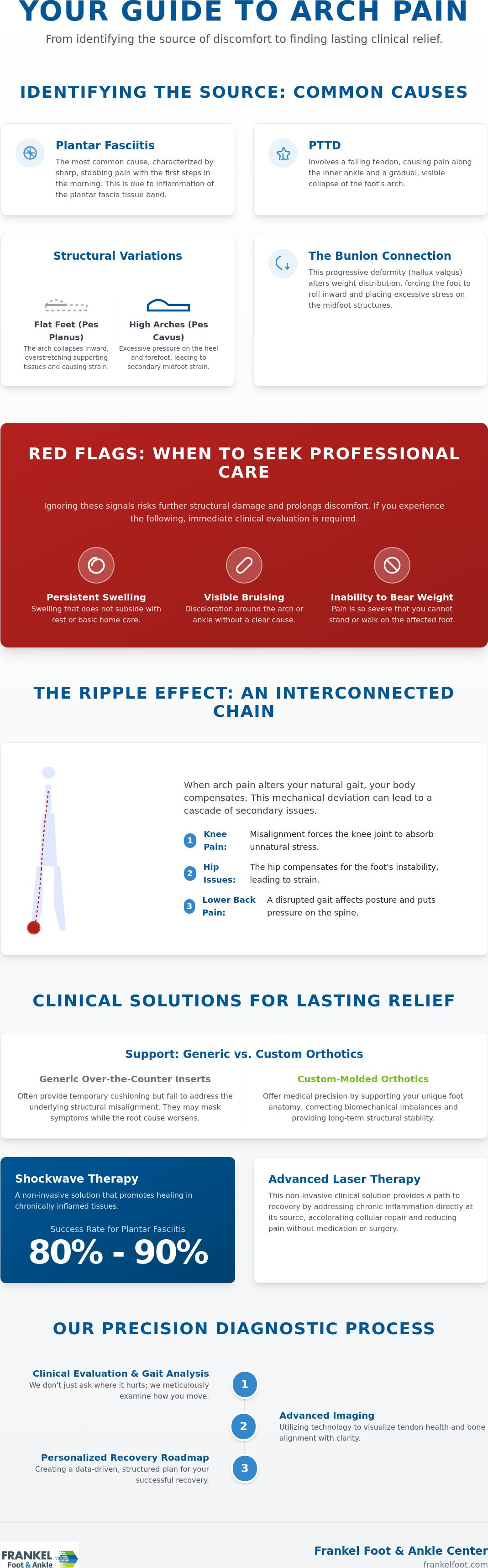
Arch pain is a symptom of biomechanical imbalance rather than just localized soreness. This discomfort often arises from the complex interactions between the bones, tendons, and ligaments that comprise the medial longitudinal arch. The plantar fascia serves as a critical structural support; it absorbs shock and maintains the foot's integrity throughout the gait cycle. When this tissue is overtaxed, frequently due to Plantar fasciitis, the resulting inflammation can lead to debilitating symptoms that hinder your daily routine.
Structural variations often determine the specific type of strain your feet endure. In cases of pes planus, or flat feet, the arch collapses inward, which overstretches the supporting soft tissues. Conversely, pes cavus, or high arches, results in excessive pressure on the heel and forefoot, often causing secondary strain in the midfoot. Distinguishing between a sudden acute injury and a chronic inflammatory condition is vital for developing a recovery plan that addresses the root cause rather than just the symptoms.
Plantar Fasciitis vs. Posterior Tibial Tendon Dysfunction
Accurate differentiation between these two conditions is essential for selecting the correct treatment pathway. Plantar fasciitis is characterized by a sharp, stabbing sensation during your first steps in the morning, which typically subsides with activity but returns after rest. On the other hand, Posterior Tibial Tendon Dysfunction (PTTD) involves pain along the inner ankle and a visible, gradual collapse of the arch. While one is a fascial issue, the other involves a failing tendon. Precise clinical evaluation ensures your care plan targets the specific anatomy involved. Precision is our priority.
The Bunion Connection: How Misalignment Affects Your Arch
A bunion is far more than a cosmetic concern; it's a progressive structural deformity that fundamentally alters weight distribution. This misalignment, medically termed hallux valgus, forces the foot to roll inward and places excessive stress on the midfoot structures. Over time, this imbalance contributes significantly to chronic arch pain. For many patients, addressing the primary deformity through Scarless Bunion Surgery in Middletown is the most effective way to restore long-term stability and alleviate the strain on the arch.
Assessing Severity: When to Seek Professional Podiatric Care
Recognizing the transition from mild fatigue to a clinical concern is essential for your long-term health. While many individuals initially attempt symptoms and home care for arch pain, these methods often provide only temporary relief. If you experience persistent swelling, visible bruising, or a complete inability to bear weight on the affected foot, these are "red flag" symptoms that require immediate evaluation. Ignoring these signals doesn't just prolong your discomfort; it risks structural damage that can become increasingly difficult to manage.
The human body is an interconnected kinetic chain. When arch pain alters your natural gait, your body compensates by shifting weight to other joints. This mechanical deviation frequently leads to secondary pain in the knees, hips, and lower back. Relying on over-the-counter insoles may temporarily mask these symptoms, but it fails to address the underlying structural misalignment. For those seeking comprehensive foot pain relief, a professional assessment at the Frankel Foot & Ankle Center is the only way to ensure your entire musculoskeletal system remains protected.
Diagnostic Milestones at Frankel Foot & Ankle Center
Our diagnostic process begins with a meticulous clinical evaluation and a sophisticated gait analysis. We don't just look at where it hurts; we examine how you move. By utilizing advanced imaging technology, we can visualize tendon health and bone alignment with exceptional clarity. This data allows us to create a personalized roadmap that guides you from your initial consultation through a successful recovery. It's a structured approach designed to provide certainty and confidence for every patient we serve.
Impact on Daily Life and Long-term Mobility
Chronic discomfort does more than just hurt; it limits your ability to engage with your community. Whether you're missing out on local recreation in Middletown or strolling through Milford, the loss of mobility carries a significant psychological toll. You shouldn't have to compromise your quality of life because of persistent foot issues. Early intervention is a powerful tool that often leads to faster, non-surgical outcomes. If you're ready to reclaim your active lifestyle, our team is here to provide the specialized care you deserve.
Clinical Solutions for Lasting Arch Pain Relief
Achieving a definitive resolution for arch pain requires a strategic shift from temporary symptom management to precise structural correction. While generic, store-bought inserts offer basic cushioning, they lack the medical calibration necessary to realign a compromised gait. Custom-molded orthotics are engineered using sophisticated clinical data to provide targeted support where your unique anatomy requires it most. This level of customization ensures that underlying biomechanical imbalances are corrected, rather than merely padded, providing a foundation for permanent recovery.
For patients struggling with chronic inflammation, we utilize non-invasive laser therapy to accelerate cellular repair and reduce discomfort without the need for surgical downtime. These advanced clinical solutions for plantar fasciitis and midfoot strain represent the forefront of progressive podiatric medicine. By combining modern technology with a compassionate, patient-centered philosophy, Frankel Foot & Ankle Center has established itself as the regional leader in restorative foot and ankle care.
Specialized Treatments in Middletown, Katonah, and Milford
Accessing world-class expertise shouldn't require extensive travel or logistical hurdles. We provide high-level care across our New York and Pennsylvania locations, ensuring residents have convenient local access to specialized treatments. From conservative management strategies to advanced clinical solutions, our approach is always tailored to your specific lifestyle and recovery goals. Whether you are seeking Ankle Pain Relief in Middletown or comprehensive arch support in Milford, our team is dedicated to your long-term success.
The Path to Recovery: What Patients Can Expect
Most patients begin to notice a significant reduction in discomfort within the first few weeks of following a professional treatment plan. We empower you through comprehensive education on preventive care and proper footwear selection to ensure your results are durable. Your journey toward pain-free movement is a collaborative process built on clinical excellence and a deep commitment to your well-being. When you're ready to take the next step toward restored mobility, we invite you to schedule your consultation with Dr. Frankel today and rediscover the joy of an active life.
Reclaiming Your Mobility and Comfort
Persistent arch pain is more than a minor inconvenience; it's a clear signal from your body that your structural foundation requires professional attention. We've explored how identifying the root cause, from plantar fasciitis to complex biomechanical imbalances, serves as the essential first step toward lasting wellness. By recognizing the red flags of severity and understanding the limitations of generic, over-the-counter remedies, you can make an informed decision to prioritize your long-term health and mobility.
At the Frankel Foot & Ankle Center, we combine the high-level expertise of Dr. Marc Frankel with advanced on-site diagnostic imaging to ensure every patient receives a precise, data-driven diagnosis. Whether you visit our welcoming offices in Middletown, Katonah, or Milford, you'll find a supportive environment dedicated entirely to your recovery journey. You don't have to navigate this path alone. Our team is ready to provide the sophisticated clinical solutions and compassionate care necessary to return you to the activities you love with confidence and ease.
Schedule a Consultation for Arch Pain Relief today and take the first step toward a future defined by movement and vitality. We look forward to guiding you back to a life free from discomfort.
Frequently Asked Questions
Why does my arch hurt even when I'm not walking?
Pain at rest often indicates significant inflammation or nerve entrapment within the midfoot structures. When the plantar fascia remains in a state of chronic irritation, it doesn't always require weight-bearing to trigger discomfort. This persistent arch pain can also stem from tarsal tunnel syndrome, where a nerve is compressed as it passes through the ankle. We recommend a clinical evaluation to determine if your pain is inflammatory or neurological in nature.
Can the wrong shoes cause permanent arch damage?
Improper footwear doesn't typically cause immediate permanent damage, but it significantly accelerates the progression of underlying structural issues. Shoes that lack adequate support force the medial longitudinal arch to absorb excessive stress during every step. Over time, this repetitive strain can lead to chronic ligament laxity and permanent changes in your foot's architecture. Choosing footwear with medical-grade support is a critical component of preventive care for your long-term mobility.
Is arch pain a sign of a more serious condition like a stress fracture?
Localized arch pain can indeed be a clinical indicator of a stress fracture, particularly in the navicular or metatarsal bones. Unlike soft tissue inflammation, a stress fracture often presents as a deep, focused ache that intensifies with even minor activity. Because these tiny cracks don't always appear on standard X-rays, we utilize advanced diagnostic imaging to ensure an accurate diagnosis. Early detection is essential to prevent a minor hairline fracture from becoming a complete break.
What is the difference between a flat foot and a fallen arch?
A flat foot is typically a congenital condition where the arch never fully develops, whereas a fallen arch is an acquired deformity. Medically known as pes planus, congenital flat feet are often bilateral and present from childhood. A fallen arch, or adult-acquired flatfoot, usually occurs when the posterior tibial tendon weakens and fails to support the midfoot. Both conditions require precision-based management to restore proper biomechanical function and prevent long-term joint damage.


