


Did you know that more than 10% of adults over the age of 65 experience the structural shifts associated with adult acquired flatfoot deformity? While many individuals live with low arches without any clinical symptoms, Flatfeet only require professional calibration when they begin to disrupt your body's natural alignment or cause persistent physical strain. If you've noticed your shoes wearing unevenly or your feet feeling heavy after a simple stroll, your anatomy may be signaling a need for expert attention.
We understand how frustrating it is to deal with chronic foot fatigue or that sharp, nagging pain in your inner ankle. You've likely tried various inserts or supportive footwear only to find the relief is temporary at best. It's common to worry if your condition is progressive or if you'll eventually need complex surgery just to stay active. Our goal is to provide you with the clarity and specialized care you deserve to walk without hesitation.
By reading further, you'll discover the specific causes of arch collapse and learn exactly when it's time to seek specialist intervention. We will provide a comprehensive overview of your options, ranging from custom functional orthotics to advanced, minimally invasive surgical techniques designed to restore your stability. This guide outlines everything you need to know about achieving long-term relief and reclaiming your active lifestyle in Middletown and Milford.
Key Takeaways
- Learn how the collapse of the medial longitudinal arch impacts your foot's natural ability to absorb shock and distribute weight effectively.
- Identify specific clinical indicators, such as the "too many toes" sign, that signal when Flatfeet require specialized medical intervention.
- Discover the role of a professional biomechanical analysis in identifying the root cause of your discomfort and guiding an accurate diagnosis.
- Understand why precision-engineered custom orthotics offer superior structural support compared to standard over-the-counter inserts.
- Explore modern treatment pathways focused on stabilizing your foundation to achieve lasting pain relief and restored mobility.
What Are Flatfeet? Understanding Pes Planus and Your Foundation
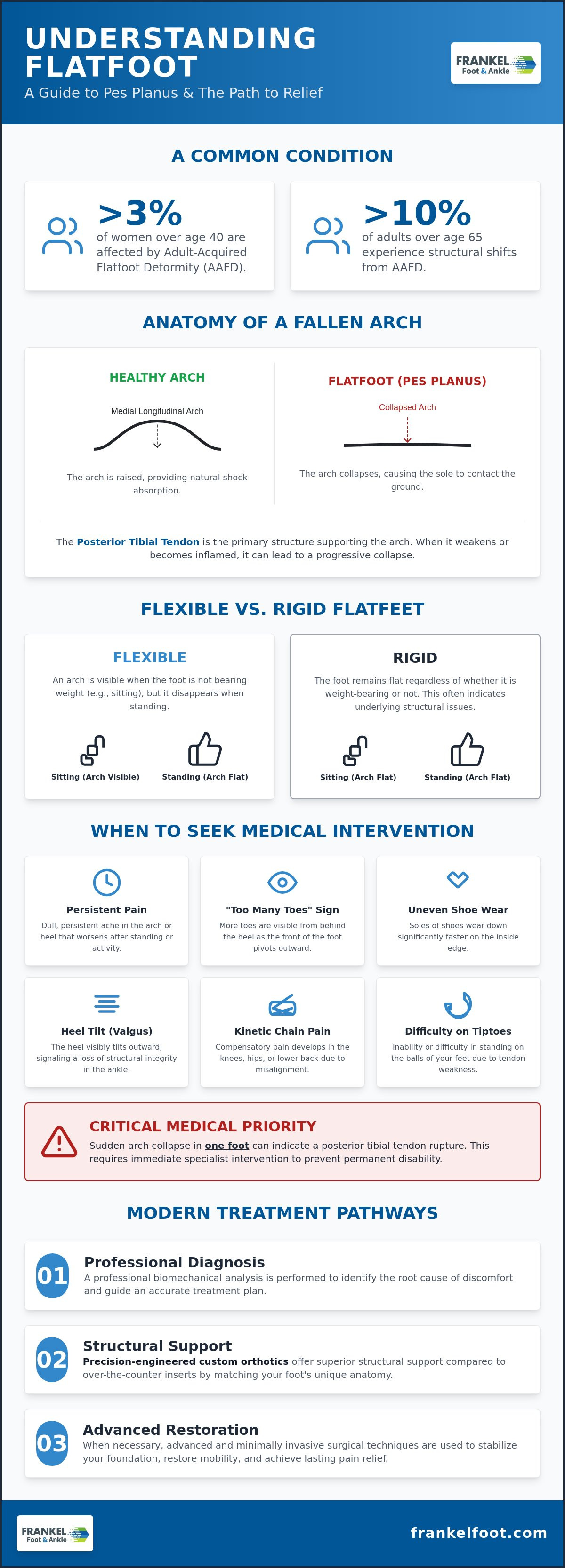
The human foot is an intricate structure designed to support your body's entire weight while adapting to various terrains. When the medial longitudinal arch, which is the primary curve along the inside of the foot, collapses or fails to develop, the condition is clinically known as Flat feet (pes planus). This arch functions as a vital shock absorber and weight distributor; it manages the impact forces generated during every step you take to protect your joints from excessive strain.
Most infants are born with seemingly flat feet due to a protective fat pad and naturally loose ligaments. While most children develop a defined arch by age six, some never do. This lack of development results in congenital Flatfeet. In other cases, an individual may have a healthy arch for decades only to experience a gradual collapse. This is known as adult-acquired flatfoot deformity (AAFD). Research indicates that this condition is surprisingly common; it affects more than 3% of women over age 40 and over 10% of all adults over age 65.
Flexible vs. Rigid Flatfeet: Why the Distinction Matters
Determining the specific nature of your condition is the first step toward effective management. You can often identify a flexible arch by observing your foot while sitting; if the arch appears when you're non-weight bearing but vanishes upon standing, it's considered flexible. While this may seem less severe, it can still lead to significant mechanical strain and secondary issues requiring foot pain relief. Conversely, rigid flatfeet remain flat regardless of position. This often indicates underlying bone fusion issues or advanced structural changes that require more intensive clinical intervention to restore comfort.
The Anatomy of a Fallen Arch
The stability of your arch relies heavily on the posterior tibial tendon, which is the primary soft tissue structure responsible for lifting the midfoot. When this tendon becomes inflamed or weakened, it can no longer provide the necessary tension to hold the bones in place. This failure, often coupled with general ligament laxity, leads to a progressive collapse of the foundation. The medial longitudinal arch is the complex arrangement of bones, ligaments, and tendons that spans the length of the foot and provides the structural integrity needed for a balanced, efficient human gait.
Recognizing the Signs: When Do Flatfeet Require Medical Intervention?
Identifying Flatfeet isn't always as simple as looking at your footprint in the sand. Many patients experience a dull, persistent ache in the medial longitudinal arch or the heel that intensifies after long periods of standing or walking. Visual indicators are equally telling; for instance, the "too many toes" sign occurs when the front of your foot pivots outward, making more toes visible from behind than usual. You might also notice your heel tilting outward, a position known as valgus, which signals that your foundation is shifting and losing its structural integrity.
This misalignment often acts as the primary driver for overpronation. When your foot rolls inward excessively, it places undue stress on the plantar fascia and the surrounding soft tissues, leading to inflammation. This structural instability doesn't stay confined to your feet. According to the MedlinePlus guide to flat feet, the resulting "Kinetic Chain" effect can lead to compensatory pain in your knees, hips, and even your lower back. If you're experiencing these systemic issues, seeking professional foot pain relief is a logical next step to prevent further mechanical breakdown.
When to Schedule a Consultation in Middletown
Monitoring your symptoms is essential for maintaining your mobility. Use this brief checklist to evaluate your condition:
- Does your foot pain worsen significantly during or after physical activity?
- Do you find it difficult or impossible to stand on your tiptoes?
- Have you noticed your shoes wearing down much faster on the inside edge?
Sudden arch collapse in just one foot is a critical medical priority. This often indicates a posterior tibial tendon rupture, which requires immediate specialist intervention to prevent permanent disability. For more details on managing these symptoms, explore our guide on Comprehensive Foot Pain Relief.
Long-term Risks of Untreated Symptomatic Flatfeet
Ignoring persistent symptoms can lead to irreversible structural changes. Over time, the abnormal friction within the midfoot and ankle joints can result in early-onset arthritis, making every step painful. You may also become more susceptible to secondary injuries like shin splints or stress fractures due to poor shock absorption. Overpronation acts as a catalyst for chronic ankle instability because it constantly overstretches the supporting ligaments and tendons.
Advanced Treatment Pathways: Restoring Mobility in Middletown and Beyond
Effective resolution of Flatfeet begins with a comprehensive biomechanical analysis. We don't just look at the height of your arch; we examine your entire gait cycle to understand how your foot interacts with the ground during each phase of movement. While many patients initially reach for over-the-counter inserts, these generic products often fail because they provide simple cushioning rather than structural correction. Precision-engineered custom orthotics are fundamentally different. They're molded to your unique anatomy to realign the subtalar joint and provide targeted foot pain relief by neutralizing abnormal forces.
Alongside orthotic therapy, we implement specialized physical therapy protocols designed to reinforce your natural foundation. These exercises focus specifically on strengthening the posterior tibial tendon and improving the flexibility of the Achilles complex. This dual approach helps stabilize the midfoot and significantly reduces the mechanical load on your arch. You can learn more about flat feet and how these conservative measures serve as a vital first line of defense against progressive deformity.
Customized Relief at Frankel Foot & Ankle Center
At our Middletown, Katonah, and Milford locations, we utilize advanced diagnostic tools to ensure an accurate assessment of your structural health. We use high-resolution imaging to evaluate tendon integrity and joint alignment, allowing us to see internal details that standard exams might miss. Our clinical philosophy centers on compassionate, patient-centered care. We're dedicated to ensuring you feel supported from your initial consultation through every step of your long-term recovery journey.
Surgical Options for Severe Cases
When conservative treatments don't provide the necessary stability, reconstructive surgical options become a viable path toward permanent relief. We specialize in minimally invasive techniques that aim to realign the foot with significantly less trauma to the surrounding tissues. These modern procedures offer faster recovery times and more predictable outcomes for those dealing with rigid or advanced arch collapse. If your condition has begun to impact the joint above the foot, you may also benefit from our expertise in Comprehensive Ankle Pain Relief.
Reclaiming Your Foundation and Lasting Mobility
Your journey toward pain-free movement begins with a clear understanding of your unique structural needs. We've explored how Flatfeet serve as more than just a physical trait; they're a complex biomechanical challenge that can influence your entire kinetic chain from your ankles to your lower back. By addressing arch collapse early through precise diagnostics and targeted therapy, you can prevent the progressive joint wear and chronic instability that often accompany untreated symptoms. Our commitment is to provide you with the specialized care necessary to move with confidence once again.
At Frankel Foot & Ankle Center, we combine the high-level expertise of Dr. Marc Frankel with advanced diagnostic imaging available at our Middletown location. This technology allows us to develop a highly specific roadmap for your recovery, utilizing a patient-centered approach that prioritizes your comfort and long-term health. Whether your path involves custom functional orthotics or progressive surgical intervention, our team is dedicated to restoring your natural alignment. Schedule your professional foot health evaluation at Frankel Foot & Ankle Center today. You don't have to navigate this journey alone; we're ready to help you take the first step toward a more active and vibrant future.
Frequently Asked Questions
Can flatfeet be cured without surgery?
Many cases of symptomatic Flatfeet can be managed successfully through non-invasive clinical pathways. While conservative treatments like custom-molded orthotics and physical therapy don't physically rebuild the arch, they neutralize the mechanical strain that causes pain. These interventions focus on stabilizing the midfoot and preventing the deformity from worsening. If your condition is flexible and detected early, these methods often provide lasting relief without the need for reconstructive surgery.
Are flatfeet hereditary or can they develop later in life?
Flatfeet can be both a congenital trait passed down through genetics and an acquired condition that develops during adulthood. Many individuals are born with a predisposition toward low arches due to hereditary ligament laxity. However, others may experience a gradual arch collapse later in life because of posterior tibial tendon dysfunction or cumulative physical stress. This distinction is vital for determining whether your treatment should focus on long-term structural support or acute tendon rehabilitation.
Do I need custom orthotics if my flat feet don’t hurt yet?
Proactive support is recommended even without acute pain if you notice uneven shoe wear or minor postural shifts during your daily activities. While asymptomatic arches may not require immediate medical intervention, a lack of structural support often leads to compensatory issues in the knees and hips. A professional biomechanical evaluation can determine if your specific foot structure puts you at risk for future injuries. Preventive care stops minor mechanical imbalances from evolving into chronic inflammatory conditions.
What are the best exercises to strengthen the arches of my feet?
Strengthening the intrinsic muscles of the foot and the posterior tibial tendon is essential for maintaining arch stability and improving shock absorption. We often recommend "short foot" exercises, where you draw the ball of your foot toward your heel without curling your toes. Stretching the Achilles tendon is equally important; a tight calf muscle can pull on the heel and force the arch to collapse further. Consistent engagement in these protocols helps reinforce your natural foundation.


