


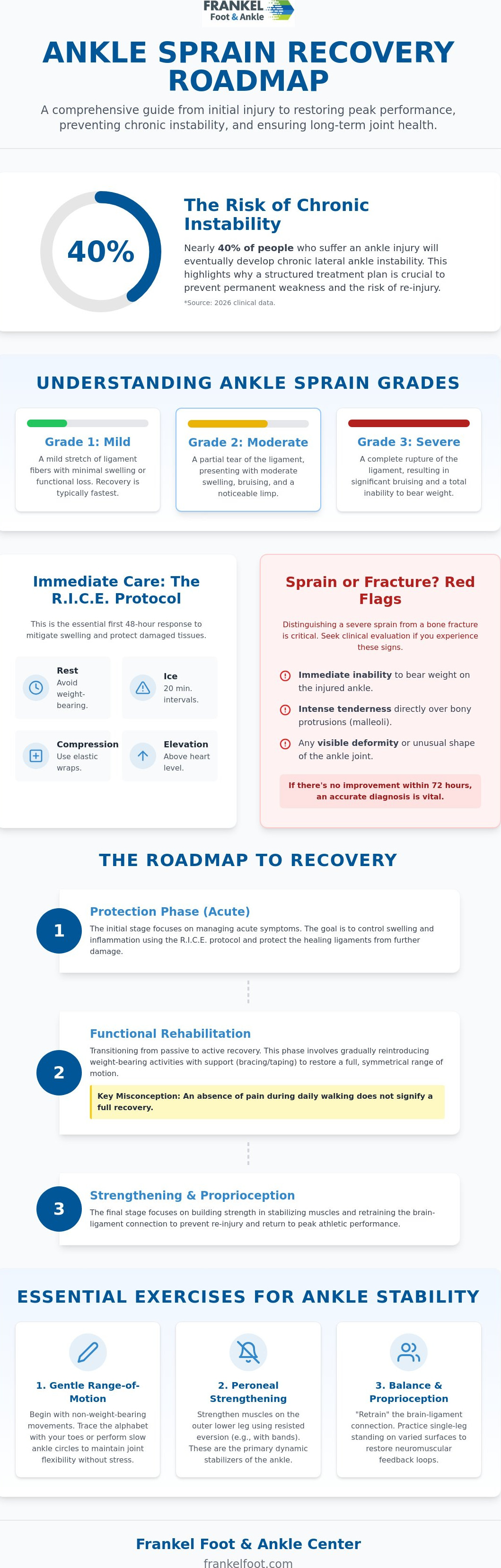
Did you know that nearly 40% of people who suffer an ankle injury will eventually develop chronic lateral ankle instability? This statistic, sourced from current 2026 clinical data, highlights why effective ankle sprain treatment must go beyond simply waiting for the swelling to subside. When you're sidelined by a sudden twist or a painful pop, the frustration of being unable to walk or exercise is immediate. It's natural to feel concerned about whether you're dealing with a simple sprain or a complex fracture, and whether your ankle will ever feel truly stable again.
At Frankel Foot & Ankle Center, we understand that your goal is a rapid return to the activities you love without the fear of re-injury. We're committed to providing a recovery path that prioritizes both your comfort and your long-term mobility. This guide will outline a comprehensive journey from immediate at-home care protocols to the advanced clinical interventions and active rehabilitation strategies that prevent permanent weakness and restore your peak performance.
Key Takeaways
- Learn how the RICE protocol serves as a vital first step in managing acute inflammation and protecting damaged ligaments during the initial 48 hours.
- Understand the progression from the protection phase to functional rehabilitation, emphasizing that a lack of pain does not always indicate a full recovery.
- Discover how a structured ankle sprain treatment plan prevents the development of chronic instability and reduces the risk of future injury.
- Identify the specific warning signs, such as persistent aching or the sensation of the ankle "giving way," that signal the need for a clinical evaluation.
- Gain insight into advanced diagnostic techniques that differentiate between a standard ligament tear and more complex injuries like fractures.
Immediate Ankle Sprain Treatment: The RICE Protocol and Grading
An ankle sprain is fundamentally the stretching or tearing of the ligaments that stabilize the joint. This injury most commonly affects the anterior talofibular ligament (ATFL), which is located on the lateral aspect of the ankle. To gain a deeper understanding of the anatomy and causes, you may find it helpful to consult this comprehensive overview of ankle sprains.
Effective ankle sprain treatment begins the moment the injury occurs. The RICE protocol stands as the essential first 48-hour response to injury, designed to mitigate swelling and protect the damaged tissues from further insult. By resting the limb, applying ice, using compression wraps, and elevating the foot above the heart, you create an environment conducive to the initial healing phase.
Our clinical team categorizes these injuries into three distinct grades to tailor your recovery plan. A Grade 1 sprain involves a mild stretch of the fibers with minimal functional loss. Grade 2 signifies a partial tear that typically presents with moderate swelling and a noticeable limp. A Grade 3 injury represents a complete rupture of the ligament, often resulting in significant bruising and a total inability to bear weight. While traditional methods favored long periods of casting, current clinical guidelines emphasize early, supported mobilization over complete immobilization for most patients to preserve joint range of motion and muscle strength.
Is It a Sprain or a Fracture?
Distinguishing between a severe ligament tear and a bone fracture is critical for your safety. Key signs of a fracture include an immediate inability to bear weight, intense tenderness directly over the bony protrusions, and any visible deformity of the joint. Specialists utilize the "Ottawa Ankle Rules," a specific set of clinical criteria, to determine if diagnostic X-rays are necessary. If you don't see improvement within 72 hours, it's vital to seek professional ankle pain relief at Frankel Foot & Ankle Center to ensure an accurate diagnosis and prevent long-term complications.
The Roadmap to Recovery: Strengthening and Functional Rehabilitation
Transitioning from the initial "Protection Phase" to the "Functional Phase" represents a critical juncture in your journey toward health. While the RICE protocol is effective for managing acute symptoms, a comprehensive ankle sprain treatment plan requires active intervention to restore structural integrity. It's a common misconception that the absence of pain during daily walking signifies a full recovery. In reality, ligaments often remain vulnerable to re-injury without targeted rehabilitation, making a structured approach essential for long-term joint health.
From restoring basic mobility to achieving peak athletic performance, each step of the rehabilitation process must be handled with precision. During this middle stage, external supports like bracing or medical-grade taping play a pivotal role by providing a safety net. These tools allow you to gradually reintroduce weight-bearing activities while preventing the excessive inversion that caused the initial injury. Clinical research on the Management of Ankle Sprains indicates that restoring a full, symmetrical range of motion before beginning high-impact activities is non-negotiable for preventing chronic issues.
Essential Exercises for Ankle Stability
- Step 1: Gentle Range-of-Motion: You should begin with non-weight-bearing movements. Tracing the "alphabet" with your toes or performing slow ankle circles helps maintain joint flexibility without overstressing the healing ATFL fibers.
- Step 2: Strengthening the Peroneal Muscles: These muscles, located on the outer side of your lower leg, act as the primary dynamic stabilizers of the lateral ankle. Strengthening them through resisted eversion helps your body naturally resist the rolling motions that lead to sprains.
- Step 3: Balance and Proprioception Training: This phase focuses on "retraining" the brain-ligament connection. Exercises like single-leg standing on varied surfaces help restore the neuromuscular feedback loops that were disrupted during the initial trauma.
If you find that your progress has plateaued or you're unsure if your joint is ready for more intense activity, seeking specialized ankle pain relief can provide the professional guidance needed for a safe and confident return to your favorite sports.
When to See an Ankle Specialist in Middletown
A common hurdle in effective ankle sprain treatment is the dismissive belief that an injury is "just a sprain" and will eventually resolve on its own. While minor stretches may heal with time, research indicates that between 36% and 40% of patients develop chronic lateral ankle instability after an initial injury. This condition often manifests as the joint frequently "giving way" during lateral movements or a persistent, deep aching that lingers long after your activity has ended. Ignoring these warning signs can lead to permanent joint degeneration and a significant decrease in your long-term mobility.
At Frankel Foot & Ankle Center, we utilize advanced diagnostic protocols to move beyond surface-level assessments. From stress X-rays that evaluate joint laxity under controlled pressure to high-resolution MRI scans for precise ligament assessment, our diagnostic approach ensures no detail is overlooked. For those who have reached a plateau while following a standard ankle sprain recovery guide, these clinical insights are the next logical step to ensure your ligaments are healing correctly. When conservative measures fail or a Grade 3 rupture is present, minimally invasive surgical repair may be the most effective path to restoring your confidence in every step.
Personalized Care at Frankel Foot & Ankle Center
Dr. Marc Frankel provides a compassionate, patient-centered approach to treating complex sports injuries, from the initial diagnostic phase to the final stages of functional restoration. We prioritize your recovery by offering convenient access to high-level expertise across our locations in Middletown, NY; Katonah, NY; and Milford, PA. Our team stays at the forefront of progressive methodology to ensure you achieve lasting health improvements. If you're struggling with persistent ankle pain or a joint that feels unreliable, schedule a consultation today to begin a structured recovery plan tailored to your specific physical needs.
Restoring Your Confidence and Mobility
Recovering from a ligament injury is a deliberate process that requires more than just time; it demands a structured approach to healing. Effective ankle sprain treatment bridges the gap between initial symptom management and the full restoration of your joint's dynamic stability. By prioritizing early mobilization and specialized strengthening exercises, you can actively reduce the risk of developing the persistent weakness that affects nearly 40% of patients. It's essential to remember that while the initial pain may fade, the structural integrity of your ankle depends on a complete rehabilitation cycle.
During the recovery phase, it is vital to avoid heavy physical labor like yard maintenance that could risk a re-injury. To keep your property looking its best while you heal, you can explore Project-based landscaping installation and recurring maintenance fees from Frank & Son Landscaping.
If you're still experiencing a sensation of instability or lingering discomfort, our team is here to provide the clinical expertise you deserve. Dr. Marc Frankel specializes in delivering advanced ankle pain relief through precise diagnostics and personalized care plans. With convenient locations in Middletown NY, Katonah NY, and Milford PA, we're dedicated to helping you return to your active lifestyle with total confidence. Schedule your ankle consultation at Frankel Foot & Ankle Center today to ensure your recovery is thorough and lasting. You don't have to navigate this journey alone, and we look forward to supporting your path back to peak performance.
Frequently Asked Questions
How long does it take for a sprained ankle to heal completely?
The complete recovery timeline depends largely on the severity of the initial ligament damage and your commitment to rehabilitation. A mild Grade 1 sprain typically resolves within one to three weeks; however, a more severe Grade 2 or 3 injury may require six weeks to several months of dedicated care. It's vital to follow a progressive ankle sprain treatment plan to ensure the ligament fibers have matured sufficiently to handle the high-impact stresses of athletic activity.
Can I walk on a sprained ankle if it does not hurt too much?
You can often begin walking on the injured limb if you're able to do so without significant pain or a noticeable limp. Current clinical guidelines favor early, supported weight-bearing to prevent muscle atrophy and maintain joint mobility. If you experience sharp pain or the joint feels unstable, you should utilize a brace to protect the healing tissues. This transition should be monitored carefully to prevent aggravating the damaged ligaments during the initial healing phase.
What happens if an ankle sprain is left untreated?
Neglecting proper care significantly increases your risk of developing chronic lateral ankle instability. Statistics indicate that up to 40% of individuals who forgo professional ankle sprain treatment experience recurring episodes where the ankle "gives way" during movement. Over time, this persistent instability leads to repetitive micro-trauma within the joint. This can accelerate the onset of post-traumatic osteoarthritis and cause permanent limitations in your physical range of motion and overall quality of life.
When is surgery necessary for a sprained ankle?
Surgical intervention is generally reserved for severe Grade 3 ruptures that fail to stabilize with conservative physical therapy or for patients suffering from long-term chronic instability. If your joint remains unreliable after months of dedicated strengthening, a minimally invasive procedure may be required to repair or tighten the overstretched ligaments. Dr. Marc Frankel evaluates each case using advanced diagnostics to determine if a surgical approach is the most effective path toward restoring your long-term joint health.


