


Did you know that up to 40% of individuals who sustain a lateral ankle injury develop chronic instability or a recurring "giving way" sensation within twelve months? It's deeply frustrating when a single misstep leads to sharp pain that halts your daily routine, often leaving you uncertain whether you're dealing with a simple strain or a complex bone fracture. We understand that your priority is a swift, stable return to the activities you love, which is why professional ankle sprain treatment is essential for a lasting recovery.
This guide outlines a sophisticated pathway for healing, moving from initial protection at home to advanced clinical diagnostics and stabilization in Middletown. You'll discover how to accurately identify your injury grade and implement a methodical recovery plan designed to reduce swelling, restore strength, and ensure your long-term mobility remains uncompromised.
Key Takeaways
- Categorize your injury using the three-grade severity system to understand whether you are facing a minor ligament stretch or a complete rupture.
- Master the transition from acute inflammation control to progressive functional loading to ensure your ligaments heal with maximum strength and flexibility.
- Recognize the specific clinical red flags that necessitate professional ankle sprain treatment in Middletown to avoid the risk of chronic joint instability.
- Explore how specialized podiatric diagnostics can identify occult fractures or tendon damage that standard home care might overlook.
Understanding Ankle Sprain Severity: The 3-Grade System
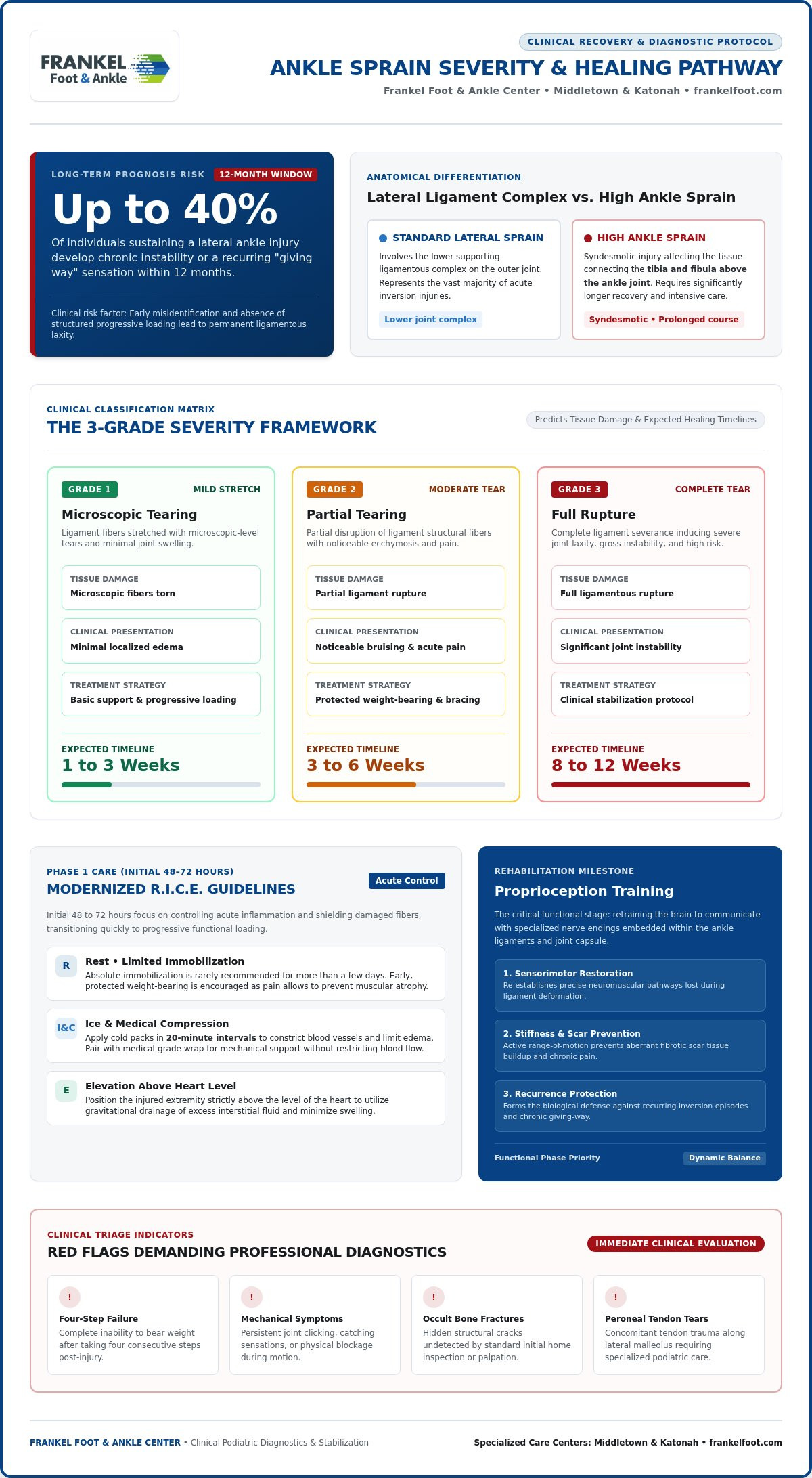
An ankle sprain occurs when the ligaments supporting the joint are stretched or torn beyond their normal range. An ankle sprain is a ligamentous injury typically involving the lateral complex. Identifying the precise severity of this damage is the first step toward effective ankle sprain treatment. While most injuries involve the lower ligaments, a high ankle sprain, or syndesmotic injury, affects the tissue connecting the tibia and fibula above the ankle joint. These injuries often demand a significantly longer recovery period and more intensive management than standard lateral sprains. It's vital to recognize these differences early; if you don't, you risk long-term complications like chronic instability.
The Clinical Grades of Ankle Sprains
Clinicians utilize a three-grade ankle sprain classification to determine the appropriate level of intervention and predict healing timelines. This methodical approach ensures that every patient receives a recovery plan tailored to their specific tissue damage. At Frankel Foot & Ankle Center, we prioritize advanced diagnostics to categorize your injury accurately and facilitate rapid healing.
- Grade 1: These mild injuries involve microscopic tearing of the ligament fibers with minimal swelling. Most patients return to full activity within 1 to 3 weeks with basic supportive care and progressive loading.
- Grade 2: This moderate classification features partial tearing of the ligament, resulting in noticeable bruising and pain. Recovery typically takes 3 to 6 weeks and often involves protected weight-bearing and specialized bracing to ensure the fibers heal without excessive laxity.
- Grade 3: As the most severe form, a Grade 3 sprain represents a full rupture of the ligament. This leads to significant joint instability and typically necessitates an 8 to 12-week recovery path where professional ankle sprain treatment focuses on clinical stabilization to restore full function.
The Progressive Recovery Protocol: From RICE to Rehabilitation
The initial 48 to 72 hours following an injury focus on controlling acute inflammation and shielding damaged ligament fibers from further strain. Effective ankle sprain treatment requires a delicate balance between protection and early mobilization. While passive rest is necessary immediately following the trauma, transitioning toward active range-of-motion exercises prevents the joint stiffness and scar tissue buildup that can lead to chronic discomfort. This methodical progression is essential for achieving lasting ankle pain relief and restoring your natural gait. We prioritize a patient-centered approach that guides you through each phase of tissue repair.
Following a structured ankle sprain aftercare and recovery protocol ensures that the healing process remains on track. Perhaps the most critical component of this journey is proprioception training. This involves retraining your brain to communicate with the specialized nerve endings in your ankle joint. By restoring this vital sensorimotor connection, you significantly reduce the risk of future instability and the frustration of recurring sprains. It's about building a foundation for a resilient return to your daily activities.
Implementing the R.I.C.E. Method Corrected
Modern clinical guidelines have refined the traditional approach to initial care to promote faster healing during ankle sprain treatment. This evolution ensures that early interventions support, rather than hinder, the natural recovery process.
- Rest: Absolute immobilization is rarely recommended for more than a few days. Prolonged inactivity can weaken the surrounding musculature, so we often encourage early, protected weight-bearing as pain allows.
- Ice and Compression: Apply cold packs for 20-minute intervals to constrict blood vessels and limit edema. Combine this with a medical-grade compression wrap to provide stability and mechanical support without restricting circulation.
- Elevation: Positioning the injured limb above the level of your heart is a simple yet powerful way to utilize gravity for draining excess fluid from the injury site.
Advanced Ankle Sprain Treatment in Middletown and Katonah
While the initial stages of recovery can often be managed at home, certain clinical indicators signal the need for professional intervention. If you experience an inability to bear weight after four steps or notice persistent "clicking" and catching sensations within the joint, specialized ankle sprain treatment becomes necessary to prevent long-term complications. These symptoms often point toward underlying issues that standard rest cannot resolve, such as occult fractures or peroneal tendon tears that require precise identification. Addressing these red flags early is the most effective way to avoid the cycle of chronic instability.
Our diagnostic process in Middletown utilizes advanced imaging and physical assessment to rule out these complex injuries. By following established AAOS ankle sprain evaluation and treatment guidelines, we ensure that every patient receives a definitive diagnosis. This methodical approach allows us to transition from basic care to sophisticated ankle sprain treatment, including custom functional bracing and targeted clinical physical therapy. These interventions are designed to restore full athletic function while addressing the sensorimotor deficits that often follow a severe ligamentous tear.
When to Visit Frankel Foot & Ankle Center
Seeking an expert consultation for ankle pain relief ensures that your recovery is built on a foundation of clinical accuracy. Dr. Marc Frankel and our dedicated team provide local access to specialized care at our offices in Middletown NY, Katonah NY, and Milford PA. For those experiencing persistent symptoms or recurring instability, our guide on Comprehensive Ankle Pain Relief offers deeper insights into managing chronic cases. We remain committed to guiding you from the moment of injury through to a complete and confident return to your active lifestyle.
Restoring Your Stability and Confidence
Recovering from a ligamentous injury requires more than just time; it demands a structured approach that respects the biological phases of healing. By accurately identifying your injury grade and implementing a progressive loading protocol, you can prevent the long-term cycle of instability. Expert care by Dr. Marc Frankel provides the specialized diagnostics necessary for an accurate injury grading, ensuring that your ankle sprain treatment is tailored to your unique clinical needs.
Our compassionate, patient-centered approach bridges the gap between initial at-home care and advanced medical stabilization. We're dedicated to helping you return to your active lifestyle with a foundation of strength and resilience. Don't let a misstep lead to chronic pain. Schedule a consultation for professional ankle pain relief at Frankel Foot & Ankle Center today. Your journey toward a full and stable recovery begins with precise, professional guidance.
Frequently Asked Questions
How long does it take for a sprained ankle to heal?
Healing timelines depend heavily on the specific grade of your injury and the consistency of your rehabilitation. While mild stretches might resolve in under three weeks, complex tears often require several months of dedicated care. Our clinics in Middletown and Katonah provide the advanced diagnostics necessary to establish a realistic recovery schedule. This specialized oversight ensures you don't return to sports prematurely and risk long-term instability.
Should I wrap a sprained ankle at night?
Wrapping your ankle at night is generally not recommended unless specifically directed by a clinician. While compression helps manage edema during the day, it can inadvertently restrict circulation or cause discomfort while you're asleep. Instead, focus on elevating the limb to encourage drainage. If you experience persistent nocturnal pain, a consultation at our Milford or Middletown facilities can help determine if specialized bracing is necessary.
Can I walk on a sprained ankle if it does not hurt too much?
Early weight-bearing is often beneficial if the pain is manageable and no fracture is present. We utilize the Ottawa Ankle Rules to determine if walking is safe or if imaging is required. If you can't take four steps without significant distress, it's essential to seek professional evaluation. Our team provides the necessary diagnostics to ensure you aren't aggravating a more complex ligamentous tear or bone injury.
What is the fastest way to get swelling down in my ankle?
The most effective way to reduce swelling is through consistent elevation above the level of your heart combined with medical-grade compression. This utilizes gravity to drain excess fluid while providing mechanical support to the injured tissues. For patients seeking professional ankle sprain treatment in Middletown, we often combine these at-home methods with clinical interventions to ensure a faster return to your daily activities.


