


Could a painful bump on your big toe affect a joint several inches higher? If you're asking, “can bunions cause knee pain,” the answer is sometimes: a bunion may change how you place your foot and walk, which can alter forces through the leg. That connection is possible, but it doesn’t mean the bunion is the only cause of your knee discomfort or that surgery is automatically needed.
It makes sense to wonder whether limping, shifting your weight, or shortening your stride is putting extra strain on your knee. This article explains how bunion-related gait changes may influence knee mechanics, what else may contribute to knee pain, and when an evaluation is appropriate. You’ll also learn which symptoms, walking changes, and timing details to share during a foot and ankle evaluation so your concerns can be considered together and next steps can reflect your needs.
Key Takeaways
- Can bunions cause knee pain? Changes in foot comfort or movement may affect how you walk, but the connection varies from person to person.
- Note which foot has the bunion, when your knee symptoms occur, and whether discomfort changes your walking.
- Knee pain can have causes independent of a bunion, so observations alone can’t identify the source.
- Persistent, worsening, or movement-limiting symptoms deserve clinical evaluation. Bunion surgery isn’t automatically the answer to knee pain.
Can bunions cause knee pain? Understanding the possible connection
Can bunions cause knee pain? They may contribute indirectly, but a bunion doesn’t automatically explain discomfort at the knee. A bunion, also called hallux valgus, involves a change in alignment at the joint where the big toe meets the foot. The toe may angle toward the smaller toes as the joint shifts, creating the visible bump. What is a Bunion? offers an overview of the condition and its features.
The joint may become sore or stiff, making it uncomfortable to push off through the big toe during a step. Some people respond by placing more weight along the outer edge of the foot, taking shorter steps, or adjusting how they move. These changes vary: not everyone with a bunion walks differently, and not every change in walking causes knee symptoms.
How a change in walking may affect the knee
The foot helps guide the lower leg as it moves through each step. If bunion discomfort changes how the foot bears weight or pushes off, the leg may move and load differently, potentially affecting forces at the knee. A bunion may change walking mechanics, and those changes may add stress to the knee, but they don’t establish the cause of an individual’s knee pain.
That distinction matters. Knee pain can arise independently of foot alignment, and symptoms alone can’t identify a specific knee condition. A foot and ankle clinician can consider the bunion, foot movement, walking pattern, and your description of knee symptoms without assuming one problem caused the other. When examining how compensatory movement strains joints higher up the leg, clinics like Golden Bay Chiropractic Works similarly evaluate whole-body biomechanics and alignment. The connection is a possibility to discuss, not a diagnosis.
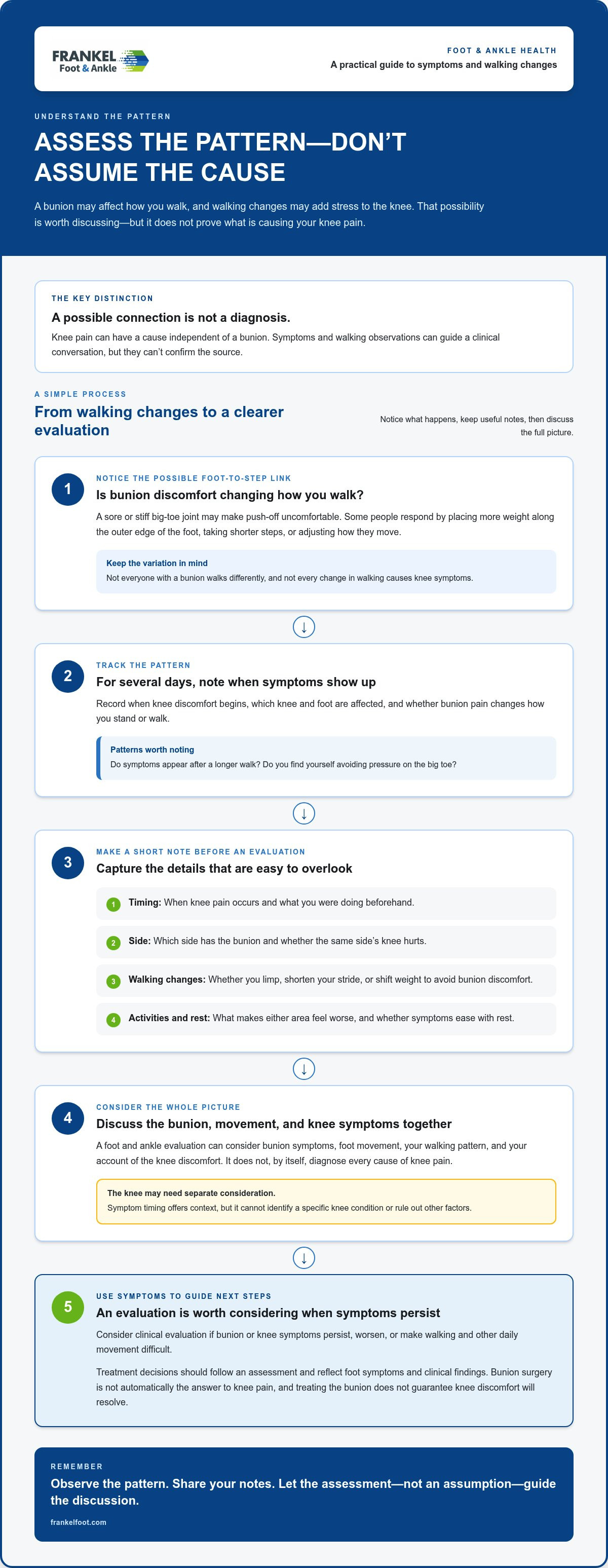
How to assess whether a bunion may be influencing your knee pain
If you're wondering, “can bunions cause knee pain,” start by tracking patterns rather than assuming the foot is the source. For several days, note when knee discomfort begins, which knee and foot are affected, and whether bunion pain changes how you stand or walk. For example, do symptoms appear after a longer walk, or do you notice yourself avoiding pressure on the big toe? These observations can guide a clinical conversation, but they can’t confirm a cause.
Knee pain may have its own explanation, separate from the bunion. The timing of symptoms offers useful context, but it doesn’t rule out other factors or identify a specific knee condition. An assessment of your bunion can consider its symptoms alongside foot movement, walking pattern, and your account of the knee discomfort, rather than treating a connection as a foregone conclusion.
What details are useful to share during an evaluation?
Before your appointment, jot down details that can be easy to overlook in the moment:
- When the knee pain occurs and what you were doing beforehand.
- Which side has the bunion and whether the same side’s knee hurts.
- Whether you limp, shorten your stride, or shift your weight to avoid bunion discomfort.
- Which activities make either area feel worse, and whether symptoms ease with rest.
A foot and ankle evaluation can assess bunion symptoms and their possible effect on movement; it doesn’t, by itself, diagnose every cause of knee pain. If you’re also experiencing foot discomfort, the comprehensive foot pain relief approach can help you learn more about addressing foot symptoms. Bring your notes to the conversation so your foot concerns and knee symptoms can be considered together when discussing next steps.
Next steps when you have both a bunion and knee pain
Consider a clinical evaluation if bunion or knee symptoms persist, worsen, or make walking and other daily movement difficult. You don’t need to determine on your own whether the foot is causing the knee pain. An evaluation can help assess the bunion and its effect on foot movement, while knee and joint issues may benefit from dedicated musculoskeletal care from providers such as Dr. Horine Chiropractic.
Treatment decisions should follow an assessment. If bunion care is discussed, the decision should reflect your foot symptoms and clinical findings, not an assumption that correcting the bunion will resolve knee pain. Knee discomfort may have a separate cause and may continue even if the foot feels more comfortable.
What a patient-first bunion-care conversation can cover
A thoughtful discussion can include how the bunion feels, whether it affects your stride or weight-bearing, and which activities have become difficult. Dr. Marc Frankel can consider these concerns as part of a foot and ankle evaluation and discuss appropriate next steps. He is board-certified by the American Board of Foot and Ankle Surgery and a Fellow of the American College of Foot and Ankle Surgeons.
Bring your symptom notes and questions, including what you hope to improve and whether knee pain is limiting activity. The Frankel Foot & Ankle Center serves Pennsylvania, New York, and New Jersey, with offices in Milford, Pennsylvania, Middletown, New York, and Katonah, New York. An evaluation can clarify bunion-related concerns without promising that bunion treatment will address a separate knee problem.
For information about care for bunions and other foot concerns, explore foot and ankle care at The Frankel Foot & Ankle Center.
Take the Next Step Toward More Comfortable Movement
Questions like “can bunions cause knee pain” don’t have to lead you to choose which symptom matters more. Start by thinking about what you’d like to do more comfortably, whether that’s walking for exercise, standing through the workday, or getting around without changing your stride. Sharing that goal can guide a care conversation focused on your needs, not assumptions about what’s causing the pain.
At The Frankel Foot & Ankle Center, attentive, compassionate care starts with listening to your concerns. Dr. Marc Frankel brings specialized foot and ankle expertise to discussions about your symptoms and possible next steps. To discuss bunion symptoms and foot and ankle care, explore compassionate foot and ankle care. You can also Follow Our Social Media for updates from the center.
Frequently Asked Questions
Can bunions cause hip pain as well as knee pain?
A bunion may be associated with hip discomfort if changes in foot movement affect how the leg moves, but that isn’t inevitable. Hip pain can also have causes unrelated to the foot. Notice whether it appears during activities such as climbing stairs or getting up from a chair, and share those details during an evaluation rather than assuming the bunion is responsible.
Can a bunion cause knee pain if my foot does not hurt?
It’s possible, though painless foot symptoms make a direct link less obvious. A bunion may affect toe-joint movement or how the foot bears weight even when it isn’t sore. If you’re wondering, “can bunions cause knee pain” without foot pain, consider whether your big toe feels stiff or your push-off feels different. These clues can guide an assessment, but they can’t confirm the cause.
Will correcting a bunion make my knee pain go away?
Not necessarily. Bunion correction may be considered to address bunion-related symptoms, but it can’t guarantee that knee pain will resolve. If the knee discomfort has a separate cause, for example, it may continue after bunion treatment. A clinician can discuss the goals of bunion care and whether your knee symptoms need separate assessment before you make a treatment decision.
Can bunions cause arthritis in the knee?
A bunion isn’t established as a direct cause of knee arthritis. If it changes the way you walk, it may affect how forces travel through the leg, but that alone doesn’t show that it caused joint changes. Persistent knee stiffness, swelling, or pain deserves clinical attention. This applies whether you live in Middletown, New York, Katonah, New York, or Milford, Pennsylvania.


