


Should you push through Achilles pain to finish a run? If your thought is “achilles hurts when i run,” it’s understandable to wonder whether the soreness is minor or a reason to stop. Pain is a signal to adjust and assess, not to force your pace.
This article covers common reasons Achilles pain can develop during running and what to do when it starts. Training changes and other factors may contribute, and symptoms alone cannot identify the cause. A sudden pop or difficulty pushing off with your foot can indicate a serious injury and needs immediate medical attention. For persistent or concerning symptoms, a foot and ankle evaluation can help clarify what may be going on and guide next steps.
Key Takeaways
- If “achilles hurts when i run,” training changes, hills, footwear, or calf tightness may be relevant, but symptoms alone can’t confirm a cause.
- If pain starts mid-run, stop rather than push through, and pay attention to how your symptoms change.
- Training adjustments and recovery depend on your symptoms and individual circumstances; there isn’t one plan for every runner.
- A foot and ankle evaluation can consider your running history and examination findings to help guide next steps and a return to running.
Why Does My Achilles Hurt When I Run? Understand the Tendon and Common Triggers
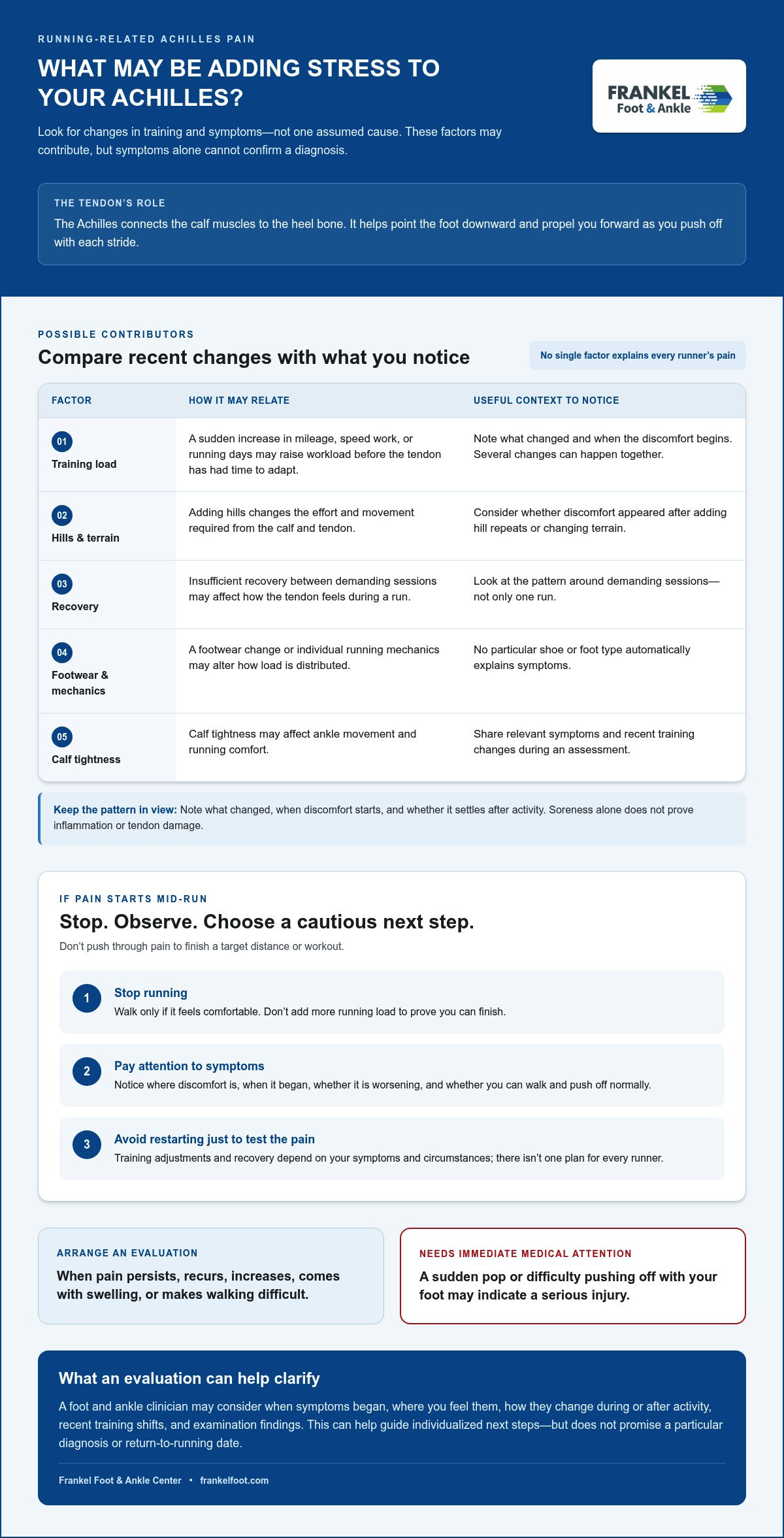
The Achilles tendon connects the calf muscles to the heel bone. It helps point your foot downward and propel you forward as you push off with each stride. If achilles hurts when i run, where and when you feel discomfort may offer clues, but those details can’t identify the cause on their own. The Achilles tendon works through a range of movements and forces, and several factors may affect how it feels during a run.
Running discomfort can develop when the tendon is exposed to a change in workload it hasn’t had time to adapt to. Possible contributors include:
- A sudden increase in mileage, speed work, or the number of running days
- Adding hills, which changes the effort and movement required from the calf and tendon
- Insufficient recovery between demanding sessions
- A footwear change or individual running mechanics that alter how load is distributed
- Calf tightness, which may affect ankle movement and running comfort
These are possibilities, not a diagnosis. Similar symptoms can have different explanations, and soreness alone doesn’t prove inflammation or tendon damage.
Which running patterns may place extra stress on the Achilles tendon?
Look at the pattern around your symptoms rather than blaming one run or pair of shoes. For example, discomfort that appears after you add hill repeats may coincide with a new training demand. Symptoms after increasing both pace and distance may have several possible contributors. Note what changed, when the discomfort begins, and whether it settles after activity. Sudden changes in mileage, speed, terrain, or recovery can affect tendon loading, but no single threshold predicts pain for every runner.
Footwear and personal mechanics may also play a role, though no particular shoe or foot type automatically explains symptoms. For runners looking to address broader joint alignment and lower-body strain, practices like Vitalité Chiropractic provide supportive musculoskeletal care and pain relief. Sharing recent training changes and the timing of your discomfort can give a foot and ankle clinician useful context for an assessment.
What to Do When Achilles Pain Starts During a Run
If your Achilles starts hurting mid-run, don’t try to prove you can finish. Stop and pay attention to the change rather than adding more running load to the area.
- Stop running. Walk only if it feels comfortable. Don’t push through pain to reach a target distance or finish a workout.
- Pay attention to the symptoms. Note where the discomfort is, when it began, whether it’s worsening, and whether you can walk and push off normally. These details may help guide an evaluation.
- Choose a cautious next step. Avoid restarting the run just to test the pain. Training changes and recovery depend on your symptoms and circumstances, so there isn’t one plan that fits every runner.
For general information about symptoms and causes, the Mayo Clinic’s overview of Achilles tendinitis can provide context, but it can’t determine what’s causing your pain. Reading about a condition also can’t establish that it’s safe for you to keep running.
When is it sensible to pause running and arrange an evaluation?
Arrange an evaluation if pain persists, recurs, increases, comes with swelling, or makes walking difficult. A sudden pop or inability to push off with your foot may signal a serious injury and needs immediate medical attention. If “achilles hurts when i run,” don’t use this article to diagnose a tendon condition or decide on your own that running is safe. The Frankel Foot & Ankle Center provides sports medicine solutions for foot and ankle injuries to help you understand appropriate next steps.
How a Foot and Ankle Evaluation Can Guide Your Return to Running
When running-related Achilles pain persists or keeps returning, an evaluation can help replace guesswork with a clearer understanding of what may be contributing. A clinician may ask when symptoms began, where you feel them, how they change during or after activity, and whether your training has recently shifted. Examination findings are considered alongside that history to help distinguish possible causes and shape appropriate next steps.
An evaluation can help you discuss your concerns and make decisions based on your symptoms and activity needs, but it doesn’t promise a particular diagnosis or return-to-running date. For broader context on discomfort around the ankle, explore this ankle pain relief guide. The American Academy of Orthopaedic Surgeons also provides general information about Achilles Tendinitis.
What can a clinician help clarify about running-related Achilles pain?
A foot and ankle clinician can consider how symptoms relate to running, changes in activity, and examination findings, then discuss individualized options. Dr. Marc Frankel is board-certified by the American Board of Foot and Ankle Surgery and a Fellow of the American College of Foot and Ankle Surgeons. The Frankel Foot & Ankle Center provides sports medicine solutions for foot and ankle injuries, with care focused on your concerns and goals.
If Achilles pain is affecting your training, explore foot and ankle care at the Milford, PA; Middletown, NY; or Katonah, NY office. An assessment can help you consider next steps without assuming every runner has the same symptoms or recovery needs.
Move Forward With a Clearer Plan
When achilles hurts when i run, uncertainty can make every training decision feel like a risk. You don’t have to settle on a diagnosis or decide alone whether to return to your usual routine. A thoughtful next step can help you make choices that respect your symptoms and keep your longer-term running goals in view. Progress doesn’t need to follow a fixed calendar; it should take your individual needs into account.
At Frankel Foot & Ankle Center, Dr. Marc Frankel is board-certified by the American Board of Foot and Ankle Surgery and a Fellow of the American College of Foot and Ankle Surgeons. If Achilles symptoms are affecting your running, explore compassionate foot and ankle care in Milford, PA, Middletown, NY, or Katonah, NY.
Frequently Asked Questions
Is it okay to keep running if my Achilles hurts?
Usually, no. If discomfort begins or grows as you run, continuing to finish the workout can make it harder to judge how the area is responding. End the session rather than testing it with faster strides or hills. If walking feels uncomfortable afterward, avoid another run until you have individualized guidance about how to resume activity.
Can tight calves cause Achilles pain when running?
Yes, calf tightness may affect ankle movement and how force is shared through the calf and Achilles during a stride. It’s one possible contributor, not proof of the cause. Notice whether tightness is new, occurs on one or both sides, or coincides with changes in your running. Share that context during an assessment rather than assuming stretching alone will resolve the pain.
When should I see a doctor for Achilles pain from running?
Arrange an evaluation if pain keeps returning, intensifies, affects everyday activities, or doesn’t settle after you modify aggravating exercise. A sudden pop or inability to push off needs immediate medical attention. For runners in Middletown, Katonah, and Milford, local foot and ankle care can help clarify concerning symptoms and guide decisions around activity.
Does Achilles pain while running always mean tendinitis?
No. “Tendinitis” is not a diagnosis you can confirm from pain alone, and discomfort doesn’t automatically establish inflammation or tendon damage. Nearby tissues or other foot and ankle conditions may cause overlapping symptoms. If “achilles hurts when i run,” use that as a reason to pay attention, not as a label; a clinician can assess the full picture.


