


If your ankle keeps giving way, the problem may involve balance, muscle control, ligament support, or a combination of factors. After repeated sprains, unpredictable instability can make everyday activities and a return to sports feel uncertain. Chronic ankle instability treatment starts with understanding why the ankle feels unreliable: functional instability and mechanical looseness may call for different approaches. Exercise may help, but it can be hard to know whether a home routine is enough or whether you need a specialist evaluation.
This guide explains how recurring instability is assessed, what non-surgical care commonly involves, and when persistent symptoms may warrant reassessment. At The Frankel Foot & Ankle Center, Dr. Marc Frankel, board-certified by the American Board of Foot and Ankle Surgery and a Fellow of the American College of Foot and Ankle Surgeons, provides ankle pain care and sports medicine solutions for foot and ankle injuries. The Center serves patients at its Milford, Pennsylvania; Middletown, New York; and Katonah, New York offices.
Key Takeaways
- Recurring ankle giving-way after a sprain can have different causes, including functional control deficits or mechanical ligament instability.
- Chronic ankle instability treatment is individualized. Rehabilitation commonly aims to build strength, balance, coordination, and confidence during movement.
- Repeated sprains, ongoing instability, or difficulty with daily activities or sports are reasons to seek a clinical assessment.
- A specialist evaluation can help clarify what may be contributing to instability and guide appropriate next steps for your ankle health.
What Chronic Ankle Instability Means, and Why Your Ankle Keeps Giving Way
A sprain may seem to heal, yet the ankle can still feel unreliable later. Repeated giving-way can be frustrating, especially on stairs, uneven ground, or during sports. Chronic ankle instability describes persistent or recurring feelings of instability after an ankle injury, often alongside repeat sprains. It may follow damage to the ligaments that support the ankle, but the cause of an unsteady feeling can vary.
An ankle sprain occurs when supporting ligaments are stretched or torn. The general overview of Ankle Sprain describes how these injuries affect the ligaments around the joint. If symptoms return after the initial injury, a clinical assessment can help determine whether instability may relate to ligament structure, movement control, or both. Symptoms alone cannot confirm the cause or establish a diagnosis.
How to recognize recurring ankle instability
Notice when the ankle feels unreliable rather than trying to test it yourself. Recurring instability may show up as:
- Repeated sprains or episodes when the ankle rolls unexpectedly.
- Apprehension during turns, on uneven surfaces, or when changing direction.
- A sensation that the ankle may give way, even without a new injury.
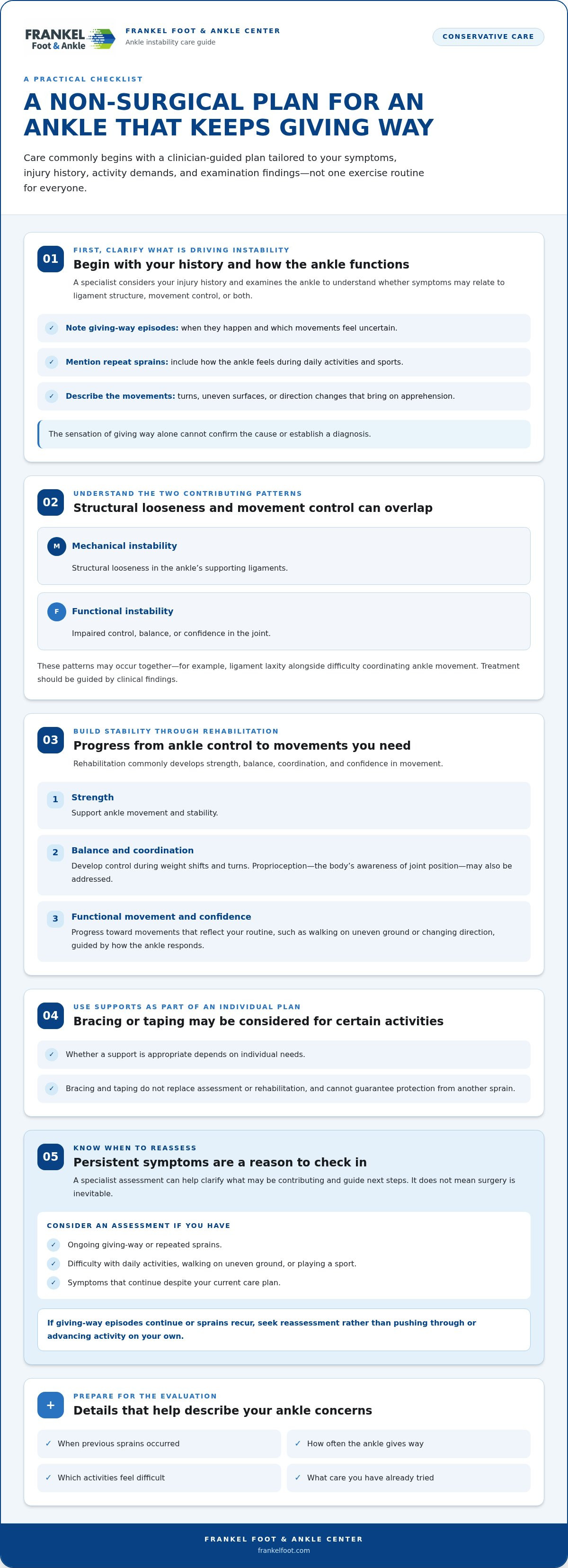
Mechanical instability involves structural looseness in the ankle’s supporting ligaments; functional instability involves impaired control, balance, or confidence in the joint. These forms can overlap. For example, ligament laxity may occur alongside difficulty coordinating ankle movement. A specialist considers your injury history and examines the ankle to understand what may be contributing. That distinction matters because chronic ankle instability treatment should be guided by clinical findings, not by the sensation of giving way alone.
Chronic Ankle Instability Treatment: A Practical, Non-Surgical Starting Point
Care usually starts with a clinician-guided plan, not the same set of exercises for everyone. Chronic ankle instability treatment commonly begins with non-surgical care tailored to your injury history, symptoms, activity demands, and clinical findings. For individuals looking to support tissue recovery and overall physical resilience alongside joint rehabilitation, practices like Westridge Holistic medicine emphasize root-cause healing and whole-body care. The aim is to address what may be limiting stability and build control for the movements you need in daily life or sports.
A clinician can ask when the ankle gives way, whether sprains have recurred, and which movements feel uncertain, then assess how the ankle functions. Rehabilitation often develops strength alongside balance and proprioception, the body’s awareness of joint position. The Ohio State University on Ankle Instability also highlights rehabilitation’s role in addressing factors that can contribute to ongoing symptoms.
What a step-by-step conservative plan may address
Instead of simply increasing activity, treatment goals can progress from basic ankle control to movements that reflect your routine, such as walking on uneven ground or changing direction. A plan may address:
- Strength to support ankle movement and stability.
- Balance and coordination to improve control during weight shifts and turns.
- Confidence with functional movement, guided by how the ankle responds.
Bracing or taping may also be considered for certain activities, based on individual needs. These supports do not replace assessment or rehabilitation, and they cannot guarantee protection from another sprain. If giving-way episodes continue or sprains recur, seek reassessment rather than pushing through or advancing activity on your own. For a personalized discussion of ankle symptoms and care, explore The Frankel Foot & Ankle Center’s ankle pain care.
When to Seek Specialist Care for Chronic Ankle Instability
You do not have to wait for another serious sprain before seeking an assessment. Ongoing giving-way, repeated sprains, or difficulty with activities you value, from walking on uneven ground to playing a sport, are good reasons to discuss your ankle with a specialist. An evaluation can help clarify what may be contributing and identify next steps. It does not mean surgery is inevitable.
The right path for chronic ankle instability treatment depends on your symptoms and examination findings. Many care plans begin with non-surgical measures. If symptoms persist, further assessment can help inform a discussion of other options. For broader background, see this ankle pain relief guide and ankle sprain treatment guide.
What to expect from an ankle instability evaluation
Before your visit, note when previous sprains occurred, how often the ankle gives way, which activities feel difficult, and what care you have already tried. These details help describe how the problem affects you. The clinician considers your history alongside an examination to guide appropriate next steps and discuss a plan suited to your needs.
At The Frankel Foot & Ankle Center, Dr. Marc Frankel is board-certified by the American Board of Foot and Ankle Surgery and a Fellow of the American College of Foot and Ankle Surgeons. The Center provides ankle pain care and sports medicine solutions for foot and ankle injuries. Patients in Milford, Pennsylvania; Middletown, New York; and Katonah, New York, can discuss recurring ankle concerns and care options at a local office. Learn more about the Center’s ankle pain care.
Take a Confident Step Toward Your Next Activity
Living with an ankle you do not fully trust can gradually narrow the activities you feel comfortable doing. Your next step does not have to be choosing a specific treatment. Think about what you want to return to, which movements make you hesitant, and what questions you would like answered. Sharing those details gives a specialist a clearer picture of your priorities and helps shape a thoughtful conversation about care.
For chronic ankle instability treatment, an individualized evaluation can help clarify appropriate next steps. Dr. Marc Frankel is board-certified by the American Board of Foot and Ankle Surgery and a Fellow of the American College of Foot and Ankle Surgeons.
Schedule an ankle evaluation with the patient-first team at The Frankel Foot & Ankle Center and take a supportive first step toward moving with greater confidence. The Center has offices in Milford, Pennsylvania; Middletown, New York; and Katonah, New York.
Frequently Asked Questions
Can chronic ankle instability improve without surgery?
Yes, non-surgical care is commonly the starting point, and improvement may be possible without an operation. A clinician may recommend rehabilitation focused on ankle strength, balance, and position awareness, with activity adjustments or external support when appropriate. The right chronic ankle instability treatment depends on assessment findings. If instability continues despite a guided plan, a specialist can reassess the cause and discuss other options.
How is chronic ankle instability diagnosed?
Diagnosis usually draws on your injury and symptom history, a physical examination, and imaging when needed. A clinician may ask how the ankle feels during turning or walking, then assess its movement and ligament stability. Imaging can help evaluate supporting structures or other injury. No single symptom or home maneuver can confirm the diagnosis, so share the full pattern of episodes and previous injuries.
What exercises help chronic ankle instability?
Rehabilitation may include progressive strengthening, balance practice, and proprioceptive exercises that train the body to sense and control ankle position. Specific activities should reflect your examination findings and current ability. A clinician or physical therapist can guide progression from controlled movements toward tasks such as turning or sport-related motions, an approach often emphasized by sports injury and rehabilitation centers such as ABI Promedical. Avoid copying a generic routine if it causes pain or the ankle keeps giving way.
When should I see a specialist for an ankle that keeps giving way?
Arrange an assessment if the ankle repeatedly gives way, you sustain another sprain, or instability limits walking, work, or recreation. Bring a brief record of when episodes happen and which activities you have stopped or changed. Patients in Milford, Pennsylvania; Middletown, New York; and Katonah, New York, can seek ankle care through The Frankel Foot & Ankle Center and discuss individualized next steps.


