


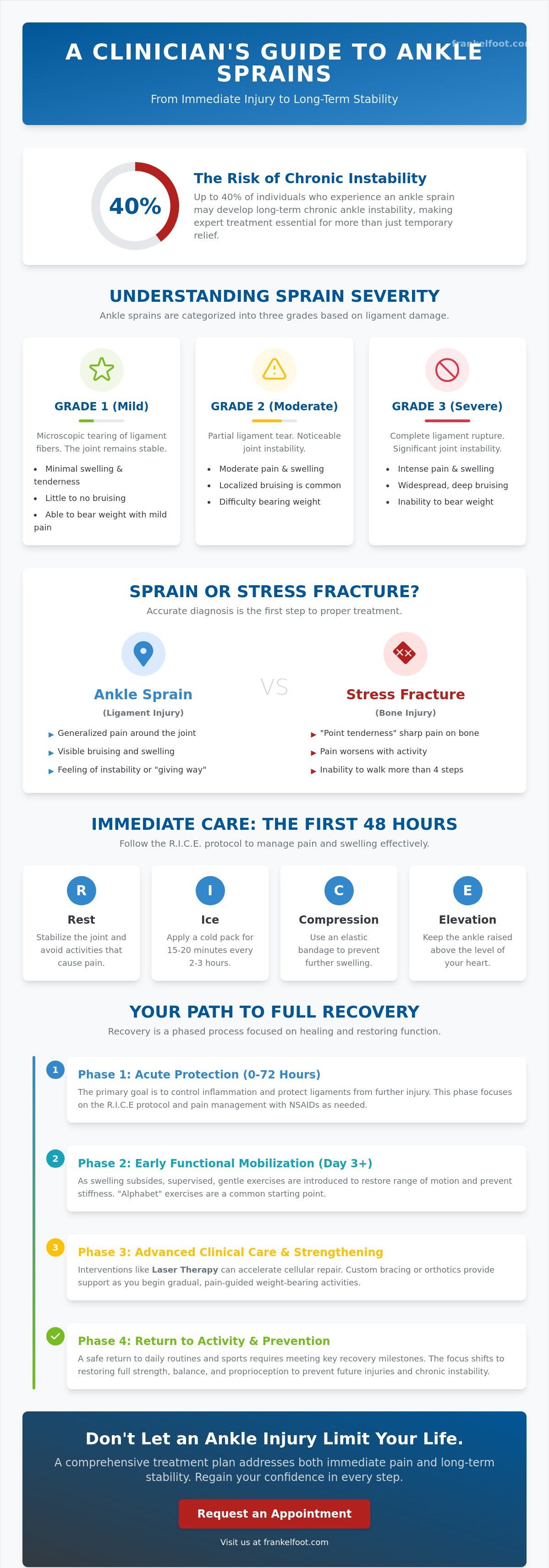
Did you know that up to 40% of individuals who experience an ankle sprain may develop chronic ankle instability? This statistic highlights why a specialized approach to ankle sprain treatment is essential for more than just temporary relief. We recognize the frustration of managing intense swelling and the difficulty of walking after a sudden injury. It's common to feel a sense of uncertainty about your long-term mobility and the fear that your ankle might remain vulnerable.
Our goal is to provide a clear, supportive path toward recovery that addresses both your immediate pain and your future stability. You'll learn the most effective strategies for healing, from the critical first 48 hours of first aid to the advanced clinical care required for professional-grade restoration. We'll explore how to reduce swelling, assess the severity of your injury, and follow a methodical plan that ensures a safe return to your daily routine.
Key Takeaways
- Learn how to distinguish between minor ligament stretches and significant tears by identifying specific clinical symptoms like localized bruising and intense swelling.
- Master the implementation of the R.I.C.E. protocol to effectively manage edema and facilitate a smoother transition to the early mobilization phase.
- Discover why a comprehensive ankle sprain treatment plan must address both immediate pain relief and long-term functional stability to prevent recurrent injuries.
- Understand the critical recovery milestones required for a safe return to daily activities and competitive sports based on the grade of your injury.
- Gain insights into the hidden complexities of severe sprains, including potential nerve damage that may impact your balance and coordination if left unaddressed.
Identifying Ankle Sprain Severity and Symptoms
An ankle sprain occurs when the tough bands of tissue that support your bones, known as ligaments, are stretched or torn beyond their anatomical limits. Understanding the Anatomy of an ankle sprain is the first step toward effective recovery. Most injuries involve an inversion motion, where the foot rolls inward and damages the outer ligaments. Less common is an eversion injury, which happens when the foot rolls outward, potentially affecting the complex medial ligaments. Recognizing these mechanics helps us tailor your ankle sprain treatment to the specific structures involved.
Immediate symptoms typically include localized pain, visible bruising, and significantly swollen ankles. While some discomfort is expected, early diagnosis is vital to prevent permanent ligament laxity or chronic instability. If a sprain isn't managed correctly from the onset, the ligaments may heal in a lengthened position, leaving the joint vulnerable to future injury. We prioritize a thorough evaluation to ensure your recovery plan matches the biological needs of the damaged tissue.
The Three Grades of Ankle Sprains
Clinicians categorize these injuries into three distinct levels to guide the intensity of care. A Grade 1 sprain involves microscopic tearing with minimal swelling, where the joint remains stable. Grade 2 signifies a partial tear, often resulting in moderate pain and noticeable difficulty bearing weight. The most severe, Grade 3, involves a complete ligament rupture. This stage is frequently characterized by total joint instability and intense bruising, requiring a more aggressive approach to clinical rehabilitation.
Is It a Sprain or a Stress Fracture?
Distinguishing between soft tissue damage and a bone injury is a critical part of the diagnostic process. While a sprain causes generalized pain around the ligaments, a stress fracture in foot bones often presents as "point tenderness," where the pain is sharpest directly on the bone. If you cannot walk more than four steps or if the pain is localized to the bony prominences, we utilize diagnostic imaging to confirm the diagnosis. An X-ray is typically the first line of defense to rule out fractures, while an MRI provides a detailed view of ligament integrity and potential bone bruising that an X-ray might miss.
Effective Treatment Strategies for Ankle Pain Relief
The initial response to an injury sets the tone for your entire recovery journey. During the first 48 hours, the R.I.C.E. protocol (Rest, Ice, Compression, and Elevation) remains the gold standard for immediate care. This method is specifically designed to stabilize the joint and manage the physiological response to trauma. Effectively controlling swollen ankles is a vital first step, as excessive edema can limit your range of motion and prolong the healing process. For a detailed clinical overview of these foundational steps, you can explore various Ankle Sprain Treatment Options provided by medical researchers.
Pharmacological support, such as non-steroidal anti-inflammatory drugs (NSAIDs), can be a useful tool for managing acute inflammation and pain. However, these should be viewed as a temporary bridge toward functional recovery rather than a standalone solution. As the initial swelling subsides, the focus of your ankle sprain treatment must shift from total immobilization to controlled movement to prevent joint stiffness and muscle atrophy. We monitor this transition closely to ensure the ligaments are ready for increased demand.
Advanced Clinical Interventions
Modern podiatric care offers sophisticated tools that go beyond basic home care. Laser therapy is an excellent non-invasive option that uses specific wavelengths of light to stimulate cellular repair and accelerate the reduction of deep-tissue swelling. For patients requiring additional stability during the vulnerable healing phase, custom bracing or orthotics can provide necessary structural support without completely restricting movement. If you're struggling with persistent discomfort, seeking professional ankle pain relief through these advanced modalities can help restore your confidence in every step.
The Importance of Early Functional Mobilization
While rest is necessary, prolonged inactivity can lead to secondary issues like ligament weakness and reduced balance. Verified clinical trends suggest that supervised exercise therapy should ideally begin within 48 to 72 hours of the injury. We often recommend gentle "alphabet" exercises, where you use your big toe to trace letters in the air, to restore proprioception and range of motion without overstressing the tissue. Transitioning to weight-bearing activities should be a gradual, pain-guided process, often supported by a semi-rigid or lace-up brace for four to six weeks to ensure long-term joint integrity.
Recovery Timeline and Preventing Chronic Instability
Recovery is a structured journey through specific Phases of Ankle Sprain Rehab. For mild sprains, you can typically expect a return to sedentary work within two weeks, with a full return to sports by week four. Moderate to severe injuries require a more patient approach, often taking six to eight weeks for a complete return to athletic participation. This timeline is vital for ensuring ligaments have regained the tensile strength necessary to support your body weight during dynamic movements.
Beyond the visible ligament damage, severe sprains often involve "invisible" injuries such as nerve stretching or compression. These neurological issues can impair your balance and lead to a persistent "giving way" sensation if not addressed. Failing to manage these components increases the risk of developing chronic ankle pain or permanent joint laxity. Dr. Marc Frankel utilizes a comprehensive recovery model that prioritizes both structural stability and neurological restoration, helping patients achieve a stable, scarless recovery.
Strengthening and Balance Training
Rebuilding the peroneal muscles on the outside of the ankle is a cornerstone of professional ankle sprain treatment. We utilize balance board training to restore your proprioception, which is the body's natural "position sense" that tells your brain where your foot is in relation to the ground. This neuro-muscular retraining is essential for preventing future rolls. Once your stability is restored, we guide your transition back to high-impact activities like running or jumping to ensure your ankle can handle the load safely.
When to Visit Frankel Foot & Ankle Center
While many injuries respond well to early intervention, certain red flags shouldn't be ignored. If you experience persistent swelling after two weeks or a recurring feeling of instability, it's time for a specialized evaluation. We offer advanced clinical care and personalized recovery plans at our locations in Middletown, Katonah, and Milford. You can schedule a consultation at Frankel Foot & Ankle Center to receive a definitive diagnosis and a clear path back to the activities you love.
Secure Your Path to Full Mobility
Your journey from an acute injury to full athletic participation requires a methodical approach that prioritizes both structural healing and long-term joint stability. By accurately identifying the severity of your injury and transitioning from immediate protection to functional mobilization, you can significantly reduce the risk of recurring issues. Effective ankle sprain treatment isn't just about managing the initial swelling; it's about restoring the complex connection between your muscles and your nervous system to ensure your joint remains resilient under pressure.
Dr. Marc Frankel provides specialized, expert care designed to deliver advanced ankle pain relief through progressive medical methodologies. With three convenient locations serving New York and Pennsylvania, our team is dedicated to guiding you through every phase of your recovery with precision and genuine compassion. We focus on achieving lasting results so you can return to your daily activities with absolute confidence in your physical capabilities.
Schedule your ankle evaluation at Frankel Foot & Ankle Center today to ensure your recovery is handled with the highest level of clinical expertise. We're here to support your return to a pain-free, active lifestyle.
Frequently Asked Questions
How long does it take for a sprained ankle to stop swelling?
Initial intense swelling typically begins to subside within 48 to 72 hours when the R.I.C.E. protocol is followed diligently. However, residual edema can linger for several weeks depending on the severity of the ligament damage. While a Grade 1 injury might look normal within a week, Grade 3 ruptures often involve persistent swelling that fluctuates as you increase your daily activity levels and weight-bearing exercises.
Can I walk on a sprained ankle if it doesn't hurt too much?
You can generally walk on the ankle if you can do so without a limp or significant pain, provided you use a semi-rigid brace for structural support. Early mobilization is often beneficial for mild injuries to maintain joint flexibility and prevent muscle atrophy. If you experience sharp pain or a sensation that the ankle is "giving way," you should stop immediately to avoid causing further damage to the vulnerable ligaments.
Should I wrap my sprained ankle with an ACE bandage overnight?
It's usually best to avoid wearing tight compression wraps while you sleep because your circulation naturally slows down during rest. Restricting blood flow overnight can lead to numbness or increased discomfort without providing the active benefits seen during the day. Instead, focus on keeping your ankle elevated above the level of your heart while sleeping to encourage fluid drainage and naturally reduce morning stiffness.
What is the fastest way to heal a sprained ankle for sports?
The most efficient path to recovery involves combining early functional mobilization with advanced ankle sprain treatment options like laser therapy to accelerate cellular repair. Starting supervised physical therapy within 72 hours of the injury helps restore your balance and strength much faster than rest alone. This proactive approach ensures your ligaments regain the necessary tensile strength to handle the high-impact demands of running, jumping, and pivoting.
How can I tell if my ankle pain is a sprain or a broken bone?
A fracture typically presents with "point tenderness" directly on the bone and an inability to bear weight for more than four steps, whereas a sprain causes pain in the soft tissues. You might also notice a visible deformity or hear a distinct "crack" at the time of injury. Because the symptoms of a severe sprain and a stress fracture overlap, we utilize diagnostic imaging to ensure you receive the correct clinical care.
When is surgery necessary for a sprained ankle?
Surgical intervention is typically reserved for patients who experience chronic instability or those with complete Grade 3 ruptures that don't respond to conservative therapy. If your ankle remains unstable or continues to "roll" during normal activities despite months of dedicated strengthening, a ligament repair may be necessary. Most individuals, however, achieve a full and stable recovery through a well-structured, non-surgical rehabilitation program that prioritizes proprioceptive training and muscle rebuilding.


