


A 2026 study of runners revealed that 26.5 percent of participants suffered from a bone stress injury, yet many people still struggle to distinguish between simple soreness and a true stress fracture in foot. You've likely experienced that nagging, persistent pain that refuses to subside even after a full night of rest. It's a confusing and often frightening position to be in, especially when you're unsure if pushing through the discomfort will lead to a long-term loss of mobility. We recognize the frustration of being sidelined from the activities you love by an injury that isn't always visible to the naked eye.
We believe that every patient deserves a clear, methodical approach to their recovery journey. By using our expert-led clinical checklist, you'll learn how to identify the signs of biological bone remodeling failure and understand the necessary steps for proper management based on the latest 2026 medical guidelines. This article provides a comprehensive overview, from recognizing subtle symptoms to establishing a structured six to eight week recovery timeline. We'll provide the clarity you need to decide when it's time to seek specialized foot pain relief at our Middletown or Katonah locations.
Key Takeaways
- Identify the distinct "Crescendo Pain" pattern to determine if your discomfort is a result of repetitive submaximal loading rather than simple muscle fatigue.
- Perform a professional self-assessment using our 5-point checklist to evaluate specific indicators like point tenderness and persistent night pain.
- Gain insight into the clinical diagnostic process, including how digital imaging is used to confirm a stress fracture in foot with precision.
- Establish a realistic recovery framework that outlines the transition from rest to activity over a structured six to twelve week period.
- Learn when to transition from home management to professional care to ensure lasting foot pain relief and prevent a complete bone failure.
Recognizing the Early Warning Signs of a Foot Stress Fracture
A stress fracture is not a sudden event like a break from a traumatic fall; rather, it's a biological failure where the bone cannot keep up with repetitive submaximal loading. When you subject your feet to consistent stress without providing adequate recovery time, the bone remodeling process falls behind, resulting in a microscopic hairline crack. This condition, often referred to as a stress fracture in foot, represents a critical stage of overuse that requires immediate clinical attention to prevent a complete structural failure of the bone.
One of the most telling indicators is the "Crescendo Pain" pattern. Unlike typical muscle soreness that often dissipates as you warm up, stress injury pain typically begins shortly after you start an exercise session and intensifies as you continue the activity. It usually subsides during periods of rest but returns with predictable precision once weight-bearing resumes. While a standard bone bruise involves generalized discomfort, a true fracture is characterized by intense, localized tenderness. You can often identify the exact site of the injury by applying pressure with one finger to a specific point, most commonly on the second or third metatarsals or the calcaneus (heel bone).
The Difference Between Acute Fractures and Stress Injuries
An acute fracture usually announces itself with a sudden, audible "pop" followed by immediate swelling and bruising. In contrast, a stress injury develops with a deceptive, gradual onset that can be easy to dismiss during its early stages. It's vital to understand that a stress fracture in foot often remains invisible on standard digital X-rays for the first two to three weeks. During this latency period, the bone is actively trying to heal, but the new bone formation hasn't yet reached a density detectable by traditional imaging methods.
Why "Pushing Through" is a Dangerous Strategy
Ignoring these early warning signs can escalate a minor stress reaction into a complete, displaced fracture that may require surgical intervention. Beyond the immediate risk to the bone itself, your body will naturally alter its gait to avoid the painful area. This compensatory movement shifts the physical load to other joints, frequently creating a secondary need for ankle pain relief as the surrounding tendons and ligaments become overstressed. Addressing the injury early ensures a faster return to activity and protects the overall mechanical integrity of your lower extremities.
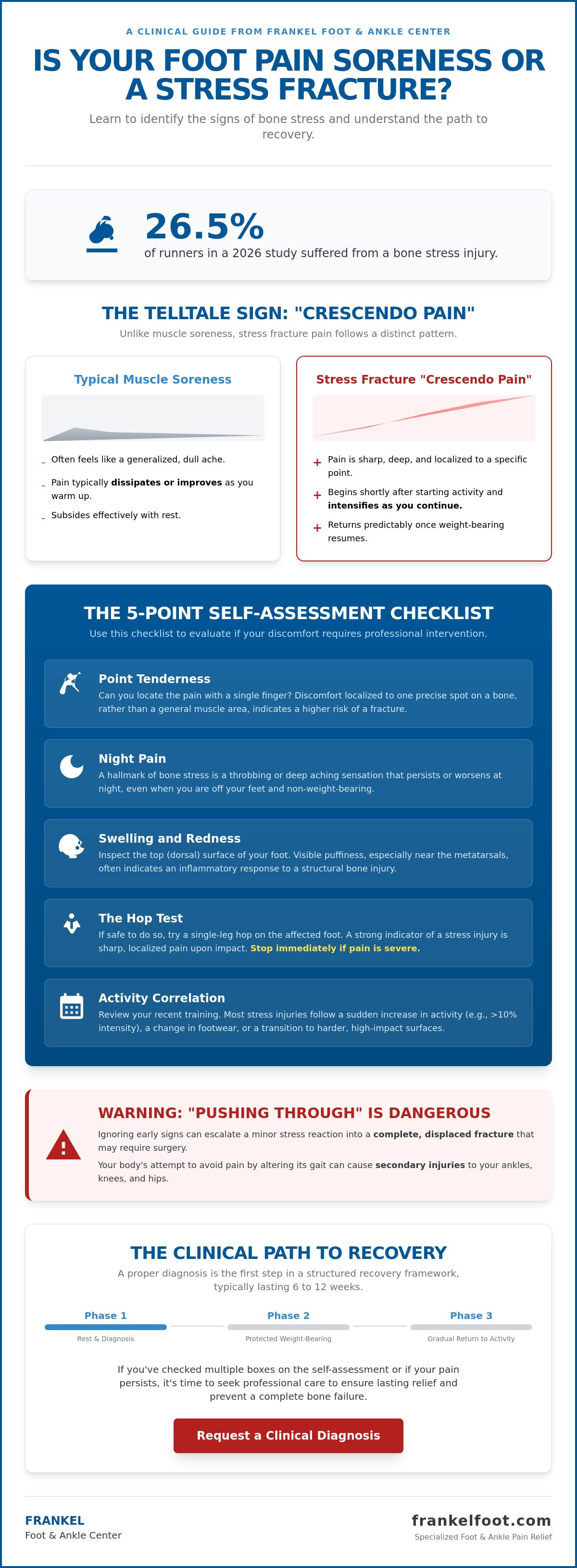
The 5-Point Stress Fracture Self-Assessment Checklist
While only a clinical examination can provide a definitive diagnosis, you can use several diagnostic markers to evaluate the likelihood of a stress fracture in foot. This systematic approach helps you differentiate between minor soft tissue strain and potential bone failure. Use the following checklist to assess your symptoms and determine if your discomfort requires professional intervention.
- Point Tenderness: Attempt to locate the specific source of pain with a single finger. If the discomfort is localized to one precise spot on a bone rather than a general area of muscle, the risk of a structural fracture is significantly higher.
- Night Pain: Monitor your symptoms while at rest. A hallmark of bone stress is a throbbing or aching sensation that persists even when you are non-weight-bearing in bed.
- Swelling and Redness: Inspect the dorsal surface of your foot. Puffiness near the metatarsals or around the ankle bone often indicates an inflammatory response to a structural injury.
- The Hop Test: If you can safely do so, try a single-leg hop on the affected foot. Sharp, localized pain upon impact is a strong indicator of a stress injury. Stop immediately if the pain is severe.
- Activity Correlation: Review your recent training history. Most stress injuries follow a 10 percent or greater increase in intensity, a change in footwear, or a transition to high-impact surfaces.
Identifying High-Risk Zones in the Foot
Not all bone injuries heal with equal ease. According to the American Academy of Orthopaedic Surgeons' guide on Stress Fractures of the Foot and Ankle, certain areas are classified as high-risk zones. Fractures in the navicular bone or the base of the fifth metatarsal, known as a Jones fracture, require urgent care. These regions have a notoriously poor blood supply. Without specialized intervention, these fractures are prone to non-union, where the bone fails to knit back together naturally.
When to Move from Home Care to a Specialist
You can initially manage suspected overuse injuries with a 48-hour trial of RICE: rest, ice, compression, and elevation. However, if your pain persists after 72 hours of total rest, a formal evaluation is necessary. Delaying a professional diagnosis can lead to long-term mobility issues or a complete break. If you're concerned about persistent discomfort, our team at Frankel Foot & Ankle Center can help you determine the safest path forward for lasting foot pain relief.
Clinical Pathways to Recovery: From Diagnosis to Prevention
Professional intervention is the cornerstone of a successful recovery once your self-assessment suggests a potential injury. At Frankel Foot & Ankle Center, we utilize advanced diagnostic tools, including high-resolution digital X-rays and specialized physical examinations, to confirm the precise location and severity of the bone stress. You can learn more about stress fracture diagnosis and treatment to understand how clinical findings dictate a personalized management plan. Most patients can expect a recovery timeline ranging from 6 to 12 weeks for a stress fracture in foot, depending on the specific bone's biological healing rate and its history of weight-bearing stress.
We advocate for "Relative Rest" rather than total inactivity to keep you moving safely. This approach allows you to maintain cardiovascular fitness through low-impact activities like swimming or cycling, which don't compromise the healing bone. We also evaluate several underlying factors to ensure your recovery is both thorough and permanent:
- Vitamin D and calcium levels to support bone density and long-term structural integrity.
- Biomechanical irregularities that may cause uneven weight distribution across the metatarsals.
- Footwear choices that lack proper shock absorption for your specific foot type and activity level.
Advanced Treatment Options in Middletown and Katonah
Our clinical team specializes in redistributing mechanical pressure through custom-molded orthotics. These precision-engineered devices protect the vulnerable site while you regain mobility. Our expertise in scarless bunion surgery techniques reflects our broader commitment to minimally invasive, patient-centered care. If you live in Milford, PA, or Middletown, NY, we invite you to schedule a consultation at Frankel Foot & Ankle Center for a personalized recovery roadmap.
Prevention: Building a Resilient Foot
The 10% Rule states that you should never increase your weekly exercise volume or intensity by more than 10 percent to avoid repetitive loading injuries. Additionally, implementing a regular shoe rotation ensures that your footwear provides consistent shock absorption and structural support, preventing the bone fatigue that leads to a stress fracture in foot.
Securing Your Path to Long-Term Foot Health
Recognizing the early indicators of a stress fracture in foot is the first step toward reclaiming your active lifestyle. We've outlined how to distinguish between minor soreness and structural bone failure, the critical importance of identifying high-risk zones, and the methodical timeline required for biological healing. A precise clinical foundation ensures that you avoid the risks of persistent injury and instead move toward permanent relief and stability.
Led by Dr. Marc Frankel, a specialist in advanced podiatric surgery, our practice provides a balance of high-level expertise and patient-centered warmth. We offer sophisticated diagnostic tools and personalized treatment plans from our convenient locations in Middletown, Katonah, and Milford. Our team excels in both conservative management and advanced surgical relief, ensuring every patient receives a tailored approach to their unique recovery needs. You don't have to navigate the uncertainty of persistent pain alone.
Schedule your expert foot evaluation at Frankel Foot & Ankle Center today to begin your journey toward a pain-free future. We're dedicated to supporting you through every stage of your recovery so you can return to the activities you love with total confidence.
Frequently Asked Questions
Can I walk on a foot with a stress fracture?
Walking on a suspected stress fracture is generally discouraged during the acute phase because continued weight-bearing can prevent the bone from knitting back together. While some low-risk fractures allow for protected walking in a stiff-soled shoe or medical boot, high-risk areas require strict immobilization to avoid a full displaced break. Our clinical team evaluates the injury's stability to determine the exact level of weight-bearing that's safe for your specific recovery path.
How long does it take for a stress fracture in the foot to heal?
The typical recovery period for a stress fracture in foot spans between 6 and 12 weeks, depending on the bone's location and its natural blood supply. Bones like the metatarsals may heal closer to the six-week mark, while the navicular or fifth metatarsal often requires the full 12-week window to achieve structural integrity. We utilize follow-up clinical exams to ensure the bone has sufficiently remodeled before clearing you for a return to high-impact activities.
Will a stress fracture show up on an X-ray immediately?
Stress fractures are notoriously difficult to detect on digital X-rays during the first two to three weeks of symptoms. The initial hairline crack is often too microscopic to be visible until the body begins the remodeling process and forms a "callus" of new bone around the injury site. If your pain persists despite a negative X-ray, we may recommend more sensitive diagnostic imaging to confirm the injury and ensure you receive appropriate foot pain relief early.
What happens if a stress fracture is left untreated?
Ignoring a stress injury can cause the hairline crack to progress into a complete, displaced bone fracture that may require surgical intervention. This can lead to a "non-union," where the bone fails to heal properly, resulting in chronic pain and permanent mobility limitations. Additionally, as you subconsciously alter your gait to protect the injured area, you may develop secondary strain in the surrounding joints, eventually requiring professional ankle pain relief to address the new mechanical imbalances.


