


What if you could permanently correct your bunion without the long, painful recovery or the permanent, visible scars that traditional surgery often leaves behind? For many people, the decision to seek treatment feels like a difficult choice between living with chronic foot pain or sacrificing months of their life to a slow and restrictive healing process. It's natural to worry about whether you'll ever fit into your favorite shoes again or if your feet will ever look the same after a procedure.
You deserve a solution that respects both your health and your active lifestyle. In this guide, we'll explore the different types of bunion surgery available today, moving from traditional legacy methods to the latest progressive methodologies. You'll learn how modern scarless techniques are revolutionizing the patient experience by offering a return to regular footwear in as little as two to six weeks while prioritizing aesthetically pleasing results that restore your confidence and mobility.
Key Takeaways
- Understand why modern correction focuses on three-dimensional realignment of the metatarsal bone rather than simply shaving down a bony growth.
- Compare the extensive tissue disruption of traditional open procedures with the precision of "keyhole" incisions used in minimally invasive methods.
- Discover how the various types of bunion surgery influence your long-term success rates and the likelihood of the deformity recurring.
- Explore the "Scarless and Painless" protocol, which utilizes advanced suturing and strategic incision placement to ensure your feet look as good as they feel.
- Learn how progressive surgical techniques can reduce your recovery timeline, allowing for a return to regular footwear in weeks rather than months.
The Three Primary Categories of Bunion Correction Surgery
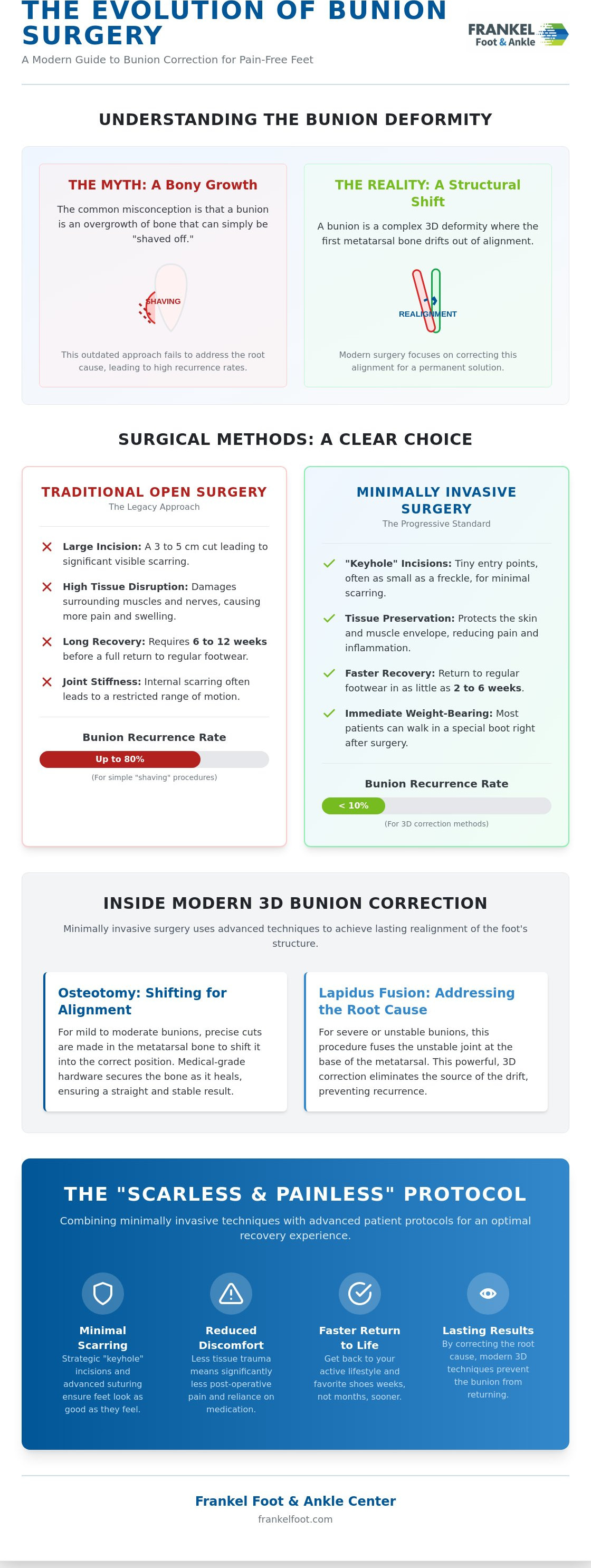
To understand the various types of bunion surgery, one must first recognize that a Bunion is not simply a growth of extra bone. Instead, it's a complex structural deformity where the first metatarsal bone shifts outward, causing the hallux to lean toward the smaller toes. While an exostectomy, which involves the simple removal of the bony prominence, was once a standard approach, modern podiatry recognizes that "shaving the bump" rarely addresses the underlying misalignment. Without correcting the bone's position at its source, the deformity almost always returns. Today, surgical intervention focuses on precise anatomical restoration and long-term stability.
Osteotomy: Shifting the Bone for Alignment
The osteotomy remains a highly effective procedure for mild to moderate cases. During this process, a surgeon makes precise cuts in the bone to shift it into a healthier, straighter position. We then utilize medical-grade pins, screws, or plates to secure the bone during the healing phase. The specific technique depends on the severity of the shift. A distal osteotomy involves a cut near the toe joint for minor corrections, while a proximal osteotomy addresses more significant deviations by cutting closer to the midfoot. This methodical approach ensures the correction matches your specific foot structure and physiological needs.
Lapidus Fusion: Addressing the Root Cause
For patients experiencing severe instability or those with a high risk of recurrence, the Lapidus procedure offers a permanent, three-dimensional correction. This technique addresses hypermobility at the foundation of the foot: the tarsometatarsal joint. By fusing this unstable joint, we eliminate the root cause of the bone's outward drift. This is particularly vital because research from 2026 indicates that 3D correction methods have a recurrence rate of less than 10 percent. In contrast, traditional methods like a simple exostectomy can see recurrence rates as high as 60 to 80 percent. By stabilizing the midfoot, we don't just fix the appearance; we restore the foot's functional integrity for years to come.
Traditional Open Surgery vs. Minimally Invasive Methods
Choosing between different types of bunion surgery involves more than just selecting a bone-realigning technique; it requires deciding on the surgical access method. Historically, Bunion surgery was performed through an "open" approach. This method involves a three to five centimeter incision, which provides the surgeon with a direct view but necessitates significant disruption of the surrounding soft tissues, tendons, and nerves. This extensive exposure is the primary cause of the long, difficult recovery periods often associated with podiatric surgery.
The Downside of Traditional Procedures
Traditional open surgery often results in a "surgical" appearance of the foot due to extensive scar tissue formation. This internal scarring can lead to persistent joint stiffness and a restricted range of motion, which can be frustrating for those hoping to return to athletic activities. Patients frequently encounter significant post-operative swelling and a heavy reliance on pain medication during the initial weeks. In 2026, clinical observations suggest that traditional open procedures still require six to twelve weeks for a full return to regular footwear, a timeline that many active individuals find difficult to accommodate.
The Rise of Keyhole Techniques
Minimally Invasive Surgery (MIS) represents a progressive shift toward patient comfort and aesthetic preservation. By utilizing specialized tools and real-time imaging, we can perform complex bone corrections through "keyhole" incisions often no larger than a freckle. This preservation of the skin and muscle envelope leads to significantly lower trauma and reduced post-operative discomfort. You can learn more about how we manage your comfort in our guide on Is Bunion Surgery Painful? The Modern Approach.
The difference in recovery is profound. While traditional methods might keep you in a heavy cast or on crutches, modern MIS techniques allow many patients to bear weight in a specialized boot almost immediately. The adoption of these minimally invasive techniques increased by 34% between 2025 and 2026, reflecting a growing demand for faster, more comfortable transitions back to daily life. If you're ready to explore these advanced options, you can consult with our specialists to determine the best path for your recovery.
The Gold Standard: Scarless and Painless Bunion Surgery
While understanding the mechanical differences between various types of bunion surgery is essential, the ultimate goal for most patients is a return to normalcy without the burden of visible evidence or lingering discomfort. At Frankel Foot & Ankle Center, we've refined our specialized "Scarless and Painless" protocol to meet this specific need. This approach represents a commitment to both aesthetic excellence and physiological comfort, ensuring that your recovery doesn't feel like a setback. By focusing on advanced podiatric plastics and nerve-sparing techniques, we provide a standard of care that prioritizes your long-term lifestyle goals.
We achieve "Scarless" results through meticulous planning and strategic incision placement. Rather than making large, central cuts, we utilize tiny, precise entries hidden within the natural contours of the foot. When combined with advanced suturing techniques, the result is a foot that looks as natural as it feels. To address the "Painless" promise, we employ long-acting local anesthetics and sophisticated nerve blocks. This proactive pain management strategy bypasses the intense post-operative discomfort often associated with older methods, allowing our patients in Middletown and Milford to return to their professional and personal lives with minimal interruption.
Prioritizing Foot Aesthetics
You shouldn't have to choose between a life without pain and the confidence to wear open-toed shoes. Traditional methods often prioritize bone movement at the expense of skin integrity, but modern podiatric plastics allow us to achieve both. By treating the skin with the same level of precision as the bone, we ensure your foot retains its natural beauty, a commitment to aesthetic excellence shared by leading specialists like Dr. Leonard Grossman. This focus on aesthetics is a primary reason why our patients choose progressive correction over legacy procedures that focus solely on mechanical alignment.
Your Journey at Frankel Foot & Ankle Center
Your path toward recovery begins with advanced 3D diagnostics at our Katonah or Middletown facilities. This technology allows Dr. Marc Frankel to create a customized surgical plan tailored to your unique anatomy. It's vital to choose a surgeon who specializes exclusively in the complexities of the foot and ankle to ensure every detail is addressed. You can learn more about our scarless bunion surgery and how our dedicated team supports you from the initial consultation through your rapid return to activity.
Reclaim Your Mobility and Confidence
The landscape of podiatric medicine has shifted significantly, moving away from aggressive traditional procedures toward refined, patient-centered solutions. You now have a choice among various types of bunion surgery, ranging from standard realignment to advanced 3D corrections that address the root cause of the deformity. By prioritizing minimally invasive techniques, you can avoid the extensive scarring and prolonged recovery periods that once defined foot surgery, opting instead for a path that preserves both function and aesthetics. In addition to physical health, supporting your emotional resilience during recovery is vital, and Benessere Marriage and Family Therapy, Inc offers the specialized counseling needed to navigate such life-changing transitions.
Choosing the right specialist is the most critical step in your recovery journey. With over 20 years of specialized surgical experience and board-certified expertise in reconstructive foot surgery, Dr. Marc Frankel is dedicated to providing the highest level of care. We invite you to visit our convenient locations in Middletown, Katonah, or Milford to experience a compassionate approach to healing. Please schedule your consultation with Dr. Frankel to discuss scarless bunion options and discover how a customized plan can return you to the activities you love. Your journey toward pain-free walking and beautiful feet starts with a single, informed decision.
Frequently Asked Questions
What is the most common type of bunion surgery performed today?
The most common procedure is an osteotomy, which involves a precise surgical cut to realign the metatarsal bone. Surgeons often utilize this approach among different types of bunion surgery because it addresses the structural shift rather than just the surface bump. This methodology is highly effective for mild to moderate deformities and uses medical-grade hardware to maintain the new alignment during the healing process.
Can bunions be removed without leaving a large scar?
Modern minimally invasive techniques allow for bunion correction through tiny keyhole incisions that are often no larger than a few millimeters. While the term scarless highlights the cosmetic benefits, these procedures involve minimal tissue disruption compared to traditional open surgery. We utilize strategic incision placement and advanced suturing to ensure that any remaining marks are nearly imperceptible, allowing you to wear open-toed shoes with confidence.
How long is the recovery for minimally invasive bunion surgery?
Recovery from minimally invasive surgery is significantly faster than traditional methods, with many patients returning to regular footwear within two to six weeks. In contrast, older techniques often required six to twelve weeks in a cast or heavy boot. Most patients can bear weight in a specialized surgical boot almost immediately, which helps maintain mobility and reduces the risk of joint stiffness during the initial healing phase.
Will I need to be put under general anesthesia for my bunion operation?
Most modern bunion operations are performed as outpatient procedures under local anesthesia with light sedation rather than full general anesthesia. This approach reduces the physiological stress on your body and allows for a quicker recovery from the sedative effects. By utilizing long-acting nerve blocks, we can ensure your foot remains comfortably numb for several hours after the procedure, which minimizes the need for heavy post-operative pain medication.


