


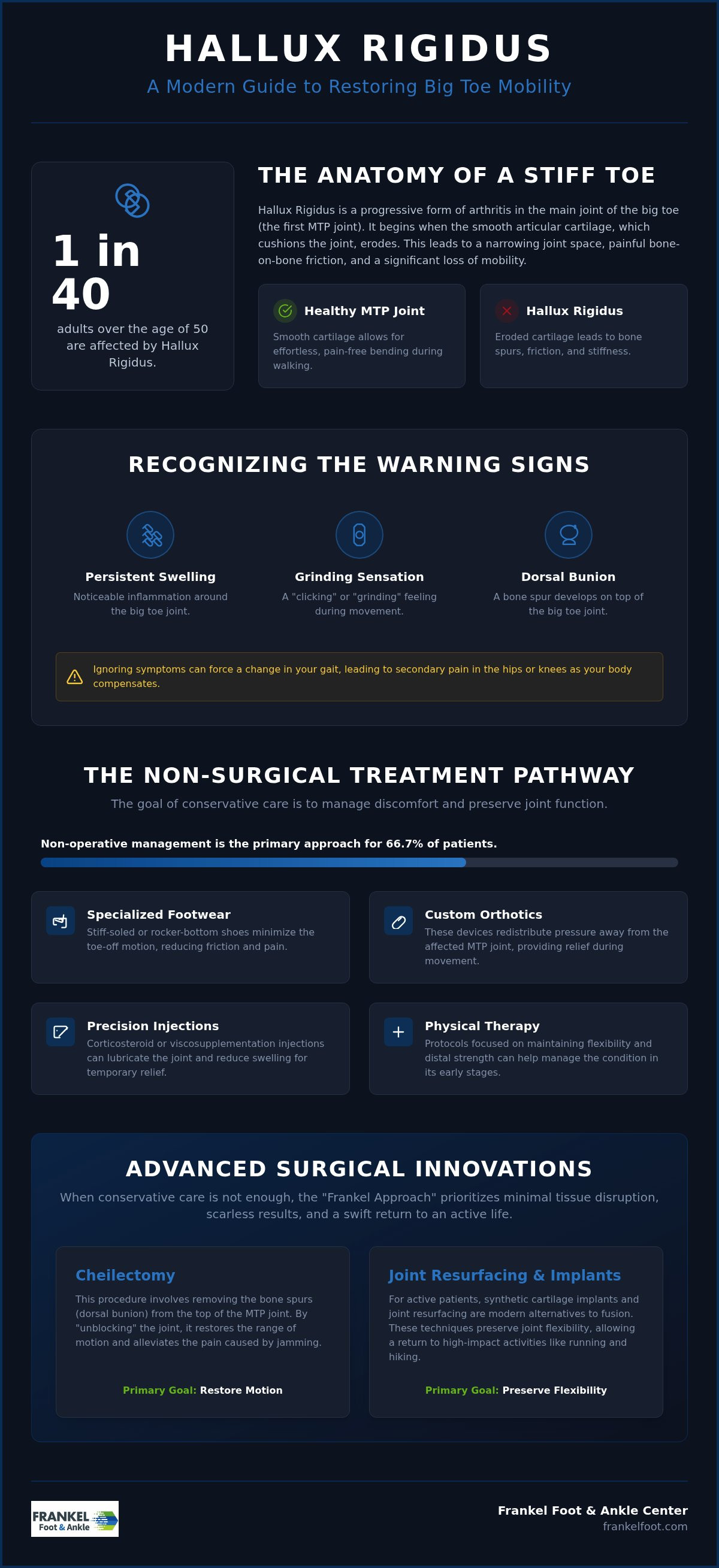
Did you know that hallux rigidus affects approximately 1 in 40 adults over the age of 50, often turning a simple morning walk into a source of significant distress? If you're seeking effective hallux rigidus treatment, you likely understand the frustration of a visible bone spur dictating your footwear or cutting your hiking trips short. You deserve a specialized solution that addresses this progressive stiffness while respecting your need for a swift and comfortable recovery.
By 2026, medical advancements have introduced sophisticated solutions that prioritize both your comfort and your long-term mobility. At Frankel Foot & Ankle Center, Dr. Marc Frankel provides a patient-centered approach that bridges the gap between clinical excellence and genuine care. We'll examine the full spectrum of modern options, from conservative regenerative therapies to precision surgical interventions that restore your range of motion and return you to the activities you love.
Key Takeaways
- Learn how cartilage erosion in the first MTP joint leads to progressive stiffness and why early diagnosis is essential for preserving joint function.
- Discover how conservative strategies, including specialized footwear and activity modifications, can effectively manage daily discomfort in early-stage cases.
- Explore advanced hallux rigidus treatment options, such as minimally invasive cheilectomy, which focus on restoring mobility through scarless and painless techniques.
- Understand the "Frankel approach" to recovery, which prioritizes minimal tissue disruption to ensure a swift return to high-impact activities like running and hiking.
Understanding Hallux Rigidus: Why Your Big Toe Loses Mobility
The first metatarsophalangeal (MTP) joint serves as the foundational pivot point for every step you take. In a healthy foot, smooth articular cartilage cushions this joint, allowing the big toe to bend upward effortlessly during the push-off phase of walking. When this cartilage erodes, the joint space narrows and bone-on-bone friction begins. Hallux rigidus affects approximately 1 in 40 adults over the age of 50, making it one of the most common forms of foot arthritis. For those seeking Understanding Hallux Rigidus, it's vital to recognize that this isn't merely "wear and tear." It often stems from specific foot mechanics, such as an elevated first metatarsal bone or previous traumatic injuries. Hallux rigidus is a progressive arthritic condition that requires early diagnosis to preserve the joint. When considering hallux rigidus treatment, addressing these mechanical causes is essential. Beyond the physical ache, the psychological toll is significant. We've seen how patients feel a loss of identity when they can't participate in morning runs or weekend hikes.
Recognizing the Stages of Big Toe Arthritis
Medical professionals categorize the progression of this condition from hallux limitus to hallux rigidus. While "limitus" implies restricted motion, "rigidus" indicates total joint stiffness. You may experience several distinct symptoms:
- Persistent swelling around the big toe joint
- A "grinding" or "clicking" sensation during movement
- Development of a dorsal bunion (bone spur) on top of the toe
Ignoring these signs and delaying hallux rigidus treatment often forces your body to compensate. This shift in your gait frequently leads to secondary pain in the hip or knee as your body struggles to find balance. Early intervention at the Frankel Foot & Ankle Center focuses on halting this progression before mobility is permanently lost.
Non-Surgical and Conservative Treatment Pathways
The initial phase of hallux rigidus treatment follows a methodical "treatment ladder" designed to preserve joint health without immediate surgical intervention. In 2026, we prioritize activity modification and anti-inflammatory management to calm the joint's reactive environment. A 2023 study indicates that non-operative management remains the primary approach for 66.7% of patients. Footwear selection is a cornerstone of this process. Stiff-soled shoes and rocker-bottom designs are specifically engineered to minimize the "toe-off" motion that causes bone-on-bone friction. Custom orthotics complement this by redistributing vertical pressure away from the first MTP joint. Readers can explore our broader resources for foot pain relief to understand how these conservative tools fit into a larger wellness strategy.
From Precision Injections to Physical Therapy
Clinical interventions like corticosteroid or viscosupplementation injections serve as powerful tools for temporary relief. These treatments lubricate the joint and reduce localized swelling, often delaying the need for more invasive procedures. We also advocate for specific physical therapy protocols that focus on maintaining current flexibility and distal strength. Typically, if a patient experiences persistent pain during daily walks after 3 to 6 months of conservative care, the treatment has reached its limit. At this stage, exploring advanced hallux rigidus treatment is the most effective way to protect your long-term mobility. If you're ready for a professional evaluation, Dr. Marc Frankel offers expert guidance on big toe arthritis to ensure you don't lose another day to discomfort.
Surgical Innovations: Minimally Invasive Solutions in Middletown
When conservative measures no longer provide relief, surgical intervention becomes the pathway to reclaiming an active lifestyle. Dr. Marc Frankel utilizes the "Frankel approach," a methodology that prioritizes minimal tissue disruption and scarless results. Unlike traditional "open" procedures that may require extensive incisions, our focus remains on precision. This sophisticated hallux rigidus treatment is available at our Middletown, Katonah, and Milford offices, providing patients with a destination for advanced joint-preservation techniques.
One of the most effective procedures for hallux rigidus treatment is the Cheilectomy, which involves removing bone spurs to "unblock" the joint and restore motion. For active patients who wish to avoid the rigidity of a traditional fusion, we offer advanced joint resurfacing and synthetic cartilage implants. These modern alternatives allow for continued flexibility, ensuring you can return to the trails or the track without the limitations of a fused joint.
Why Scarless and Painless Techniques Change the Recovery Game
Traditional surgery often involves significant post-operative discomfort and visible scarring. Our minimally invasive methods utilize smaller incisions and fewer stitches, which inherently reduces the body's inflammatory response. We pair this technical precision with an advanced local anesthesia protocol to uphold our "painless" philosophy. Most patients find they can return to walking in protective footwear much sooner than expected, often within days rather than weeks. This progressive methodology ensures that your recovery is as seamless as the surgery itself.
Reclaiming Your Active Lifestyle with Precision Care
Restoring mobility to your big toe is a journey that begins with understanding the progression of arthritis and exploring the most advanced clinical solutions available. Whether your path involves specialized footwear and orthotics or the precision of a minimally invasive cheilectomy, the goal remains the same: a return to the activities that define you. At Frankel Foot & Ankle Center, we combine authoritative expertise in scarless surgical techniques with a compassionate, patient-centered care model. Dr. Marc Frankel provides a specialized focus on foot and ankle arthritis relief, ensuring every individual receives a tailored recovery plan. Don't let persistent joint stiffness dictate your footwear or your future. You can schedule a consultation with Dr. Frankel in Middletown, Katonah, or Milford today to discuss your hallux rigidus treatment. We're here to guide you back to every step with confidence and comfort.
Frequently Asked Questions
Can hallux rigidus be reversed without surgery?
Hallux rigidus cannot be reversed without surgical intervention because the condition involves the physical erosion of joint cartilage and the formation of bone spurs. However, non-surgical hallux rigidus treatment effectively manages symptoms and slows the progression of the arthritis. By utilizing custom orthotics and activity modifications at our Middletown or Katonah offices, we can significantly reduce daily pain and improve your long-term quality of life.
What is the difference between a bunion and hallux rigidus?
While both conditions affect the big toe, they are fundamentally different. A bunion is a structural misalignment where the toe leans toward the second toe, creating a bump on the side. Hallux rigidus is a degenerative arthritic condition characterized by joint stiffness and bone spurs on the top of the joint. Dr. Marc Frankel utilizes advanced diagnostics to ensure you receive the correct care for your specific diagnosis.
How long is the recovery for a minimally invasive cheilectomy?
Recovery from a minimally invasive cheilectomy is significantly faster than traditional open surgery. Most patients are able to walk in a protective surgical shoe within a few days of the procedure. While full healing of the soft tissues takes several weeks, our "painless" surgical philosophy and precision techniques allow patients in Milford and Middletown to return to light daily activities much sooner than historical recovery timelines suggested.
Will I have to stop running if I have big toe arthritis?
You don't necessarily have to abandon running, but you may need to adapt your approach. In early stages, stiff-soled shoes or rocker-bottom sneakers protect the joint during high-impact activities. If conservative hallux rigidus treatment is no longer sufficient to support your mileage, minimally invasive surgical options are designed to restore the range of motion required for an active lifestyle. We prioritize keeping you moving safely and comfortably.


