


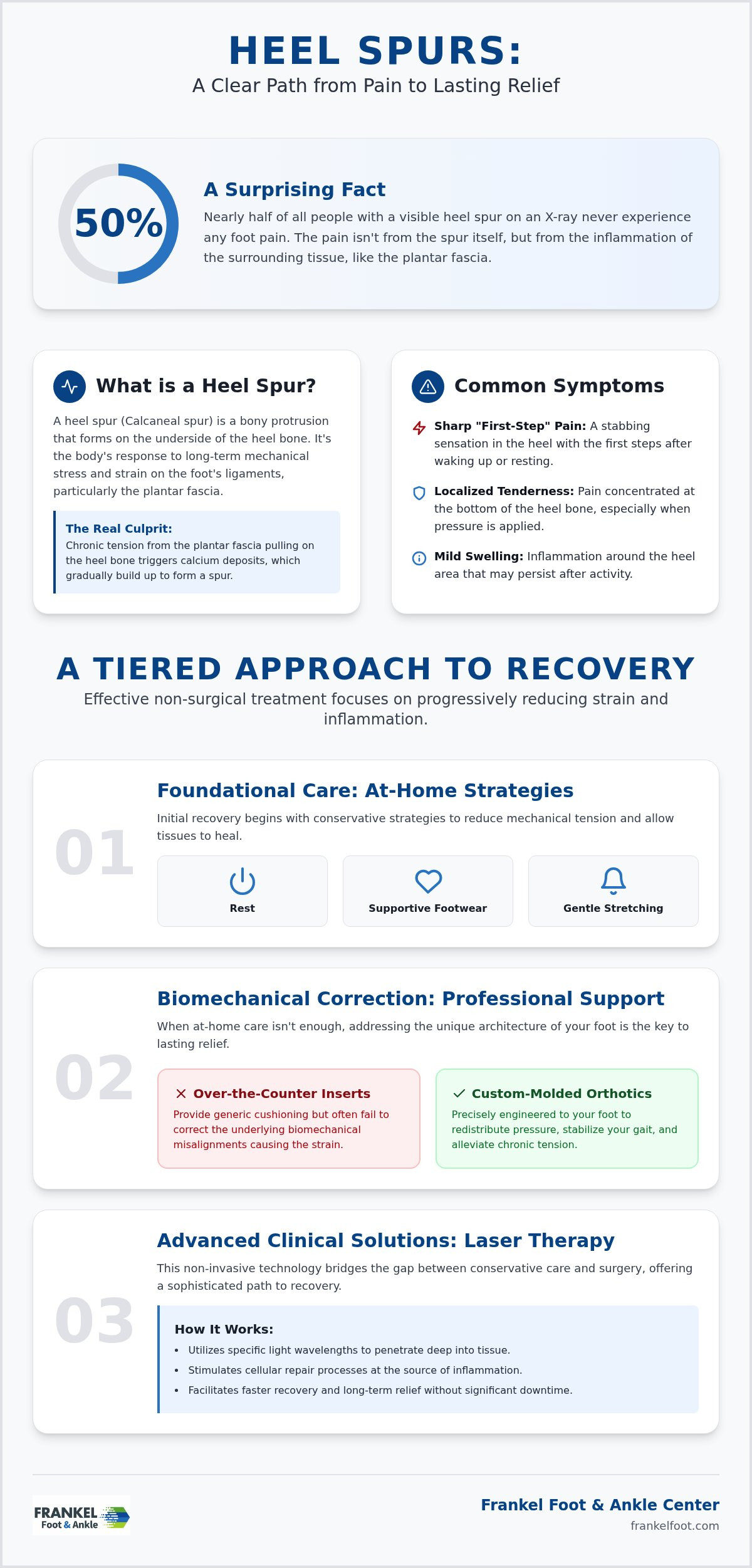
Did you know that nearly 50% of people with a visible heel spur on an X-ray never experience a single moment of foot pain? If you're currently hobbling through those first sharp steps of the morning, that statistic might feel hard to believe. It's exhausting to deal with chronic discomfort that keeps you from your favorite walking trails, especially when you're confused about whether the culprit is a bony growth or plantar fasciitis. You deserve a clear path to recovery that moves beyond temporary fixes.
This article details the most effective, non-invasive heel spur treatment options and advanced clinical strategies available in Middletown to restore your mobility. We'll explore the latest diagnostic techniques, specialized laser therapies, and biomechanical corrections that address the root cause of your pain, ensuring you can return to an active life without every step being a struggle.
Key Takeaways
- Understand the physiological connection between calcaneal protrusions and chronic ligament strain to accurately identify the underlying source of your foot discomfort.
- Discover how a personalized heel spur treatment plan utilizes both conservative stretching and advanced supportive footwear to manage daily pain and improve mobility.
- Learn the role of custom orthotics in providing essential biomechanical correction by redistributing pressure and reducing the tension that leads to bone spur formation.
- Explore progressive clinical solutions, such as advanced laser therapy, which targets deep-tissue inflammation to facilitate faster recovery and achieve long-term relief.
Understanding Heel Spurs: Why Your Heel Hurts and How to Identify It
A heel spur isn't a sudden injury but a gradual physiological response to persistent mechanical stress. Clinically known as a Calcaneal spur, this bony protrusion develops when chronic strain on the foot's connective ligaments causes calcium to accumulate on the underside of the heel bone. Many patients experience confusion regarding the distinction between these spurs and plantar fasciitis. While they're unique conditions, they're inextricably linked. The repetitive tension of the fascia pulling against the bone often triggers the spur's growth, making comprehensive heel spur treatment essential for long-term relief.
If you encounter a stabbing sensation during your first steps of the morning, your body is signaling a need for professional evaluation. This "first-step" phenomenon occurs because the plantar fascia tightens while you rest. The sudden stretch upon standing creates intense pressure on the sensitized heel area, often indicating that the underlying tissues are significantly inflamed. Addressing this early can prevent the progression of chronic discomfort.
Common Symptoms and Diagnostic Steps
Identifying the precise source of your pain requires a methodical diagnostic approach. While some spurs remain asymptomatic, many present with specific indicators that disrupt daily life. Key symptoms include:
- Localized tenderness specifically at the base of the heel bone.
- Mild inflammation or swelling that persists after activity.
- Sharp, knife-like pain during weight-bearing movements or exercise.
At Frankel Foot & Ankle Center, we utilize diagnostic imaging, such as X-rays, to confirm the presence of a calcaneal protrusion. It's vital to differentiate between acute injuries, such as stress fractures, and chronic spur-related discomfort. This level of precision ensures your recovery plan targets the biomechanical cause of tension rather than just treating the visible symptom on an image.
Non-Surgical Heel Spur Treatment Options: From Conservative Care to Advanced Therapies
Most patients achieve significant relief through a tiered approach to heel spur treatment. Initial recovery begins with conservative at-home strategies designed to reduce mechanical tension. Switching to supportive footwear with deep heel cups and rigid shanks provides the structural foundation necessary to protect the sensitized area. These simple modifications, when paired with rest, allow the surrounding soft tissues to begin the healing process naturally.
The Role of Physical Therapy and Orthotics
Consistent mechanical correction is vital for lasting results. Specific exercises, such as wall-supported calf stretches and seated plantar fascia pulls, lengthen the Achilles tendon and fascia to reduce the constant tugging on the calcaneus. While over-the-counter inserts offer generic cushioning, they often fail because they don't address individual biomechanical misalignments. Custom-molded orthotics are precisely engineered to your unique foot architecture. They effectively redistribute pressure and stabilize the gait, which alleviates the chronic strain that causes spurs to form in the first place.
When home care proves insufficient, advanced clinical interventions provide a bridge to recovery without the risks of surgery. Modern clinical management of heel spurs now frequently includes specialized laser therapy. This non-invasive technology utilizes specific light wavelengths to penetrate deep into the tissue, stimulating cellular repair and rapidly reducing localized inflammation. This progressive methodology is a cornerstone of modern heel spur treatment, offering a sophisticated option for those seeking long-term foot pain relief without the significant downtime associated with invasive procedures. Methodical care ensures your mobility returns safely and permanently.
Advanced Clinical Solutions at Frankel Foot & Ankle: When to Seek Specialist Care
Dr. Marc Frankel utilizes a meticulous diagnostic methodology to identify the specific biomechanical stressors causing your pain. We look beyond the bony growth to understand the tension patterns in your feet. This specialized approach ensures your heel spur treatment targets the functional source, not just the visible symptom. By analyzing your unique foot structure, we provide an accurate prognosis and a clear path toward lasting foot pain relief.
Our center specializes in high-level laser technology that facilitates rapid tissue repair and reduces deep-seated inflammation. This system effectively bridges the gap between basic home care and invasive surgery. By choosing these progressive, minimally invasive options, patients often experience a faster return to daily activities. While standard non-surgical heel spur treatments provide a necessary baseline, our clinical interventions offer the precision required for chronic cases that haven't responded to traditional methods.
Patient-Centered Podiatry in Middletown, Katonah, and Milford
We provide accessible, expert care for residents from New York to Pennsylvania at our three convenient regional offices. Each patient's experience is defined by a structured consultation that moves from a comprehensive initial assessment to a tailored recovery plan. This methodical process ensures no detail of your foot health is overlooked and every concern is addressed with care. Addressing persistent heel pain early prevents the development of secondary gait issues and chronic mobility limitations. We're dedicated to guiding you through a compassionate recovery that prioritizes your long-term well-being and restores your ability to walk without hesitation.
Restore Your Mobility and Step Into a Pain-Free Future
Overcoming chronic heel pain requires a transition from managing symptoms to addressing the functional biomechanics of your feet. By integrating consistent stretching, custom orthotics, and specialized clinical interventions, you can resolve the tension that drives bone spur development. Dr. Marc Frankel and his team provide advanced heel spur treatment that prioritizes long-term outcomes through minimally invasive and laser-based methodologies. Whether you visit our offices in Middletown, Katonah, or Milford, you'll receive the high-level expertise and compassionate care necessary to reclaim your active lifestyle. Don't let persistent discomfort dictate your daily movements. Take the first step toward lasting relief and professional support today. Please schedule a consultation for heel spur relief at Frankel Foot & Ankle Center to begin your personalized journey toward recovery. We look forward to helping you walk with confidence again.
Frequently Asked Questions
What is the fastest way to get rid of a heel spur?
The fastest way to achieve significant relief involves targeting the acute inflammation surrounding the bone. While the calcium deposit remains, clinical laser therapy and targeted immobilization provide the most rapid reduction in sharp pain. At our Middletown office, we utilize advanced technology to accelerate tissue repair. This methodical heel spur treatment offers a significantly faster path to comfort than traditional rest alone.
Can a heel spur go away on its own without medical treatment?
A heel spur is a permanent calcium deposit that won't physically disappear without surgical intervention. However, the pain it causes can resolve entirely if the underlying mechanical strain is corrected. Without professional heel spur treatment to address your gait and ligament tension, the inflammation often becomes a recurring cycle. Addressing these biomechanical factors is essential to achieving long-term, asymptomatic status.
Is surgery always necessary for treating chronic heel spurs?
Surgery is rarely the primary requirement for recovery. Clinical data suggests that approximately 95% of patients improve through conservative and advanced non-invasive therapies. We prioritize minimally invasive techniques and biomechanical corrections, such as custom-molded orthotics, to alleviate pressure. Surgery is typically only considered as a last resort after a year of failed conservative care. Most residents in Katonah and Milford recover without operative procedures.
How do I know if my pain is caused by a heel spur or plantar fasciitis?
Differentiating between these conditions requires professional diagnostic imaging, such as X-rays, to confirm bone involvement. While plantar fasciitis is the inflammation of the connective tissue, a spur is a physical protrusion on the heel bone. Both conditions often present with similar morning pain patterns. A structured consultation at our center ensures an accurate diagnosis, allowing us to create a plan tailored to your specific foot anatomy.


