

Imagine reaching for your favorite sneakers only to hesitate, knowing that a sharp, stabbing pain will likely cut your walk short. You've probably tried wider shoes or resting, yet that persistent "pebble in the shoe" sensation and toe numbness continue to disrupt your daily life. It's frustrating when the activities you love feel out of reach because of chronic foot discomfort. This guide provides a comprehensive roadmap for Morton's neuroma treatment, moving from conservative home remedies to the advanced clinical interventions we offer in Middletown to restore your mobility.
We'll explore how a methodical approach, from specialized orthotics to modern nerve decompression techniques, can help you return to an active lifestyle. You'll gain a clear understanding of the next clinical steps to eliminate pain and regain your confidence with every step.
Key Takeaways
- Recognize the hallmark symptoms of nerve thickening, such as radiating toe numbness and the sensation of a pebble in your shoe, to facilitate early and effective intervention.
- Understand the critical role of specialized podiatric care in your Morton's neuroma treatment, particularly how custom-molded orthotics offer more precise pressure relief than generic retail inserts.
- Examine how advanced clinical solutions utilize minimally invasive methods to decompress the nerve, providing a sophisticated alternative to traditional surgery with reduced downtime.
- Follow a structured path toward recovery that moves from immediate pain stabilization to long-term mobility strategies, ensuring you return to an active lifestyle without discomfort.
Understanding Morton’s Neuroma and Early Intervention Strategies
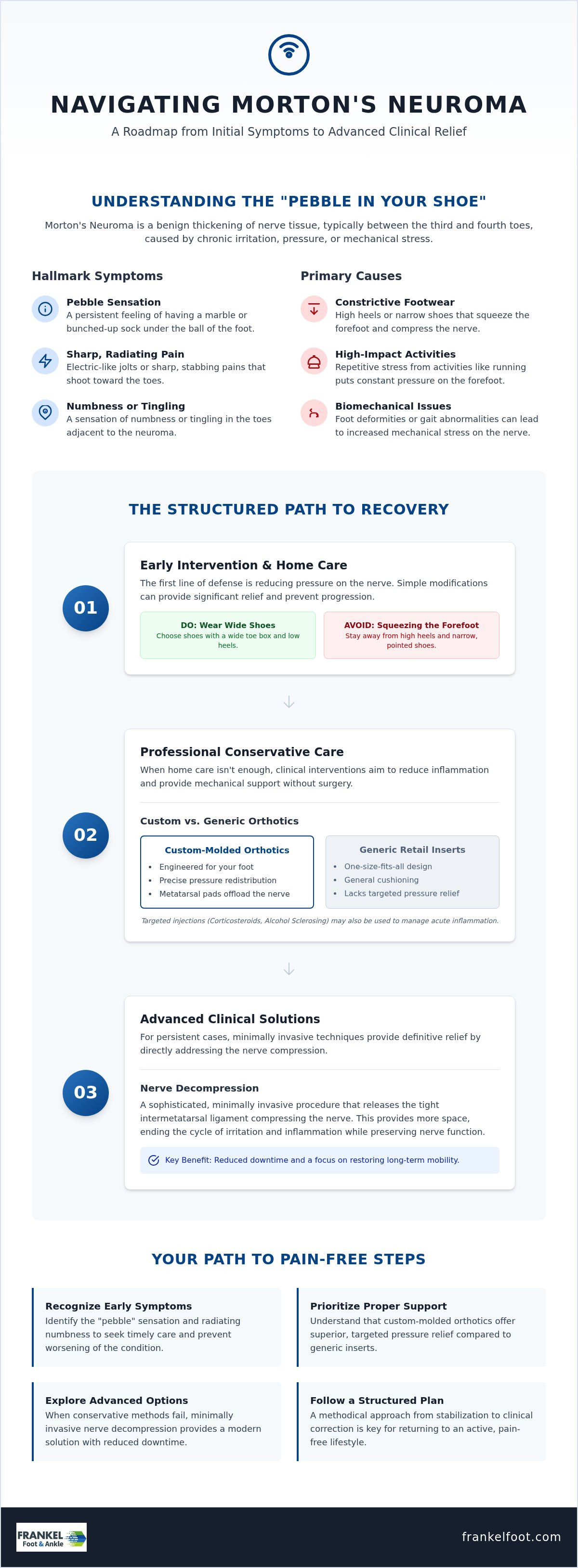
Morton’s neuroma is a benign, fibrous thickening of the intermetatarsal plantar nerve that typically develops between the third and fourth toes, causing localized compression and debilitating discomfort. While the term may sound intimidating, it isn't a malignant growth. Instead, it's a reactive thickening of the nerve tissue in response to chronic irritation or pressure. Patients frequently describe the sensation as having a marble or a bunched-up sock stuck under the ball of the foot.
The primary causes often stem from mechanical stress. High-heeled shoes that squeeze the forefoot or repetitive, high-impact activities like running can compress the nerve against the metatarsal bones. This persistent friction leads to inflammation and radiating toe numbness that can halt your daily routine. Recognizing these triggers is the first step toward effective Morton's neuroma treatment and long-term relief.
Identifying the "Pebble in Your Shoe" Sensation
It's vital to differentiate a neuroma from general metatarsalgia, which typically presents as a broad, dull ache across the forefoot. In contrast, a neuroma produces sharp, electric-like pains localized to a specific spot. You can perform a simple "squeeze test" at home by firmly compressing the sides of your forefoot with your hand. If this action reproduces a sharp pain or a distinct clicking sensation, it's time to seek a professional evaluation.
Understanding Morton's Neuroma empowers you to make immediate changes to your daily habits. Footwear modification is your first line of defense; switching to shoes with a wider toe box and lower heels significantly reduces the pressure on the affected nerve. At Frankel Foot & Ankle Center, we focus on these early stabilization strategies to help you manage symptoms before they necessitate more advanced clinical interventions.
Professional Treatment Pathways: From Stabilization to Clinical Relief
When home modifications fail to provide lasting relief, a structured clinical approach becomes necessary to prevent permanent nerve damage. We utilize diagnostic ultrasound to visualize the nerve and confirm the neuroma's specific dimensions, ensuring an accurate baseline for professional treatment for Morton's neuroma. This transition marks the shift from symptomatic guessing to precision-based medical care.
Management of acute inflammation often involves targeted injections to break the cycle of pain. Corticosteroids can rapidly reduce swelling around the nerve, while alcohol sclerosing injections aim to chemically desensitize the area in more persistent cases. These clinical interventions provide the immediate relief required to focus on long-term mechanical stabilization and gait correction.
Custom Orthotics and Conservative Stabilization
Unlike generic retail inserts, custom-molded orthotics are engineered to redistribute pressure away from the vulnerable metatarsal heads. By incorporating precisely placed metatarsal pads, we can offload the compressed nerve and prevent further mechanical irritation during movement. For our local patients navigating the steep, hilly terrain of the Hudson Valley, we frequently recommend combining these devices with wide-toe-box footwear to ensure the forefoot isn't constricted during elevation changes.
Finding the correct balance between activity and mechanical support is essential for recovery. You can explore our guide on comprehensive foot pain relief to see how these conservative strategies integrate into a broader wellness plan. If your current routine doesn't stop the "walking on a marble" sensation, it's time to consult with the experts at Frankel Foot & Ankle Center to discuss a tailored intervention.
Advanced Clinical Solutions and Long-Term Recovery
When conservative stabilization fails to resolve the persistent "walking on a marble" sensation, Advanced clinical solutions for foot pain offer a definitive path toward relief. We specialize in progressive methodologies that prioritize the preservation of nerve function through specialized diagnostic and surgical techniques. Morton's neuroma treatment at this stage transitions from simple pressure management to active clinical correction. Our focus remains on restoring your quality of life while minimizing the physical and emotional stress often associated with chronic foot discomfort.
Minimally Invasive Approaches to Nerve Decompression
Nerve decompression is a sophisticated technique where the intermetatarsal ligament is released to provide the nerve with more space, effectively ending the cycle of compression and inflammation. This differs significantly from a neurectomy, which involves the total excision of the nerve tissue. During a professional consultation at Frankel Foot & Ankle Center, we evaluate the nerve's condition to determine if decompression is viable. Patients in Middletown and Milford find that these minimally invasive procedures often allow for a return to full mobility within two to six weeks, which is significantly faster than traditional open surgery.
In cases where the nerve damage is irreversible, a neurectomy may be considered the most effective option for permanent pain elimination. We guide you through this decision with a balance of clinical expertise and genuine care, addressing any anxieties about the procedure or recovery. The ultimate goal isn't just the removal of a painful sensation; it's the emotional freedom of walking, running, and wearing your favorite shoes without the constant shadow of pain. By intervening before permanent nerve damage occurs, we ensure your journey leads back to the active lifestyle you deserve.
Step Toward a Pain-Free Future
Living with the persistent sensation of a "pebble in your shoe" doesn't have to be your permanent reality. By understanding the progression of Morton's neuroma treatment, you can move confidently from basic stabilization to advanced clinical relief. Whether your path involves custom orthotics to redistribute pressure or minimally invasive decompression to address the root cause, the focus remains on restoring your mobility and comfort. Led by Dr. Marc Frankel, our team specializes in patient-centered outcomes across our convenient locations in Middletown, Katonah, and Milford. You don't have to let nerve pain dictate your activity levels or footwear choices any longer. We're here to provide the expertise and compassionate care necessary for a full recovery. Schedule a consultation at Frankel Foot & Ankle Center for personalized neuroma relief and reclaim the active lifestyle you love.
Frequently Asked Questions
How do I know if I have Morton’s neuroma or just foot pain?
Morton’s neuroma presents with distinct indicators like sharp, electric-like pain between the third and fourth toes or a sensation that you're walking on a marble. Unlike general foot pain, it often includes radiating toe numbness or burning. A clinical evaluation in Middletown can confirm the diagnosis through a physical squeeze test or ultrasound imaging to differentiate it from other inflammatory conditions.
Can Morton’s neuroma go away on its own without treatment?
A neuroma is a structural thickening of nerve tissue, so it rarely resolves without some form of intervention. While resting or changing footwear might temporarily alleviate the pebble in your shoe sensation, the underlying nerve irritation typically persists. Seeking professional Morton's neuroma treatment early prevents the condition from progressing to a stage where permanent nerve damage or more invasive surgical measures become necessary.
What are the best shoes for someone with a Morton’s neuroma?
The most effective footwear features a wide toe box that allows the metatarsal bones to spread naturally, reducing nerve compression. You should prioritize shoes with low heels and ample cushioning to offload the forefoot. For residents navigating the uneven terrain in Milford or Middletown, selecting supportive footwear with a firm sole helps stabilize the foot and prevents the repetitive friction that aggravates neuroma symptoms.
Is surgery the only way to cure a neuroma permanently?
Surgery isn't the only permanent solution, as many patients achieve lasting relief through conservative stabilization and custom-molded orthotics. These non-invasive methods focus on correcting the mechanical issues causing the nerve irritation. However, if symptoms don't improve after six months of conservative care, minimally invasive decompression or specialized nerve removal may be recommended to provide definitive, long-term relief and restore full mobility.


