


Could that persistent ache in your midfoot be more than just a temporary strain from a new pair of running shoes? For many dedicated athletes in Middletown and Milford, the drive to push through discomfort often masks the early warning signs of stress fracture foot symptoms. It's frustrating when a dull throb begins to sharpen during exercise, eventually making it impossible to maintain your training schedule without significant distress. You aren't alone in wondering if your discomfort is a minor setback or a structural issue that requires clinical intervention.
Learning to identify these specific medical markers is essential for distinguishing between general muscle fatigue and a true cortical crack. We'll provide a methodical breakdown of the "red flag" indicators, such as localized swelling on the top of the foot and pain that lingers even after you've stopped moving. This article outlines a clear path to recovery, helping you understand when advanced diagnostic imaging is necessary to prevent a progressive injury from becoming a surgical necessity. By the end, you'll have the expertise needed to safeguard your long-term health and return to the activities you love with confidence.
Key Takeaways
- Recognize that a stress fracture is a progressive hairline crack caused by repetitive sub-maximal loading, distinguishing it from acute traumatic injuries.
- Identify the hallmark stress fracture foot symptoms through the "pain-activity cycle," where localized discomfort vanishes during rest but returns sharply with movement.
- Apply the "Point Tenderness Test" to differentiate between bone-specific damage and soft tissue issues like extensor tendonitis by pinpointing the exact location of the pain.
- Understand the limitations of early-stage X-rays and the necessity of advanced MRI or CT diagnostics for a precise clinical evaluation in athletes.
- Learn how timely intervention and specialized recovery pathways can prevent minor stress injuries from evolving into complex surgical cases.
More Than Just Soreness: Recognizing Stress Fracture Foot Symptoms
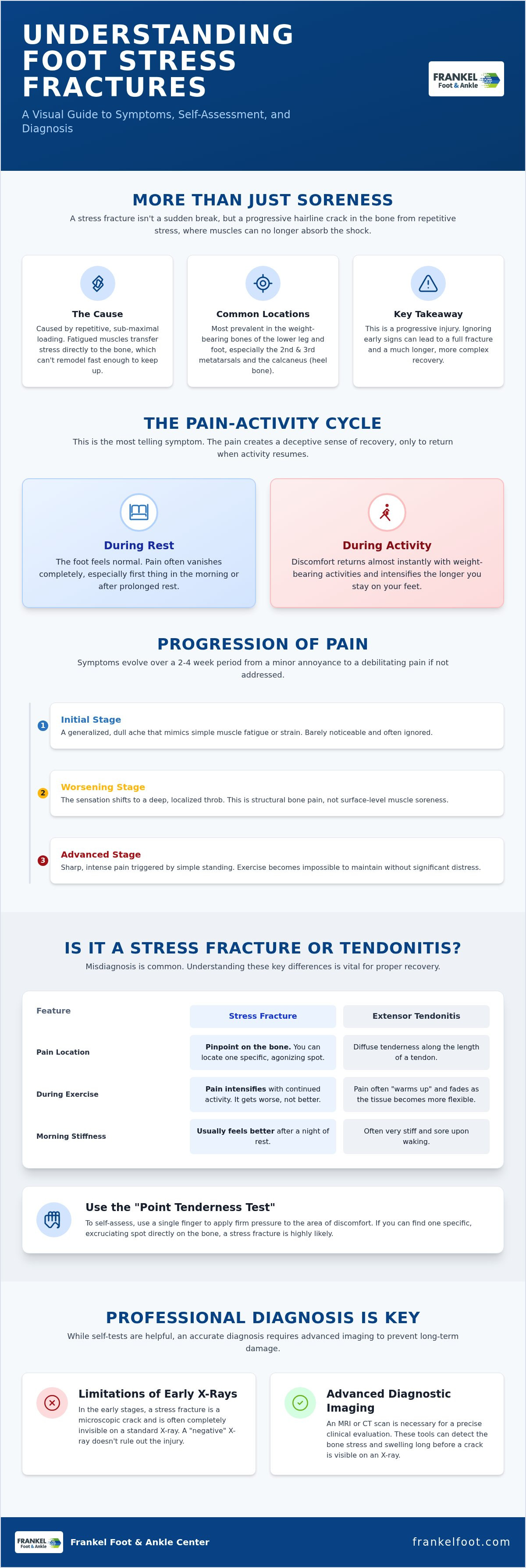
A stress fracture isn't a sudden, catastrophic break. Instead, it's a microscopic hairline crack that develops from repetitive, sub-maximal loading. This occurs when the muscles become fatigued and can no longer absorb added shock, eventually transferring that stress to the bone. A foundational step in understanding stress fractures is recognizing that the bone hasn't snapped; it has simply failed to remodel itself fast enough to keep up with the physical demands of your activity. While these injuries can occur anywhere in the lower extremity, they are most prevalent in the second and third metatarsals or the calcaneus.
The "pain-activity cycle" is perhaps the most telling of all stress fracture foot symptoms. You might notice that your foot feels perfectly normal while resting or first thing in the morning. However, the discomfort returns almost instantly with weight-bearing activities. This cycle creates a deceptive sense of security, often leading athletes to believe they've recovered, only to experience a sharp return of pain the moment they resume their training schedule.
The Progression of Pain and Discomfort
Stress fractures follow a predictable timeline, typically evolving from a barely noticeable annoyance to an unbearable limitation over a two-to-four-week period. Initially, you may feel a generalized, dull ache that mimics simple muscle fatigue or strain. As the crack worsens, this sensation shifts into a deep, localized throb. Unlike muscular soreness, which often feels like a surface-level burning or tightness, bone pain feels structural and intense. You might eventually find that even the simple act of standing triggers a sharp sensation that makes your usual exercise routine impossible to maintain.
Visual Indicators: Swelling and Bruising
While pain is the primary indicator, physical changes provide additional clues. Localized edema, or swelling, frequently appears on the top of the foot. This swelling can be so pronounced that it obscures the visibility of the tendons leading to your toes, making the area look puffy or "filled in." Interestingly, bruising is quite rare with this type of injury. If you notice significant purple or blue discoloration, it's more likely you've sustained an acute ligament tear or a traumatic fracture rather than a stress-related issue. Identifying these subtle differences is the first step toward ensuring a safe, rapid recovery.
Is It a Stress Fracture? Differentiating Symptoms from Common Injuries
Distinguishing between various types of foot pain is a complex task for even the most seasoned athletes. Often, a sudden change in footwear or a transition to harder training surfaces, such as moving from a track to asphalt, can mask stress fracture foot symptoms by mimicking the sensations of a simple muscle strain. However, the stakes of a misdiagnosis are high. Properly differentiating symptoms is vital for choosing the right recovery path and avoiding long-term structural damage.
One of the most reliable self-assessment tools is the "Point Tenderness Test." To perform this, use a single finger to apply firm pressure directly onto the bone in the area of discomfort. If you can pinpoint one specific, agonizing spot on the bone, it's highly likely a fracture. Soft tissue injuries generally present with more diffuse tenderness that spans the length of a muscle or tendon. Clinical specialists may also utilize the "Hop Test" under supervision. If you find it impossible to hop on the affected foot without immediate, sharp pain, the injury has likely progressed beyond a simple strain.
| Feature | Stress Fracture | Extensor Tendonitis |
|---|---|---|
| Pain Location | Pinpoint on the bone | Diffuse along the tendon |
| Reaction to Stretching | No significant change | Pain typically increases |
| Morning Stiffness | Usually feels better after rest | Often very stiff and sore |
| During Exercise | Pain intensifies with activity | Pain often "warms up" and fades |
Stress Fracture vs. Tendonitis
The most significant differentiator is how the pain responds to movement. Tendonitis often follows a "warm-up" pattern where the discomfort actually decreases as the tissue becomes more flexible during exercise. A stress fracture behaves in the opposite manner. Because the bone is struggling to support your weight, the pain will escalate steadily the longer you stay on your feet. If your discomfort doesn't dissipate after the first ten minutes of a walk or run, you should stop immediately.
When "Walking It Off" Becomes Dangerous
Continuing to train through these signals is a dangerous gamble that can lead to a non-union, where the bone fails to heal on its own, or even a complete, displaced break. Ignoring the body's warning signs transforms a manageable recovery into a months-long ordeal. Exploring Comprehensive Foot Pain Relief strategies early is the most compassionate choice you can make for your future mobility. If you're unsure about the severity of your condition, a professional consultation is the most reliable way to secure the foot pain relief you need to stay active safely.
Professional Diagnosis and Recovery Pathways in Middletown
Confirming stress fracture foot symptoms requires a sophisticated diagnostic approach because early-stage injuries are often invisible on standard X-rays. During the first few weeks, the bone hasn't yet begun the visible remodeling process, leading to many "false negative" results in urgent care settings. To avoid the frustration of a missed diagnosis, Dr. Frankel utilizes a comprehensive methodology that prioritizes clinical expertise and advanced imaging. According to the American Academy of Orthopaedic Surgeons on stress fractures, a definitive diagnosis in active individuals often necessitates an MRI or CT scan to visualize bone marrow edema before a fracture line even appears on a traditional film.
Once we establish the severity of the injury, our focus shifts to a strict non-weight-bearing strategy. This period of rest is non-negotiable for ensuring the bone heals without permanent complication. We often utilize specialized walking boots or custom orthotic devices to offload pressure from the affected metatarsals, allowing you to maintain some mobility while protecting the structural integrity of the foot. Our goal is to move you through a structured recovery that transitions from total rest to gradual loading, effectively preventing the high recurrence rates that plague athletes who return to sport too soon.
Advanced Diagnostic Imaging in Our NY and PA Offices
Patients in Middletown and Milford benefit from high-level diagnostics without the need for long-distance travel. During follow-up appointments, we look for the appearance of "callus formation" on later X-rays. This new bone growth is a welcome clinical sign that your body is successfully bridging the hairline crack. By monitoring this biological progress, we can precisely time your return to activity, ensuring your bones are strong enough to handle the impact of your specific training routine.
Your Personalized Path to Relief
At Frankel Foot & Ankle Center, we believe that every patient deserves a recovery plan as unique as their athletic goals. Our compassionate care model combines clinical precision with a deep understanding of the emotional toll that injury takes on an active lifestyle. Whether you are dealing with metatarsal issues or seeking Ankle Pain Relief in Middletown, our team provides the expert guidance necessary for a safe return to peak performance. We don't just treat the injury; we support the individual through every step of their healing journey.
Secure Your Path to a Safe Recovery
Recognizing the early signs of a hairline break is the only way to prevent a minor injury from becoming a permanent limitation. Whether you've identified stress fracture foot symptoms through pinpoint tenderness or noticed the persistent "pain-activity cycle" during your workouts, the next step is a clinical evaluation that looks beyond basic imaging. Ignoring these signals risks a complete bone break, but proactive intervention ensures your structural health remains intact.
Led by Dr. Marc Frankel, an expert in advanced podiatric surgery, Frankel Foot & Ankle Center provides the sophisticated care you need in Middletown NY, Katonah NY, and Milford PA. We specialize in progressive methodologies, including scarless and painless recovery techniques, to get you back to your routine safely. Don't let persistent discomfort dictate your future training schedule. Schedule a Consultation with Dr. Frankel for Foot Pain Relief to ensure your recovery is handled with clinical precision and genuine compassion. You have the power to protect your mobility and return to peak performance with confidence.
Frequently Asked Questions
Can I still walk with a stress fracture in my foot?
You can often physically walk with a stress fracture, but doing so is highly detrimental to the healing process. While the pain might feel manageable at first, every step applies repetitive force to the weakened bone. This continued pressure prevents the hairline crack from closing and can lead to a more severe, displaced fracture. It's essential to utilize a walking boot or crutches as directed by a specialist to ensure the bone remains stable during recovery.
How do I know if my foot pain is a stress fracture or a muscle strain?
The primary differentiator is whether the pain is localized to the bone or spread across soft tissue. A muscle strain often feels like a surface-level tightness that improves as the area "warms up" during activity. Conversely, stress fracture foot symptoms are characterized by a deep, throbbing ache that focuses on a specific bony point. If the discomfort worsens the longer you stay on your feet, it's a strong indicator of a bone-related injury rather than a simple strain.
What happens if a stress fracture goes untreated?
Ignoring a stress fracture can lead to a complete bone break or a condition known as a non-union. A non-union occurs when the bone fails to knit back together properly, often resulting in chronic pain and a loss of structural integrity. In these advanced cases, surgical intervention may become necessary to stabilize the foot. Seeking early diagnostic care helps prevent these long-term complications and ensures you don't face a much longer, more invasive recovery period.
How long does it take for a foot stress fracture to heal completely?
A typical recovery period for a foot stress fracture spans six to eight weeks of restricted activity. This duration allows the bone enough time to undergo the necessary remodeling and strengthening phases. Adhering to a methodical return-to-play plan is vital, as returning to high-impact exercise too early can be dangerous. Research indicates that a prior bone stress injury can increase the risk of recurrence by six to seven times if the initial healing process isn't managed properly.


