


Imagine preparing for a crisp morning hike through the Hudson Valley, only to find that a sharp, persistent ache in your ankle makes every step a struggle. It's a frustrating reality for many residents in Middletown and Katonah who worry that a simple injury might require major surgery. You're likely tired of the confusion between a lingering tendon strain and a deeper bone issue, especially when it keeps you sidelined from the sports and local trails you love. Securing an accurate ankle pain diagnosis is the essential first step toward reclaiming your mobility and peace of mind.
This guide explains the methodical steps required to identify the specific cause of your discomfort. You'll learn what to expect during a professional podiatric consultation and discover how modern, non-invasive treatments provide lasting relief. We'll explore the diagnostic process that bridges immediate symptom assessment with the long-term mechanical corrections needed to get you back on your feet.
Key Takeaways
- Learn to categorize your discomfort by its specific location and sensation to help narrow down potential causes like tendonitis or structural alignment issues.
- Understand the methodical steps involved in a professional ankle pain diagnosis, including physical joint manipulation and a thorough review of your medical history.
- Discover how specific diagnostic findings translate into personalized treatment plans, such as custom orthotics designed to correct your gait and provide lasting stability.
- Explore modern, non-invasive pathways to recovery, including advanced laser therapy for chronic inflammation and specialized techniques that prioritize your long-term mobility.
Decoding Your Symptoms: A Systematic Guide to Ankle Pain Assessment
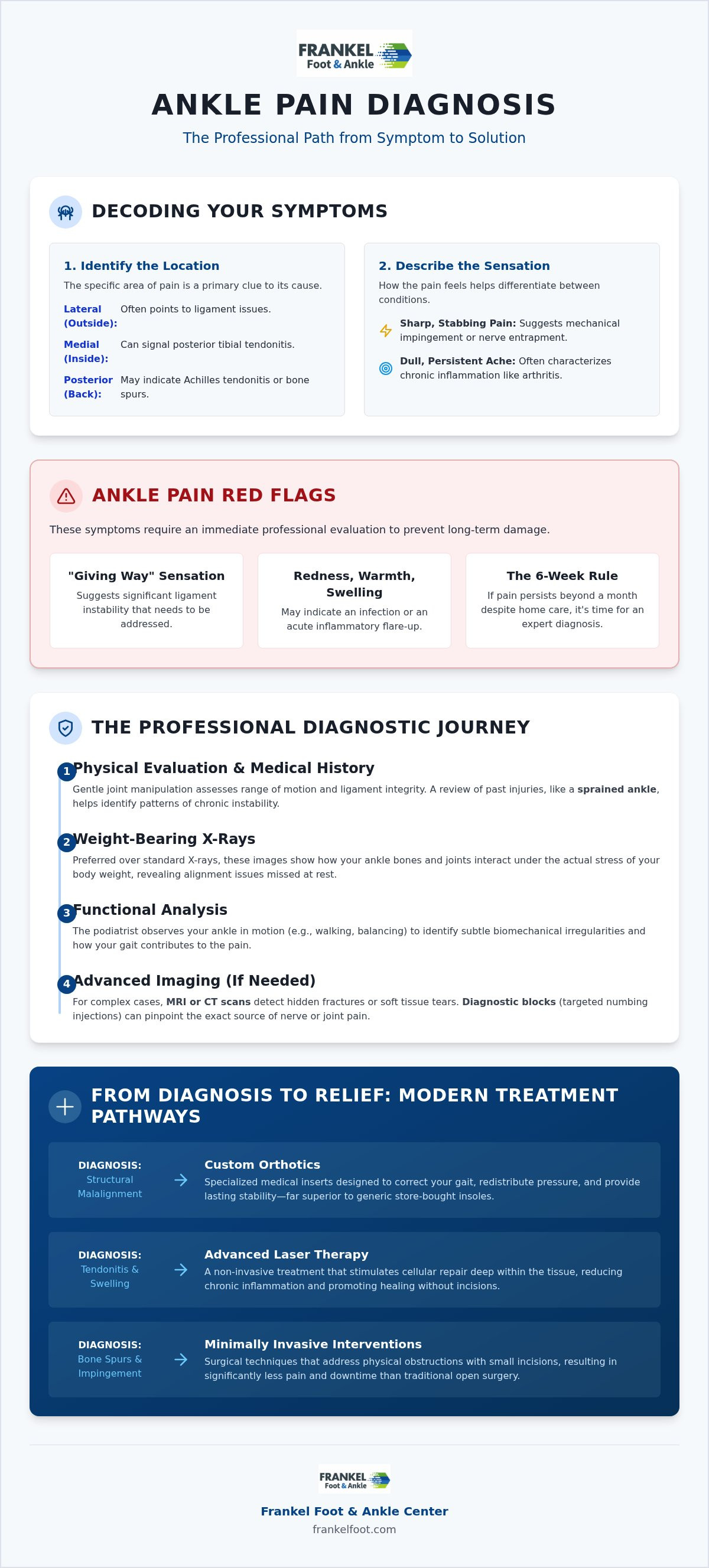
Understanding the source of your discomfort begins with a methodical mapping of exactly where and how you feel it. Securing a proper ankle pain diagnosis starts with identifying whether the pain is lateral (outside), medial (inside), or posterior (back). Lateral pain often points to ligamentous issues, while medial or posterior discomfort can signal posterior tibial tendonitis or bone spurs. A sharp, stabbing sensation frequently indicates a mechanical impingement or nerve entrapment. Conversely, a dull, persistent ache often characterizes chronic inflammatory conditions like arthritis. You might notice these symptoms intensify when navigating the uneven terrain of local Hudson Valley trails or walking on the pavement in Middletown. A wide range of Ankle problems can manifest through these physical cues, making specialized observation critical. Ankle impingement is a common cause of chronic discomfort in active adults, occurring when soft tissue or bone fragments become trapped between the joint bones during movement.
Ankle Pain Red Flags: When to Seek Immediate Professional Diagnosis
While some minor soreness resolves with rest, certain "red flags" demand an expert ankle pain diagnosis to ensure long-term mobility. If you experience a frequent "giving way" sensation, it suggests significant ligament instability that could lead to permanent joint damage if left unaddressed. Noticeable redness, warmth, or sudden swelling may indicate an infection or an acute inflammatory flare-up. We generally recommend following the six-week rule. If your pain persists beyond a month despite home care, it's time for a professional evaluation at Frankel Foot & Ankle Center. Our team provides the precision and care necessary to identify the root cause before it limits your lifestyle further.
The Professional Diagnostic Journey: What to Expect During Your Consultation
Entering our clinic for an ankle pain diagnosis marks the transition from uncertainty to a structured recovery plan. Your consultation begins with a focused physical evaluation where we gently manipulate the joint to assess range of motion and ligament integrity. We investigate your medical history thoroughly, as a previous Sprained Ankle or a history of "rolling the ankle" often serves as the catalyst for current chronic instability. By identifying these historical patterns, we can better understand the underlying structural weaknesses that lead to persistent discomfort.
Precision is paramount in our diagnostic methodology. We prefer weight-bearing X-rays over standard films because they illustrate how your ankle bones interact under the stress of your actual body weight. To complement these images, Dr. Frankel performs a detailed functional analysis to observe the ankle in motion and identify subtle biomechanical irregularities. If you're seeking clarity on your condition, our team at Frankel Foot & Ankle Center is ready to provide a definitive assessment.
Advanced Imaging and Precision Diagnostics in Middletown
In complex cases, we utilize MRI or CT scans to detect occult fractures or intricate soft tissue tears that standard imaging might miss. We also employ diagnostic blocks, which involve targeted injections to temporarily numb specific areas, allowing us to pinpoint the exact nerve or joint space generating your pain. This methodical approach ensures your treatment plan targets the actual source of distress rather than just the symptoms. For more information on navigating your recovery, read our guide on Comprehensive Ankle Pain Relief.
Transitioning from Diagnosis to Relief: Modern Treatment Pathways
Once a definitive ankle pain diagnosis is reached, the clinical focus shifts from investigation to active restoration. For many patients, a finding of structural malalignment leads to the use of custom orthotics. These aren't generic store-bought inserts; they're specialized medical tools designed to correct your gait and redistribute pressure effectively. Precision matters. For those managing tendonitis or chronic swelling, laser therapy offers a sophisticated, non-invasive path to relief by stimulating cellular repair without the need for incisions. When physical obstructions like bone spurs or joint impingement are the primary culprit, minimally invasive interventions allow us to address the issue with significantly less downtime than traditional open surgery. If your specific diagnosis involves a recent injury, understanding the Ankle Sprain Treatment pathway is essential for preventing the cycle of chronic instability.
Personalized Recovery Plans at Frankel Foot & Ankle Center
We believe every patient deserves a recovery strategy tailored to their unique lifestyle. Whether you're a high-impact athlete striving to return to competition or a resident seeking comfortable daily mobility, your long-term health is our central focus. We emphasize the importance of methodical follow-up care to ensure the ankle remains stable and pain-free for years to come. Our team at Frankel Foot & Ankle Center provides accessible, high-level care across our locations in Middletown New York, Katonah New York, and Milford Pennsylvania. We're here to help. This patient-centered approach ensures that your ankle pain diagnosis leads to a precise and effective solution that fits your life. To further support your journey toward total wellness, exploring resources like the Quantum Resonant Healing Center can help you maintain peak vitality alongside your recovery.
Understanding the nuances of your symptoms and undergoing a professional evaluation are the essential foundations of recovery. From analyzing specific mechanical triggers to utilizing advanced imaging techniques, the path to lasting relief is both methodical and supportive. Achieving an accurate ankle pain diagnosis is the first step toward a personalized treatment plan that addresses the root cause of your discomfort rather than just masking the symptoms. Led by Dr. Marc Frankel, our team utilizes advanced, patient-centered technology to guide every step of your journey toward improved mobility. With convenient locations in Middletown New York, Katonah New York, and Milford Pennsylvania, specialized expertise is always within reach. You don't have to navigate persistent discomfort alone. Schedule your comprehensive ankle pain diagnosis with Dr. Frankel today.Frequently Asked Questions
How do I know if my ankle pain is a sprain or a fracture?
Differentiating between these injuries requires professional imaging, but key indicators include your ability to bear weight and the exact location of tenderness. A fracture often involves intense pain directly over the bone and an inability to take even a few steps. Sprains typically involve soft tissue swelling and ligamentous tenderness. A professional ankle pain diagnosis at our Middletown clinic provides the clarity needed for proper treatment.
Can chronic ankle pain be diagnosed without surgery?
Yes, the vast majority of ankle conditions are identified using non-invasive methods such as physical examinations, weight-bearing X-rays, and advanced MRI scans. Surgery is rarely used as a diagnostic tool; instead, we rely on functional analysis and diagnostic blocks to pinpoint pain sources. Our goal in Katonah and Milford is to identify the root cause using the least invasive technology available before discussing any intervention.
Why does the back of my ankle hurt when I walk?
Pain in the posterior region of the ankle is frequently linked to Achilles tendonitis or posterior ankle impingement. This discomfort often intensifies during the push-off phase of walking or when climbing hills in the Hudson Valley. It can also be caused by a small extra bone called an os trigonum. A precise evaluation helps determine if inflammation or mechanical friction is the primary driver of your symptoms.
What should I bring to my first ankle pain diagnostic appointment?
Please bring a list of your current medications, any previous imaging results like X-rays or MRIs, and the footwear you use most frequently. Examining your shoes allows Dr. Frankel to analyze wear patterns that indicate specific biomechanical issues. Providing a detailed timeline of your symptoms and any past injuries helps us streamline your ankle pain diagnosis and create a targeted recovery plan that fits your lifestyle.


