


You stepped off the curb wrong several days ago, and despite the ice packs and elevation, the swelling around your outer ankle remains stubbornly unchanged. It's frustrating to be stuck on the sidelines, especially when you're unsure if you need professional ankle sprain treatment or if the injury is actually a fracture. You're likely worried that this setback might lead to a lifetime of weakness or that "giving out" sensation that often follows an improperly healed injury. We understand how important it is to get back on your feet quickly and with total confidence in your body's stability.
Choosing clinical intervention is about more than just managing immediate pain; it's a vital step in preventing chronic instability and long-term ligament damage. In this guide, you'll discover the clinical difference between basic home care and the advanced recovery strategies used by specialists to ensure a fast, reliable return to your daily routine. We'll explain how precise diagnostics and expert-led interventions at our Middletown and Katonah locations can confirm your injury's severity and provide the relief you need to bear weight and move freely once again.
Key Takeaways
- Distinguish between microscopic ligament stretching and complete tears to accurately assess the true severity of your injury.
- Discover how professional ankle sprain treatment utilizes advanced diagnostic imaging and medical-grade immobilization to accelerate your return to activity.
- Identify the warning signs of Chronic Ankle Instability and learn how specialized care prevents a cycle of recurring weakness or "giving out."
- Understand the clinical difference between managing symptoms at home and implementing a professional recovery plan for long-term joint stability.
Categorizing Sprain Severity: From Mild Stretches to Complete Tears
An ankle sprain occurs when the tough bands of connective tissue, known as ligaments, are forced beyond their natural range of motion. These ligaments act as the primary stabilizers for your joint, and when they're overstretched, the resulting damage exists on a clinical spectrum. Understanding the specific grade of your injury is the first step toward effective ankle sprain treatment, as each level of severity requires a different therapeutic approach to ensure the joint regains its full structural integrity.
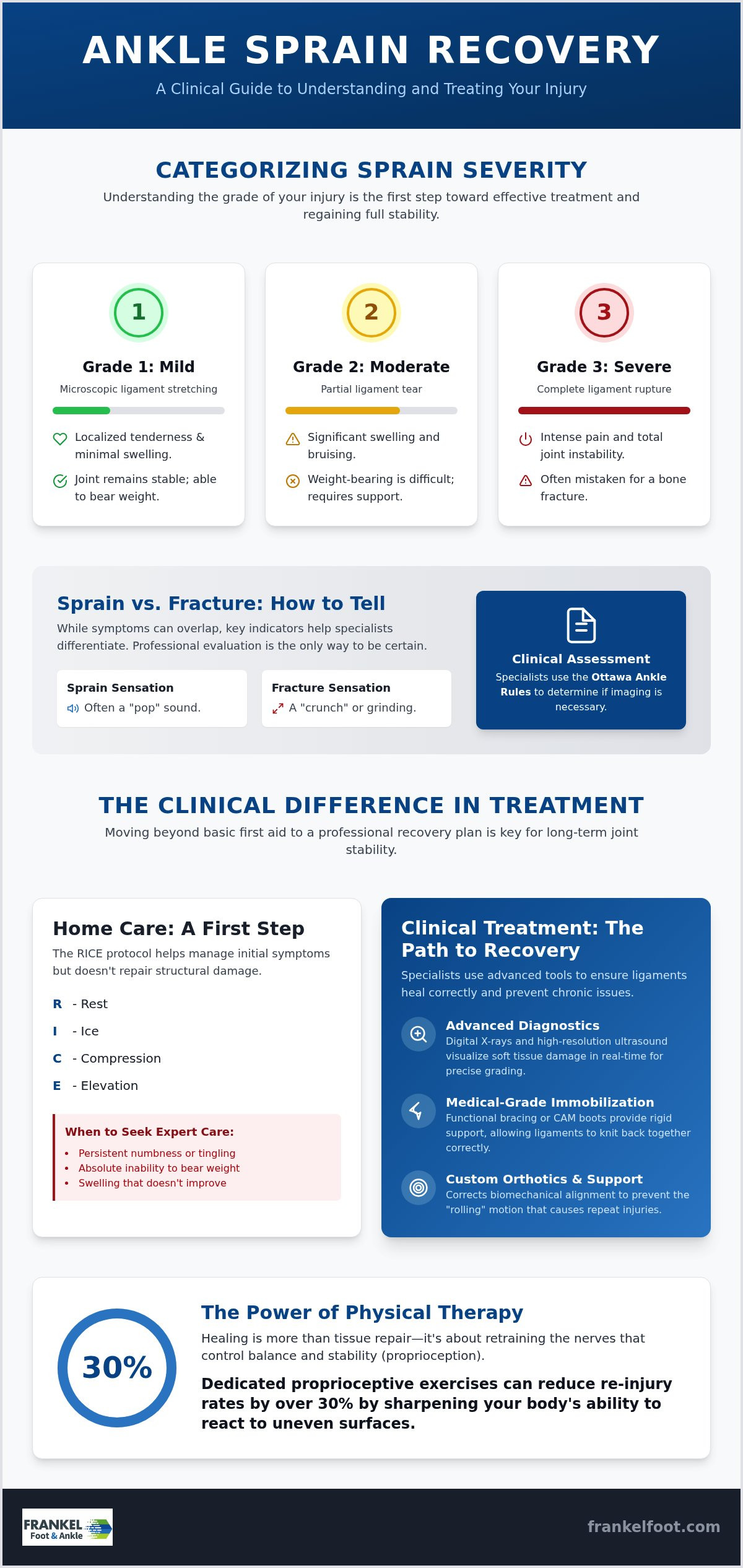
- Grade 1 (Mild): This involves microscopic tearing of the ligament fibers. You'll likely experience localized tenderness and minimal swelling, but the joint remains stable enough to support your weight with minor discomfort.
- Grade 2 (Moderate): This grade signifies a partial ligament tear. You'll notice significant swelling and bruising, and the joint may feel slightly loose. Bearing weight becomes difficult and often requires clinical support.
- Grade 3 (Severe): This is a complete ligament rupture. The pain is often intense, and the joint feels entirely unstable. Because the symptoms are so severe, this grade is frequently mistaken for a bone fracture.
Sprain vs. Fracture: How to Tell the Difference
Distinguishing between a severe ligament tear and a broken bone is a common concern for patients in Middletown and Katonah. While a "pop" sound often accompanies a ligament tear, a "crunch" or grinding sensation frequently points toward a fracture. Our specialists utilize the Ottawa Ankle Rules, a precise clinical framework, to evaluate specific points of bone tenderness and your ability to take four steps. This diagnostic standard helps us determine if digital imaging is necessary. For a comprehensive sprained ankle overview, it's vital to recognize that symptoms often overlap, making professional evaluation the only way to rule out a break.
Immediate First Aid: The Limits of RICE
The traditional RICE protocol (Rest, Ice, Compression, Elevation) is a helpful starting point for managing initial inflammation, but it isn't a complete ankle sprain treatment plan. While ice may numb the area, it doesn't repair the underlying structural damage. It's time to stop self-treating and seek expert care if you notice red flags like persistent numbness, tingling in the toes, or an absolute inability to bear weight. Ignoring these signs can lead to improper healing and a lifetime of joint instability.
Clinical Treatment Pathways: How Specialists Accelerate Healing
Professional ankle sprain treatment goes beyond the basic compression used at home. While over-the-counter remedies might dull the initial ache, they often fail to address the deeper structural damage that leads to chronic issues. We utilize advanced in-office diagnostics, such as digital X-rays and high-resolution ultrasound, to visualize soft tissue damage in real-time. This level of precision is essential for classifying ankle sprain severity and determining if you require medical-grade immobilization. Unlike simple elastic bandages, functional bracing or CAM boots provide the rigid support necessary for ligaments to knit back together correctly without sacrificing the health of the surrounding kinetic chain.
Our approach prioritizes the relationship between the foot, ankle, and calf. By managing inflammation with professional-grade interventions, we reduce pressure on the joint, allowing for earlier weight-bearing. If your recovery has stalled at home, seeking expert ankle pain relief can bridge the gap between simple rest and a return to full function.
Custom Orthotics and Support
Custom inserts play a pivotal role in long-term stability by correcting the biomechanical alignment of your foot. These devices are specifically designed to prevent the "rolling" motion that typically triggers repeat injuries. As you transition from a protective boot to functional footwear, podiatric supervision ensures your gait remains balanced, protecting the newly healed ligaments from premature strain and ensuring your weight is distributed evenly across the foot.
Physical Therapy and Proprioception
Physical therapy is a cornerstone of modern ankle sprain treatment because it addresses the neurological impact of the injury. Healing isn't just about tissue repair; it's about retraining the nerves that communicate your ankle's position to your brain. This "balance" connection, or proprioception, is often damaged during a sprain. Clinical research indicates that dedicated proprioceptive exercises reduce re-injury rates by over 30% by sharpening your body's ability to react to uneven surfaces and sudden movements.
Preventing Chronic Instability: The Frankel Approach
The most significant risk of a poorly managed injury is entering the "Weak Ankle" cycle. This occurs when ligaments heal in a stretched, weakened position, leading to Chronic Ankle Instability (CAI). Patients often describe a persistent sense of wobbliness or a recurring fear that the joint will "give out" during simple movements. In our Middletown and Katonah clinics, we prioritize a specialized diagnostic approach to identify hidden damage that standard home care often misses. Effective ankle sprain treatment isn't just about the first forty-eight hours; it's about ensuring the joint remains stable for the next forty years.
Tailoring a recovery plan requires a deep understanding of ankle sprain severity and recovery timelines. While many providers focus on a "quick fix" to get you walking, we analyze the long-term mechanics of your gait. This thoroughness prevents the accumulation of micro-trauma that eventually leads to permanent joint wear. We serve as a dedicated guide, moving you through progressive phases of healing with precision and care.
When is Surgery Necessary?
For elite athletes or individuals with severe mechanical instability, ligament reconstruction may be the most viable path to restoring high-level performance. Dr. Frankel possesses extensive expertise in these complex procedures, yet he remains committed to a conservative-first philosophy. Surgery is never the first option; it's a carefully considered step taken only after we've exhausted modern, non-invasive ankle sprain treatment pathways without achieving the necessary stability.
Your Path to Pain-Free Mobility
True recovery extends beyond the absence of pain. A follow-up exam is essential to check for internal scar tissue or adhesions that can limit your range of motion long after the swelling subsides. To learn more about the full spectrum of care, we encourage readers to view our Comprehensive Ankle Pain Relief guide. Taking these final steps ensures your return to sports or daily life is both safe and permanent.
Restore Your Stability and Confidence
Recovering from a joint injury requires a clinical approach that looks beyond immediate pain relief. By identifying the precise grade of your injury and utilizing medical-grade stabilization, you can avoid the long-term risks of chronic instability. Our specialized care for patients in Middletown, Katonah, and Milford combines on-site advanced diagnostics with a patient-centered philosophy to provide immediate answers and lasting results. We prioritize your total mobility, ensuring that every ligament heals with the structural integrity needed for an active life.
This commitment to physical health is especially important for individuals in demanding roles; for example, commercial drivers recovering from an injury must often pass a DOT physical exam Fort Lauderdale to ensure they meet the necessary safety and health regulations to return to the road.
Our team is dedicated to guiding you through every phase of recovery with expertise and compassion. We focus on restoring the kinetic chain to prevent future injuries and help you return to the activities you love. Schedule a consultation with Dr. Frankel for expert ankle sprain treatment today. We look forward to supporting your journey toward a fast and stable recovery.
Frequently Asked Questions
How long does it take for a sprained ankle to heal completely?
Complete healing varies significantly based on the specific grade of ligament damage. A mild Grade 1 sprain typically resolves within one to three weeks, while a moderate Grade 2 injury often requires three to six weeks of structured care. Severe Grade 3 ruptures may take several months to achieve full structural stability. Professional ankle sprain treatment ensures that you don't return to activity prematurely, which prevents the development of chronic joint weakness.
Can I walk on a sprained ankle if it doesn't hurt too much?
You should only bear weight if the ankle joint is stable and the pain is manageable without a significant limp. Walking on an improperly supported sprain can lead to further ligament stretching and delay the natural healing process. If you experience a "giving out" sensation or sharp pain during weight-bearing, it's essential to use medical-grade immobilization. Our specialists provide functional bracing that allows for safe movement while protecting the injured tissues from secondary trauma.
What is the fastest way to get swelling down after an ankle sprain?
The most effective way to reduce swelling is through medical-grade compression and keeping the limb elevated above the level of your heart. While ice packs offer temporary relief, professional ankle sprain treatment often includes clinical interventions that manage inflammation more efficiently than home remedies alone. Reducing fluid buildup quickly is vital because persistent swelling can limit your range of motion and lead to the formation of restrictive scar tissue within the joint.
Is it a sprain or a break? When should I see a doctor in Middletown?
It's often difficult to distinguish a severe sprain from a fracture without professional diagnostic imaging. You should visit our Middletown office immediately if you cannot take four steps, experience intense bone tenderness, or notice significant bruising that appeared rapidly. We provide on-site digital X-rays to give you immediate answers. Early clinical evaluation ensures that you receive the correct immobilization and avoids the complications associated with an undiagnosed bone break.


