


What if that persistent twinge in your ankle isn't just a simple strain, but a silent signal that your long-term mobility is at risk? You've likely spent days resting and icing, hoping the discomfort will vanish so you can return to your morning run or daily errands. It's common to feel confused about the severity of a foot injury, especially when you're worried that a medical visit might lead straight to the operating table. However, understanding exactly when to see a doctor for ankle pain is the most critical step in preventing chronic instability and ensuring a swift return to the activities you love.
At Frankel Foot & Ankle Center, we believe that every patient deserves a precise diagnosis that balances clinical excellence with genuine compassion. This guide provides clear criteria to help you distinguish between a minor ache and a serious injury that requires professional intervention. We'll examine the red flags that necessitate an expert's eye, from localized swelling to an inability to bear weight. By exploring the range of modern treatments available, from advanced diagnostics to progressive non-surgical therapies, you'll gain the confidence to take control of your recovery journey and protect your physical well-being for years to come.
Key Takeaways
- Identify critical red flags such as visible deformities or an inability to complete a simple four-step weight-bearing test that require immediate professional attention.
- Apply the 48-hour rule to determine if your home care strategy is effective or if it is time to transition to specialized medical intervention.
- Understand exactly when to see a doctor for ankle pain to prevent the development of chronic instability and permanent structural vulnerability.
- Discover how advanced diagnostic imaging identifies subtle soft tissue damage that standard X-rays often fail to detect.
- Learn how a structured recovery plan at a specialized center can restore your mobility and return you to daily activities without the fear of recurring injury.
Emergency vs. Urgent: Identifying Immediate Ankle Red Flags
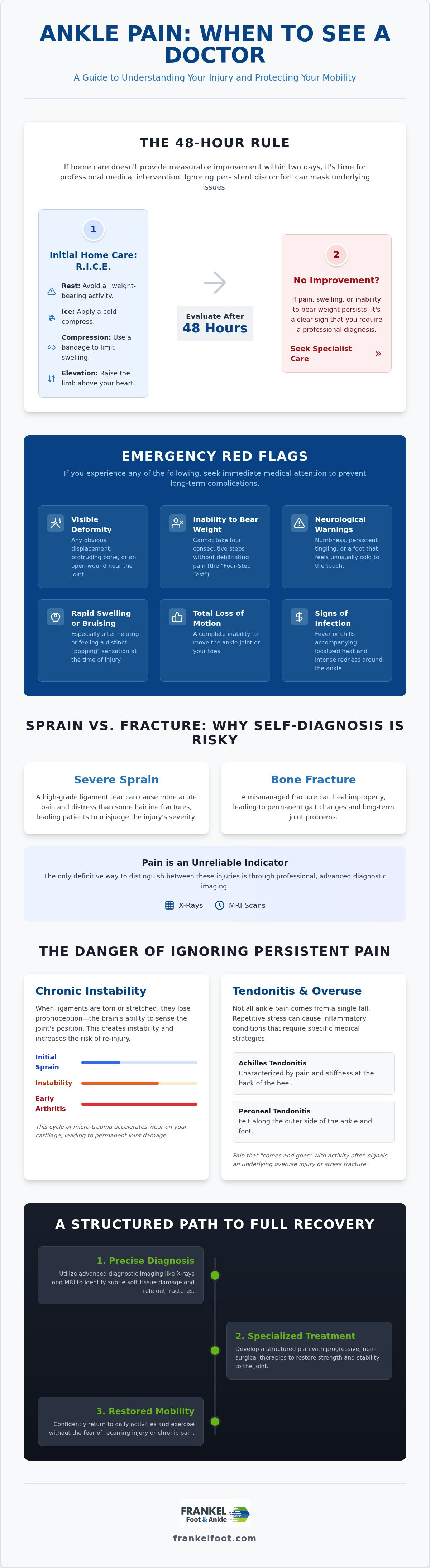
A sudden injury often leaves you in a state of uncertainty. You might wonder if your discomfort is a temporary setback or a sign of structural damage. While minor tweaks often respond to home care, certain "red flags" serve as clear indicators of when to see a doctor for ankle pain without delay. If you observe a visible deformity, a protruding bone, or an open wound near the joint, you must seek emergency medical intervention immediately. These symptoms represent high-grade trauma that requires urgent stabilization to prevent long-term complications.
Beyond visible trauma, your ability to bear weight is a primary diagnostic clue. Experts often utilize a simple four-step test: if you cannot take four steps without significant, debilitating pain, professional imaging is necessary. You should also remain vigilant for neurological or vascular warnings. Numbness, a persistent tingling sensation, or a foot that feels unusually cold to the touch can indicate nerve or vascular compromise. Because these sensations can sometimes stem from spinal issues rather than local injury, specialists like Dr. Rodrigo Ávila Cervantes · Spine Neurosurgeon emphasize the need for a comprehensive diagnosis to ensure treatment success. When severe swelling or deep bruising appears rapidly after a distinct "popping" sensation, it often signals a ruptured ligament or tendon that demands a specialist's evaluation.
When to Seek Immediate Medical Attention
You need a professional assessment if you experience any of the following traumatic symptoms:
- A total inability to move the ankle joint or toes.
- Fever or chills accompanying localized heat and redness, which may indicate infection.
- Extreme tenderness specifically on the bony prominences of the ankle.
Within the first 60 minutes of a suspected fracture or high-grade sprain, focus on total immobilization. Avoid all weight-bearing activity, elevate the limb above the level of your heart, and apply a cold compress to manage the initial inflammatory surge before you reach a clinical setting.
The Difference Between a Sprain and a Fracture
Pain levels are notoriously unreliable when distinguishing between a severe sprain and a bone fracture. Some high-grade ligament tears cause more acute distress than a hairline fracture, leading many patients to delay care. Because a mismanaged fracture can heal improperly and cause permanent gait changes, obtaining professional X-rays or a high-definition MRI at Frankel Foot & Ankle Center is the only definitive way to rule out a break and ensure your recovery begins on a solid foundation.
The "Wait and See" Risk: Why Persistent Pain Requires a Specialist
While the initial shock of an injury might fade, the absence of acute trauma doesn't necessarily mean your ankle is healthy. Many patients wait weeks, hoping a minor ache will resolve on its own. However, the 48-hour rule is a vital benchmark for your recovery. If following the RICE protocol (Rest, Ice, Compression, and Elevation) doesn't yield measurable improvement within two days, you've reached the point when to see a doctor for ankle pain. Ignoring persistent discomfort often masks underlying mechanical issues that home care simply cannot address.
For active individuals, such as hikers navigating the trails in Milford or commuters walking the platforms in Katonah, pain that "comes and goes" is particularly deceptive. This intermittent flare-up often signals a stress fracture or chronic tendonitis. Without a professional gait analysis, these small structural vulnerabilities lead to a cycle of recurrent injury. If you find yourself toughing it out only to have the pain return during daily exercise, it's time to seek specialized ankle pain relief to prevent permanent damage.
Chronic Instability and the Danger of Repeat Injuries
When ligaments are stretched or torn during a sprain, they often lose their proprioception, which is your brain's ability to sense the joint's position. This loss of nerve feedback creates a dangerous instability that makes you significantly more likely to trip or roll your ankle again. Left unmanaged, this cycle of micro-trauma accelerates the wear on your cartilage, frequently progressing from a simple sprain to early-onset ankle arthritis. Professional intervention restores this balance before the joint becomes permanently compromised; for those interested in how nerve health impacts other areas of the body—including symptoms like throat tightness—you can learn more about Precision Spinal Care and its focus on upper cervical alignment.
Signs of Tendonitis and Overuse
Not all ankle issues stem from a single trip or fall. Overuse injuries like Achilles tendonitis, characterized by pain at the back of the heel, or peroneal tendonitis, felt along the outer side of the ankle, require specific medical strategies. These conditions are inflammatory responses to repetitive stress rather than acute trauma. For a deeper look at managing these complexities, explore our Ankle Sprain Treatment guide to understand how tailored therapy can facilitate lasting relief.
Advanced Ankle Care in Middletown, Katonah, and Milford
Transitioning from a mindset of "toughing it out" to a structured recovery plan is a pivotal moment in your health journey. At Frankel Foot & Ankle Center, we replace guesswork with diagnostic precision. While standard X-rays are helpful for identifying bone breaks, they often miss the nuanced soft tissue damage that causes chronic instability. We utilize state-of-the-art imaging to visualize ligaments, tendons, and cartilage in high definition. This level of clarity is essential when deciding when to see a doctor for ankle pain, as it ensures your treatment addresses the actual root cause rather than just the surface symptoms.
For those interested in how a multi-system diagnostic method can uncover the root cause of various medical conditions without invasive procedures, you can learn more about מרכז רפאל.
Our clinical methodology prioritizes the least invasive path to recovery. Many patients achieve lasting relief through non-surgical interventions that go beyond traditional home care. These options range from custom-molded orthotics that correct biomechanical imbalances to advanced laser therapies designed to neutralize deep-tissue inflammation. In cases where structural damage is severe, Dr. Frankel utilizes minimally invasive surgical techniques. These modern procedures are designed for extreme precision, resulting in less tissue disruption and a significantly faster return to your professional and personal life.
This commitment to surgical precision is also found in specialized fields like neurosurgery; click here to see how minimally invasive spine surgery can address nerve-related issues that impact overall mobility.
While podiatric care focuses on the foot and ankle, a holistic approach to recovery often includes ensuring proper spinal and joint alignment. Resources like naturalcarecenter.net demonstrate how chiropractic adjustments can complement localized treatments by improving the body's overall biomechanical efficiency.
Personalized Treatment Plans for Lasting Relief
Every patient's recovery goals are unique. We tailor our medical interventions to suit your specific lifestyle, whether you're a high-impact athlete or someone seeking foot pain from arthritis management. This customized approach ensures that your recovery plan is both sustainable and effective for your long-term mobility. We foster a supportive environment where your physical concerns are met with high-level expertise and genuine care.
Restoring Mobility and Confidence
We take pride in offering a patient-centered warmth that distinguishes our practice from impersonal hospital systems. Residents in Middletown, Katonah, and Milford can expect a thorough consultation where no detail is overlooked and every concern is addressed. Your mobility is our primary mission. Don't allow a minor ache to evolve into a permanent limitation that dictates your quality of life. Schedule a consultation with Dr. Frankel today and take the first step toward restoring your confidence and physical freedom.
Protecting Your Mobility and Restoring Your Active Lifestyle
Choosing the right path for your recovery requires a balance of patient intuition and clinical expertise. From identifying immediate red flags like visible deformity to applying the 48-hour rule for persistent discomfort, you now have the tools to decide when to see a doctor for ankle pain. Delaying care often leads to structural vulnerabilities, but professional intervention ensures that a minor injury doesn't become a chronic limitation. By prioritizing precise diagnostics and tailored treatment plans, you can move past the uncertainty of injury and return to the activities that define your daily life.
Led by Dr. Marc Frankel, a dedicated leader in podiatric medicine, our team provides specialized expertise in achieving a scarless and painless recovery. We operate from three convenient locations serving New York and Pennsylvania, ensuring that high-level care is always within reach for residents in Middletown, Katonah, and Milford. Whether you require advanced non-surgical therapies or minimally invasive surgical techniques, our focus remains entirely on your long-term health and comfort.
Don't let persistent discomfort dictate your future movements. Request Your Ankle Consultation at Frankel Foot & Ankle Center today to begin your journey toward lasting relief. We're here to guide you every step of the way with the compassion and skill you deserve.
Frequently Asked Questions
How do I know if my ankle is sprained or broken?
You cannot definitively distinguish between a severe sprain and a bone fracture without professional diagnostic imaging such as an X-ray or high-definition MRI. While fractures often involve immediate, localized bone tenderness and an inability to bear weight, high-grade ligament tears frequently present with similar intensity and swelling. If you hear a distinct "crack" at the time of injury or observe an obvious physical deformity, it likely indicates a break that requires urgent stabilization.
Can I walk on a sprained ankle if it doesn’t hurt that much?
Walking on an un-stabilized injury is generally discouraged because it can exacerbate ligament damage and significantly delay the natural healing process. Even if the pain feels manageable, the joint's structural integrity may be compromised. Continued weight-bearing on an untreated injury often leads to micro-tears, which eventually result in chronic instability or secondary injuries to the surrounding peroneal tendons.
What happens if I leave chronic ankle pain untreated?
Leaving persistent discomfort unaddressed significantly increases your risk of developing chronic ankle instability and early-onset arthritis. Untreated injuries often heal with excessive scar tissue or permanently stretched ligaments, causing the joint to "give way" during normal activity. This mechanical failure creates a cycle of repeat injuries that destroys protective cartilage and permanently limits your future mobility.
How long should I wait for ankle pain to go away before seeing a doctor?
You should follow the 48-hour rule: if your symptoms don't show measurable improvement after two days of rest, ice, and elevation, it's time to seek professional care. Understanding exactly when to see a doctor for ankle pain prevents a temporary setback from becoming a lifelong physical limitation. Persistent pain beyond this window usually suggests an underlying structural issue that requires specialized medical intervention.


