


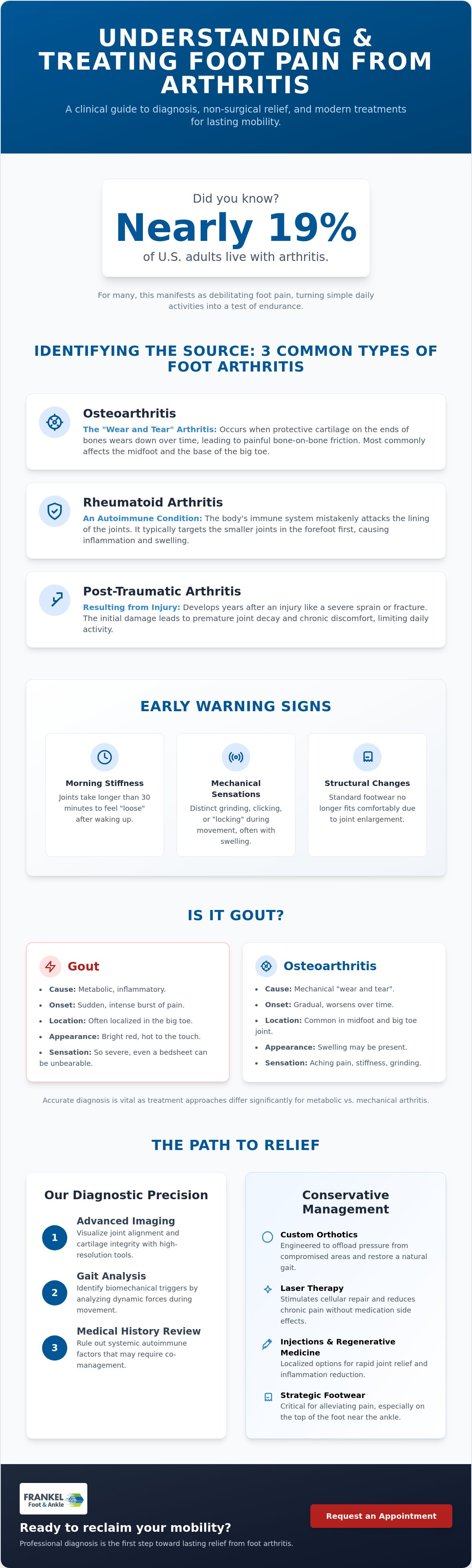
Did you know that nearly 19% of adults in the United States currently navigate the daily challenges of arthritis? For many residents in Middletown, this reality manifests as the sharp, debilitating foot pain from arthritis that turns a simple morning walk into a grueling test of endurance. You've likely felt that frustrating morning stiffness where every step feels labored, or perhaps you're struggling to distinguish whether your discomfort stems from a bunion, gout, or progressive joint wear.
We understand that living with chronic joint pain is both physically and emotionally taxing. Our commitment is to transition you from a state of persistent discomfort to a future of lasting mobility through specialized podiatric care and modern diagnostic precision. This guide provides a clear path toward a definitive diagnosis and explores the latest advancements in minimally invasive, scarless surgical techniques. You'll discover how professional medical methodology can provide the long-term relief you deserve without a heavy reliance on medication.
Key Takeaways
- Distinguish between mechanical wear-and-tear and systemic inflammation to ensure your clinical treatment aligns with your specific arthritic condition.
- Learn how specialized podiatric assessments in Middletown target the root cause of foot pain from arthritis to restore your natural gait and comfort.
- Explore conservative interventions, such as custom orthotics, designed to offload pressure from sensitive joints and provide significant relief without immediate surgery.
- Discover the benefits of modern, scarless surgical techniques that address arthritic damage while prioritizing both aesthetic outcomes and a rapid return to activity.
- Understand the clinical decision-making process between joint restoration and fusion to preserve maximum mobility in the ankle and midfoot.
Identifying the Source: Types of Foot Pain from Arthritis
Understanding the specific nature of your discomfort is the first step toward effective clinical management. Because the foot contains 30 distinct joints, the clinical presentation of foot pain from arthritis varies significantly depending on the underlying pathology. While many patients assume their pain is a natural consequence of aging, it's often rooted in specific different types of arthritis that require tailored interventions to stop further joint decay.
Osteoarthritis remains the primary culprit for "wear and tear" in the midfoot and the base of the big toe. It occurs when the protective cartilage that cushions the ends of your bones wears down over time, eventually leading to bone-on-bone friction. In contrast, Rheumatoid Arthritis is an autoimmune condition where the body's immune system mistakenly attacks the lining of the joints, typically targeting the smaller joints in the forefoot first. For many active individuals in Middletown, post-traumatic arthritis is a common concern. This condition arises years after an initial injury, such as a severe ankle sprain or fracture, leading to premature joint decay and chronic discomfort that can limit your daily activity.
Early Warning Signs You Should Not Ignore
Identifying these symptoms early can prevent long-term mobility loss and help you avoid more invasive procedures later. Watch for these clinical indicators during your daily routine:
- Persistent morning stiffness: If it takes longer than 30 minutes for your joints to feel "loose" or mobile after waking up.
- Mechanical sensations: Feeling a distinct grinding, clicking, or "locking" during movement, often accompanied by visible swelling around the joint.
- Structural changes: Noticing that your standard footwear no longer fits comfortably because of joint enlargement or shifting bone alignment.
Distinguishing Gout from Other Arthritic Conditions
Gout is a metabolic form of inflammatory arthritis that often mimics acute injuries due to its rapid onset. It typically presents with a sudden, intense burst of pain, often localized in the big toe, making even the weight of a bedsheet unbearable. The affected area may appear bright red and feel hot to the touch. It's vital to learn more about the treatment of gout disease to understand how its management differs from the mechanical approach used for osteoarthritis. Accurate diagnosis ensures you receive targeted care that addresses the chemical or mechanical root of your pain.
Clinical Diagnosis and Non-Surgical Relief in Middletown
At our dedicated facilities in Middletown, Katonah, and Milford, we bridge the gap between generalized discomfort and targeted clinical resolution. Accurate identification of the pathology behind foot pain from arthritis requires a level of diagnostic precision that goes beyond physical observation. Our practitioners utilize advanced imaging and high-resolution assessment tools to visualize joint alignment and cartilage integrity, ensuring that your recovery plan is built on verified medical data rather than guesswork.
The Diagnostic Process at Frankel Foot & Ankle Center
This evaluation includes a comprehensive gait analysis to identify the biomechanical triggers that contribute to accelerated joint wear. By analyzing the dynamic forces exerted on your feet during movement, we can determine exactly where structural support is failing and where pressure is most acute. We also perform a meticulous review of your medical history to rule out systemic autoimmune factors that may require specialized co-management. Relying on professional podiatric diagnosis is essential for long-term mobility, as it provides a level of anatomical insight that self-assessment simply cannot replicate.
Conservative Management Strategies
Once a diagnosis is established, we implement a range of conservative management strategies designed to stabilize the joint and reduce inflammation. Custom orthotics are a cornerstone of this approach, as they are engineered to offload pressure from compromised areas and restore a natural gait. For those seeking non-invasive options, laser therapy offers a sophisticated method to stimulate cellular repair and reduce chronic pain without the side effects of systemic medication. We also offer localized steroid injections and regenerative medicine options for rapid joint relief.
Strategic footwear selection is also critical, particularly for alleviating pain on the top of the foot near the ankle, where pressure from laces or poor support can worsen symptoms. Patients often find that a balanced combination of non-surgical and surgical treatments provides the most robust long-term outcome. If you're ready to regain your independence, you can explore comprehensive foot pain relief through our established protocols. Our team is here to provide personalized foot pain relief that addresses your unique health goals and restores your quality of life.
Advanced Surgical Solutions for Arthritic Joint Damage
When conservative measures no longer provide sufficient relief, modern surgical interventions offer a path back to an active lifestyle. For many patients, the chronic foot pain from arthritis is exacerbated by secondary structural issues like bunions or bone spurs. We specialize in advanced techniques that address these complications while minimizing trauma to the surrounding tissues. Our approach transitions you from a state of restricted movement to a future of functional independence.
One of our primary clinical focuses is joint restoration, which aims to preserve natural movement rather than resorting immediately to fusion. While joint fusion is sometimes necessary for severe instability, restoration techniques allow for a greater range of motion in the ankle and midfoot. We also perform minimally invasive debridement to remove "joint mice" and bone spurs that cause painful grinding sensations. This precise approach is essential when managing arthritis of the feet, as it addresses mechanical obstructions without the need for extensive open surgery.
The Advantage of Scarless and Painless Techniques
Dr. Frankel utilizes an advanced methodology that prioritizes both functional recovery and aesthetic results. By choosing specialized techniques, Middletown patients experience minimal tissue disruption, which translates to a significantly faster and less painful recovery period. You can discover the benefits of scarless bunion surgery as a transformative option for correcting arthritic toe alignment without visible scarring. Our compassionate post-operative care ensures that your transition from the operating room to your daily routine is as seamless as possible.
When is Surgery the Right Choice?
Determining the appropriate time for surgery involves assessing your daily quality of life and the limitations imposed by foot pain from arthritis. If simple tasks like grocery shopping or morning walks become painful despite orthotics and injections, it's time to consider a surgical consultation. Timely intervention doesn't just fix the foot; it prevents the development of secondary pain in the knees and hips caused by an altered, compensatory gait. Our goal is to provide a permanent solution that restores your confidence in every step.
Reclaiming Your Active Lifestyle in Middletown
Managing the complexities of foot pain from arthritis requires more than just masking the symptoms; it demands a clinical strategy that addresses both the mechanical and inflammatory roots of your discomfort. We've explored how transitioning from diagnostic uncertainty to precise, specialized care can redefine your quality of life. Whether your path involves custom orthotics to offload joint pressure or advanced, scarless surgical techniques to restore structural alignment, our focus remains on achieving lasting results that honor your body's natural function and aesthetic.
As a specialist in scarless and painless surgery, Dr. Frankel combines board-certified podiatric expertise with a compassionate, patient-centered care model that prioritizes your comfort at every stage. You don't have to accept chronic stiffness or limited mobility as an inevitable part of your daily routine. We invite you to schedule a consultation with Dr. Frankel in Middletown, Katonah, or Milford to begin your comprehensive journey toward recovery. Our team is dedicated to providing the sophisticated medical guidance and innovative treatments you need to walk with confidence and ease again.
Frequently Asked Questions
How can I tell if my foot pain is arthritis or just overuse?
Overuse injuries typically resolve with rest and basic home care within a few days; however, foot pain from arthritis is characterized by its persistent nature and tendency to flare up after periods of inactivity. If you notice that your joints feel stiff for more than 30 minutes every morning or if you experience a grinding sensation during movement, these are strong clinical indicators of an arthritic condition. A professional evaluation using advanced imaging is the only way to accurately distinguish between soft tissue strain and progressive joint decay.
Is surgery for foot arthritis always the last resort?
Surgery is not necessarily a last resort but rather a proactive intervention used when conservative treatments no longer support your desired quality of life. In many cases, early surgical restoration can prevent the joint from reaching a state of total collapse, which would eventually require more invasive fusion procedures. We view surgery as a precise tool to restore your biomechanical alignment and protect the health of your knees and hips from compensatory strain.
What is the most effective treatment for gout in the foot?
The most effective approach to gout involves a dual strategy of metabolic management and localized anti-inflammatory care. Because gout is caused by uric acid crystals rather than mechanical wear, we focus on treatments that neutralize the chemical triggers of the flare-up while protecting the joint from permanent structural damage. This specialized methodology ensures that the intense, sudden pain is managed quickly and that future episodes are prevented through proper clinical guidance.
Can scarless bunion surgery help if I already have arthritis in the joint?
Scarless bunion surgery is highly effective for patients who have developed arthritic changes at the base of the big toe. By realigning the joint through minimally invasive techniques, we can significantly reduce the bone-on-bone friction that causes foot pain from arthritis. This modern approach allows us to correct the structural deformity and alleviate joint pressure with minimal tissue disruption, leading to a much faster recovery than traditional open surgeries.


