


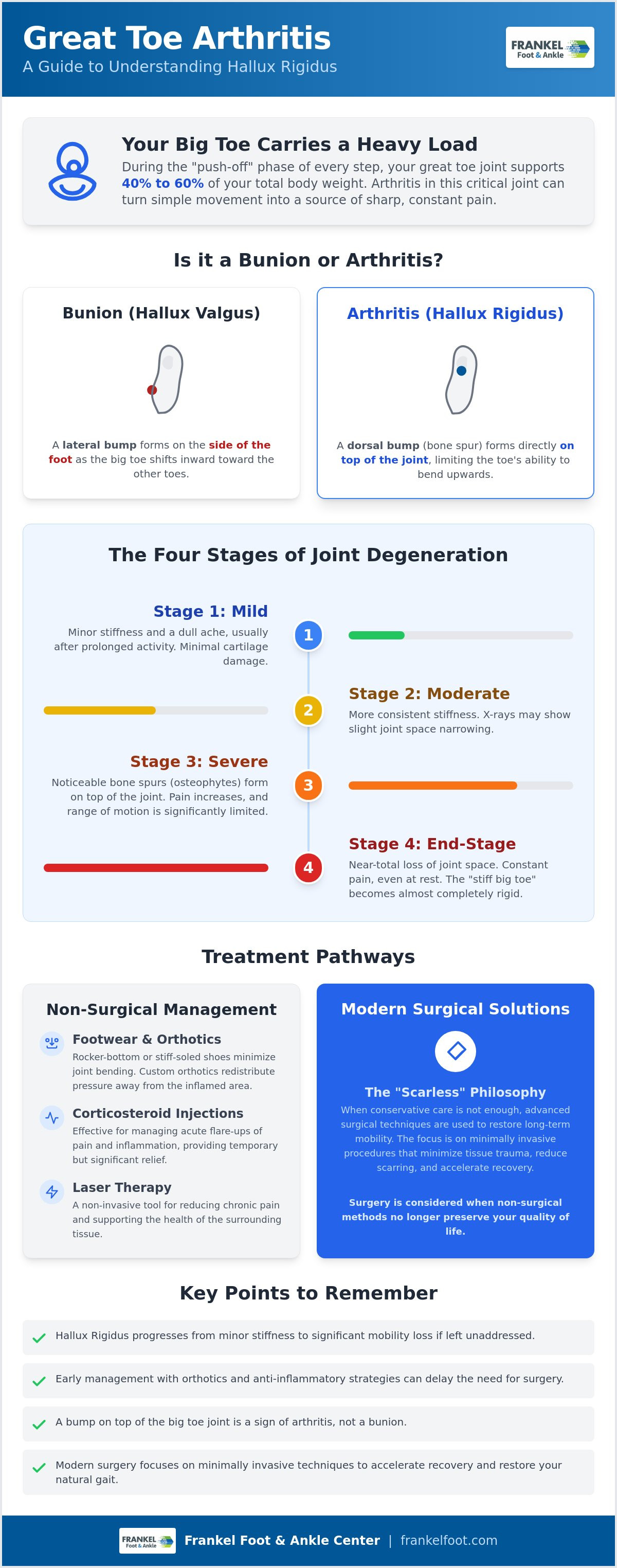
Did you know that your big toe carries approximately 40% to 60% of your total body weight during the push-off phase of every single step? When you're living with great toe joint arthritis, this simple mechanical reality becomes a source of constant, sharp frustration. We understand how discouraging it feels to set aside your favorite footwear because of painful bone spurs or to skip your morning exercise because the joint stiffness has become too much to manage. You deserve a solution that combines high-level surgical expertise with a warm, supportive approach to your recovery.
In this guide, you'll discover how to identify the specific stages of big toe arthritis and explore the latest non-surgical and minimally invasive treatments designed to restore your mobility. We'll provide a methodical look at how various clinical grades impact your movement and what modern interventions can do to reduce chronic inflammation. From early diagnostic imaging to advanced recovery protocols, you'll find a clear path toward restoring your range of motion and returning to the activities you love in Middletown and Milford.
Key Takeaways
- Understand why great toe joint arthritis, medically known as Hallux Rigidus, progresses from minor stiffness to significant mobility loss if left unaddressed.
- Learn how to manage early-stage joint discomfort through a methodical combination of specialized orthotics and targeted anti-inflammatory strategies.
- Discover the "Scarless" surgical philosophy that utilizes advanced, minimally invasive techniques to minimize tissue trauma and accelerate your recovery.
- Identify the critical clinical stages of cartilage wear to determine whether conservative care or specialized intervention is most appropriate for your lifestyle.
- Explore how modern podiatric advancements can restore your natural walking gait and eliminate the sharp pain experienced during the push-off phase of movement.
Understanding Great Toe Joint Arthritis (Hallux Rigidus)
Great toe joint arthritis, clinically known as Hallux Rigidus (Stiff Big Toe), involves the progressive erosion of protective cartilage within the metatarsophalangeal (MTP) joint. Your big toe isn't just a digit; it's a critical mechanical lever that facilitates balance and provides the necessary propulsion for every step you take. When this cartilage wears thin, the joint loses its smooth gliding surface. Hallux Rigidus is a degenerative condition that limits the toe's ability to bend upward. This restriction often stems from a combination of genetic predisposition, structural foot alignment, or repetitive trauma from past sports injuries.
The Four Stages of Joint Degeneration
The progression of the disease follows a predictable clinical path that dictates your treatment options. Stages 1 and 2 often present as mild stiffness or a dull ache that surfaces after long days on your feet. By Stage 3, the body attempts to stabilize the failing joint by growing new bone. This results in noticeable bone spurs, or osteophytes, that form on the top of the joint. Stage 4 represents the most advanced phase, characterized by constant pain even at rest and a near-total loss of joint space.
Is it a Bunion or Arthritis?
Many patients arrive at our Middletown or Milford offices confused about the source of their foot pain. While both conditions involve a protrusion, the location is the key differentiator. A bunion creates a lateral bump on the side of the foot as the toe shifts inward. In contrast, great toe joint arthritis produces a dorsal bump directly on top of the joint. It's also possible that bunions and gout may mimic or even complicate your symptoms, making a professional diagnostic evaluation essential for a clear recovery path.
Non-Surgical Management and Pain Relief Strategies
Managing great toe joint arthritis begins with a methodical approach to reducing mechanical stress on the metatarsophalangeal joint. In the early stages, our goal is to preserve as much natural function as possible by limiting the repetitive bending that causes inflammation. Many patients find that early intervention in Middletown can delay the necessity of operative procedures by several years. From adjusting daily activity levels to incorporating anti-inflammatory medications, these conservative strategies form a vital foundation for your recovery journey.
Footwear and Orthotic Interventions
The foundation of non-surgical care often lies in your choice of footwear. We frequently recommend shoes with rocker-bottom soles, which assist with the natural gait cycle by rolling the foot forward without requiring the big toe to bend significantly. Stiff-soled shoes are equally vital as they minimize the demand placed on the joint during the push-off phase of walking. Additionally, custom orthotics play a crucial role by redistributing pressure away from the sensitive joint and onto more stable structures of the foot. By providing this structural support, you can continue staying active without exacerbating the underlying cartilage wear.
Clinical Treatments: Beyond the Pharmacy
When home care is insufficient, advanced clinical interventions provide a higher level of relief. Corticosteroid injections are effective for managing acute flare-ups, while modern laser therapy offers a non-invasive tool for reducing pain and supporting tissue health. While these methods are highly effective for Grade 1 and 2 cases, understanding the full range of Surgical Options for Hallux Rigidus helps patients recognize when it's time to transition to more permanent solutions. If you're struggling to find consistent foot and ankle pain relief, a structured consultation can help define the most effective path forward. You don't have to manage this condition alone; our team is here to help you evaluate your treatment options and restore your quality of life.
Modern Surgical Solutions: Restoring Motion with Minimal Scars
When conservative measures like orthotics or injections no longer preserve your quality of life, surgical intervention becomes a necessary step toward long-term mobility. For many patients, the anxiety surrounding traditional surgery involves concerns about visible scarring and a lengthy, painful recovery. At our practices in Middletown and Milford, we utilize a "Scarless" philosophy that prioritizes minimally invasive techniques. By employing smaller incisions and advanced instrumentation, we aim to minimize tissue trauma and promote a more aesthetic result. These progressive methods, often discussed in clinical reviews of Hallux Rigidus (Great Toe Arthritis), allow us to address the underlying degeneration while preserving the delicate structures surrounding the joint.
Cheilectomy: Shaving the Bone Spurs
For individuals in Stages 1 through 3 of great toe joint arthritis, a cheilectomy is often the preferred joint-preserving procedure. This technique involves carefully shaving away the painful bone spurs, or osteophytes, that have accumulated on the top of the joint. By removing this mechanical obstruction, we restore the toe's ability to bend upward, significantly improving your natural gait. One of the most rewarding outcomes for our patients is the restored ability to wear diverse shoe styles that were previously too painful to accommodate the dorsal "bump." While advanced Stage 4 cases might require a joint fusion for stability, a cheilectomy offers a powerful solution for maintaining motion.
The Frankel Approach to Recovery
We believe your journey toward recovery should be as comfortable as possible. The Frankel Foot & Ankle Center focuses on painless recovery protocols that integrate advanced local anesthetics with precise surgical skill. Our patients often find that the sophisticated techniques used for ankle pain relief translate seamlessly to forefoot procedures, ensuring a supportive experience from start to finish. Most individuals return to protected walking within days and can resume light exercise shortly thereafter. We encourage local residents to visit Frankel Foot & Ankle for a specialized evaluation to determine which path best fits their lifestyle and health goals.
Taking the Next Step Toward Pain-Free Mobility
Living with great toe joint arthritis doesn't mean you have to accept a permanent decline in your active lifestyle. By understanding the progressive nature of Hallux Rigidus and utilizing a methodical approach to treatment, you can find a solution that fits your specific stage of joint wear. From early-stage orthotic support to advanced joint-preserving surgery, modern podiatry offers the tools necessary to eliminate chronic inflammation and restore your natural range of motion.
Dr. Marc Frankel and our clinical team are dedicated to providing sophisticated care through specialized scarless and painless surgical techniques. We understand the importance of a clear path to recovery; it's why we offer comprehensive evaluations at our convenient locations in Middletown NY, Katonah NY, and Milford PA. Schedule a Consultation for Big Toe Pain Relief at Frankel Foot & Ankle today to begin your journey toward lasting relief. You deserve to move with confidence and comfort once again.
Frequently Asked Questions
Can great toe joint arthritis be cured without surgery?
While there is no current medical cure that reverses the loss of cartilage, great toe joint arthritis can often be managed effectively without surgery in its earlier stages. Non-surgical protocols focus on reducing inflammation and mechanical stress through custom orthotics, stiff-soled shoes, and targeted clinical treatments like laser therapy. These interventions aim to stabilize the joint and alleviate pain, allowing many patients to maintain an active lifestyle while delaying the need for operative procedures.
What happens if Hallux Rigidus is left untreated?
Hallux Rigidus is a progressive condition that typically worsens over time if left unaddressed. As the protective cartilage continues to erode, the body often attempts to stabilize the joint by producing bone spurs, or osteophytes. This leads to increased stiffness, a significant reduction in your range of motion, and a compensatory gait that may cause secondary pain in the hips or lower back. Early diagnosis is essential to preserve as much natural joint function as possible.
Is surgery for big toe arthritis painful?
Modern surgical advancements have revolutionized the patient experience, focusing on minimizing tissue trauma and prioritizing a comfortable recovery. At our centers, we utilize sophisticated scarless and painless surgical protocols that integrate advanced local anesthetics with minimally invasive techniques. These smaller incisions lead to reduced post-operative swelling and discomfort. Most patients find the recovery process much more manageable than traditional methods, allowing for a quicker return to daily activities with minimal reliance on heavy pain medications.
How do I know if I need a cheilectomy or a joint fusion?
The decision between a cheilectomy and a joint fusion depends on the specific clinical stage of your great toe joint arthritis. A cheilectomy is a joint-preserving procedure ideal for patients in Stages 1 through 3 who still have adequate healthy cartilage. It involves removing bone spurs to restore motion. In contrast, a joint fusion is typically reserved for Stage 4 cases where the joint space is entirely lost. This procedure provides lasting stability and eliminates pain by fusing the bones together.


