


Loosening your shoe laces or buying new sneakers won't solve a problem that starts deep within the joint. When you experience persistent pain on top of foot near ankle, the true issue is rarely just surface footwear pressure. It's deeply frustrating to endure a sharp ache every time you walk uphill or flex your foot, especially when you can't tell whether you're facing a simple tendon strain or a deeper bone issue.
You don't have to navigate recovery through guesswork. This guide reveals the exact anatomical causes behind dorsal discomfort, from extensor tendonitis to nerve compression, and outlines clinically grounded steps to secure lasting relief. We'll explore practical at-home adjustments to ease pressure immediately and highlight the essential symptoms that require a dedicated podiatric evaluation.
Key Takeaways
- Distinguish between soft tissue inflammation and bone impingement to uncover the root cause of your pain on top of foot near ankle.
- Recognize how specific movement triggers, such as pulling the toes upward or flexing forward, signal distinct anatomical injuries.
- Implement immediate conservative relief techniques, including targeted ice therapy and pressure-reducing window lacing methods.
- Identify critical red-flag symptoms, such as weight-bearing inability or persistent swelling, that require dedicated podiatric imaging.
Primary Causes of Pain on the Top of the Foot Near the Ankle
Discomfort along the dorsal surface often stems from distinct mechanical tensions rather than a single generalized issue. To understand why you have pain on top of foot near ankle, you must evaluate the tissues crossing the anterior joint line. While systemic conditions are among the common causes of ankle pain, localized dorsal discomfort usually tracks back to three specific mechanical problems:
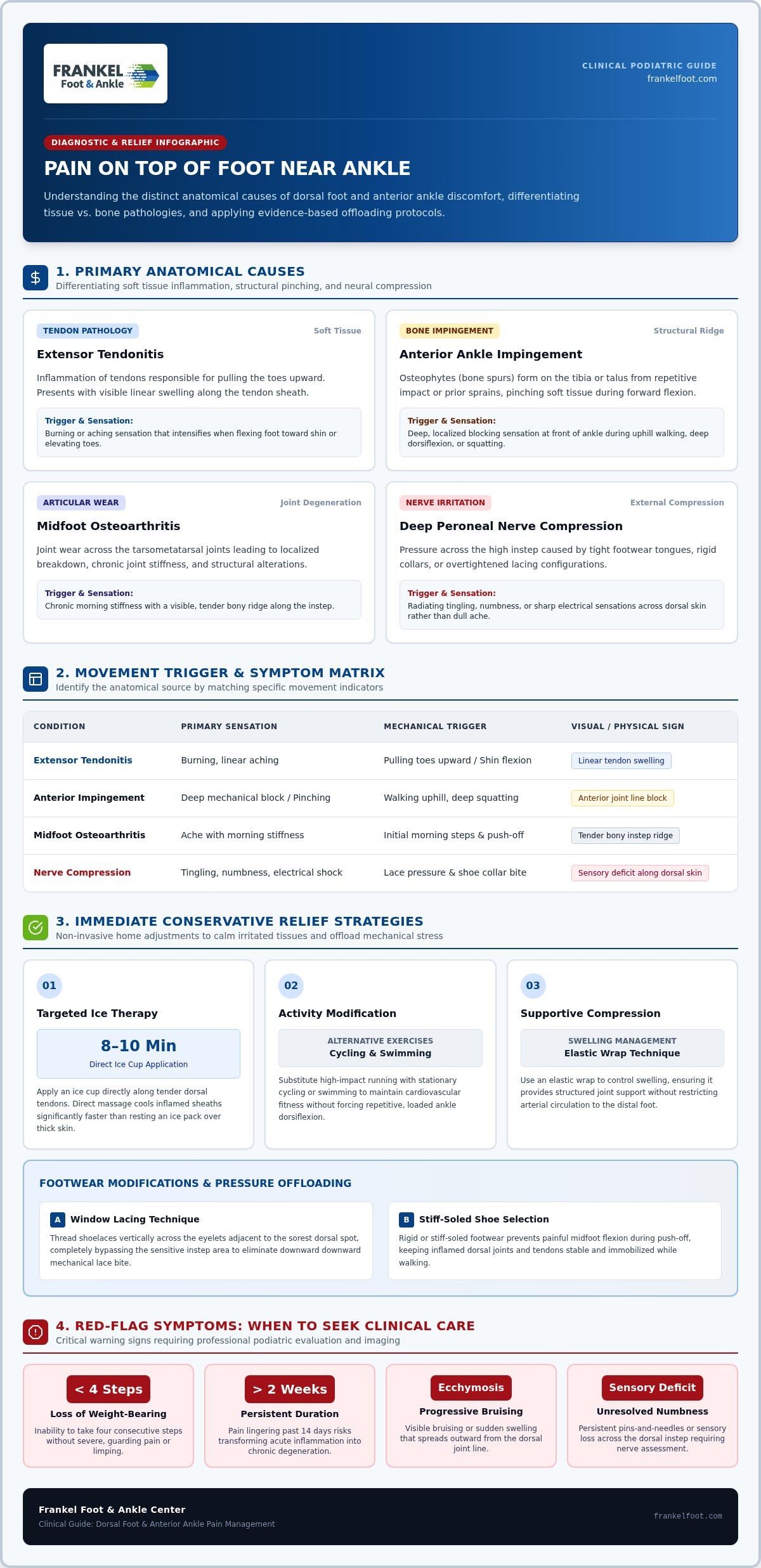
- Extensor Tendonitis: Inflammation of the tendons responsible for pulling the toes upward causes a distinct burning or aching sensation that intensifies when flexing the foot toward the shin.
- Anterior Ankle Impingement: Repetitive impact or past sprains can stimulate osteophytes, or bone spurs, on the tibia or talus. These bony ridges pinch soft tissue during forward flexion, especially when walking uphill or squatting.
- Midfoot Osteoarthritis: Joint wear across the tarsometatarsal joints produces chronic morning stiffness and creates a visible, tender bony ridge along the instep.
Extensor Tendonitis vs. Anterior Impingement and Nerve Compression
Differentiating soft tissue inflammation from structural bone pinching is vital for finding lasting foot pain relief. Extensor tendonitis typically flares during toe elevation and presents with visible, linear swelling along the tendon sheath. Conversely, anterior impingement creates a deep, localized blocking sensation at the front of the ankle during deep dorsiflexion.
Tight footwear tongue pressure introduces a third factor: compression of the deep peroneal nerve. When rigid shoe collars or overtightened laces bite across the high instep, the nerve becomes irritated. This impingement radiates tingling, numbness, or sharp electricity across the dorsal skin rather than producing a dull mechanical ache.
Differentiating Symptoms and Immediate At-Home Relief Strategies
Relieving mechanical stress starts with isolating which movements provoke your discomfort. Recognizing distinct Tibialis Anterior Tendonitis symptoms, such as weakness during heel walking or tenderness along the tendon path, helps differentiate soft tissue strain from articular impingement. When you develop acute pain on top of foot near ankle, resting the joint and removing focal pressure should be your first priority.
Begin with direct, conservative interventions to calm irritated dorsal tissues:
- Targeted Ice Therapy: Apply an ice cup directly along the tender dorsal tendons for 8 to 10 minutes. This targeted massage cools inflamed sheaths faster than resting an ice pack over thick skin.
- Activity Modification: Substitute high-impact running with stationary cycling or swimming. These low-impact options maintain cardiovascular fitness without forcing repetitive, loaded ankle dorsiflexion.
- Supportive Compression: Use an elastic wrap to control swelling, ensuring it supports without restricting arterial circulation.
Evaluating Footwear Modifications and Conservative Offloading
Your shoe choice directly dictates the mechanical force placed across the dorsal instep. Rigid or stiff-soled shoes prevent painful midfoot flexion during push-off, keeping inflamed joints stable while you walk. If standard footwear causes lace bite, adopt window lacing: thread your shoelaces vertically across the eyelets adjacent to the sorest spot, bypassing the sensitive area completely to eliminate downward pressure.
Offloading dorsal friction provides fast symptomatic comfort, but chronic inflammation often requires professional biomechanical assessment. Review our comprehensive guide on comprehensive foot pain relief to discover structured conservative therapies. If persistent discomfort restricts your everyday routine, our team at Frankel Foot & Ankle Center can tailor dedicated non-invasive strategies to restore lasting mobility.
When to Seek Professional Podiatric Care for Lasting Relief
Mild tissue irritation often responds to prompt rest, yet specific warning signs indicate structural pathology that home remedies cannot resolve. If you cannot bear weight without limping or observe spreading bruising across the dorsal midfoot, seek an urgent evaluation. Persistent pain on top of foot near ankle that lingers beyond two weeks also warrants a targeted clinical assessment before acute inflammation transforms into chronic tendon degeneration.
- Loss of Weight-Bearing Function: Inability to take four consecutive steps without severe, guarding pain.
- Progressive Ecchymosis: Visible bruising or sudden swelling that spreads outward from the dorsal joint line.
- Sensory Deficits: Unresolved numbness or persistent pins-and-needles across the instep.
Clinical Diagnostic Imaging and Targeted Non-Surgical Solutions
Accurate recovery begins with precision diagnostics. Advanced in-office digital X-rays and dynamic ultrasound allow podiatrists to pinpoint subtle cortical stress fractures or extensor tears that manual exams miss. Evaluating the foot under active weight-bearing conditions exposes the precise structural faults driving dorsal stress.
Once diagnosed, non-invasive therapies deliver reliable stability without surgery. Custom-molded orthotics realign the medial arch, transferring ground reaction forces away from the anterior joint capsule to relieve localized pinching. At Frankel Foot & Ankle Center, Dr. Marc Frankel designs individualized conservative protocols, guiding patients from diagnostic assessment to lasting ankle pain relief across Middletown NY, Katonah NY, and Milford PA.
Reclaim Comfort and Step Confidently Again
Living with persistent pain on top of foot near ankle shouldn't dictate your daily activity. Pinpointing whether dorsal discomfort stems from tendon inflammation, nerve irritation, or joint spurs is the essential first step toward lasting recovery. While simple footwear modifications provide immediate mechanical relief, resolving chronic instability requires a precise, diagnostic-first approach.
Led by Dr. Marc Frankel, our team focuses on gentle, conservative, and minimally invasive treatments to restore natural mobility before ever considering surgery. With dedicated podiatric offices in Middletown, Katonah, and Milford, comprehensive clinical care is always close to home. Take control of your recovery today and schedule a consultation for foot and ankle pain relief. Pain-free movement is entirely within reach.
Frequently Asked Questions
Can tight shoe laces cause pain on top of the foot near the ankle?
Yes, overtightened laces frequently cause pain on top of foot near ankle by compressing delicate dorsal tissues against the underlying bone. This friction inflames the extensor tendon sheaths and pinches the deep peroneal nerve, a condition commonly known as lace bite. Switching to window lacing techniques removes direct downward pressure across the high instep and allows irritated tissues to calm.
How can I tell if dorsal foot pain is a tendon issue or a stress fracture?
Tendon irritation hurts primarily during active motion, whereas stress fractures generate deep, throbbing aches that often persist at rest. With extensor tendonitis, pain intensifies when you pull your toes upward toward your shin. A stress fracture typically presents with pinpoint tenderness directly over a specific bone, localized warmth, and sharp discomfort that steadily escalates with each weight-bearing step.
What does anterior ankle impingement feel like when walking?
Anterior impingement feels like a sharp pinching sensation or physical mechanical block right where the foot meets the lower leg. You'll notice it most when walking uphill, descending stairs, or squatting, as the ankle joint flexes deeply forward. This movement traps inflamed soft tissue or bone spurs between the tibia and talus, noticeably limiting your pain-free range of motion.
When should I see a podiatrist for pain on the top of my foot?
Schedule an evaluation if pain on top of foot near ankle persists for more than two weeks or impairs your normal gait. Severe swelling, spreading bruising, or nerve numbness require prompt clinical imaging. At Frankel Foot & Ankle Center, Dr. Marc Frankel provides diagnostic-first care across Middletown and Katonah, NY, and Milford, PA, prioritizing targeted conservative therapies for lasting relief.


