


What if the inward roll you are trying to eliminate is actually the exact mechanism designed to protect your joints? Normal ankle pronation serves as your body's built-in shock absorber, yet it often gets blamed for persistent lower-body discomfort. If you regularly finish a walk with aching arches or notice the inner edges of your shoes wearing down prematurely, you are likely wondering whether your foot is collapsing inward too far and placing undue strain on your knees and hips.
In this guide, you will learn how to distinguish between healthy biomechanics and the mechanical stress of overpronation, empowering you to prevent secondary complications like bunions and determine whether orthotic support is necessary. Ahead, we examine the mechanics of your stride, identifiable warning signs, and proven pathways to restore pain-free movement.
Key Takeaways
- Understand the vital biomechanical difference between healthy ankle pronation, which absorbs walking impact, and excessive rolling that strains foot tendons.
- Discover how comprehensive diagnostic gait evaluations identify the root causes of persistent arch fatigue, uneven tread wear, and referred joint pain.
- Explore how targeted footwear strategies and prescription orthotic support can stabilize your stride and restore functional alignment.
- Learn when conservative therapies are insufficient and how specialized clinical intervention protects against secondary deformities like bunions.
Understanding Ankle Pronation vs. Overpronation
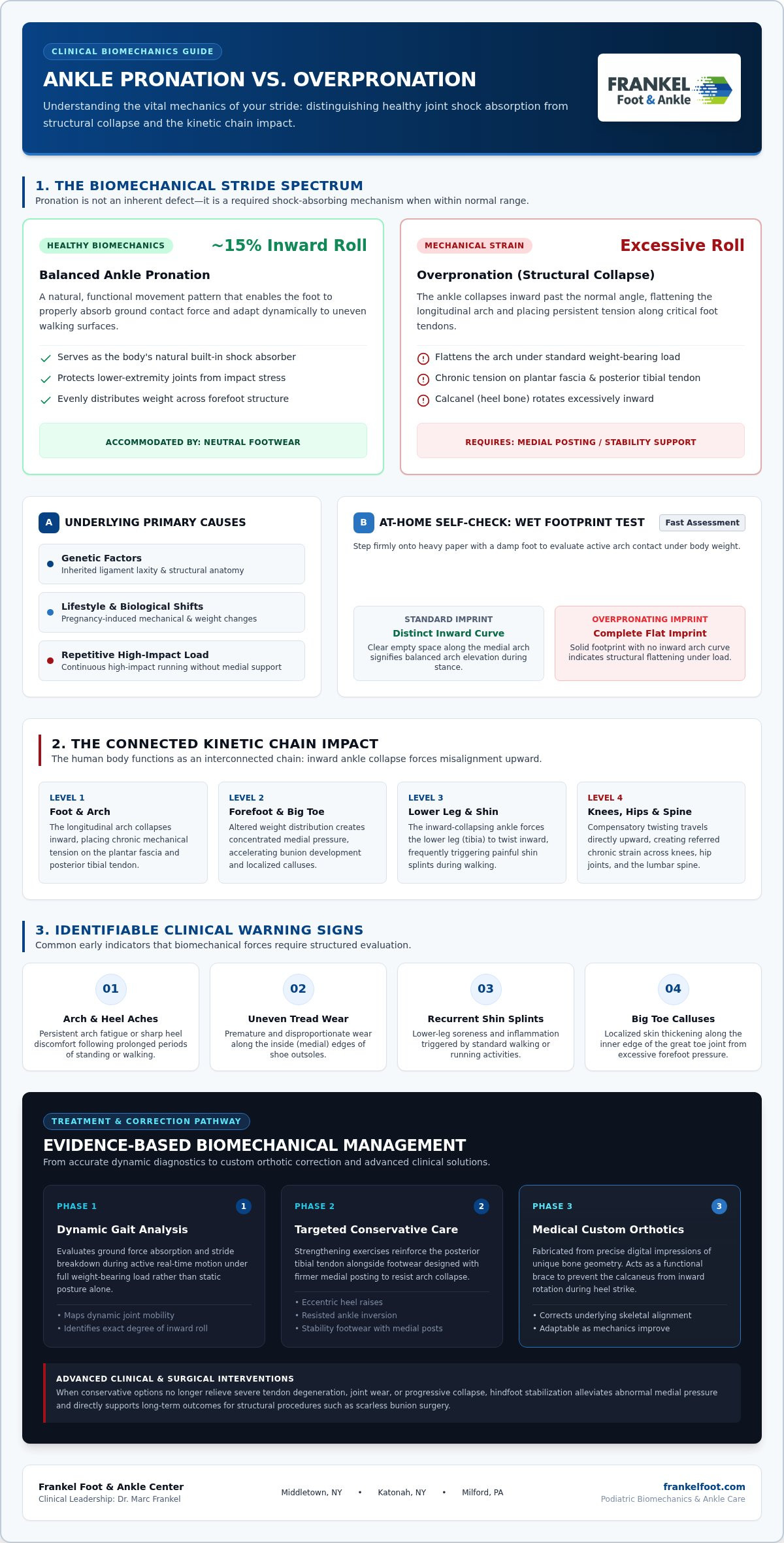
Many people mistakenly view pronation as a structural defect, but clinical biomechanics tells a different story. In truth, pronation is a natural movement that allows your foot to absorb shock and adapt to uneven surfaces. During a balanced gait, healthy ankle pronation involves an inward roll of roughly fifteen percent. Mechanical issues emerge only during overpronation, where the ankle rolls excessively inward. This structural collapse flattens the arch and places chronic tension on the plantar fascia and posterior tibial tendon.
Underlying causes range from genetic ligament laxity to lifestyle factors such as pregnancy or repetitive high-impact running. To check your foot structure at home, perform a quick wet footprint test: step onto heavy paper with a damp foot. If your print shows a complete imprint without an inward curve along the arch, your feet likely sit flat and roll inward under load.
Symptoms and Long-term Risks of Mechanical Misalignment
Left unmanaged, abnormal inward rolling stresses the entire lower extremity. Common early indicators include:
- Persistent heel or arch pain after prolonged standing
- Shin splints triggered by standard walking or running
- Localized calluses along the inner edge of the big toe
Over time, the biomechanical instability of overpronation alters weight distribution across the forefoot. This concentrated pressure accelerates the development of bunions at the base of the big toe joint. Because the body functions as an interconnected kinetic chain, an inward-collapsing foot also forces the lower leg to twist inward, creating chronic strain that travels up to the knees, hips, and lumbar spine.
Diagnostic Methods and Conservative Management Strategies
Accurate clinical assessment begins with dynamic gait analysis, which captures motion in real time to reveal exactly where biomechanics break down. Clinicians evaluate how the foot absorbs ground force under active weight-bearing rather than relying solely on static posture. Understanding your specific degree of ankle pronation allows specialists to prescribe targeted footwear. Neutral footwear accommodates balanced mechanics, while stability shoes incorporate firmer medial posting to counteract inward arch collapse. Targeted strengthening, particularly eccentric heel raises and resisted inversion, helps reinforce the posterior tibial tendon. Yet, when at-home stretching proves insufficient for lasting ankle pain relief, formal clinical intervention becomes necessary.
Structured clinical oversight remains central to diagnosing and managing overpronation effectively before chronic microtrauma accumulates across the joint complex.
The Role of Custom Orthotics in Biomechanical Correction
Generic store-bought insoles offer temporary cushioning, but they cannot correct underlying skeletal misalignment. In contrast, medical-grade custom orthotics are fabricated from precise digital impressions of your unique bone structure. By supporting the midfoot, they act as a functional brace to prevent the calcaneus (heel bone) from rotating excessively inward during heel strike. Regular adjustments ensure the orthotic adapts as your muscular control and stride mechanics improve. If persistent joint discomfort continues to limit your mobility, the team at Frankel Foot & Ankle Center can evaluate your biomechanics and craft an individualized plan to restore lasting comfort.
Advanced Clinical Solutions for Chronic Ankle Issues
When conservative interventions like supportive shoes or custom orthotics no longer relieve persistent joint stiffness and structural pain, advanced clinical care becomes the logical next step. Severe tendon degeneration, joint wear, or progressive structural collapse can make everyday standing unbearable. At Frankel Foot & Ankle Center, our focus centers on diagnosing biomechanical deficits and delivering lasting foot pain relief. Addressing the underlying mechanical drivers of ankle pronation is essential; stabilizing the hindfoot alleviates abnormal medial pressure, directly protecting long-term outcomes for structural corrections like scarless bunion surgery.
Residents across Middletown NY, Katonah NY, and Milford PA shouldn't wait for minor joint aches to evolve into debilitating mobility limits before scheduling a thorough podiatric assessment.
Personalized Care at Frankel Foot & Ankle Center
Under the leadership of Dr. Marc Frankel, our practice approaches complex lower-extremity conditions with methodical clinical expertise and compassionate care. Each patient's path begins with a detailed diagnostic consultation, mapping joint mobility, gait dynamics, and weight distribution. Rather than offering short-term fixes, our team designs progressive treatment pathways tailored to your anatomy. From non-invasive structural therapy to minimally invasive surgical intervention, our goal remains clear: correcting faulty alignment to restore functional mobility and deliver dependable ankle pain relief.
Restore Alignment and Protect Your Mobility
Understanding your gait is the first step toward lasting comfort. Healthy ankle pronation cushions every step, but untreated overpronation places excessive strain across your entire kinetic chain, accelerating joint wear and soft tissue fatigue. Taking proactive measures through precise biomechanical correction shields your feet from progressive deformities and preserves your active lifestyle.
At Frankel Foot & Ankle Center, our compassionate team provides expert podiatric care across Middletown, Katonah, and Milford. Whether you require conservative alignment therapy or advanced intervention such as scarless bunion surgery, we prioritize patient-centered outcomes built for long-term relief. Don't let chronic aches dictate your daily routine. Schedule your comprehensive gait analysis at Frankel Foot & Ankle Center today and take a confident step toward pain-free living.
Frequently Asked Questions
What is the difference between overpronation and flat feet?
Flat feet describe a static foot shape where the arch rests flat against the ground, whereas overpronation refers to a dynamic motion where the foot rolls inward too far during gait. While people with low arches often overpronate, they aren't identical conditions. A clinical assessment clarifies whether your structural shape causes functional issues or if it operates smoothly without excessive joint strain.
Can ankle pronation be corrected without surgery?
Yes, abnormal ankle pronation can typically be managed without surgical intervention through conservative biomechanical care. Prescription custom orthotics, targeted posterior tibial tendon exercises, and structured footwear realign your stride effectively. Surgery is rarely required for the pronation itself, remaining reserved for severe joint instability or advanced secondary complications that don't respond to proactive, non-invasive therapies.
How do I know if I need custom orthotics for my overpronation?
You likely need custom orthotics if store-bought insoles fail to relieve persistent arch, heel, or knee ache after walking. Visible uneven tread wear along the inside edges of your shoes is another common indicator. A professional gait analysis identifies whether your joint alignment requires personalized calcaneal support to eliminate mechanical stress and protect your stride.
Does overpronation cause bunions or make them worse?
Overpronation accelerates bunion formation by directing repetitive, excessive ground force onto the first metatarsal joint. As the arch collapses inward, the big toe is forced toward the second toe, destabilizing the joint structure over time. Managing this inward collapse protects your forefoot, while patients suffering from established painful deformities can explore scarless bunion surgery for lasting correction.


