


What if the persistent ache in your lower back or the chronic fatigue in your arches isn't a sign of aging, but a direct result of a subtle misalignment known as ankle overpronation? Many individuals notice uneven wear patterns on their shoes or struggle to distinguish between simple flat feet and a complex gait abnormality. It's frustrating to endure daily walking-related discomfort without knowing if your inward-rolling ankles are the true source of your pain.
This article will help you identify ankle overpronation and discover the professional pathways to restoring your natural gait and preventing chronic pain. We examine the mechanics of your stride and highlight advanced clinical solutions available in the Middletown area, guiding you from initial diagnostic gait analysis to targeted treatments that offer lasting foot and ankle pain relief.
Key Takeaways
- Identify the biomechanical signs of ankle overpronation, specifically how excessive inward rolling during movement leads to arch collapse and structural fatigue.
- Understand the correlation between untreated gait abnormalities and the development of secondary conditions like bunions, hammertoes, and adult-acquired flatfoot.
- Learn why professional diagnostic gait analysis is a critical step in measuring misalignment and preventing long-term joint degeneration.
- Discover the therapeutic benefits of medical-grade custom orthotics for restoring your natural stride and achieving sustainable relief from chronic foot pain.
What is Ankle Overpronation and How Does It Affect Your Gait?
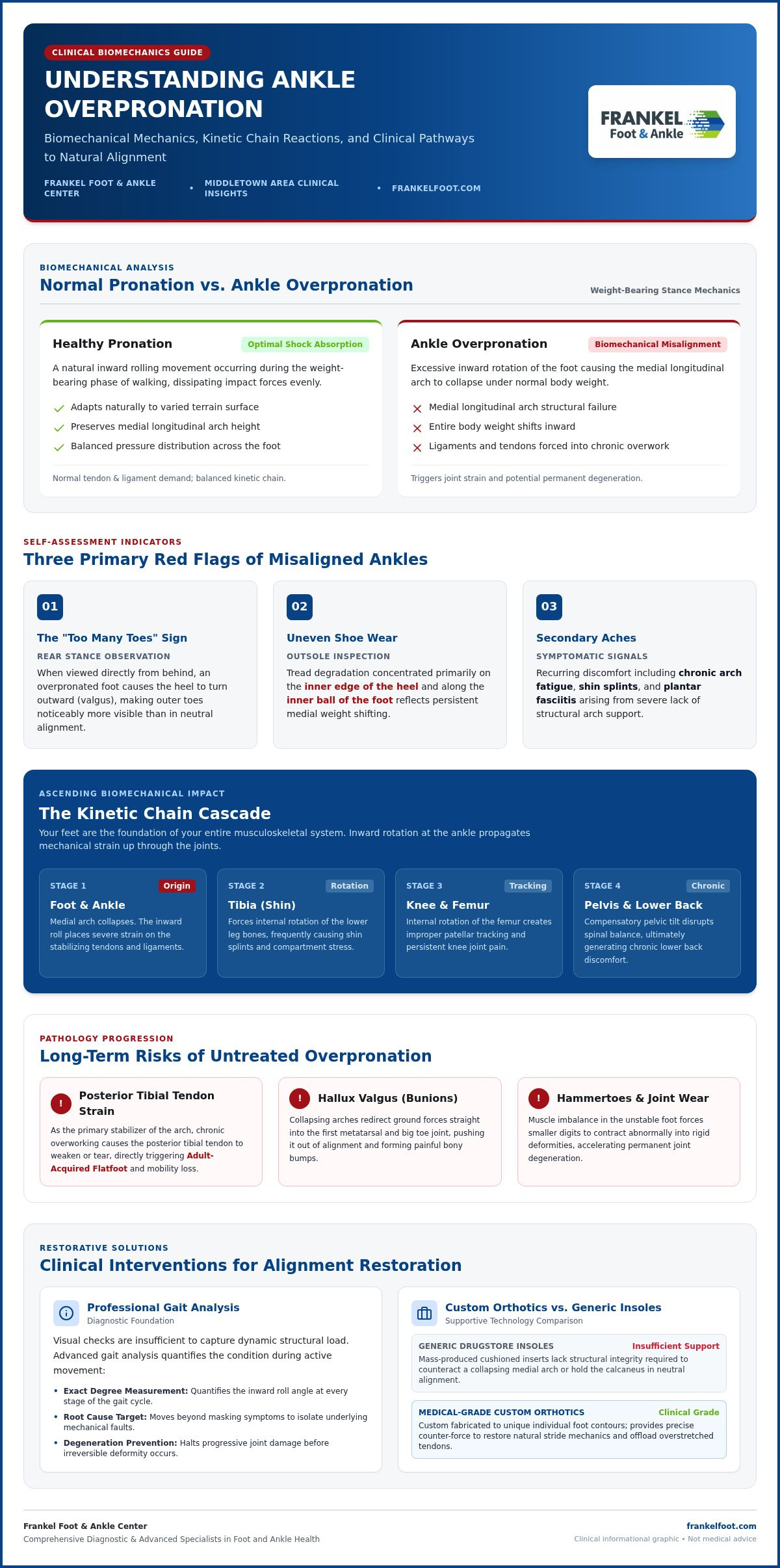
Pronation is a natural movement of the foot that occurs during the weight-bearing phase of walking. It serves as a vital shock-absorption mechanism, allowing the foot to adapt to varied terrain. However, ankle overpronation occurs when this inward rotation becomes excessive. When the foot rolls too far inward, the medial longitudinal arch collapses, which shifts the body's entire weight distribution toward the inner foot. This structural failure doesn't just affect your step; it places significant strain on the entire kinetic chain, from the small bones of the feet to the alignment of your knees and hips.
Distinguishing between healthy movement and structural strain is essential for long-term health. While normal pronation is necessary, overpronation forces the ligaments and tendons to work harder than they should. This persistent stress often leads to a search for professional foot pain relief to address the underlying biomechanical instability. At Frankel Foot & Ankle Center, we focus on identifying these subtle shifts before they lead to permanent joint degeneration.
Common Signs and Symptoms of Misaligned Ankles
Identifying misalignment early can prevent years of discomfort. You don't need a medical degree to spot the initial red flags, though a professional diagnosis is always recommended. Look for these specific indicators:
- The "Too Many Toes" Sign: When viewed from behind, an overpronated foot causes the heel to turn out, making the outer toes more visible than they would be in a neutral stance.
- Uneven Shoe Wear: Check the soles of your favorite sneakers. Excessive wear concentrated on the inner edge of the heel and the ball of the foot is a hallmark of ankle overpronation.
- Secondary Aches: Chronic arch fatigue, shin splints, and plantar fasciitis are frequently linked to this lack of structural support.
The Long-Term Impact of Untreated Overpronation on Foot Health
Ignoring the subtle signs of ankle overpronation often leads to a cascade of structural issues that extend far beyond a tired arch. When the foot persistently rolls inward, it places immense, repetitive stress on the posterior tibial tendon. This tendon is the primary stabilizer of your arch; when it's overworked, it can weaken or tear, leading to a condition known as adult-acquired flatfoot. This progressive deformity doesn't just change the shape of your foot; it fundamentally alters how you move, often requiring comprehensive foot pain relief to manage the resulting inflammation and loss of mobility.
Biomechanical instability also serves as a catalyst for other painful deformities. Clinical observations show a strong correlation between over-pronated feet and an increased likelihood of developing hallux valgus, commonly known as bunions, as well as hammertoes. As the arch collapses, the pressure shifts to the big toe joint, forcing it out of alignment. Addressing these issues early at Frankel Foot & Ankle Center can help prevent the need for more invasive surgical interventions later in life.
Beyond the Foot: The Kinetic Chain Reaction
Your feet are the foundation of your entire musculoskeletal system. When ankle overpronation occurs, it triggers a kinetic chain reaction that travels upward. The inward rotation of the ankle forces the tibia and femur to rotate internally, which often manifests as persistent knee pain or tracking issues. Over time, this misalignment can even cause a compensatory pelvic tilt, resulting in chronic lower back discomfort. Effective ankle pain relief must look past the immediate ache to correct the fundamental mechanical errors at the source.
Clinical Pathways for Correcting Overpronation and Restoring Alignment
While supportive footwear is a start, resolving persistent biomechanical issues requires a clinical approach. A professional gait analysis is the foundation of effective treatment. This diagnostic tool measures the exact degree of ankle overpronation during movement, providing data that visual checks simply can't capture. By understanding the precise angles of misalignment, we can develop a strategy that targets the root cause of your discomfort rather than just masking the symptoms. Professional intervention ensures that ankle overpronation doesn't progress into debilitating joint damage.
Many patients initially turn to generic drugstore insoles, but these mass-produced inserts often lack the structural integrity needed to correct a collapsed arch. In contrast, medical-grade custom orthotics are fabricated to match your unique foot contours, providing the specific support necessary to realign the ankle. We often pair these devices with physical therapy focused on the intrinsic muscles of the foot, which helps build the functional strength required for sustainable, long-term stability.
Expert Podiatric Care in Middletown and Milford
At Frankel Foot & Ankle Center, Dr. Marc Frankel develops personalized treatment plans based on a patient’s specific activity level and anatomy. Our comprehensive approach includes:
- Advanced diagnostic imaging to rule out structural fractures or ligament tears.
- Customized orthotic fabrication for precise realignment.
- Targeted rehabilitation programs to strengthen the foot's supporting structures.
Seeking a consultation early at our Middletown or Milford offices is a proactive step that helps you regain mobility and prevents the need for future surgical interventions. It's about providing high-level expertise with a patient-centered focus that prioritizes your long-term recovery.
Take Control of Your Mobility and Alignment
Addressing ankle overpronation early is the most effective way to protect your long-term mobility and prevent secondary complications like bunions or chronic knee pain. By moving beyond temporary drugstore fixes and embracing professional gait analysis, you ensure your foundation is stable for years to come. Led by Dr. Marc Frankel, our team at Frankel Foot & Ankle Center provides advanced podiatric solutions designed for your specific anatomy. We maintain convenient locations in Middletown, Katonah, and Milford to ensure that expert care is always within reach. You don't have to accept daily arch fatigue or walking-related discomfort as your baseline. Schedule a comprehensive gait analysis at Frankel Foot & Ankle Center today to start your journey toward pain-free living. Your path to restored alignment and lasting comfort begins with a single, expert evaluation.
Frequently Asked Questions
Can ankle overpronation be corrected without surgery?
Yes, many patients achieve significant ankle pain relief through conservative methods like custom orthotics and targeted physical therapy. These non-invasive clinical pathways focus on stabilizing the arch and strengthening supporting muscles. While severe structural deformities might eventually require intervention, addressing misalignment early in our Middletown or Milford offices often prevents the need for invasive procedures later in life.
What are the best types of shoes for people who overpronate?
Individuals with ankle overpronation should prioritize stability or motion control footwear. These specific shoe designs feature a firmer material on the inner side of the midsole to prevent the arch from collapsing inward during your stride. It's essential to look for a rigid heel counter and a sole that resists twisting. Proper footwear provides a necessary foundation for daily activity and long-term joint protection.
Is overpronation the same thing as having flat feet?
These terms describe different aspects of foot health, though they're often linked. Flat feet refers to a low or absent arch when standing still. Ankle overpronation describes the excessive inward rolling of the foot during movement. You can have a visible arch that collapses dynamically while walking, which is why our diagnostic process in Middletown focuses on how your foot functions under weight.
How do custom orthotics help with ankle alignment?
Custom orthotics act as a precise medical interface between your foot and the ground. Unlike generic drugstore inserts, these devices are molded to your unique anatomy to provide specific support where your arch fails. By redistributing pressure and controlling the range of motion, they effectively realign the ankle joint. This clinical solution is a cornerstone of long-term foot pain relief for our patients.


