


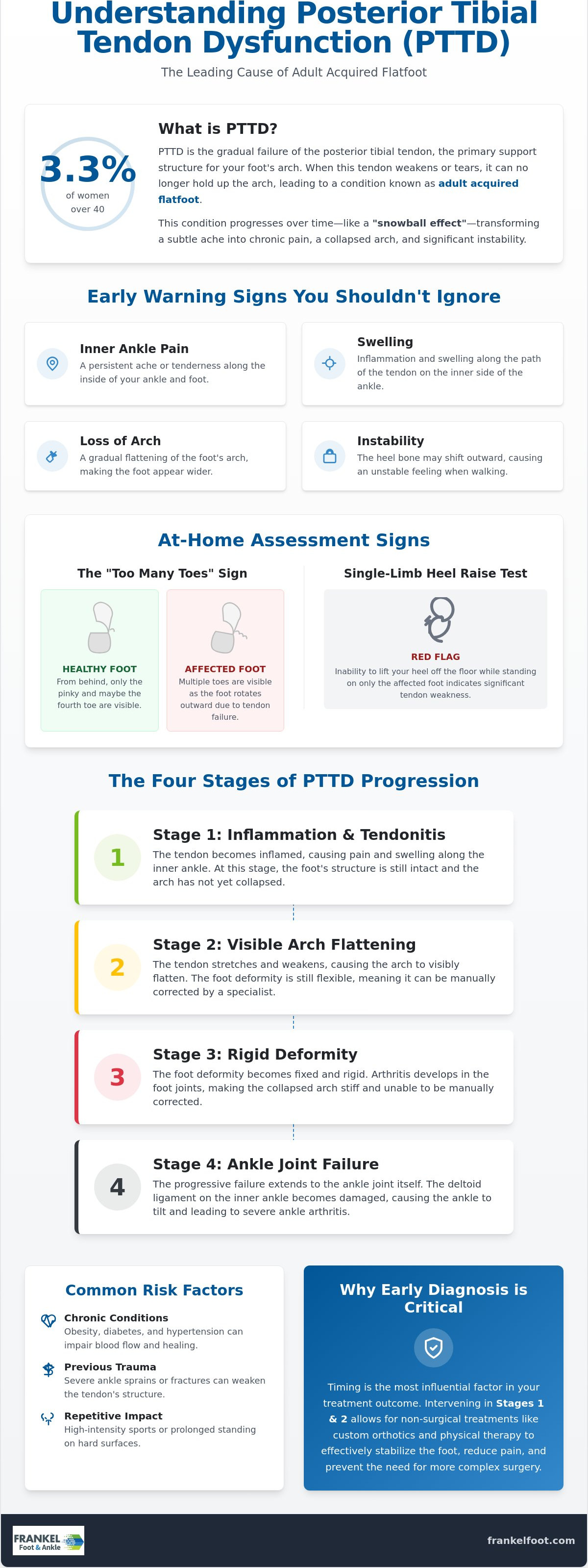
Did you know that posterior tibial tendon dysfunction is the primary cause of acquired flatfoot in adults, affecting approximately 3.3% of women over the age of 40? It often begins as a subtle ache along the inner ankle, but without specialized intervention, this condition can progress like a snowball, leading to a collapsed arch and chronic instability. You likely feel the strain most when standing for long periods or notice that your favorite shoes no longer provide the support they once did because of a shifting foot structure.
We understand how discouraging it's to deal with persistent swelling and pain that keeps you from your daily walks. This guide will help you identify the specific stage of your condition and explore advanced treatment options to restore your arch and eliminate discomfort. We'll examine the four distinct stages of progression and discuss how a combination of custom orthotics and specialized physical therapy can prevent permanent foot deformity, helping you return to the active lifestyle you deserve with confidence and ease.
Key Takeaways
- Understand how the failure of the posterior tibial tendon leads to adult acquired flatfoot and the progressive collapse of your natural arch structure.
- Learn to distinguish between early-stage tendonitis and the visible structural changes that occur as posterior tibial tendon dysfunction progresses toward arch flattening.
- Discover the critical importance of early intervention to stabilize the foot before it reaches a rigid state that requires more complex surgical correction.
- Explore specialized non-surgical pathways, from custom orthotics to bracing, that focus on reducing chronic ankle pain and restoring daily mobility.
- Gain insight into how a staged treatment approach can prevent permanent foot deformity and help you return to your favorite activities without discomfort.
What is Posterior Tibial Tendon Dysfunction (PTTD)?
At its core, Posterior tibial tendon dysfunction represents the gradual failure of the most critical support structure in your foot. The posterior tibial tendon is responsible for holding up your arch and providing the leverage needed for a healthy stride. When this tendon loses its integrity, the result is adult acquired flatfoot, a condition where a previously normal arch begins to sink toward the ground. This isn't merely a cosmetic change; it's a mechanical failure that alters how your entire body moves.
Many patients initially mistake the discomfort for general soreness or the inevitable effects of getting older. The pain typically localizes around the medial malleolus, which is the prominent bone on the inner side of your ankle. It's easy to overlook these early warning signs, yet early detection is the key to preventing the "snowball effect" of structural damage. At the Frankel Foot & Ankle Center, we focus on identifying these changes before they lead to permanent deformity.
The Vital Role of the Posterior Tibial Tendon
The tendon follows a precise path from your calf muscle, wrapping behind the inner ankle bone to attach to the bones of the midfoot. Its primary function is to lock the bones of the foot into a rigid lever during the push-off phase of walking. When the tendon is compromised, the foot stays "unlocked" and flexible at the wrong time, causing the arch to collapse and the heel to shift outward. This lack of stability can lead to a range of issues, from inner ankle pain to a complete loss of mobility.
Common Causes and Risk Factors
While Posterior Tibial Tendon Dysfunction can affect anyone, certain factors significantly increase your risk. We often see this condition stem from a combination of systemic health issues and mechanical stress. Key risk factors include:
- Chronic conditions like obesity, diabetes, and hypertension, which can impair blood flow to the tendon and slow the natural healing process.
- Previous trauma, such as severe ankle sprains or fractures, that may have weakened the tendon's attachment points.
- Repetitive impact from high-intensity sports or occupations that require standing on hard surfaces for extended periods.
Over time, these stressors lead to microscopic tears within the tendon fibers. Because the tendon has a zone of poor blood supply, it struggles to repair itself effectively, leading to the chronic degeneration that characterizes this condition.
Identifying the Four Stages of PTTD
Understanding the progression of Posterior tibial tendon dysfunction is vital because the condition is inherently degenerative. It doesn't just stay the same; it evolves as the tendon loses its ability to resist the forces of daily walking. We categorize its advancement into four distinct stages to determine the most effective clinical path for your recovery.
- Stage 1: This involves early inflammation and tendonitis. You'll likely experience persistent pain and swelling along the inner ankle, but your foot's arch remains structurally intact and functional.
- Stage 2: The arch begins to flatten visibly. While the foot remains flexible, meaning we can still manually move the joints into a corrected position, the tendon is no longer strong enough to support your weight.
- Stage 3: The deformity becomes rigid. At this point, the collapsed arch cannot be manually corrected because arthritic changes have begun to fuse the joints in a misaligned position.
- Stage 4: The failure extends beyond the foot. The chronic instability leads to the tilting of the ankle joint, which often results in severe deltoid ligament damage and widespread ankle arthritis.
The 'Too Many Toes' Sign and Other Tests
You can perform a simple assessment at home by standing in front of a mirror and looking at your heels from behind. In a healthy foot, you should only see the pinky toe and perhaps part of the fourth toe. If you see "too many toes" peeking out from the outside of your foot, it's a clear indicator that your foot has rotated outward due to tendon failure. Another significant red flag is the inability to perform a single-limb heel raise. If you can't lift your heel off the floor while standing on only the affected foot, the tendon has likely reached a state of significant weakness. Seeking professional ankle pain relief through a clinical evaluation is the most reliable way to confirm these findings.
Why Early Diagnosis is Critical in Middletown
Timing is the most influential factor in your treatment outcome. In Stages 1 and 2, we can often utilize non-invasive Posterior Tibial Tendon Insufficiency treatment protocols, such as custom orthotics and physical therapy, to halt the progression. If you wait until the foot becomes rigid, the options for recovery become much more complex and often require reconstructive surgery. Delaying care creates a snowball effect where the failure of the tendon puts undue stress on surrounding ligaments and joints. If you've noticed your arch is flatter than it used to be, consulting with a specialist at the first sign of change can help you preserve your long-term mobility.
Treatment Pathways: From Orthotics to Advanced Surgery
The path to recovery depends entirely on the current stage of your condition. For those in the early phases of Posterior tibial tendon dysfunction, our primary goal is to alleviate inflammation and provide the mechanical support your tendon can no longer offer on its own. We often begin with the RICE protocol (rest, ice, compression, and elevation) alongside temporary activity modifications to reduce immediate strain on the inner ankle.
Non-Surgical Management at Frankel Foot & Ankle Center
Custom-molded orthotics are a cornerstone of our conservative care. Unlike over-the-counter inserts, these devices are designed from precise digital scans of your feet to redistribute pressure away from the failing arch. This stabilization helps prevent further collapse while providing significant foot pain relief. In more acute cases, we may utilize a walking boot for a brief period of immobilization. This allows the tendon to rest and heal without the constant stress of weight-bearing. Once the initial pain subsides, we transition patients into a structured physical therapy program that focuses on eccentric exercises, which are specifically designed to strengthen the posterior tibial muscle and improve long-term stability.
Advanced Surgical Solutions for Structural Correction
When conservative measures don't stop the progression of Posterior tibial tendon dysfunction, or if the condition has already reached a rigid stage, surgical intervention becomes necessary. Dr. Frankel specializes in advanced reconstructive techniques designed to realign the foot and restore its natural function. This may involve a tendon transfer, where a healthy tendon is repurposed to support the arch, or an osteotomy to reposition the heel bone and improve the foot's mechanics. The ultimate objective of any surgical plan is to stop the cycle of pain and prevent permanent deformity. We're committed to guiding you through every step of this process, ensuring you return to a pain-free, active lifestyle with the confidence that your foundation is secure.
Restoring Your Stability and Long-Term Mobility
Managing the progression of Posterior tibial tendon dysfunction requires a proactive approach that prioritizes early diagnosis and specialized intervention. By recognizing the subtle signs of arch collapse and inner ankle pain today, you can avoid the rigid, arthritic changes that define the later stages of this condition. Whether your recovery involves custom-molded orthotics to stabilize your foundation or advanced reconstructive techniques to realign your foot, the focus remains on achieving lasting relief and structural integrity. Your mobility is worth protecting.
At the Frankel Foot & Ankle Center, Dr. Marc Frankel provides a sophisticated yet compassionate environment dedicated to solving complex foot and ankle concerns. We combine advanced diagnostics with a patient-centered philosophy to ensure you feel supported through every phase of your journey. You don't have to let chronic discomfort limit your movement or dictate your lifestyle. We're here to help you regain your footing and return to the activities you love.
Schedule a consultation at Frankel Foot & Ankle Center to protect your mobility today. We look forward to helping you step forward with renewed strength and comfort.
Frequently Asked Questions
Can PTTD go away on its own with rest?
Rest alone is insufficient to resolve the structural issues associated with Posterior tibial tendon dysfunction. While temporary immobilization helps reduce acute swelling, the tendon remains compromised and prone to further degradation once you resume walking. Proper recovery requires a targeted plan that combines mechanical support with muscle strengthening to prevent the cycle of pain from continuing as the condition progresses.
What happens if posterior tibial tendon dysfunction is left untreated?
Neglecting Posterior tibial tendon dysfunction typically leads to a progressive collapse of the foot's internal architecture. Over time, the flexible arch becomes a rigid deformity as the joints in the midfoot and hindfoot begin to fuse in a misaligned position. This structural failure eventually spreads to the ankle joint, causing chronic instability and painful arthritis that significantly limits your ability to walk or stand.
Are custom orthotics enough to fix a falling arch?
Custom orthotics serve as a vital support system to halt the progression of a falling arch, but they don't repair the damaged tendon fibers themselves. These precision devices are most effective when used as part of a multi-faceted treatment approach. By pairing orthotics with progressive loading exercises, we can stabilize the foot's alignment while simultaneously improving the tendon's capacity to handle the stresses of daily movement.
How do I know if my ankle pain is PTTD or just a sprain?
Pain from a standard ankle sprain typically occurs on the outer side of the joint following a sudden twist, whereas tendon dysfunction focuses on the inner ankle and midfoot. You'll often notice that the discomfort intensifies during activity and is accompanied by a gradual flattening of your arch. If your inner ankle feels weak or looks significantly different from your healthy foot, it's a sign that the tendon requires specialized attention.


