


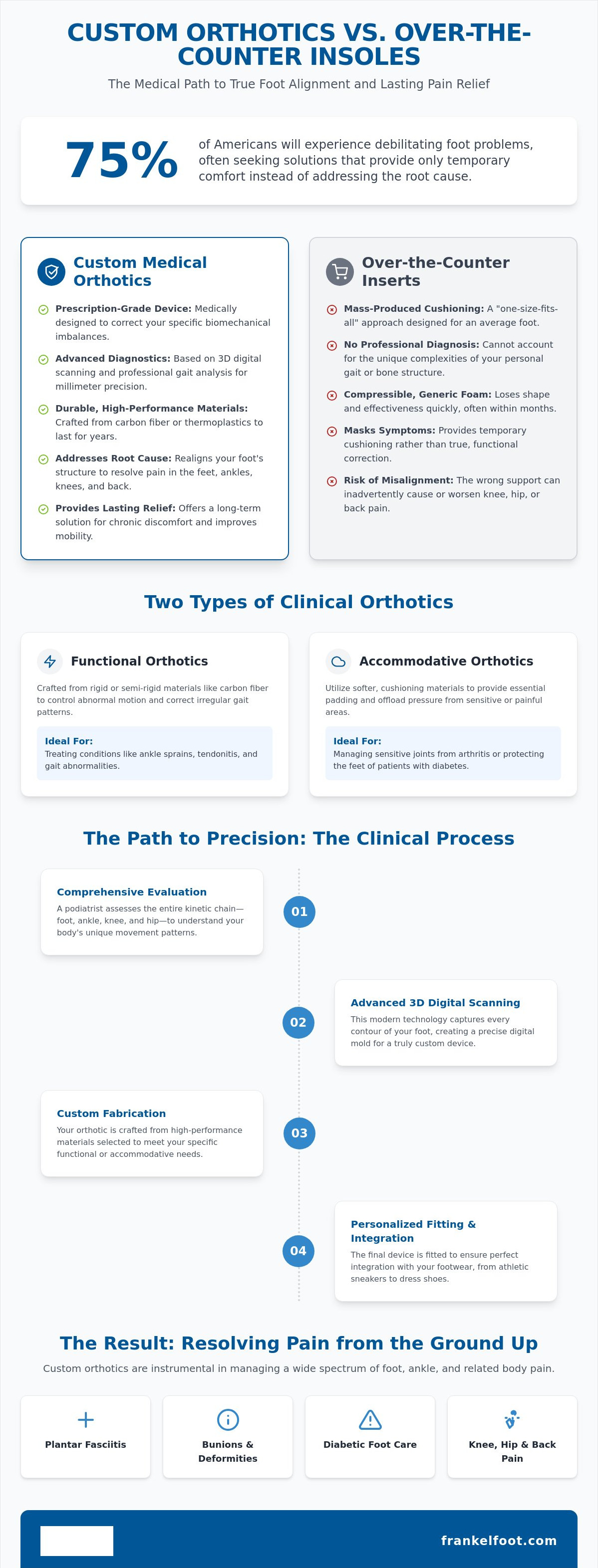
Approximately 75% of Americans will experience debilitating foot problems at some point in their lives, yet most attempt to solve chronic discomfort with a one-size-fits-all solution found on a pharmacy shelf. You've likely felt that sharp, stabbing pain in your heel during your first steps in the morning or the dull ache in your lower back after a long day on your feet in Middletown or Katonah. It's frustrating to invest in various arch supports only to find that the relief is temporary or nonexistent. We understand the exhaustion that comes from standing for long periods when every step feels like a challenge to your well-being.
This article explores why professional Orthotics are a medical necessity for correcting biomechanical imbalances rather than just a simple cushion for your shoes. You'll learn the critical differences between custom-crafted devices and over-the-counter inserts, and how precise alignment can finally resolve your persistent foot, ankle, and back pain. We provide a clear preview of how professional validation and advanced diagnostics lead to the pain-free mobility you deserve, moving you from constant discomfort to a life of restored movement and lasting relief.
Key Takeaways
- Identify the crucial distinction between simple retail cushioning and prescription-grade biomechanical appliances designed to correct your specific foot architecture.
- Understand how advanced diagnostics and digital gait analysis ensure your Orthotics are fabricated from high-performance materials like carbon fiber for durable, functional support.
- Learn how specialized alignment can resolve chronic discomfort from the heel and ankle up through the lower back by addressing the root cause of your gait issues.
- Discover how personalized orthotic therapy integrates with comprehensive care plans at our Middletown and Katonah offices to support recovery after minimally invasive procedures.
- Gain the clinical clarity needed to choose a medical-grade solution that provides professional validation and long-term, pain-free mobility.
Understanding Orthotics: Medical Devices vs. Retail Insoles
Medical orthotics are prescription-grade biomechanical appliances designed to correct specific foot imbalances. While many people first encounter inserts at a local pharmacy, these mass-produced cushions lack the scientific precision required for genuine correction. A deeper Understanding Orthotics reveals that professional devices serve as specialized medical tools to realign the foot's structure, rather than just providing a temporary layer of foam. Unlike over-the-counter products that offer fleeting comfort, custom Orthotics work to shift how your weight is distributed, creating a stable foundation for your entire body.
We typically categorize these clinical devices into two distinct types based on their primary function:
- Functional orthotics: These are crafted from rigid or semi-rigid materials, such as carbon fiber, to control abnormal motion and correct irregular gait patterns.
- Accommodative orthotics: These utilize softer materials to provide essential cushioning and offload pressure from sensitive areas or painful deformities.
Common Conditions Treated with Professional Orthotics
From stabilizing the arch to realigning the heel, professional devices manage a wide spectrum of foot and ankle pain. For patients struggling with plantar fasciitis, custom Orthotics provide the necessary tension relief on the plantar fascia ligament to facilitate healing. These devices are also instrumental in offloading pressure from bunions or diabetic ulcers, which helps prevent the progression of deformities and reduces the risk of long-term complications.
Why 'One-Size-Fits-All' Often Fails
Custom vs. Over-the-Counter: The Science of Precision
Precision is the hallmark of medical-grade Orthotics. While retail inserts rely on generic foam that often compresses and loses effectiveness within months, professional devices utilize high-performance materials like carbon fiber and specialized thermoplastics. These medical-grade components are designed to maintain their structural integrity for several years, providing a level of durable support that retail products cannot match. Each device is specifically engineered to integrate with your preferred footwear, ensuring a perfect fit in everything from narrow dress shoes to high-impact athletic sneakers.
The Clinical Diagnostic Process
A podiatrist's evaluation extends far beyond the foot itself. We examine the entire kinetic chain, meticulously assessing how movement in the ankle, knee, and hip influences your overall gait. Our diagnostic approach has transitioned from traditional plaster casting to advanced 3D digital scanning. This modern technology captures every contour of your foot with millimeter accuracy, allowing for a level of customization that pharmacy kiosks simply cannot replicate. If you're struggling with persistent discomfort, you can learn more about our diagnostic approach during a professional consultation.
Functional vs. Accommodative Orthotics
The choice between device types depends entirely on your clinical needs. Functional devices are typically prescribed for patients with an ankle sprain history or recurring tendonitis, as these rigid structures control abnormal motion. Conversely, accommodative Orthotics prioritize pressure redistribution and shock absorption. These are essential for managing the sensitive joints associated with arthritis or protecting the feet of patients with diabetes. This targeted methodology ensures that your treatment addresses the root cause of your pain rather than just masking the symptoms.
Orthotic Solutions at Frankel Foot & Ankle Center
At Frankel Foot & Ankle Center, we view Orthotics as a dynamic component of a comprehensive recovery plan rather than a standalone product. Our offices in Middletown, Katonah, and Milford prioritize a patient-centered approach where every device is integrated into a broader strategy for long-term health. For instance, we frequently use custom devices to stabilize and support the foot following scarless bunion surgery, ensuring the corrected alignment remains protected during the healing phase. This holistic methodology ensures that your treatment addresses both immediate symptoms and the underlying structural mechanics of your gait.
Our commitment to your mobility doesn't end when you receive your devices. We provide meticulous follow-up care and necessary adjustments to ensure your Orthotics remain effective as your walking patterns improve and your pain subsides. This ongoing partnership allows us to fine-tune the support you receive, facilitating a seamless transition back to the activities you love. A professional consultation is the first step toward reclaiming the active lifestyle you deserve.
A Personalized Path to Recovery
The "Frankel Advantage" lies in our ability to combine sophisticated medical technology with compassionate, individualized attention. For many patients, professional orthotic therapy serves as a highly effective, non-invasive alternative for those seeking ankle pain relief without immediate surgical intervention. By precisely correcting the orientation of the foot, we can often resolve complex discomfort and prevent the progression of musculoskeletal issues before they require more intensive measures.
What to Expect at Your Orthotics Consultation
Your journey begins with a thorough consultation where we discuss your symptoms, lifestyle needs, and medical history in detail. We then conduct a physical examination and gait analysis to identify the specific biomechanical triggers of your pain. Once your custom devices are fabricated, we host a dedicated fitting session to ensure total comfort and proper function. We encourage residents in Middletown and the surrounding regions to take this definitive first step toward better foot health. Reclaiming a pain-free, active lifestyle is possible when you have the right foundation beneath you.
Take the First Step Toward Lasting Foot Health
Choosing the right support for your feet is a decision that impacts your entire kinetic chain, from your ankles to your lower back. We've explored how medical-grade Orthotics offer a level of corrective precision that store-bought inserts simply cannot match. By utilizing advanced digital 3D foot scanning technology, we ensure that every device provides the exact biomechanical correction your body requires. Whether you're seeking a non-invasive solution for chronic pain or supporting your recovery after a procedure, our goal is to provide a foundation that promotes long-term mobility and comfort.
Dr. Marc Frankel brings board-certified expertise to every patient interaction, ensuring that your journey is guided by clinical skill and genuine care. With convenient local clinics in Middletown, Katonah, and Milford, professional relief is more accessible than ever. Don't let persistent discomfort dictate your daily activities or limit your potential for movement. We invite you to schedule your custom orthotics consultation at Frankel Foot & Ankle Center today. Reclaiming a life of pain-free activity starts with a single, supported step toward professional care.
Frequently Asked Questions
How do I know if I actually need custom orthotics?
You likely require a professional evaluation if you experience persistent pain in your feet, ankles, or lower back that doesn't improve with rest or generic inserts. Other physical indicators include uneven wear patterns on the soles of your shoes or recurring calluses on specific areas of your feet. These symptoms often point to underlying biomechanical imbalances that only a prescription-grade device can accurately address and correct.
Does health insurance typically cover the cost of custom orthotics?
Many private insurance plans provide coverage for Orthotics when they're prescribed by a specialist to treat a specific medical diagnosis. Because every policy is unique, it's essential to review your "Durable Medical Equipment" benefits with your provider to understand your specific level of coverage. Our administrative team can assist you by providing the necessary clinical documentation and diagnostic codes required to facilitate your insurance claim process.
How long does it take to break in new custom orthotics?
The standard break-in period for new devices typically spans ten to fourteen days as your body adjusts to its new alignment. We advise patients to begin with just two hours of wear on the first day and add one additional hour each following day. This gradual integration helps prevent muscle fatigue and ensures your feet adapt comfortably to the structural support provided by the medical-grade materials.
Can I move my custom orthotics between different pairs of shoes?
While you can often move your Orthotics between similar types of footwear, such as various pairs of sneakers, they're not always interchangeable between vastly different shoe styles. A device crafted for a spacious athletic shoe might be too bulky for a tapered dress shoe or a slim boot. We recommend selecting footwear with removable factory insoles to ensure your custom devices sit flush and provide the intended level of support.


