


Did you know that 81% of adults will experience debilitating foot pain at some point in their lives? When your mobility is compromised, the process of choosing a foot and ankle specialist often feels daunting. You might worry about the prospect of permanent scarring from a bunion correction or feel anxious about a lengthy, painful recovery period. It's completely understandable to seek a solution that respects both your physical health and your aesthetic concerns while providing total relief.
In this guide, you'll discover how to identify a practitioner who bridges the gap between sophisticated surgical precision and genuine, patient-centered warmth. We will clarify the distinctions between various medical credentials and outline the specific criteria for selecting a leader in modern podiatry. From evaluating the latest scarless laser technologies to understanding the importance of a clear, communicative bedside manner, you'll learn exactly what to look for to ensure a swift return to the activities you love. We provide the roadmap you need to secure care that is as effective as it is compassionate, ensuring your journey toward recovery is methodical and supported.
Key Takeaways
- Understand the clinical distinctions between a Podiatrist (DPM) and an Orthopedic Surgeon (MD) to ensure your provider has the specific expertise your recovery demands.
- When choosing a foot and ankle specialist, prioritize experts who offer advanced laser therapy and minimally invasive techniques for faster, more comfortable results.
- Discover why board certification remains the non-negotiable benchmark for surgical safety and professional excellence in the modern medical landscape.
- Learn to identify critical red flags, such as practitioners who bypass conservative treatments to recommend major surgery as the initial option.
- Evaluate the benefits of scarless and painless surgical methodologies that focus on both functional restoration and post-operative aesthetic appeal.
Understanding the Qualifications of a Foot and Ankle Specialist
Your journey toward lasting relief begins with trust; trust is built on the foundation of verified expertise. When you're choosing a foot and ankle specialist, the credentials behind the name are your first line of defense against substandard outcomes. It's vital to look for a practitioner who hasn't just studied general medicine, but has mastered the specific biomechanical intricacies of the lower extremities. This level of focus ensures that your care is grounded in precision and advanced methodology.
Podiatrist vs. Orthopedist: Which is Right for You?
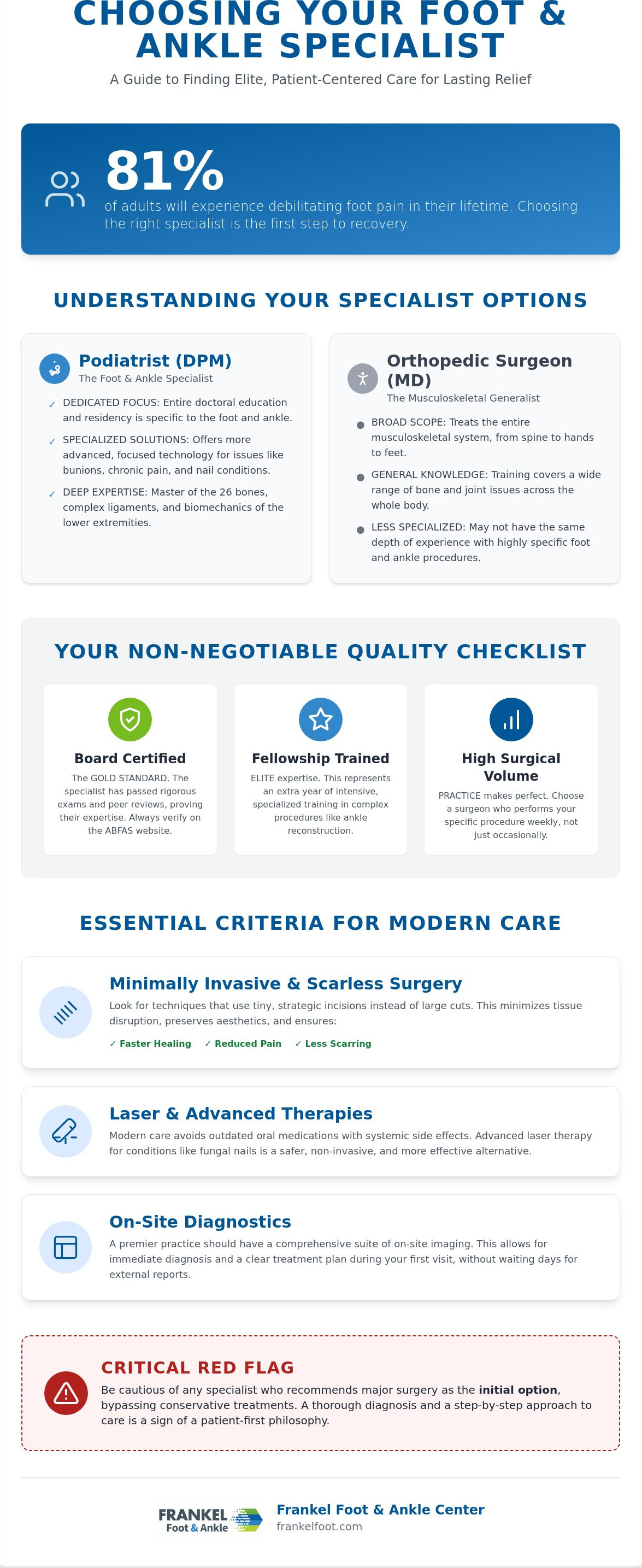
Patients often feel confused by the choice between a Podiatrist (DPM) and an Orthopedic Surgeon (MD). While an orthopedist is a generalist who treats the entire musculoskeletal system, a podiatrist dedicates their entire doctoral education and residency specifically to the foot and ankle. For localized issues like bunions, chronic foot pain, or fungal nails, a specialized DPM often offers more focused technological solutions. Understanding Podiatry involves recognizing that these specialists spend years refining techniques for the 26 bones and complex ligaments of the foot, offering a level of specialization a general surgeon may not match.
Verifying Credentials and Board Status
Board certification is the non-negotiable baseline for quality care. You can easily verify a doctor's status through the American Board of Foot and Ankle Surgery (ABFAS) website by searching their name in the provider directory. It's important to distinguish between "board eligible" and "board certified" in your search. A board-certified specialist has passed rigorous examinations and peer reviews after years of practice, whereas those who are merely "eligible" haven't yet completed these final, critical validation steps.
Elite Expertise: Fellowship and Volume
Beyond the basics, seek out "Fellowship Training" as a marker of elite expertise. This represents an additional year of intensive specialization in complex ankle reconstruction or advanced bunion correction. Always ask about surgical volume. You want a surgeon who performs your specific procedure weekly, not occasionally. Choosing a foot and ankle specialist who prioritizes high-volume experience ensures they're prepared for every anatomical variation. At Frankel Foot & Ankle Center, we believe this depth of specialization allows for the precision required in modern, scarless, and painless techniques.
Essential Criteria for Selecting Your Specialist: Beyond the Basics
Identifying the right provider requires looking past standard credentials to see how they leverage modern science for your benefit. When you're choosing a foot and ankle specialist, you should scrutinize the tools they utilize daily to resolve complex issues. Does the practice rely on outdated oral medications with potential systemic side effects, or do they offer advanced laser therapy for fungal nails? Modern care should prioritize your long-term wellness through precision technology that minimizes risk while maximizing results.
Immediate answers provide peace of mind during a stressful health journey. A premier practice maintains a comprehensive diagnostic suite with on-site imaging, allowing for the delivery of foot pain relief during your initial visit rather than forcing you to wait days for external radiology reports. This efficiency reflects the rigorous podiatric physician training that prepares specialists to act as both high-level diagnosticians and skilled surgeons. It's this combination of speed and accuracy that defines elite care in 2026.
The Role of Minimally Invasive and Scarless Surgery
Traditional foot surgeries often leave behind significant scarring and require months of downtime. In contrast, scarless bunion surgery utilizes specialized instruments to correct alignment through tiny, strategic incisions. Minimally invasive surgery is a procedure that minimizes tissue disruption to ensure faster healing. By preserving the surrounding soft tissue, these techniques drastically reduce post-operative pain and help you return to your daily routine with confidence and aesthetic satisfaction.
Outcome-Focused Care: Laser and Advanced Therapies
Effectiveness shouldn't come at the cost of your overall health. Laser fungal treatment provides a non-invasive, safer alternative to traditional topical or oral treatments that can be hard on the body. Similarly, finding comprehensive ankle pain relief should involve a progressive strategy that begins with conservative, at-home care before moving to advanced clinical solutions. Your specialist should be a compassionate guide who prioritizes the least invasive path to recovery. If you value a partnership built on transparency and innovation, our team at Frankel Foot & Ankle Center is ready to support your journey.
Red Flags and the Final Decision: Finding Your Best Path to Relief
The final stage of choosing a foot and ankle specialist requires a keen eye for both clinical excellence and personal compatibility. While previous sections focused on technical expertise and modern technology, your ultimate decision should rest on how a provider balances high-level precision with genuine compassion. Understanding when to see a foot specialist is only the beginning; you must also ensure the specialist you select views you as a partner in the recovery process rather than just another case on a surgical schedule.
What to Avoid in a Foot Specialist
Be wary of any practice that feels stuck in the past. Warning signs include a lack of digital records or a reliance on outdated equipment instead of modern laser technology. A major red flag is a "surgery-first" mentality. If a doctor pushes major surgery as the only option without discussing conservative therapies or minimally invasive alternatives, they may be ignoring your long-term mobility goals. A confident, highly skilled specialist will always encourage a second opinion, as they prioritize your peace of mind over their own bottom line.
Making the Final Choice for Your Health
- How quickly can I return to my normal footwear and weight-bearing exercise?
- What specific steps do you take during the procedure to minimize post-operative pain?
- Can you provide examples of the typical aesthetic results for this scarless technique?
Trust your intuition regarding the doctor's transparency and level of care. If you're ready to move forward with a provider who prioritizes your comfort and functional outcomes, schedule a consultation with Dr. Frankel to experience a modern, patient-centered approach to podiatric medicine.
Step Toward a Future of Pain-Free Mobility
The process of choosing a foot and ankle specialist is more than a medical decision; it's a commitment to your long-term quality of life. By prioritizing board-certified expertise and identifying the red flags of outdated practices, you've already taken the most difficult steps toward recovery. You now understand that modern podiatry should offer a seamless blend of clinical precision and genuine empathy, ensuring that your unique health goals remain the focus of every treatment plan.
From advanced laser technology for non-invasive fungal treatments to our specialized scarless and painless surgical techniques, we're dedicated to providing the highest standard of care across New York and Pennsylvania. We believe that no patient should have to choose between aesthetic results and functional relief. Our methodical approach ensures that every detail of your journey is handled with the clinical professionalism you deserve and the patient-centered warmth you need.
Schedule your consultation at Frankel Foot & Ankle Center today to begin your path toward lasting relief. We look forward to helping you regain your stride with confidence and comfort.
Frequently Asked Questions
What is the difference between a podiatrist and a foot and ankle surgeon?
A foot and ankle surgeon is a podiatric physician or orthopedic surgeon who has completed an intensive surgical residency and often a specialized fellowship. While all podiatrists treat lower extremity conditions, surgeons focus on corrective procedures for structural issues. When you're choosing a foot and ankle specialist, it's vital to confirm they have the specific surgical volume and board certification required to handle complex reconstructive cases with precision and care.
How do I know if my foot specialist is using the latest technology?
You can identify a modern practice by the presence of on-site digital diagnostics and advanced treatment options like laser therapy for fungal toenails. A forward-thinking specialist invests in technology that prioritizes non-invasive solutions and rapid recovery over traditional, more aggressive methods. During your consultation, ask if they utilize digital scanning for orthotics or minimally invasive surgical tools, as these are hallmarks of a practice that stays at the forefront of medical advancement.
Is bunion surgery always painful, or are there 'painless' options?
Bunion surgery doesn't have to be a painful experience thanks to modern scarless techniques and advanced local anesthetic blocks. These minimally invasive methods allow surgeons to correct the bone alignment through tiny incisions, which significantly reduces trauma to the surrounding soft tissues. This approach minimizes the post-operative inflammatory response, allowing patients to enjoy a much more comfortable recovery period. To see how these techniques impact the healing timeline, Ohio Foot & Ankle Surgeon provides a detailed breakdown of the process; visit their website to learn more about what to expect after surgery.
Should I see a specialist in Middletown or travel to a larger city for foot surgery?
Accessing elite care in local offices like Middletown, Katonah, or Milford provides the same advanced technology found in major cities with the added benefit of easier recovery. Traveling long distances for surgery can increase physical stress and complicate your post-operative follow-up schedule. Local accessibility ensures your specialist is readily available for every step of your healing journey, providing a level of personalized, compassionate care that's often difficult to find in larger, more impersonal metropolitan centers.


