


What if the way you manage your injury in the first 48 hours determines whether you'll still be feeling the effects five years from now? It's common to feel frustrated by persistent swelling that won't subside or a lingering fear that your ankle will never regain its former strength. You aren't alone in questioning whether home care is enough or if it's time to consult a specialist to address these concerns. This guide provides a comprehensive roadmap for sprained ankle treatment, bridging the gap between immediate RICE protocols and the advanced clinical interventions that restore long-term stability. We'll explore the critical healing timeline, identify exactly when to visit our experts in Middletown, Katonah, or Milford, and outline the methodical steps required for a full return to the activities you enjoy most.
Key Takeaways
- Understand how clinical grading identifies the specific severity of ATFL tears, helping you determine when professional sprained ankle treatment is necessary to ensure proper healing.
- Discover why modern podiatry favors functional bracing and medical-grade compression over total immobilization to protect ligaments while facilitating active recovery.
- Learn to recognize the warning signs of ligamentous laxity to prevent the development of chronic ankle instability and recurring injury cycles.
- Explore the role of proprioceptive training in retraining the neural connection between your brain and ankle, which is essential for restoring long-term balance and stability.
Initial Assessment: The Clinical Grading of Ankle Sprains
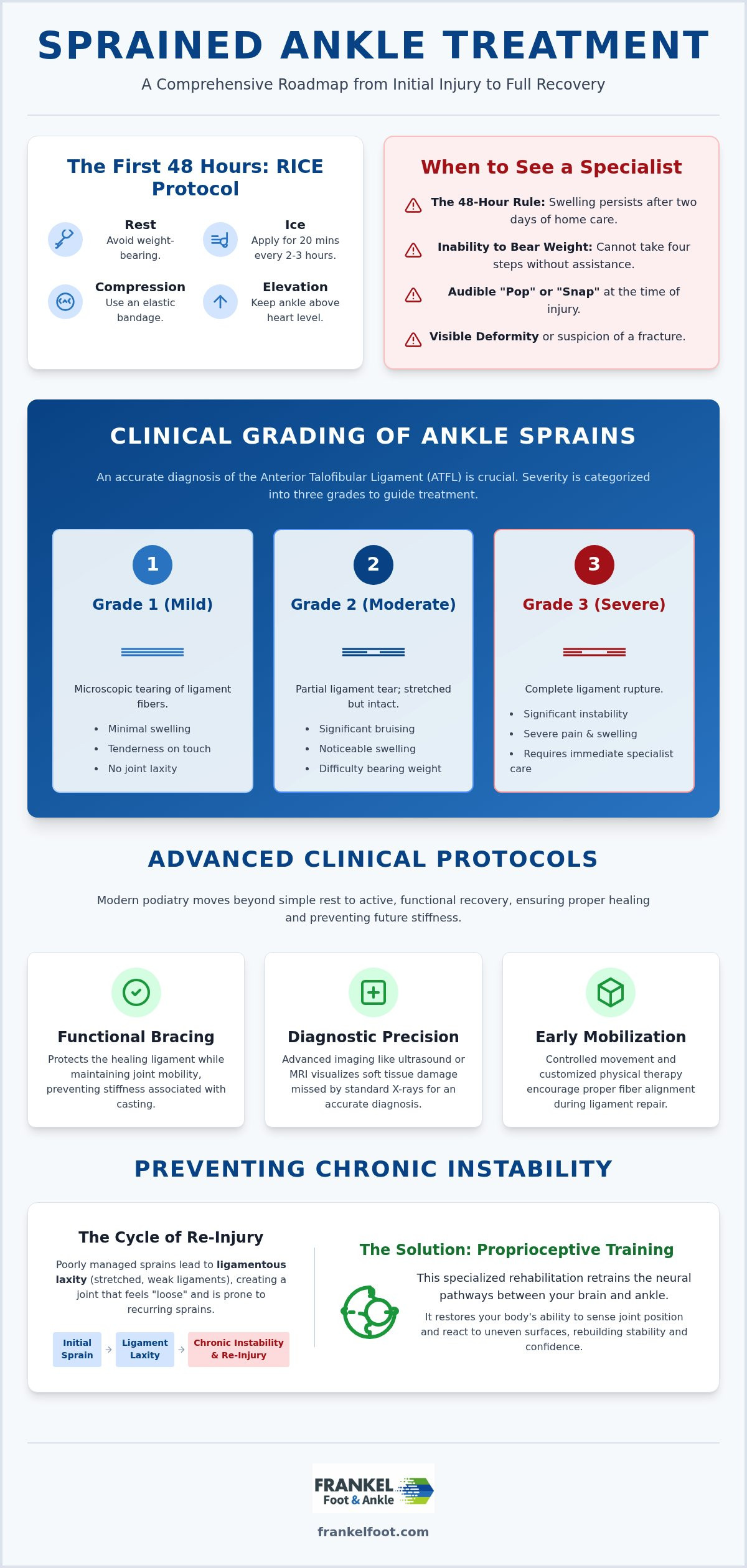
An ankle sprain typically involves the anterior talofibular ligament (ATFL), which is the most vulnerable tissue during an inversion injury. Understanding the severity of this damage is the first step in effective sprained ankle treatment. We categorize these injuries into three distinct clinical grades to guide the recovery process:
- Grade 1 (Mild): This involves microscopic tearing of the ligament fibers. You'll likely experience minimal swelling and tenderness without any joint laxity.
- Grade 2 (Moderate): A partial tear occurs where the ligament is stretched but remains intact. This grade is characterized by significant bruising and a noticeable difficulty bearing weight.
- Grade 3 (Severe): This represents a complete ligamentous rupture. It often results in significant joint instability and requires immediate specialist intervention to assess the structural integrity of the ankle; for those needing help navigating the road to recovery, The Injury Specialists can connect you with a network of medical and legal professionals.
When to Transition from Home Care to Professional Diagnosis
While many patients begin with the RICE method, the 48-hour rule is a vital benchmark for safety. If persistent swelling continues after two days of home care, a professional clinical exam is necessary. Warning signs like audible pops, visible deformity, or the inability to take four steps require immediate attention.
At our clinics in Middletown, Katonah, and Milford, Dr. Frankel utilizes precise physical manipulation and potential imaging to rule out occult fractures. This methodical assessment ensures your sprained ankle treatment plan is built on an accurate diagnosis rather than guesswork. We prioritize your comfort while establishing a clear clinical baseline for your recovery journey.
Advanced Clinical Treatment Protocols for Accelerated Healing
While the RICE protocol is an essential first step, modern sprained ankle treatment at Frankel Foot & Ankle Center moves quickly into specialized clinical protocols. We prioritize functional bracing over total immobilization. This approach allows the ligament to heal while maintaining joint mobility, preventing the stiffness often associated with traditional casting. To further stabilize the area, we utilize medical-grade compression and specialized orthotics that protect the healing anterior talofibular ligament (ATFL) during weight-bearing activities. These tools provide the necessary support to facilitate a faster transition back to daily movement.
Diagnostic precision is the cornerstone of our methodology. In our Middletown facility, we utilize advanced imaging like high-resolution ultrasound or MRI to visualize soft tissue damage that standard X-rays might miss. This level of diagnostic detail is essential for a successful sprained ankle treatment strategy. It allows Dr. Frankel to tailor pharmacological management specifically to your needs, balancing the strategic use of oral NSAIDs with targeted topical anti-inflammatories for effective pain relief. For those who prioritize having advanced first-aid solutions at home, you can discover Burn-Fix for specialized hydrogel burn care. This methodical approach ensures that every aspect of your recovery is addressed with clinical precision.
Specialized Physical Therapy and Medical Interventions
Our rehabilitation philosophy centers on early mobilization. Unlike the "cast and wait" methods of the past, controlled movement encourages proper fiber alignment during ligament repair. We integrate sophisticated in-office treatments, from therapeutic laser applications to regenerative medicine options, to accelerate cellular recovery. Each patient receives a customized rehabilitation plan designed to restore full range of motion. If you are struggling with lingering pain, our team can provide the expert ankle pain relief needed to return to your previous activity levels safely.
Restoring Stability and Preventing Chronic Ankle Instability
A common misconception is that the healing process ends once the initial pain and swelling subside. However, untreated or poorly managed sprains often lead to ligamentous laxity, a condition where the ligaments remain stretched and lose their structural tension. This laxity is the primary driver of chronic ankle instability, creating a cycle where the joint feels "loose" and is prone to recurring injuries. Effective sprained ankle treatment must address this underlying weakness to prevent a lifetime of instability and joint wear.
To break this cycle, we emphasize proprioceptive training. This specialized rehabilitation retrains the neural pathways between your brain and your ankle, restoring your body's ability to sense joint position and react to uneven surfaces. By strengthening these connections, we help you regain the confidence to return to high-impact activities in Katonah and Milford without the constant fear of another "roll." For those with significant structural damage, surgical intervention using scarless techniques or ligament repair may be the most compassionate long-term solution to restore full function.
Localized Care and Specialized Recovery in New York and Pennsylvania
Accessing expert care at our Middletown facility ensures you receive the consistent follow-up necessary for a successful clinical outcome. We don't believe in a one-size-fits-all approach. Instead, we develop a personalized "back-to-sport" or "back-to-work" timeline tailored to your specific physical demands and lifestyle goals. This methodical progression ensures that your return to activity is safe, sustainable, and supported by professional expertise. You can learn more about our philosophy by exploring our comprehensive ankle pain relief strategies that transition patients from acute injury to long-term health.
Taking the First Step Toward Lasting Ankle Stability
Navigating the journey from an acute injury to a full return to activity requires more than just patience; it demands a structured, clinical approach. By understanding the specific grade of your injury and transitioning from basic home care to advanced sprained ankle treatment, you protect yourself against the long-term risks of ligamentous laxity. Our team focuses on restoring your natural range of motion while retraining the vital neural connections that keep you balanced and secure. Dr. Marc Frankel and our dedicated staff provide this high-level expertise with genuine warmth at our convenient locations in Middletown, Katonah, and Milford. We invite you to schedule a comprehensive ankle evaluation at Frankel Foot & Ankle Center to ensure your recovery is both complete and permanent. You don't have to settle for a "weak" ankle when professional, specialized care is within reach.
Frequently Asked Questions
How long does a Grade 2 ankle sprain typically take to heal?
A Grade 2 ankle sprain typically requires four to eight weeks to heal completely. Because this involves a partial tear of the ligament, the recovery timeline depends on the consistency of your rehabilitation. While initial pain may subside within two weeks, the underlying tissue needs more time to regain its structural integrity and prevent future instability during physical activity.
Can I walk on a sprained ankle if it doesn't hurt too much?
You should only walk on a sprained ankle if you can do so without significant pain or an altered gait. Walking too early on a compromised ligament can turn a mild injury into a chronic issue. If you must move, utilizing a functional brace as part of your sprained ankle treatment provides the support needed to prevent further stretching of the healing fibers.
What is the difference between a high ankle sprain and a standard sprain?
A standard sprain involves the lower ligaments like the ATFL, while a high ankle sprain affects the syndesmosis ligaments located above the ankle joint. These injuries are often more complex and require a significantly longer recovery period. High ankle sprains typically result from a twisting outward motion and often necessitate more specialized clinical monitoring to ensure the tibia and fibula remain stable.
When should I consider surgery for a recurring ankle sprain?
Surgery becomes a consideration when conservative sprained ankle treatment, such as physical therapy and bracing, fails to resolve chronic instability. If you experience frequent "giving way" of the joint or persistent pain that limits your lifestyle, Dr. Frankel may recommend a ligament repair. Modern techniques focus on restoring the natural tension of the ligaments to provide a permanent, stable solution for active patients.


