


What if waiting for your bunion to become 'unbearable' is actually causing permanent damage to your foot's structural integrity? You likely find yourself balancing the chronic pain of your daily commute with the fear that surgical correction requires months of downtime and visible scarring. It's a common dilemma for those struggling to find professional footwear or feeling self-conscious about their foot's appearance. In this article, we'll define exactly when is bunion surgery necessary by identifying the clinical thresholds that move beyond simple discomfort.
You will discover how modern, scarless techniques and specialized painless protocols are redefining the patient experience. We'll also outline the journey toward pain-free mobility, ensuring you have the expertise needed to make an informed decision about your long-term health and comfort. Our goal is to provide a clear, methodical path from initial diagnostic signs to a sophisticated recovery that respects your active lifestyle.
Key Takeaways
- Learn to identify the transition from a cosmetic concern to a functional impairment, helping you determine exactly when is bunion surgery necessary to preserve your joint health.
- Identify the critical clinical signs, including persistent pain despite orthotic use and toe misalignment, that indicate conservative management has reached its limit.
- Discover the benefits of modern scarless techniques that allow for precise correction through minimal incisions, significantly reducing visible scarring and tissue trauma.
- Understand how modern painless protocols and specialized anesthesia are utilized to minimize post-operative discomfort and support a more efficient recovery process.
Understanding the Threshold: When Bunion Pain Becomes a Medical Priority
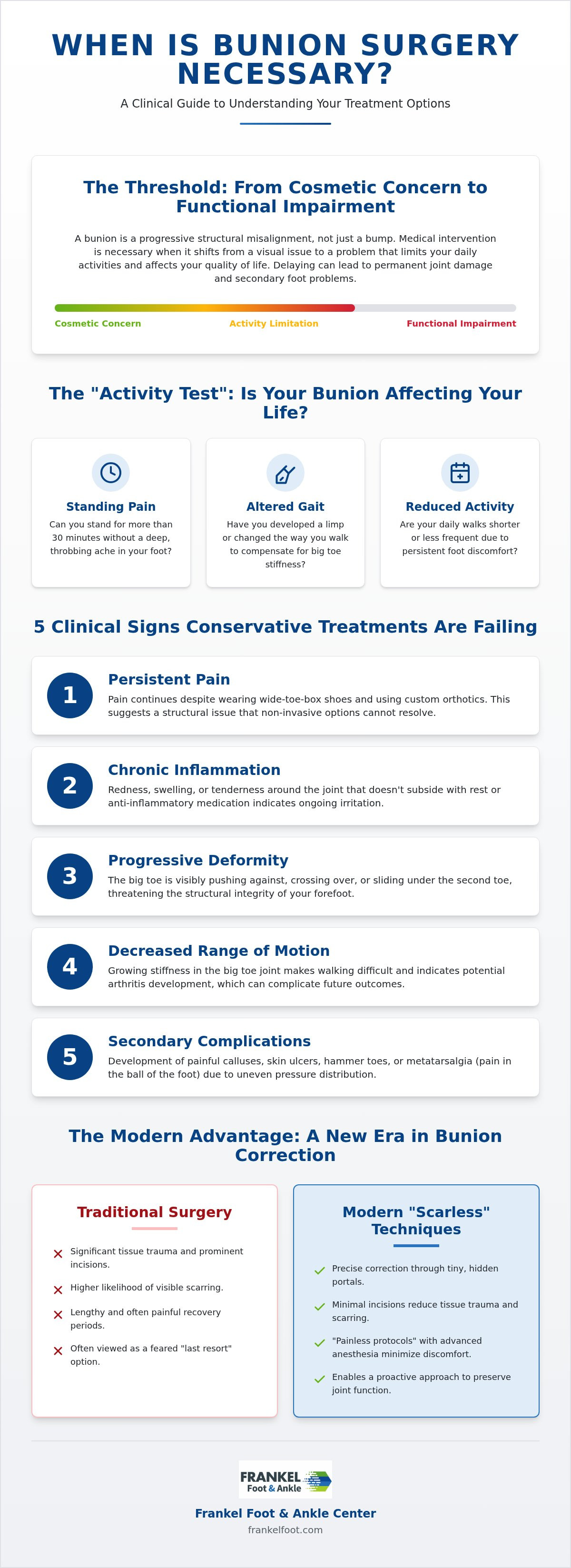
Many patients view a bunion as a minor aesthetic nuisance, but clinical intervention is required when the deformity shifts from a cosmetic concern to a functional impairment of the metatarsophalangeal (MTP) joint. To understand what is a bunion, one must recognize it as a progressive structural misalignment rather than a simple bump on the skin. Determining when is bunion surgery necessary often hinges on the 'Activity Test.' If you're consistently modifying your exercise routines, social engagements, or professional wardrobe to accommodate foot pain, the threshold for medical intervention has likely been crossed.
Delaying a consultation until the discomfort is 'unbearable' can be a counterproductive strategy. This progression often triggers secondary pathologies, from the development of hammer toes to chronic metatarsalgia, as the foot attempts to redistribute weight away from the compromised MTP joint. Seeking early intervention at Frankel Foot & Ankle Center can prevent these cascading complications and preserve the long-term health of your forefoot.
Functional Limitations and Quality of Life Indicators
We encourage patients to monitor specific daily indicators of joint health to help decide when is bunion surgery necessary for their specific situation. These signs often manifest during routine movements that were previously effortless.
- Evaluate your ability to stand for more than 30 minutes without experiencing a deep, throbbing ache.
- Identify if you've developed a limp or an altered gait to compensate for big toe stiffness.
- Note if your daily walks have become shorter or less frequent due to persistent discomfort.
Conservative care is officially considered to have failed when non-invasive modalities, such as custom orthotics and footwear modifications, no longer prevent the mechanical degradation of the joint or the persistence of daily pain.
5 Clinical Signs That Conservative Treatments Are No Longer Sufficient
Recognizing when is bunion surgery necessary involves monitoring specific physiological shifts that indicate conservative measures have reached their limit. While many patients begin with non-invasive options, persistent pain that continues despite wearing wide-toe-box shoes and using custom orthotics often suggests a structural issue that requires correction. According to clinical standards for when bunion surgery is recommended, chronic inflammation, redness, or swelling that doesn't subside with rest or anti-inflammatory medication also signals a need for intervention.
Physical changes provide further evidence of joint failure. If your big toe is visibly pushing against or crossing over the second toe, the structural integrity of your entire forefoot is under threat. You may also notice a decrease in the range of motion of the big toe joint. This stiffness often indicates potential arthritis, which can make future surgical outcomes less predictable if the joint surface becomes too damaged. Determining when is bunion surgery necessary is ultimately about protecting the joint before these changes become irreversible.
Progressive Deformity and Secondary Complications
A misaligned joint creates uneven pressure, often leading to painful calluses or skin ulcers that further inhibit movement. Beyond these surface issues, the persistent friction and joint misalignment can accelerate 'bunion-induced' arthritis. Seeking specialized foot pain relief early is essential to prevent these secondary pathologies from becoming permanent. If you're experiencing these clinical signs, you can consult with our specialists to explore modern, scarless correction techniques that prioritize both function and aesthetics.
The Modern Advantage: Why Scarless Bunion Surgery Changes the Decision
Traditional surgical methods often involved significant tissue trauma and prominent incisions that required lengthy healing periods. Today, advanced scarless techniques allow our specialists to perform precise correction through tiny, hidden portals. This technological shift fundamentally changes how patients evaluate when is bunion surgery necessary. Rather than viewing intervention as a last resort to be feared, patients can now choose a proactive path that preserves joint function without the heavy burden of traditional open surgery.
Our painless protocols are a cornerstone of this modern approach. By combining sophisticated local anesthesia with surgical precision, we've designed a recovery process that prioritizes minimal discomfort. When deciding on bunion surgery, the reduction in post-operative trauma is a vital factor. These minimally invasive methods ensure that the structural integrity of the foot is restored while sparing the delicate surrounding tissues, allowing for a more efficient and comfortable healing journey from the moment you leave the clinic.
Strategic Intervention in Middletown, Katonah, and Milford
A specialized consultation at Frankel Foot & Ankle Center is the first step in assessing your candidacy for these advanced procedures. We provide comprehensive care from the initial diagnostic imaging to the final stages of your recovery. Our presence in Middletown, Katonah, and Milford ensures that patients across the Tri-State area don't have to travel far for elite surgical expertise. Accessing scarless bunion surgery locally provides the convenience of nearby follow-up appointments, which are essential for monitoring your progress. This proximity often makes the choice of when is bunion surgery necessary much clearer for active individuals who need to balance their recovery with professional and family commitments.
Restoring Your Mobility Through Advanced Care
Recognizing the transition from a cosmetic concern to a functional impairment is the most critical step in preserving your long-term foot health. By monitoring clinical indicators such as persistent inflammation and toe misalignment, you can accurately determine when is bunion surgery necessary to prevent secondary complications like arthritis. Modern intervention no longer requires the invasive incisions of the past. Our specialized scarless techniques and painless protocols are designed to minimize discomfort and accelerate your return to an active, pain-free lifestyle.
Dr. Marc Frankel and our dedicated team offer expert guidance across our Middletown, Katonah, and Milford locations. We're committed to providing a supportive environment where your recovery is our primary focus. Don't let chronic discomfort dictate your daily choices any longer. Schedule your consultation at Frankel Foot & Ankle Center to see if scarless surgery is right for you and take the first step toward lasting relief and renewed confidence.
Frequently Asked Questions
Is bunion surgery considered a major operation?
Modern scarless bunion surgery is a minimally invasive outpatient procedure rather than a traditional major operation. By utilizing tiny portals and specialized instrumentation, Dr. Frankel avoids the large, traumatic incisions of the past. This approach is designed for minimal discomfort and allows patients in Middletown and Katonah to recover in the comfort of their own homes shortly after the correction is complete.
Can a bunion return after I have surgery?
While traditional methods had higher recurrence rates, our advanced 3D correction techniques significantly minimize the chance of a bunion returning. Success often depends on addressing the underlying structural instability of the joint. Understanding when is bunion surgery necessary involves evaluating these mechanical factors. Precise realignment ensures long-term stability and helps patients in Milford maintain their mobility without the fear of the deformity reappearing.
How long do I need to be off work following a scarless bunion procedure?
Recovery timelines vary, but most patients with sedentary jobs return to work within three to five days following a scarless procedure. Because these techniques involve less tissue trauma, early weight-bearing is often possible. If your profession requires significant standing or physical activity, you might need a few weeks of modified duty. Our team provides personalized recovery plans to ensure you return to your routine safely.
What happens if I choose not to have bunion surgery?
Choosing to delay intervention often leads to the progression of the deformity and the development of secondary conditions like hammer toes or arthritis. As the joint misaligns further, it creates uneven pressure that can cause chronic pain and skin ulcers. Determining when is bunion surgery necessary is a proactive way to stop this degeneration before it permanently impacts your gait and limits your footwear options.


