


Did you know that between 70% and 80% of all clinical cases of ankle osteoarthritis are actually secondary to a prior injury, such as a severe sprain or fracture? It's incredibly frustrating when a simple movement becomes a source of persistent pain, making it difficult to walk or maintain your favorite exercise routine. You might feel confused about whether your symptoms point to a minor strain or something requiring a specialist's intervention.
This guide will help you gain a comprehensive understanding of your ankle anatomy so you can identify the root causes of your discomfort and discover modern pathways to restoring your mobility. From the delicate ligament complexes to the primary weight-bearing bones, we'll explore the joint's mechanics, help you distinguish a sprain from a fracture, and outline exactly when it's time to seek expert care to ensure a full recovery.
Key Takeaways
- Gain a clear perspective on how the talus and malleolus work in tandem to provide the mechanical stability required for fluid motion.
- Learn to identify the specific symptoms that distinguish common ankle sprains from more complex fractures or chronic arthritic changes.
- Discover the modern diagnostic protocols, including advanced imaging, that help clinicians move beyond surface-level symptoms to find the root cause of pain.
- Explore a range of specialized treatment options, from custom orthotics to progressive rehabilitation, designed to restore your confidence and activity levels.
Understanding Ankle Anatomy: The Foundation of Mobility
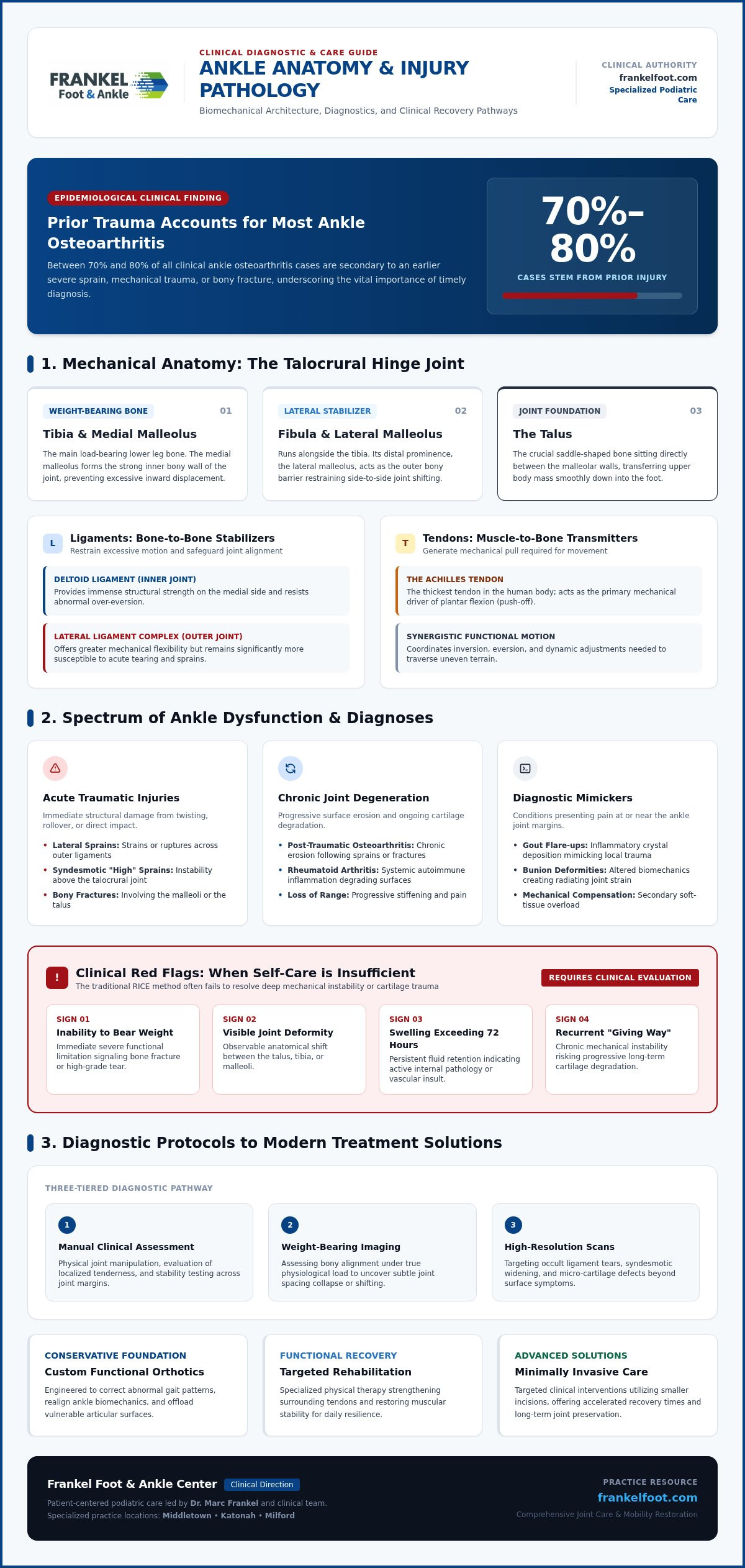
The ankle functions as a sophisticated hinge joint, known as the talocrural joint and ankle anatomy. This structure is primarily formed by the convergence of three bones: the tibia, the fibula, and the talus. The stability of this assembly relies heavily on the lateral malleolus and the medial malleolus. These bony protrusions at the end of the fibula and tibia act as the "walls" of the joint, preventing excessive side-to-side shifting during weight-bearing activities. It's this precise alignment that allows you to navigate uneven surfaces with confidence.
Mechanical integrity is further reinforced by a network of connective tissues. On the inner side, the deltoid ligament provides immense strength and resists over-eversion. The lateral ligament complex on the outer side is more flexible but also more susceptible to injury. These structures work together to guide the joint's motion while protecting the bone surfaces from excessive wear. From providing structural stability to facilitating explosive movement, each component plays a critical role in your daily life.
The Crucial Role of Tendons and Ligaments
Understanding the difference between these tissues is vital for recognizing injury patterns. Ligaments connect bone to bone, acting as stabilizers that limit abnormal joint volume. In contrast, tendons connect muscle to bone, facilitating the mechanical pull required for movement. Both are essential for fluid, pain-free motion.
- The Achilles Tendon: As the thickest tendon in the body, it's the primary driver of plantar flexion, allowing you to push off the ground while walking or running.
- Synergistic Movement: The coordination between these structures enables complex motions like inversion and eversion.
When these components work in harmony, they provide the resilience needed for daily activity. If you're experiencing instability, seeking specialized ankle pain relief is a proactive step toward maintaining your long-term mobility.
Common Causes of Ankle Pain and Dysfunction
Identifying the source of discomfort is the first step toward effective recovery. Acute ankle injuries often range from simple ligamentous strains to complex syndesmotic "high" ankle sprains and fractures. While a lateral sprain typically involves the outer ligaments, a fracture may involve the malleoli or the talus itself. Understanding the nuances of ankle injuries and disorders is essential because 70% to 80% of osteoarthritis cases in this joint stem from prior trauma. Chronic conditions like rheumatoid arthritis can also degrade the joint surfaces, leading to persistent stiffness and reduced range of motion. Sometimes, systemic issues mimic localized injury; for instance, it's common to confuse the inflammatory pain of gout or bunion deformities when symptoms manifest near the joint margin.
Signs Your Ankle Pain Requires Specialist Attention
Self-care has its place, but certain red flags indicate a need for professional intervention. If you experience an inability to bear weight, visible deformity, or swelling that doesn't subside within 72 hours, a clinical evaluation is necessary. The traditional RICE method often fails to address deep mechanical instability or underlying cartilage damage. For those struggling with recurrent "giving way" or chronic discomfort, seeking specialized ankle pain relief ensures that the underlying pathology is corrected before long-term damage occurs. If your mobility feels compromised, reaching out for expert podiatric care can prevent a minor injury from becoming a permanent limitation.
Diagnostic Pathways and Modern Treatment Solutions
Modern diagnostics have evolved far beyond basic physical manipulation. While a manual assessment remains the starting point, clinicians now utilize weight-bearing imaging and high-resolution scans to pinpoint structural deficits. This comprehensive approach to the diagnosis and treatment of ankle injuries ensures that subtle ligament tears or cartilage defects aren't overlooked. By identifying the exact mechanism of dysfunction, we can transition from generalized care to a highly targeted recovery plan that addresses your specific needs.
Treatment strategies prioritize long-term joint preservation and functional restoration. Non-invasive interventions like custom orthotics and specialized physical therapy often provide relief by correcting gait abnormalities and strengthening the surrounding musculature. For cases that don't respond to conservative measures, advanced clinical solutions offer a path forward. Minimally invasive procedures now allow for corrective work with smaller incisions and faster recovery times, effectively bridging the gap between persistent pain and a return to an active lifestyle.
Personalized Care at Frankel Foot & Ankle Center
Under the guidance of Dr. Marc Frankel, our team provides a patient-centered experience across our Middletown, Katonah, and Milford locations. We understand that every journey to recovery is unique, which is why we offer everything from conservative management to specialized ankle sprain treatment. Residents in New York and Pennsylvania don't have to settle for chronic instability or the fear of major surgery.
By combining clinical excellence with a compassionate touch, we help you regain the mobility you deserve through precise methodology. If you're ready to address your discomfort and find a clear path to healing, scheduling an expert consultation is the first step toward lasting health and improved quality of life.
Taking the Next Step Toward Lasting Mobility
Understanding the intricate mechanics of your ankle is the first step toward resolving persistent discomfort. We've explored how the synergy of bones and ligaments maintains stability, the ways chronic conditions can degrade joint health, and the modern diagnostic tools that lead to precise treatment. Recovery doesn't have to be a source of anxiety when you have the right clinical guidance. At Frankel Foot & Ankle Center, led by board-certified expert Dr. Marc Frankel, we specialize in minimally invasive techniques that prioritize your comfort and results. Whether you visit us in Middletown, Katonah, or Milford, our goal is to provide a compassionate pathway back to the activities you love. Don't let pain define your routine. You can schedule a consultation for expert ankle care at Frankel Foot & Ankle Center to begin your journey toward a pain-free future.
Frequently Asked Questions
Why does my ankle hurt without a clear injury?
Ankle discomfort appearing without a specific trauma often stems from degenerative conditions like osteoarthritis or inflammatory issues such as gout. Overuse injuries, including Achilles tendonitis or stress reactions in the bone, can also develop gradually. If you're in Middletown or Katonah and notice persistent aching, it may indicate underlying mechanical instability that requires a professional diagnostic evaluation to prevent long-term joint degradation.
How do I know if my ankle is sprained or broken?
Distinguishing between a sprain and a fracture requires assessing weight-bearing ability and specific pain locations. While a sprain involves ligament stretching or tearing, a fracture is a break in the bone that often causes pinpoint tenderness over the malleolus. Visible deformity or an inability to take four steps immediately after the incident are significant indicators that you should seek imaging at a specialized center.
What are the best home remedies for swollen ankles?
Managing swelling effectively involves a transition from the traditional RICE method to the contemporary PEACE and LOVE framework. This approach prioritizes protection, elevation, and compression during the first three days, followed by pain-guided loading and vascularization. Avoid over-reliance on anti-inflammatory medications during the acute phase, as controlled inflammation is a necessary biological component of the natural structural repair process for ankle tissues.
When should I see a podiatrist for chronic ankle pain?
You should consult a specialist if your pain persists for more than a few weeks or if the joint feels unstable during daily activities. Recurrent "giving way" or localized swelling that limits your mobility are clear signs that conservative home care isn't sufficient. Residents in Milford and surrounding areas can access advanced ankle pain relief through minimally invasive techniques designed to restore function without extensive downtime.


