


Imagine waking up and dreading the first few steps toward the kitchen because your ankle feels locked in a rusted vice. For many Middletown residents, this morning stiffness isn't just a minor inconvenience. It's a growing fear that uneven sidewalks or a simple walk in the park are becoming permanent obstacles. You've likely worried that your only options are living with the ache or undergoing a massive, life-altering surgery. We understand that your goal is to stay active without the constant shadow of discomfort.
This guide offers a comprehensive roadmap for ankle arthritis treatment, focusing on methods that reduce daily pain and restore your range of motion. You'll discover how we bridge the gap from conservative non-invasive therapies to advanced, precision-based surgical solutions. We'll preview a progressive care plan designed to help you avoid major surgery while ensuring your mobility remains intact for years to come.
Key Takeaways
- Learn why ankle arthritis is frequently the result of past trauma rather than general wear, necessitating a highly specialized diagnostic approach.
- Discover how conservative measures, such as custom orthotics and bracing, serve as a foundational ankle arthritis treatment to stabilize the joint and alleviate mechanical stress.
- Identify specific activity modifications that transition your routine from high-impact strain to joint-friendly movements to preserve long-term mobility.
- Explore advanced surgical interventions ranging from minimally invasive arthroscopic debridement to precision joint fusion for restoring stability in complex cases.
Understanding Ankle Arthritis: Why Your Pain is Unique
Ankle arthritis isn't merely a byproduct of aging. It's specifically the progressive degradation of cartilage within the tibiotalar joint. This breakdown leads to chronic inflammation and painful bone-on-bone friction. While Understanding Arthritis in other joints often involves general wear, the ankle joint follows a distinct and often more complex path. It's designed for immense weight-bearing, yet once the protective cartilage thins, every step can feel like a mechanical struggle.
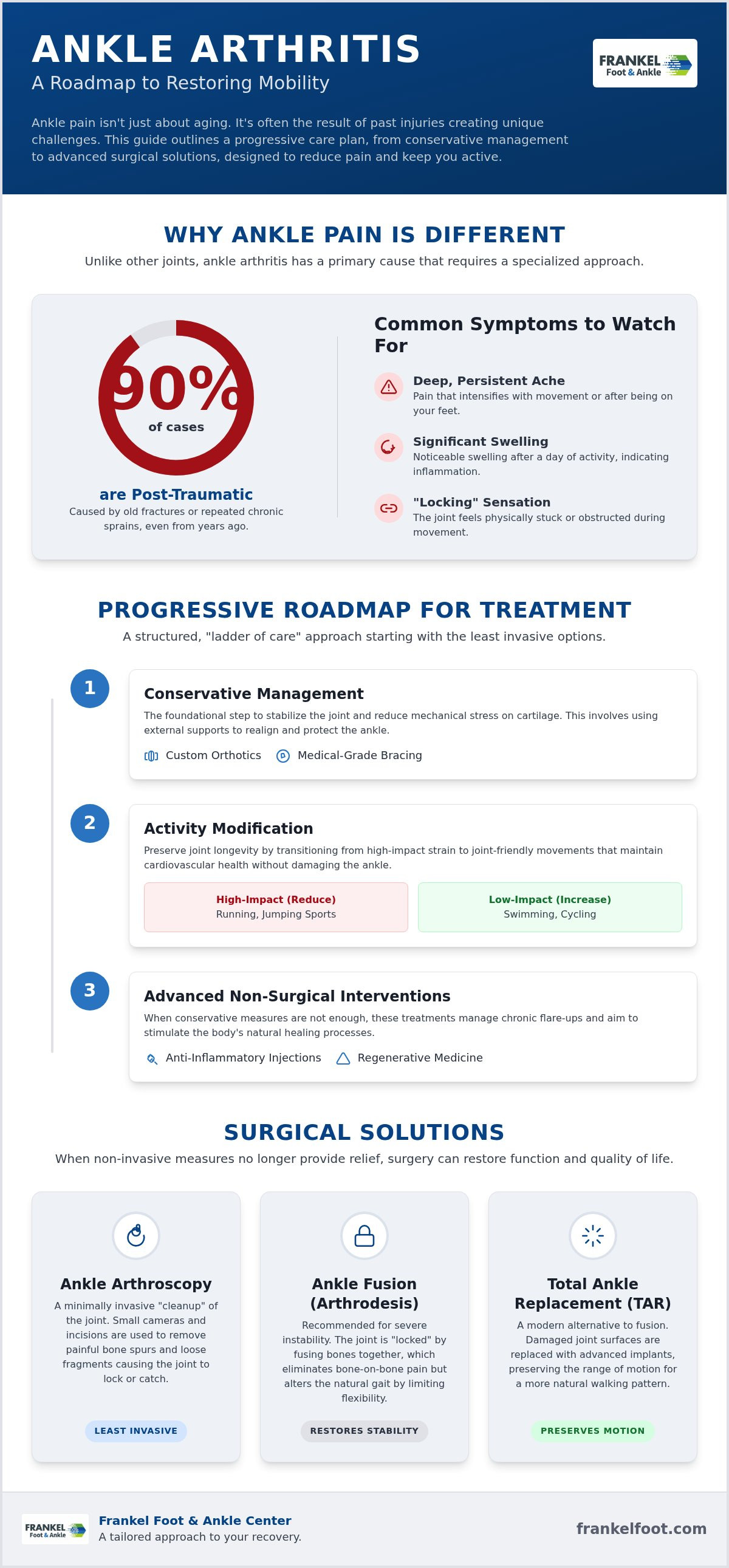
You might notice a deep, persistent ache that intensifies during movement or significant swelling after a day spent on your feet. Some patients describe a "locking" sensation where the joint feels physically obstructed. These symptoms indicate that the joint's mechanical integrity is failing. Seeking professional ankle arthritis treatment early is vital to prevent permanent loss of mobility and to manage these symptoms effectively.
Post-Traumatic vs. Osteoarthritis in the Ankle
The vast majority of ankle cases are post-traumatic. Unlike knees or hips, nearly 90% of ankle osteoarthritis is caused by prior trauma, such as old fractures or repeated chronic sprains. An injury from high school sports or a trip years ago can silently accelerate joint wear today. While the ankle joint is biologically more resistant to primary osteoarthritis than the knee, it remains uniquely vulnerable to the lasting effects of physical trauma. This structural history is why we prioritize a methodical diagnostic approach at Frankel Foot & Ankle Center to identify the exact source of your discomfort.
A Progressive Roadmap for Ankle Arthritis Treatment
Effective management of joint health requires a structured, methodical approach. We view ankle arthritis treatment as a progressive ladder of care, starting with the least invasive options to protect your natural anatomy. A precise clinical diagnosis identifying the specific types of ankle arthritis impacting your gait allows us to tailor each step to your unique lifestyle and pain levels.
- Step 1: Conservative Management. Custom-molded orthotics and medical-grade bracing stabilize the joint, effectively redistributing weight and reducing mechanical stress on the remaining cartilage.
- Step 2: Activity Modification. Transitioning from high-impact running to joint-friendly activities like swimming or cycling preserves joint longevity while keeping you active.
Managing Chronic Ankle Pain Without Major Surgery
For many in our Middletown community, the priority is maintaining an active lifestyle without immediate surgical intervention. Specialized physical therapy is essential in this phase, as it focuses on strengthening the tendons and muscles that provide secondary stability to the joint. Modern bracing techniques have also advanced significantly, offering low-profile solutions that provide rigid support while fitting comfortably in everyday footwear. By combining these methods, we provide a sophisticated approach to ankle arthritis treatment that bridges the gap from simple home care to major surgery. If you're seeking a dedicated partner in your recovery, the experts at Frankel Foot & Ankle Center are ready to guide you toward comprehensive ankle pain relief.
Surgical Solutions: Restoring Function and Mobility
When non-invasive measures no longer provide sufficient relief, surgical intervention becomes a viable path toward restoring your quality of life. Modern ankle arthritis treatment has evolved beyond simple pain management into sophisticated joint preservation and reconstruction techniques. We prioritize the least invasive methods possible to achieve lasting ankle pain relief while respecting your body's natural mechanics.
- Ankle Arthroscopy: This procedure serves as a minimally invasive "cleanup" of the joint. Using specialized cameras and small incisions, we remove painful bone spurs and loose fragments that cause the joint to lock or catch.
- Ankle Fusion (Arthrodesis): In cases of severe instability, we may recommend "locking" the joint. While this eliminates bone-on-bone pain by fusing the bones together, it does alter your natural gait by limiting joint flexibility.
- Total Ankle Replacement (TAR): As a modern alternative to fusion, TAR involves replacing the damaged joint surfaces with advanced implants. This preserves your range of motion and allows for a more natural walking pattern.
The Frankel Foot & Ankle Approach to Surgery
Precision in surgical planning is the cornerstone of our methodology. We believe that a tailored approach leads to faster recovery times and superior long-term mobility. Whether we are meeting you in Middletown, Katonah, or Milford, our evaluation process remains thorough and patient-centered. We focus on matching the specific procedure to your daily activity goals and physical requirements. For those experiencing broader discomfort, our guide on foot pain from arthritis provides additional insights into specialized care. Our goal remains consistent: to provide the advanced care necessary to return you to the activities you love.
Taking Your First Step Toward Lasting Mobility
Navigating the path to recovery requires a partner who understands that your joint pain is as unique as your physical history. You've learned that most ankle issues stem from prior trauma, which is why a methodical approach is vital for success. From stabilizing custom orthotics to advanced joint-sparing surgeries, effective ankle arthritis treatment is about preserving your natural movement while eliminating chronic discomfort. We focus on bridging the gap between simple home care and complex hospital procedures.
Dr. Marc Frankel and our team prioritize joint preservation and specialized pain relief in Middletown, Katonah, and Milford. Schedule a consultation at Frankel Foot & Ankle Center to discuss your personalized arthritis treatment plan and rediscover the joy of pain-free movement. Your journey toward restored function begins with a single, confident step.
Frequently Asked Questions
Is ankle arthritis a permanent condition or can it be reversed?
While cartilage degradation is a permanent structural change, the symptoms and functional limitations are not necessarily fixed. Current ankle arthritis treatment protocols focus on arresting the progression and managing inflammation to restore quality of life. Through a combination of regenerative therapies and joint-sparing techniques, we can significantly improve the joint environment, even if the underlying wear cannot be fully reversed.
What is the best pain relief for arthritic ankles in 2026?
The most effective pain relief today involves a multimodal strategy tailored to your specific mechanical needs. This often includes advanced biologics and regenerative medicine, such as Platelet-Rich Plasma (PRP) injections, alongside precision-molded custom bracing. These modern interventions represent a cornerstone of progressive ankle arthritis treatment, aiming to reduce the localized inflammatory response and provide structural support without relying solely on oral medications.
How do I know if I need an ankle replacement or a fusion?
Choosing between replacement and fusion depends on several factors, including your bone quality and desired activity level. Total ankle replacement is frequently the preferred modern alternative for patients who wish to preserve their natural range of motion and walking patterns. Conversely, ankle fusion may be recommended for severe instability or heavy-duty physical labor, as it provides a stable joint by permanently locking the bones.
Can I still walk long distances with ankle arthritis?
Long-distance walking is entirely possible with a structured management plan and appropriate structural support. Many patients continue to enjoy active lifestyles by utilizing custom orthotics that redistribute pressure away from the damaged joint surfaces. Success often requires transitioning to proper footwear and incorporating low-impact conditioning to strengthen the supporting tendons. Early intervention ensures that your mobility remains intact while protecting the joint.


