

What if that sharp, electric sensation shooting through your toes isn't just a temporary cramp, but a signal that your mobility is at risk? It's exhausting to live with the constant feeling of a pebble in your shoe; it limits your footwear choices and turns every step into a calculated risk. You deserve to regain your active lifestyle without the looming fear of permanent nerve damage. This guide explores a progressive approach to Morton's neuroma treatment, moving beyond temporary fixes toward lasting clinical relief. We'll examine how a tailored journey, from specialized footwear changes to Dr. Marc Frankel's advanced, minimally invasive interventions, can decompress the nerve and restore your comfort. By focusing on precision and sophisticated methodology, you can transition from persistent pain to confident, pain-free walking while avoiding the complications of traditional surgery.
Key Takeaways
- Identify the distinct "marble in the shoe" sensation and understand why addressing these early symptoms is critical for preserving long-term nerve health.
- Discover how a progressive Morton's neuroma treatment plan utilizes custom orthotics to correct biomechanical imbalances and provide immediate structural relief.
- Learn about the role of targeted clinical interventions in managing acute inflammation to restore your mobility and prevent the need for more invasive procedures.
- Explore the advantages of advanced nerve decompression techniques that prioritize functional recovery and lasting comfort over traditional nerve excision methods.
Understanding Morton’s Neuroma: Early Symptoms and Conservative Relief
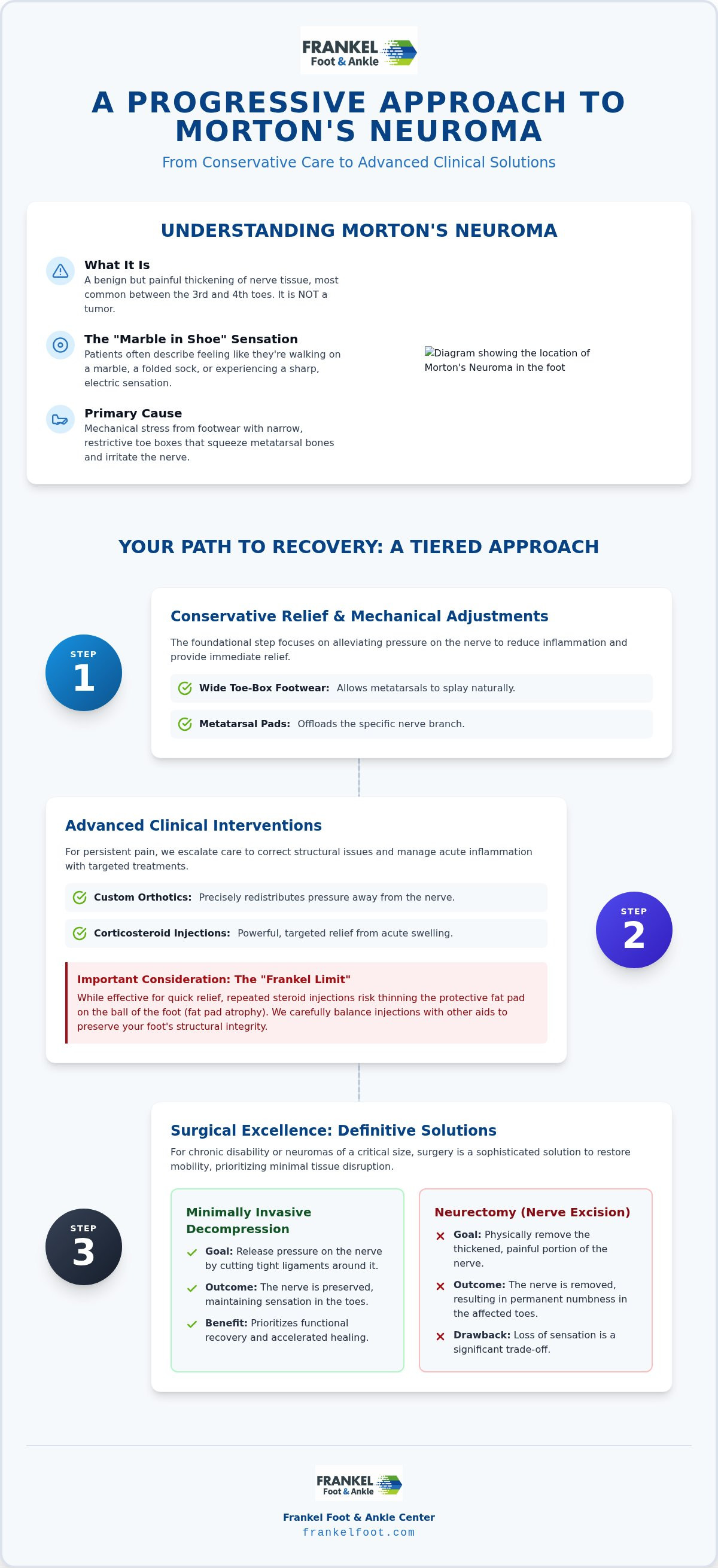
Morton's neuroma isn't a tumor; it's a benign yet painful thickening of the tissue surrounding the digital nerve leading to your toes. This condition most frequently develops between the third and fourth metatarsal heads, where the nerve is highly susceptible to compression. Patients often describe the experience as feeling like they're walking on a marble or a folded sock. This sensation stems from the inflamed nerve being pinched by adjacent bones. Understanding Morton’s Neuroma is the essential first step toward effective Morton's neuroma treatment.
Mechanical stress frequently triggers this inflammation. High-heeled shoes or footwear with narrow, restrictive toe boxes squeeze the metatarsal bones together, constantly irritating the nerve branch. At our Middletown and Katonah clinics, Dr. Marc Frankel utilizes advanced diagnostics to distinguish this condition from stress fractures or capsulitis. Accurate identification is vital. Mistaking a structural bone issue for a nerve entrapment can delay recovery and lead to chronic disability. Our specialists prioritize a thorough physical examination, moving from conservative footwear modifications to professional clinical assessments, to confirm the diagnosis before proceeding with a personalized care plan.
The Role of Footwear and Mechanical Adjustments
Conservative relief begins with alleviating the pressure that caused the thickening in the first place. Selecting shoes with a wide toe box allows your metatarsals to splay naturally, while proper arch support stabilizes the foot's biomechanical architecture. We often recommend metatarsal pads to offload the specific nerve branch, providing immediate mechanical relief. For those seeking comprehensive foot pain relief solutions, these adjustments serve as the foundation for more advanced clinical care. This methodical approach ensures we address the root cause before considering surgical options.
Advanced Clinical Interventions for Persistent Forefoot Pain
Transitioning from home care to a specialized Morton's neuroma treatment plan requires a methodical escalation of care. We start by correcting underlying structural issues through custom orthotic fabrication. These devices precisely redistribute pressure away from the nerve. If discomfort persists, targeted corticosteroid injections provide powerful relief by reducing acute swelling. We also utilize high-resolution ultrasound or MRI to measure the exact dimensions of the nerve thickening. For chronic cases, we may discuss regenerative options or alcohol sclerosing injections to achieve long-term desensitization. This structured approach, supported by clinical research on Advanced Clinical Interventions for Forefoot Pain, ensures every patient receives data-driven care tailored to their specific anatomy.
Corticosteroids and the Risk of Fat Pad Atrophy
While steroids are effective for quick relief, they aren't a permanent fix. Repeated injections carry the risk of thinning the protective fat pad on the ball of the foot. This loss of natural cushioning can lead to secondary complications, making the foot feel vulnerable. At Frankel Foot & Ankle Center, we adhere to the "Frankel limit," balancing these injections with mechanical aids or foot pain from arthritis treatments to preserve your foot's structural integrity. If a patient hasn't achieved at least six months of relief after these conservative efforts, it's often time to transition toward more permanent Morton's neuroma treatment options. You can consult with our specialists to determine the safest path for your recovery.
Surgical Excellence: Restoring Mobility in the Hudson Valley
When a neuroma exceeds a critical size or results in chronic disability, surgical intervention becomes a necessary step in your Morton's neuroma treatment. At our Middletown, Katonah, and Milford locations, we view surgery not as a daunting last resort, but as a definitive, sophisticated solution to restore your quality of life. Dr. Marc Frankel applies the same meticulous scarless bunion surgery philosophy to neuroma procedures, prioritizing minimal tissue disruption and accelerated healing. This patient-centered approach ensures that your journey moves from chronic, electric-shock pain to a state of lasting, comfortable mobility with minimal clinical downtime. Our goal is to provide a seamless transition that addresses your physical concerns with both high-level expertise and genuine care.
Minimally Invasive Decompression vs. Neurectomy
Selecting the appropriate Surgical Treatment for Morton's Neuroma depends entirely on your unique diagnostic profile and the nerve's condition. Nerve decompression involves releasing the transverse metatarsal ligament to provide immediate space for the nerve, which preserves its sensory function. In more advanced cases, a neurectomy involves the total excision of the thickened nerve segment. While traditional excision methods historically carried a risk of "stump neuroma" formation, our modern surgical precision significantly reduces this concern. Most patients experience a swift recovery, transitioning from post-operative care to regular footwear within two to four weeks. This methodical timeline is designed to ensure you return to your favorite activities without the fear of recurring pain or permanent damage, reflecting our commitment to achieving lasting health improvements for every individual we serve.
Stepping Toward a Pain-Free Future
Living with persistent forefoot pain shouldn't be your "new normal." By identifying the mechanical triggers of nerve compression and embracing a progressive Morton's neuroma treatment plan, you can reclaim the active lifestyle you love. We've explored how customized orthotics provide essential structural support, while advanced clinical interventions manage inflammation before it leads to permanent damage. For those requiring more definitive care, our minimally invasive surgical techniques prioritize rapid recovery and functional results. Dr. Marc Frankel and his team offer board-certified podiatric surgical expertise at our convenient locations in Middletown, Katonah, and Milford. We specialize in providing the sophisticated relief you need with the compassionate care you deserve. Schedule a consultation with Dr. Frankel for expert Morton’s neuroma care today and take the first step toward lasting comfort. You deserve to walk with confidence again.
Frequently Asked Questions
Can Morton’s neuroma go away on its own without medical treatment?
Morton's neuroma typically doesn't resolve on its own because it involves a physical thickening of the nerve sheath. While your symptoms might temporarily subside if you switch to wider footwear or reduce high-impact activities, the underlying structural change remains. Without professional Morton's neuroma treatment, the inflammation often returns once normal activity resumes. Early intervention prevents the condition from progressing into a chronic, debilitating issue.
Is an injection for Morton’s neuroma painful, and how long does it last?
Most patients experience only mild, temporary discomfort during the procedure, as we often use a local anesthetic to numb the area first. The duration of relief varies, but a successful corticosteroid injection typically reduces inflammation for several weeks to several months. We monitor your response closely to determine if further mechanical adjustments or advanced clinical interventions are necessary to maintain your mobility.
What happens if I leave a Morton’s neuroma untreated for several years?
Leaving this condition untreated for years can lead to permanent nerve damage and chronic, irreversible numbness in the toes. Over time, the persistent pain often causes you to alter your gait, which may trigger secondary issues in your ankles, knees, or hips. Seeking a timely diagnosis at our Middletown or Katonah offices ensures we can address the nerve thickening before it requires more complex surgical care.
How do I know if I need surgery or just better shoes for my foot pain?
Surgery is typically considered when conservative measures like wide toe boxes or metatarsal pads fail to provide relief after several months. If your pain persists despite footwear changes, it indicates the nerve thickening is too advanced for mechanical adjustments alone. Our specialists use diagnostic imaging to help you determine whether clinical injections or a surgical Morton's neuroma treatment is the most appropriate path forward.


