


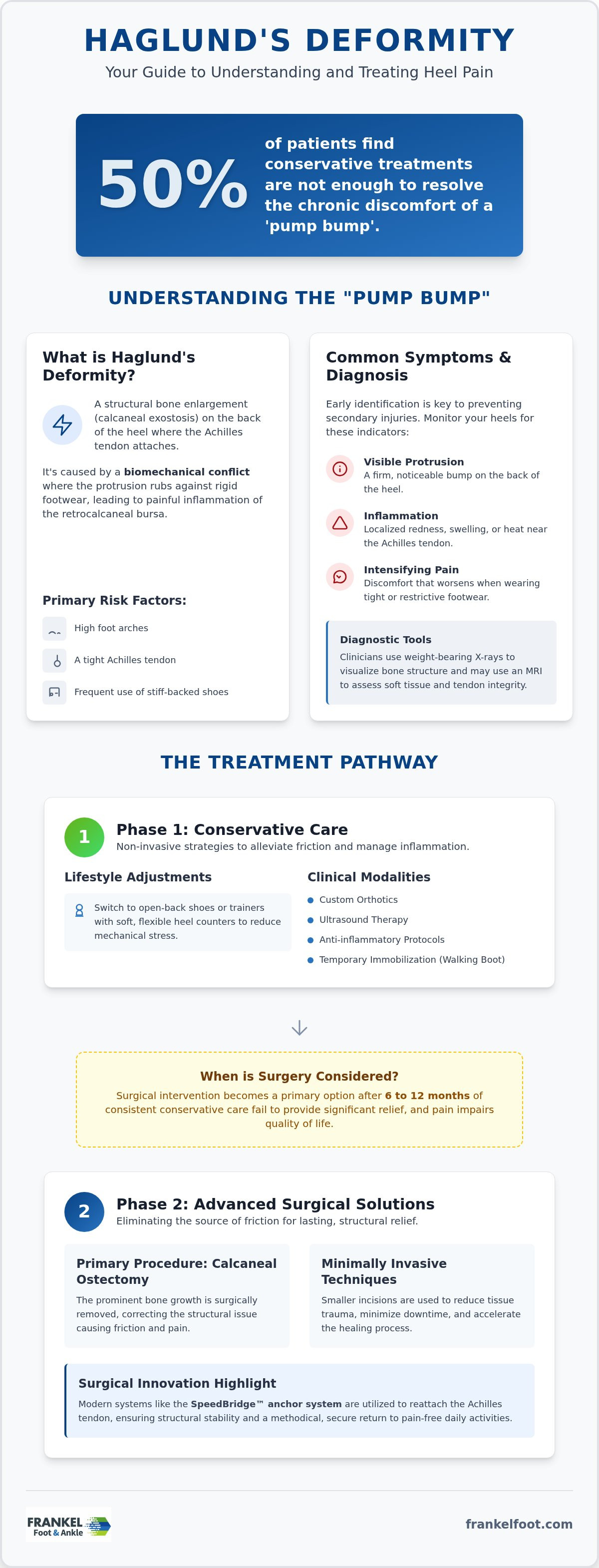
Did you know that nearly 50% of patients struggling with a painful 'pump bump' find that standard conservative treatments simply aren't enough to resolve their discomfort? If you've spent months icing your heel or rotating your footwear only to find the friction and swelling persist, you aren't alone. It's deeply frustrating when a simple walk feels like a constant battle against your own shoes. This guide explores the most sophisticated advancements in Haglund's deformity treatment to help you reclaim a life of fluid, pain-free movement.
We'll navigate the full spectrum of clinical care, from specialized lifestyle adjustments to progressive surgical interventions. You'll gain a clear understanding of how modern techniques, such as the SpeedBridge™ anchor system, are transforming recovery timelines. By linking advanced diagnostics to specific health outcomes, we provide the clarity you need to choose the right path toward lasting relief and a return to your active lifestyle.
Key Takeaways
- Understand how Haglund’s deformity develops from a biomechanical conflict between the heel bone and rigid footwear, leading to chronic inflammation of the retrocalcaneal bursa.
- Discover how targeted lifestyle adjustments, such as modifying shoe counters and utilizing custom orthotics, can effectively manage symptoms and reduce friction.
- Identify the specific clinical milestones that indicate when Haglund's deformity treatment should transition from conservative care to advanced surgical intervention for lasting relief.
- Explore modern surgical innovations that utilize specialized anchor systems to ensure structural stability and a methodical return to pain-free daily activities.
Understanding Haglund’s Deformity: More Than Just a Heel Bump
Haglund’s deformity is more than a cosmetic nuisance; it's a structural bone enlargement known as calcaneal exostosis. This growth occurs at the posterior heel bone where the Achilles tendon attaches. When this protrusion rubs against a rigid shoe, it creates a biomechanical conflict that leads to painful inflammation. Many find that this cycle of irritation makes seeking professional Haglund's deformity treatment essential for staying active.
The condition is nicknamed the "pump bump" because stiff-backed shoes frequently trigger symptoms. However, the root cause often lies in your foot's architecture. Individuals with high arches or a naturally tight Achilles tendon are more susceptible. These traits tilt the heel bone backward, increasing pressure against the shoe counter. This Haglund's syndrome overview clarifies how the bump results from years of cumulative mechanical stress.
It's vital to distinguish this deformity from other pathologies. While Haglund’s is a bony growth, retrocalcaneal bursitis is inflammation of the fluid-filled sac behind the tendon. Achilles tendonitis involves wear within the tendon itself. Differentiating these conditions is a core expertise at Frankel Foot & Ankle Center, where we focus on the source of your heel pain.
Common Symptoms and Diagnostic Steps
Early identification prevents secondary injuries. Monitor your heels for these indicators:
- A firm, visible protrusion on the back of the heel.
- Localized redness, swelling, or heat near the tendon.
- Pain that intensifies when wearing restrictive footwear.
Clinicians use weight-bearing X-rays to visualize the calcaneus. Sometimes, an MRI is required to assess the Achilles tendon's integrity and check for soft tissue inflammation. This thorough diagnostic approach ensures your Haglund's deformity treatment is tailored to your anatomy.
Effective Non-Surgical Treatments and Lifestyle Adjustments
The journey toward recovery often begins with non-invasive strategies designed to alleviate friction and manage inflammation. Since the "pump bump" thrives on pressure, the most immediate adjustment involves footwear. Transitioning to open-back clogs or trainers with soft, flexible heel counters can significantly reduce the mechanical stress on the posterior heel. For many, these simple lifestyle modifications serve as the foundation of effective Haglund's deformity treatment.
Beyond shoe selection, we address underlying foot mechanics through a variety of clinical modalities. Our approach includes:
- Custom Orthotics: These devices control heel motion and redistribute pressure, particularly for those with high arches.
- Ultrasound Therapy: This technique uses sound waves to stimulate blood flow and promote healing in the soft tissues surrounding the bone.
- Anti-inflammatory Protocols: A combination of topical or oral medications helps manage the acute pain of associated bursitis.
If these initial efforts don't provide the necessary foot pain relief, we move from lifestyle adjustments to more intensive clinical care.
Conservative Care for Patients in Middletown and Katonah
Identifying the right Haglund's deformity treatment in Middletown or Katonah means balancing clinical rest with active rehabilitation. We often guide patients toward local physical therapy resources that specialize in posterior heel pathologies. In cases of severe flare-ups, temporary immobilization using a walking boot may be necessary to completely calm the inflamed bursa. This methodical period of rest allows the soft tissues to recover before we reintroduce weight-bearing activities. Our team ensures every patient receives care tailored to their specific lifestyle, moving them from persistent discomfort to a state of lasting relief.
Advanced Clinical Solutions and Surgical Innovations
When conservative measures fail to provide relief after six to twelve months of consistent effort, surgical intervention becomes a necessary consideration. We reserve this step for patients whose chronic heel pain significantly impairs their mobility and quality of life. The primary procedure is a calcaneal ostectomy, where we surgically remove the prominent bone growth to eliminate the source of friction. Our practice prioritizes minimally invasive techniques, utilizing smaller incisions to reduce tissue trauma and accelerate the healing process. This precision-focused approach is a key component of modern Haglund's deformity treatment, ensuring that the structural integrity of the heel is restored while minimizing downtime. For those experiencing discomfort that radiates toward the joint, our comprehensive guide on Ankle Pain Relief provides additional context on maintaining long-term joint health.
Recovery and Long-Term Outcomes with Frankel Foot & Ankle
Recovery is a methodical journey that moves from initial rest to active re-engagement. We emphasize early mobilization and advanced scar management to ensure the best functional and aesthetic results. Our philosophy mirrors our approach to bunion surgery, where we strive for scarless and painless outcomes through refined surgical skill. This careful progression is a vital part of successful Haglund's deformity treatment. Key milestones include:
- Initial Healing: A brief period of protected recovery to ensure the surgical site stabilizes.
- Transition: Moving from a walking boot to standard footwear within a few weeks as comfort allows.
- Rehabilitation: A structured physical therapy regimen to restore strength and flexibility to the Achilles tendon.
This organized approach ensures you return to your active lifestyle with confidence. We don't just focus on the surgery itself, but on the long-term health of your foot and ankle.
Reclaiming Your Active Lifestyle
Living with chronic heel pain shouldn't be your daily reality. We've examined how a tiered approach to Haglund's deformity treatment moves you from initial discomfort toward a comprehensive resolution. By combining advanced diagnostic imaging on-site with a deep understanding of foot biomechanics, we identify the precise cause of your "pump bump" to ensure effective results. Our team provides compassionate care across Middletown, Katonah, and Milford, focusing on specialized scarless surgical techniques when conservative measures aren't enough. You deserve a recovery plan that prioritizes both your physical health and your long-term comfort.
We encourage you to schedule a consultation with Dr. Frankel to discuss your heel pain relief options and begin your journey toward recovery. Let's work together to restore your mobility so you can step forward with confidence once again.
Frequently Asked Questions
Can Haglund’s deformity go away on its own without surgery?
No, the bony protrusion characteristic of Haglund's deformity won't disappear without surgical removal. However, the associated pain and inflammation of the bursa often subside through conservative Haglund's deformity treatment. By utilizing heel lifts, icing, and activity modification, many patients manage symptoms effectively. While the bump remains visible, it can become entirely asymptomatic, allowing you to return to daily exercise without clinical intervention.
What are the best shoes to wear if I have a Haglund’s bump?
Optimal footwear for this condition includes open-back clogs, sandals, or shoes with a soft, collapsible heel counter. Avoid rigid-backed footwear, such as traditional dress shoes or stiff work boots, which apply direct pressure to the calcaneal exostosis. Sneakers with mesh backs or those specifically designed for Achilles comfort help minimize friction. We also recommend shoes with a slightly higher heel-to-toe drop to reduce tension on the tendon.
Is Haglund’s deformity surgery painful, and what is the recovery time?
Modern Haglund's deformity treatment utilizes advanced anesthetic techniques to ensure patient comfort during and immediately after the procedure. While some post-operative soreness is expected, we prioritize minimally invasive methods to reduce tissue trauma. Recovery typically involves two weeks of non-weight bearing, followed by several weeks in a walking boot. Most patients transition back to athletic footwear within six to twelve weeks, depending on their individual healing progress.
How do I know if my heel pain is Haglund’s or Achilles tendonitis?
Differentiation requires professional diagnostic imaging, though symptoms provide initial clues. Haglund's deformity presents as a firm, bony protrusion on the posterior heel bone, often accompanied by a red, swollen bursa. Achilles tendonitis typically involves pain higher up the tendon, often feeling like a dull ache or stiffness. On-site X-rays allow us to visualize the bone structure and confirm the exact source of your discomfort.


