


How many pairs of shoes have you tucked away in the back of your closet because that persistent ache in your big toe joint makes wearing them impossible? It's exhausting to plan your entire day around how much walking your feet can handle, and it's even harder to ignore the growing bump that makes you feel self-conscious in sandals. You deserve to understand exactly when is bunion surgery necessary to reclaim your mobility and confidence without the fear of a long, visible recovery.
This guide provides a clinical checklist of five key indicators that suggest it's time for professional intervention. We'll also explore how modern, scarless techniques offer a path to relief that prioritizes both your functional health and your aesthetic concerns, ensuring your journey back to comfort is as seamless as possible. By recognizing these signs early, you can move toward a solution that restores your quality of life with precision and care.
Key Takeaways
- Identify the transition from manageable discomfort to a progressive structural misalignment of the MTP joint that requires professional intervention.
- Recognize the specific clinical indicators, such as chronic pain and limited footwear options, that help determine when is bunion surgery necessary for your mobility.
- Explore advanced scarless and painless techniques that utilize surgical precision to provide lasting relief without compromising the aesthetic appearance of your foot.
- Gain confidence in modern recovery protocols that combine specialized anesthesia with minimally invasive methods to ensure a swift return to your daily routine.
Understanding When Bunion Pain Crosses the Line
A bunion is far more than a cosmetic protrusion; it's a progressive structural deformity known as hallux valgus. This condition involves the shifting of the first metatarsal bone away from the second, causing the big toe to lean inward toward the smaller toes. What is a bunion? It's a complex misalignment of the metatarsophalangeal (MTP) joint that alters the entire mechanical function of your foot. It's a complex misalignment.
Determining when is bunion surgery necessary often depends on the transition from occasional discomfort to persistent, disabling pain. While "annoying" pain might only occur after a long day of standing, "disabling" pain prevents you from completing basic tasks or enjoying your favorite hobbies. A bunion is medically significant when the hallux valgus angle exceeds 15 degrees and is accompanied by chronic pain that non-surgical methods cannot resolve.
Delaying treatment often causes a cascade of secondary issues. As the big toe loses its ability to bear weight, the smaller toes may develop hammertoes or the joint capsule can develop painful bursitis. Understanding when is bunion surgery necessary involves evaluating this physical toll on your body before these complications arise.
The Limitations of Conservative Treatments
Many patients at Frankel Foot & Ankle Center find that while toe spacers, custom orthotics, and wider footwear offer temporary relief, they don't fix the underlying bone structure. When chronic inflammation in the MTP joint persists despite these efforts, it's a clear signal for a more permanent solution. Managing pain shouldn't mean accepting a sedentary lifestyle or a reduced quality of life.
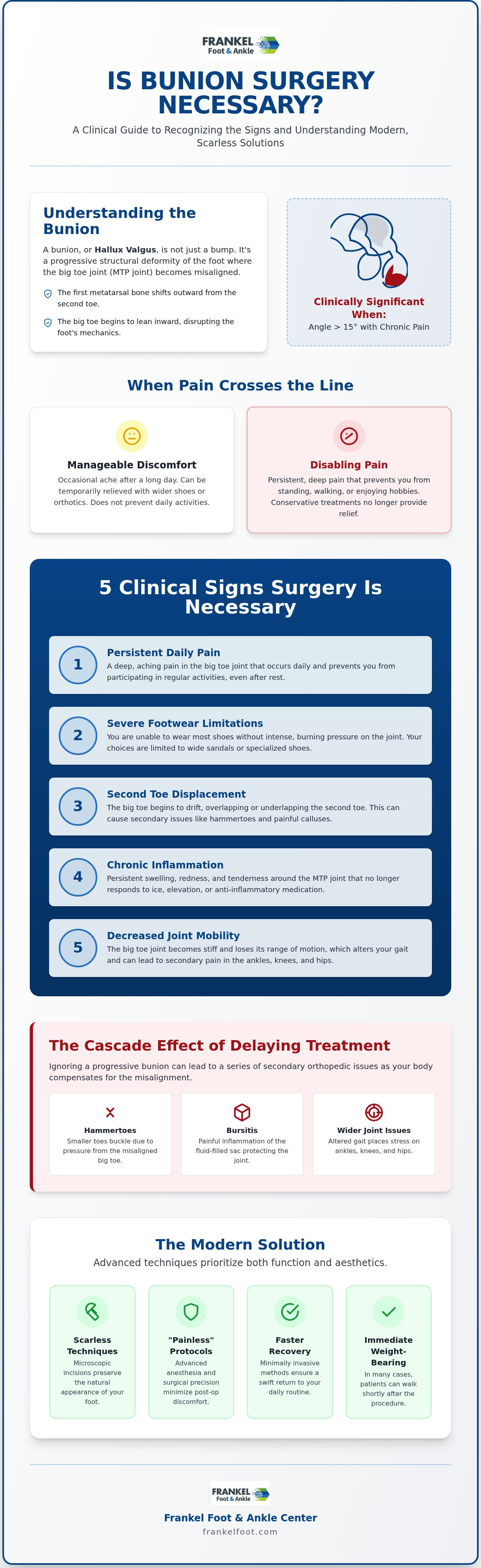
5 Clinical Signs That Bunion Surgery Is Necessary
Living with a bunion often means managing a slow decline in comfort until basic mobility feels like a chore. Recognizing specific clinical indicators helps you determine when is bunion surgery necessary to prevent permanent structural damage. While every patient's experience is unique, certain patterns signal that conservative care has reached its limit and a more definitive approach is required. When bunion surgery is necessary, it's usually because the following signs have become a daily reality:
- Persistent Daily Pain: Deep, aching discomfort in the MTP joint that prevents you from walking, standing, or engaging in light exercise despite rest.
- Footwear Struggles: An inability to wear anything other than wide-toe sandals or specialized orthopedic shoes without experiencing intense, burning pressure.
- Second Toe Displacement: A progressive shift where the big toe begins to overlap, underlap, or even dislocate the second toe, often causing painful secondary calluses.
- Refractory Inflammation: Chronic swelling and redness around the joint that no longer responds to ice, elevation, or consistent use of anti-inflammatory medications.
Evaluating Your Mobility and Joint Health
Joint stiffness is a critical factor that often goes overlooked during the early stages of a deformity. If the big toe joint loses its range of motion, it cannot bend properly during your stride, which forces your body to compensate. This lack of flexibility creates an altered gait that ripples upward through your skeletal system. Over time, this misalignment places undue stress on your ankles, knees, and hips, leading to secondary orthopedic issues. If you notice your joint is becoming rigid or your walking pattern is changing, it's time to seek a professional evaluation at our Middletown or Katonah locations. Addressing these concerns early ensures you understand exactly when is bunion surgery necessary to protect your overall musculoskeletal health.
The Modern Solution: Scarless and Painless Bunion Surgery
Many patients hesitate to seek help because they associate podiatric procedures with long recoveries and unsightly scars. However, modern bunion surgery has evolved to prioritize both mechanical correction and aesthetic results. At Frankel Foot & Ankle Center, we utilize specialized scarless techniques that eliminate the need for large, traditional incisions. This progressive methodology addresses the underlying structural deformity while preserving the natural beauty of your foot. It's a dual-focused approach.
The primary concern for most individuals is post-operative discomfort. By combining advanced anesthesia protocols with microscopic surgical precision, we've refined the process to achieve "painless" outcomes. This level of care allows for faster recovery times and, in many instances, immediate weight-bearing. When you evaluate when is bunion surgery necessary, remember that you don't have to choose between mobility and a scar-free appearance. Our center stands as a regional leader, offering these sophisticated solutions to patients throughout New York and Pennsylvania.
What to Expect During Your Consultation
Your journey begins with a thorough diagnostic evaluation. We utilize digital imaging and physical gait analysis to understand how your bunion affects your movement. This data allows us to create a tailored treatment plan that aligns with your specific activity goals and lifestyle. Determining when is bunion surgery necessary becomes much clearer during this structured consultation. For those in Milford, PA and the surrounding areas, you can schedule a consultation for scarless relief to determine if this advanced intervention is the right step for your health.
Reclaim Your Mobility with Confidence
Recognizing the difference between minor discomfort and a progressive deformity is the first step toward lasting relief. You've learned that chronic inflammation, difficulty with footwear, and the displacement of adjacent toes are clear indicators of a structural issue that conservative care cannot fix. Understanding when is bunion surgery necessary allows you to make an informed decision before permanent joint damage occurs. Dr. Marc Frankel specializes in minimally invasive, scarless techniques designed to prioritize both your recovery and your aesthetic results. From our convenient locations in Middletown, Katonah, and Milford, we provide a patient-centered environment focused on rapid, painless outcomes. Don't let foot pain dictate your lifestyle any longer. Take the next step toward comfort and Schedule Your Bunion Consultation at Frankel Foot & Ankle Center today. Your journey to a more active, confident life begins with expert care.
Frequently Asked Questions
Is bunion surgery painful with modern techniques?
Modern surgical techniques have transformed the patient experience into a largely painless journey. By combining advanced local anesthesia blocks with minimally invasive precision, we minimize tissue trauma and post-operative discomfort. Patients often report much lower pain levels than they anticipated, allowing for a more comfortable transition into the healing phase compared to traditional open methods.
How long is the recovery period for scarless bunion surgery?
Recovery for scarless bunion surgery is significantly faster than traditional procedures. Many patients can bear weight immediately or shortly after the operation while wearing a specialized protective boot. While full bone healing takes several weeks, the reduced tissue disruption of the scarless method allows most individuals to return to light daily activities and comfortable footwear much sooner than expected.
Can a bunion come back after I have surgery?
While it's possible for a deformity to return, the risk is greatly reduced when the underlying structural misalignment is fully corrected. Understanding when is bunion surgery necessary involves identifying the root cause of the joint deviation. By precisely realigning the MTP joint and addressing ligament laxity, we provide a stable foundation that prevents the toe from shifting back into its old position.
Will insurance cover my bunion surgery if it is also for aesthetic reasons?
Insurance typically covers bunion correction when the procedure is medically necessary due to chronic pain or functional impairment. While the aesthetic benefit of a scarless result is a significant advantage, coverage is based on clinical indicators like difficulty walking or the failure of conservative care. Determining when is bunion surgery necessary for insurance purposes usually requires documented evidence of persistent symptoms.


