


Did you know that up to 40% of individuals who experience an ankle sprain eventually suffer from chronic lateral pain? If you're dealing with a persistent ache along the outer edge of your foot or swelling that worsens with every mile, you're likely feeling the strain of limited mobility. It's exhausting to manage constant instability while simply trying to walk or return to the sports you love. We believe you deserve a recovery plan that's as precise as it is compassionate. This guide outlines the most effective peroneal tendonitis treatment strategies to help you eliminate outer ankle pain and restore your confidence.
We'll explore a spectrum of care from non-invasive options like MLS Laser Therapy to specialized surgical techniques for structural repair. You'll find clear insights into recovery timelines and the progressive steps required to achieve lasting, pain-free movement.
Key Takeaways
- Identify the specific anatomy of the lateral ankle to understand why inflammation of the peroneal tendons causes chronic instability and persistent pain.
- Master the initial "Unloading Phase" of peroneal tendonitis treatment, utilizing methodical activity modification and bracing to manage early-stage inflammation.
- Learn how advanced diagnostic imaging and non-invasive technologies, such as FDA-cleared laser therapy, can significantly accelerate your return to sports.
- Gain a clear understanding of recovery timelines to help you navigate the transition from immediate symptom relief to complete functional restoration.
Understanding Peroneal Tendonitis: Why the Outside of Your Ankle Pain Persists
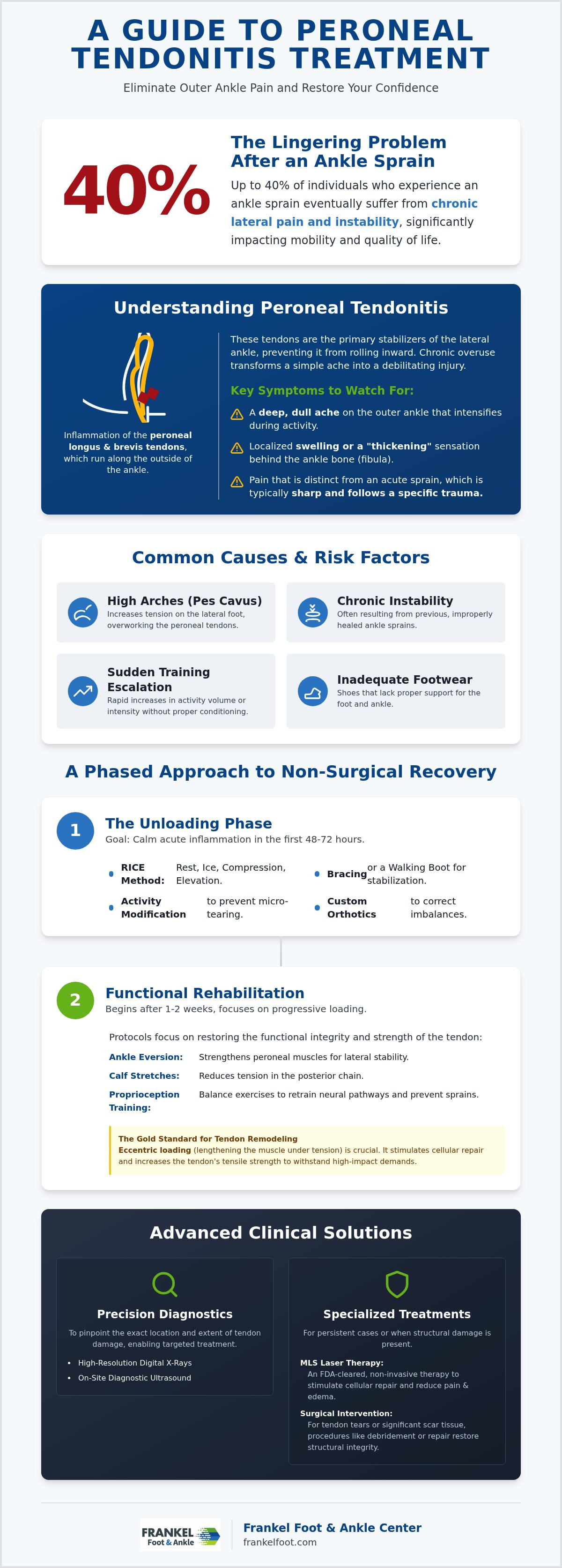
Peroneal tendonitis is a condition characterized by the inflammation of the peroneal longus and brevis tendons, which run along the outside of your lower leg and wrap behind the bony protrusion of the ankle. These vital structures serve as the primary stabilizers of the lateral ankle, preventing the foot from rolling inward during movement. Understanding Tendinopathy is essential because it highlights how chronic overuse transforms a simple ache into a debilitating injury. Peroneal tendonitis is defined as a chronic inflammatory response resulting from repetitive mechanical strain and excessive pressure on the lateral foot column.
Differentiating this condition from a standard sprain is crucial for effective peroneal tendonitis treatment. While an acute sprain often presents as immediate, sharp pain following a trauma, tendonitis typically manifests as a deep, dull ache that intensifies during activity and subsides with rest. You might notice localized swelling or a "thickening" sensation behind the fibula, signaling that the tendons are no longer gliding smoothly. At Frankel Foot & Ankle Center, we recognize that this pain isn't just a localized symptom but often a reflection of broader biomechanical imbalances.
Identifying Common Causes and Risk Factors
Mechanical alignment plays a significant role in tendon health. Individuals with high arches, known as pes cavus, often experience increased tension on the lateral foot, forcing the peroneal tendons to work harder to maintain stability. Common triggers include chronic instability from previous sprains, sudden escalations in training volume, or inadequate footwear. Identifying these triggers is a cornerstone of effective peroneal tendonitis treatment, allowing us to move beyond temporary relief toward lasting functional restoration.
Effective Non-Surgical Treatments: From RICE to Functional Recovery
Successful peroneal tendonitis treatment begins with a structured "Unloading Phase" designed to calm acute inflammation. During the first 48 to 72 hours, we prioritize the RICE method (Rest, Ice, Compression, Elevation) alongside significant activity modification. This period is essential for preventing further micro-tearing of the delicate tissue. Bracing or walking boots provide necessary stabilization, while non-steroidal anti-inflammatory drugs (NSAIDs) effectively manage initial pain levels. Once the sharpest symptoms subside, we introduce custom orthotics. These precision-crafted devices are essential for patients with high arches, as they redistribute pressure away from the lateral foot and correct the mechanical imbalances we identified earlier.
The transition from rest to active rehabilitation typically occurs within one to two weeks, or once you can bear weight without significant discomfort. If basic home care doesn't resolve the ache, seeking professional ankle pain relief ensures your recovery stays on track and prevents chronic degeneration.
Targeted Exercises and Physical Therapy Protocols
Rehabilitation focuses on restoring the functional integrity of the tendon through progressive loading. Specific protocols include:
- Ankle Eversion: Strengthening the peroneal muscles by moving the foot outward against resistance to build lateral stability.
- Calf Stretches: Reducing tension in the posterior chain to alleviate secondary strain on the lateral ankle complex.
- Proprioception Training: Balance exercises, such as standing on a foam pad, to retrain neural pathways and prevent future sprains.
Eccentric loading remains the gold standard for tendon remodeling. By lengthening the muscle under tension, we stimulate cellular repair and increase the tendon's tensile strength, ensuring it can withstand the high-impact demands of running or competitive sports.
Advanced Clinical Solutions and Specialist Care in Middletown
At Frankel Foot & Ankle Center, we initiate the clinical journey with a comprehensive diagnostic evaluation. While the symptoms discussed earlier provide a baseline, Dr. Marc Frankel utilizes high-resolution digital X-rays and on-site ultrasound to pinpoint the exact location of tendon damage. This precision allows us to implement advanced peroneal tendonitis treatment options like MLS Laser Therapy. This specific laser technology, which received FDA clearance in 2009, is highly effective at stimulating cellular metabolic activity. It offers a non-invasive path to reducing the localized edema and pain that often lingers after traditional home care fails.
For more complex cases where the tendon has developed a longitudinal tear or significant scar tissue, surgical intervention may be required. Procedures such as tendon debridement or primary surgical repair are performed to restore structural integrity and prevent future rupture. Our specialized team provides these advanced interventions across our convenient locations in Middletown, Katonah, and Milford. We focus on minimally invasive techniques whenever possible to streamline your recovery and minimize downtime.
When to See a Foot and Ankle Specialist
While mild inflammation might respond to rest, certain "red flags" signal the need for an expert consultation. If you experience a persistent "snapping" sensation behind the ankle bone or pain that hasn't improved after four weeks of diligent home care, it's time to seek a professional evaluation. We also utilize professional gait analysis to address the mechanical flaws that lead to chronic strain. To explore more about our clinical approach, visit our guide on Comprehensive Ankle Pain Relief.
Take the Next Step Toward Lasting Ankle Stability
Restoring your mobility requires a shift from merely managing symptoms to addressing the root mechanical causes of your discomfort. By combining the immediate relief strategies of the unloading phase with the long-term benefits of functional strengthening, you can effectively break the cycle of chronic lateral pain. While the path to recovery varies for every individual, a structured peroneal tendonitis treatment plan ensures that your tendons are resilient enough to handle the pressures of your daily life. We're committed to guiding you through every stage of this transition with both clinical precision and genuine care.
Dr. Marc Frankel and our dedicated team offer the specialized expertise and advanced diagnostic tools necessary to provide lasting results. Whether you're visiting us in Middletown, Katonah, or Milford, your health and comfort remain our primary focus. Schedule a consultation at Frankel Foot & Ankle Center for specialized relief and take the first step toward a pain-free, active future. We look forward to helping you regain your stride.
Frequently Asked Questions
How long does it take for peroneal tendonitis to heal?
Recovery timelines vary based on the severity of the inflammation and the consistency of your peroneal tendonitis treatment. Mild cases typically resolve within six to eight weeks of diligent physical therapy and activity modification. More chronic conditions or structural tears may require several months of specialized care to achieve full functional restoration and prevent future recurrence.
Can I walk with peroneal tendonitis?
You can usually walk with this condition, but you must prioritize mechanical unloading during the acute phase. If walking causes a sharp pain or increased swelling along the lateral ankle, we recommend using a walking boot or specialized bracing. This temporary immobilization allows the tendons to heal by preventing the repetitive strain that triggers inflammation during your gait cycle.
What is the best brace for peroneal tendonitis?
The most effective brace is typically a semi-rigid ankle stabilizer or a lace-up ankle brace that limits lateral movement. These devices provide the structural support necessary to prevent the foot from rolling outward, which directly reduces tension on the peroneal tendons. For long-term relief, we often combine bracing with custom orthotics to correct underlying foot alignment issues.
What happens if peroneal tendonitis goes untreated?
Ignoring persistent lateral ankle pain can lead to chronic tendon degeneration or a full-thickness tear. Over time, untreated inflammation weakens the tendon's structural integrity, resulting in permanent instability and a higher risk of recurrent sprains. Seeking a professional peroneal tendonitis treatment plan early prevents these complications and ensures you don't lose the ability to participate in high-impact activities.


