


What if the sharp, burning sensation in your shoe isn't just a sign of a long day, but a signal that your foot’s internal structure is under mechanical stress? You likely recognize the feeling of walking on a persistent pebble that isn't there, or the tingling numbness that forces you to cut your walk short. It’s exhausting to manage ball of foot pain that dictates which shoes you can wear and which activities you must avoid. We understand that your goal is a return to activity without compromise.
This guide will help you identify whether your discomfort stems from Morton’s neuroma or metatarsalgia, providing the clarity you need. You’ll discover how advanced, minimally invasive treatments provide immediate relief and restore your mobility without the burden of visible scarring. We examine the specific diagnostic pathways and progressive recovery options that return you to the lifestyle you love.
Key Takeaways
- Identify the clinical differences between general metatarsalgia and specific conditions like Morton’s neuroma to ensure you receive the correct diagnosis.
- Recognize the primary indicators of ball of foot pain, such as a burning sensation or the feeling of a pebble in your shoe, which often signal underlying mechanical stress.
- Learn how advanced laser therapy and custom orthotics provide non-invasive relief by addressing deep-tissue inflammation and correcting biomechanical imbalances.
- Discover how early intervention and modern treatment plans can prevent long-term complications like stress fractures while avoiding the downtime of traditional surgery.
Understanding Ball of Foot Pain: Symptoms and Common Triggers
Experiencing ball of foot pain often feels like navigating a world where every step is an obstacle. Clinically referred to as metatarsalgia, this condition involves acute inflammation and localized distress in the forefoot area. It's not a single disease but a symptom of mechanical dysfunction that can significantly disrupt your daily mobility and quality of life.
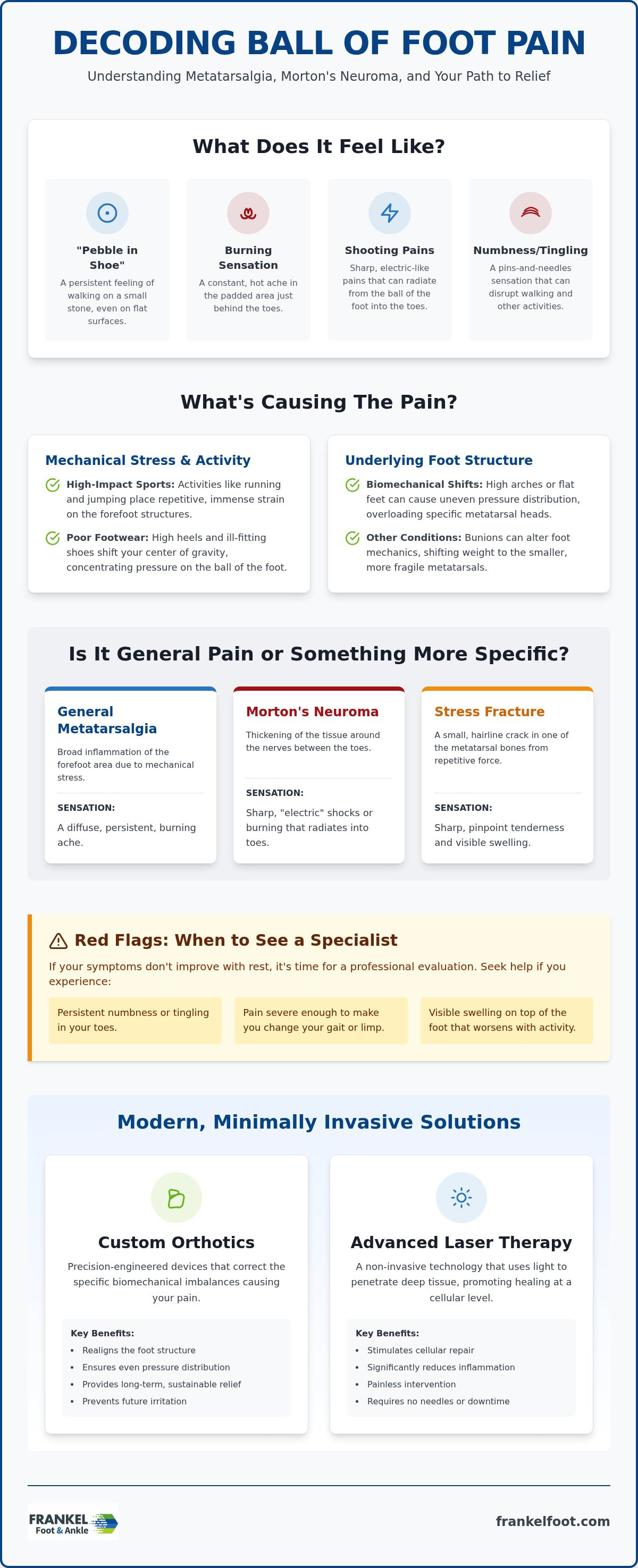
Patients frequently describe a distinct "pebble in the shoe" sensation, even when walking on flat, unobstructed surfaces. This discomfort often manifests through several specific indicators:
- Sharp, shooting pains that radiate into the toes.
- A persistent, burning ache in the padded area behind the toes.
- Increased sensitivity that worsens when standing or walking on hard floors.
Engaging in high-impact sports like running or jumping often places immense strain on the forefoot. While these activities are vital for health, the repetitive force can lead to chronic irritation of the delicate metatarsal structures. We often see patients who have pushed through the pain, only to find that the underlying inflammation has worsened, requiring more specialized foot pain relief strategies.
The Anatomy of Pressure: Why the Metatarsals Suffer
Your metatarsal heads act as the primary weight-bearers during the critical "toe-off" phase of walking. In a healthy foot, this force is distributed across the entire forefoot. However, structural variations like high arches or flat feet often cause a biomechanical shift. These shapes redistribute pressure unevenly, forcing specific metatarsals to endure an excessive load they weren't designed to support. Ill-fitting footwear and high heels further complicate this by physically shifting your center of gravity onto the forefoot cushion. This constant, concentrated pressure can eventually cause the protective fat pad to diminish, leaving the underlying nerves and bones without their natural shock absorbers.
Beyond General Aches: Identifying Morton’s Neuroma and Stress Fractures
Distinguishing the precise origin of your discomfort is the first step toward lasting recovery. While general metatarsalgia indicates broad inflammation, Morton’s Neuroma involves the physical thickening of tissue surrounding the digital nerves, typically between the third and fourth toes. This condition often produces sharp, "electric" shocks or a persistent burning that radiates directly into the toes, which is more localized than general ball of foot pain.
Conversely, a metatarsal stress fracture presents as a sharp, pinpoint tenderness rather than a diffuse ache. You might notice visible swelling on the top of the foot, especially after increased activity. Structural issues like bunions also play a significant role. When the big toe joint is compromised, it shifts the weight-bearing load to the smaller, more fragile metatarsals. This mechanical imbalance creates a cycle of repetitive stress in the forefoot, often resulting in chronic ball of foot pain that persists even during rest.
When to See a Foot Specialist in Middletown
Persistent numbness, tingling, or pain that forces you to modify your gait are significant red flags. If your symptoms don't improve with rest, it's time to seek a professional evaluation. We utilize advanced digital X-rays and precise physical examinations to differentiate between soft tissue inflammation and high-risk fractures. For those seeking Comprehensive Foot Pain Relief, understanding these clinical distinctions is vital for a successful recovery. We encourage you to reach out for an evaluation to ensure your journey toward foot pain relief is both safe and effective.
Advanced Treatment Options: Modern Relief at Frankel Foot & Ankle Center
While traditional advice often centers on rest and ice, chronic ball of foot pain typically requires a more sophisticated approach to achieve a lasting resolution. At Frankel Foot & Ankle Center, we prioritize advanced diagnostics to implement treatments that address the root cause rather than merely masking the symptoms. Custom orthotics are a cornerstone of our practice, as they're precision-engineered to correct the specific biomechanical imbalances that lead to uneven pressure distribution. By realigning the foot, these devices provide long-term relief and prevent future irritation of the delicate metatarsal heads.
For patients seeking non-invasive options, we offer advanced laser therapy. This technology utilizes specific wavelengths of light to penetrate deep into the tissue, stimulating cellular repair and significantly reducing inflammation without the need for needles or downtime. Our commitment to painless intervention ensures you don't have to choose between effective treatment and your immediate comfort.
Minimally Invasive Solutions for Lasting Recovery
In cases where structural deformities drive your discomfort, addressing the underlying issue is essential for permanent health. For instance, resolving a chronic misalignment through scarless surgery can permanently alleviate the secondary pressure that causes ball of foot pain. We utilize modern podiatric techniques that prioritize painless outcomes and rapid recovery for those we serve in NY and PA. Advanced laser therapy targets the cellular source of pain by accelerating natural tissue regeneration and neutralizing deep-seated inflammatory markers. This progressive methodology allows us to restore your mobility while ensuring the treatment process at Frankel Foot & Ankle Center is as comfortable as the results are transformative.
Restoring Comfort to Every Step
Understanding the specific cause of your ball of foot pain is the first step toward reclaiming your mobility. Precision diagnostics are essential. Whether your discomfort stems from the nerve thickening of Morton’s neuroma or the mechanical stress of metatarsalgia, we provide a targeted recovery plan. From advanced laser therapy that neutralizes deep-tissue inflammation to custom orthotics that correct imbalances, modern podiatry offers solutions that prioritize your comfort. Dr. Marc Frankel and his dedicated team at Frankel Foot & Ankle Center utilize state-of-the-art technology to ensure your journey is both effective and painless. You deserve relief.
Expert care is accessible at our locations in Middletown, Katonah, and Milford. We specialize in scarless and painless techniques designed to get you back on your feet quickly. Schedule your consultation at Frankel Foot & Ankle Center for expert relief today. You don't have to navigate this journey alone. We are here to provide the sophisticated care you need to move forward with confidence.
Frequently Asked Questions
Why does the ball of my foot feel like I'm walking on a pebble?
It's a sensation that typically indicates Morton’s Neuroma, which is a thickening of the nerve tissue between your toes. It can also result from metatarsalgia where the metatarsal heads become inflamed due to uneven pressure distribution. Professional diagnostics are necessary to distinguish between nerve damage and mechanical inflammation. We focus on identifying the structural cause to ensure your treatment is effective.
Can high heels cause permanent ball of foot pain?
High heels physically shift your center of gravity forward, forcing excessive weight onto the forefoot and potentially causing long-term damage. While the pain isn't always permanent, chronic use can lead to the atrophy of the protective fat pad or the development of neuromas. Early intervention with custom orthotics can often reverse these biomechanical shifts and protect your foot’s structural integrity.
What is the difference between metatarsalgia and Morton’s Neuroma?
Metatarsalgia is a general clinical term for inflammation and pain in the metatarsal region, often caused by mechanical stress. Morton’s Neuroma specifically involves a benign thickening of a nerve, usually between the third and fourth toes. While metatarsalgia feels like a diffuse ache, a neuroma often produces sharp, electric sensations or numbness that radiates directly into the toes.
How do I know if the pain in my forefoot is a stress fracture?
A metatarsal stress fracture usually presents with pinpoint tenderness and localized swelling on the top of the foot. Unlike general ball of foot pain, which may fluctuate, fracture pain typically intensifies during activity and lingers during rest. We utilize digital X-rays to confirm these tiny cracks in the bone that require specific immobilization and reduced weight-bearing to heal properly.
Are there non-surgical treatments for ball of foot pain available in Middletown?
Yes, we offer several non-invasive options at our Middletown facility, including advanced laser therapy and custom-molded orthotics. Laser therapy utilizes targeted light energy to reduce deep-tissue inflammation and accelerate cellular repair. These treatments focus on providing immediate relief without the downtime associated with traditional surgical procedures, ensuring a faster and more comfortable return to your daily exercise routine.
How long does it take to recover from ball of foot pain treatments?
Recovery times vary depending on the severity of the condition and the selected treatment modality. Conservative measures like orthotics or laser therapy often show results within a few weeks of consistent use. If a stress fracture is present, a typical healing period of 6 to 8 weeks is required for ball of foot pain to resolve as the bone fully stabilizes.


