


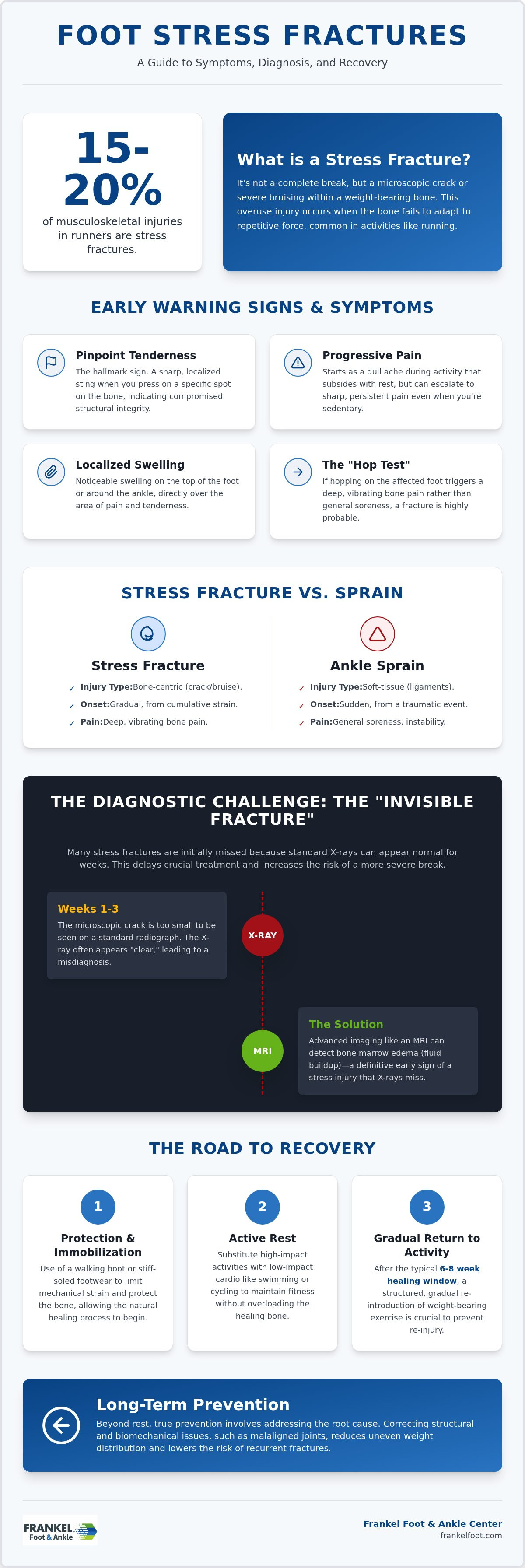
Did you know that stress fractures account for 15% to 20% of musculoskeletal injuries in runners, yet standard X-rays often miss these cracks for the first three weeks? If you're struggling with a persistent, dull ache on the top of your foot that worsens during exercise, you're likely noticing the early foot stress fracture symptoms of an overuse injury. It's frustrating when rest doesn't provide relief. You're left wondering if the pain is a minor strain or a serious bone injury.
This guide explains how to identify localized warning signs and when you need a specialist consultation at our locations in Middletown, Katonah, or Milford. You'll learn why advanced diagnostic imaging is essential to prevent a small crack from becoming a major break. We also preview the methodical steps required for a full recovery and how to avoid future injuries through precise clinical care.
Key Takeaways
- Learn how to identify foot stress fracture symptoms early, focusing on pinpoint tenderness and pain that persists despite periods of rest.
- Understand the "invisible fracture" phenomenon, where standard X-rays may appear clear for several weeks before bone healing becomes visible.
- Explore the necessity of methodical immobilization and specialized footwear to facilitate proper bone remodeling and prevent long-term structural damage.
- Master the balance of "active rest" to maintain cardiovascular health while protecting your metatarsals from further repetitive strain during the recovery process.
Identifying Foot Stress Fracture Symptoms and Early Warning Signs
It's frustrating when rest doesn't fully resolve your discomfort. To understand what is a stress fracture, one must view it as a failure of the bone to adapt to repetitive force. It isn't always a complete snap; instead, it's often a microscopic crack or severe internal bruising within a weight-bearing bone. Recognizing foot stress fracture symptoms early is the most effective way to seek foot pain relief before the condition worsens.
The hallmark sign of this injury is pinpoint tenderness. If you can press one specific spot on the bone and feel a sharp, localized sting, the structural integrity of the bone is likely compromised. You might also notice these clinical indicators:
- A dull ache that begins during activity but subsides with rest.
- Sharp pain that eventually persists even when you're sedentary.
- Localized swelling on the top of the foot or the ankle.
Stress Fracture vs. Sprain: Distinguishing the Difference
While ankle sprain symptoms involve ligament instability and soft-tissue bruising, a stress fracture is purely bone-centric. You can often distinguish the two through a "hop test." If jumping on the affected foot triggers a deep, vibrating bone pain rather than general soreness, a fracture is probable. Unlike a sprain, which follows a sudden traumatic event, these fractures develop gradually. They are the result of cumulative strain rather than a single fall. If your discomfort has increased steadily over weeks, it's time for a professional evaluation at our clinics in Middletown, Katonah, or Milford.
Diagnostic Challenges: Why Stress Fractures are Often Missed
Many patients visit general urgent care clinics expecting immediate answers, only to be told their X-ray is clear. This is the "invisible fracture" phenomenon. For the first three to four weeks, standard radiographs often appear perfectly normal because the crack is too small to register. It's only after the body begins the healing process that a bone callus, which is a cloudy area of new bone growth, becomes visible on imaging. Relying solely on an initial X-ray can delay essential foot pain relief and lead to further injury.
A specialized clinical exam is far more reliable than a generic evaluation. A podiatrist understands the subtle nuances of foot stress fracture symptoms, using manual palpation to identify the exact site of structural weakness. If you've been managing pain for over ten days, waiting for a "clear" X-ray to change is a risky strategy. Early intervention is vital to prevent a minor fissure from becoming a displaced break.
The Importance of Advanced Imaging and Expert Evaluation
Dr. Marc Frankel utilizes high-resolution digital imaging and, when necessary, recommends an MRI to identify bone marrow edema. This fluid buildup within the bone indicates a pre-fracture state or a microscopic crack that X-rays simply cannot detect. Detecting these changes early is the most effective way to avoid a complete fracture that might require surgical hardware. For patients in Middletown and Katonah, seeking an expert podiatric evaluation ensures that a minor overuse injury doesn't escalate into a long-term mobility issue. Precision in diagnostics is the foundation of our patient-centered approach.
Comprehensive Treatment and Biomechanical Prevention
Effective recovery begins with protecting the bone to allow for natural remodeling. This typically involves immobilization through specialized walking boots or stiff-soled footwear that limits mechanical strain. While ignoring foot stress fracture symptoms can lead to a complete break, a structured recovery plan facilitates healing without requiring total sedentary behavior. We often advocate for "active rest," where you substitute high-impact running with low-impact swimming or stationary cycling to maintain cardiovascular fitness. This methodical approach ensures the metatarsals aren't overloaded during the critical six-to-eight-week healing window required for bone consolidation.
Professional guidance is essential when diagnosing stress fractures and planning a safe return to sport. Beyond immediate rest, addressing structural abnormalities is vital for long-term health. For instance, undergoing scarless bunion surgery can correct malaligned joints that cause uneven weight distribution. By resolving these underlying issues, we effectively reduce the risk of compensatory injuries and recurrent fractures. A gradual transition back to weight-bearing activity, supported by physical therapy, ensures the bone has the density to handle renewed impact.
Addressing Biomechanical Triggers at Frankel Foot & Ankle Center
At our Middletown, Katonah, and Milford clinics, we analyze how your unique foot structure contributes to repetitive strain. High arches or flat feet often create localized "stress points" that predispose specific bones to microscopic cracking. We utilize comprehensive gait analysis and custom-molded orthotics to redistribute pressure away from vulnerable areas. This compassionate, expert-led intervention ensures you don't just recover from your current injury but also establish a foundation for permanent foot pain relief. Our dedicated team at Frankel Foot & Ankle Center is committed to your long-term mobility through every step of the healing journey.
Take the First Step Toward Lasting Mobility
Acknowledging the subtle nature of foot stress fracture symptoms is the first step toward a full recovery. By moving beyond the limitations of standard X-rays and addressing the biomechanical root causes of your pain, you protect your long-term health. Dr. Marc Frankel and our dedicated team provide a methodical, patient-centered approach to ensure a safe return to the activities you love. Whether you're in Middletown, Katonah, or Milford, we offer specialized expertise in advanced diagnostics and surgical solutions. Schedule your expert diagnostic evaluation at Frankel Foot & Ankle Center today to secure the precise care your recovery requires. Don't let a minor crack sideline your progress; we're here to guide you back to a pain-free life.
Frequently Asked Questions
Can I walk on a foot stress fracture?
Walking on a compromised bone is highly discouraged. While you might physically be able to limp along, doing so risks converting a microscopic fissure into a displaced fracture. Most clinical protocols require immobilization with a walking boot or stiff-soled shoe to protect the site during the remodeling phase. Seeking guidance from professional services like Active Footcare can help ensure proper protection of the injury, preventing the need for more invasive surgical interventions later.
Most non-displaced metatarsal stress fractures require six to eight weeks of reduced weight-bearing to achieve clinical healing. This specific timeline allows for essential bone consolidation and remodeling. Your recovery duration depends on the specific bone involved and your adherence to "active rest" protocols. High-risk areas often require a more extended period of immobilization to ensure a successful and lasting outcome.
Will a stress fracture show up on an X-ray immediately?
Standard radiographs rarely detect an injury in its initial stages. It typically takes three to four weeks for the bone to produce a visible callus, which is the first sign of healing on an X-ray. Because early foot stress fracture symptoms often precede visible imaging changes, Dr. Frankel may utilize advanced diagnostics to identify bone marrow edema before a major break occurs.
What happens if a foot stress fracture goes untreated?
For medical trainees who need to master these diagnostic criteria and imaging interpretations for their specialist board exams, check out FRACPractice for comprehensive online study tools.
Ignoring foot stress fracture symptoms can lead to serious complications. These include a complete bone break or a non-union where the bone fails to knit back together. Chronic pain and permanent structural instability may develop; these often require surgical hardware for correction. Early intervention at our clinics ensures the bone heals correctly, preserving your mobility and preventing long-term biomechanical dysfunction.


