

Did you know that approximately 20% of adults over the age of 65 experience the persistent discomfort of a hammertoe? You've likely felt that sharp pain in the ball of your foot or the mounting frustration when your favorite shoes no longer fit. It's natural to feel embarrassed about your toe's appearance or fearful that invasive surgery is the only path forward. Finding an effective hammertoe treatment shouldn't be an overwhelming hurdle. It should be a clear, supported journey toward reclaiming your mobility.
We're here to guide you through this condition with clinical expertise and genuine warmth. You'll learn to identify the stages of deformity and navigate the best options available today. We explore everything from simple lifestyle adjustments to advanced, minimally invasive solutions. This guide provides a clear understanding of your treatment timeline, helping you achieve the lasting results of pain-free walking and straightened toes.
Key Takeaways
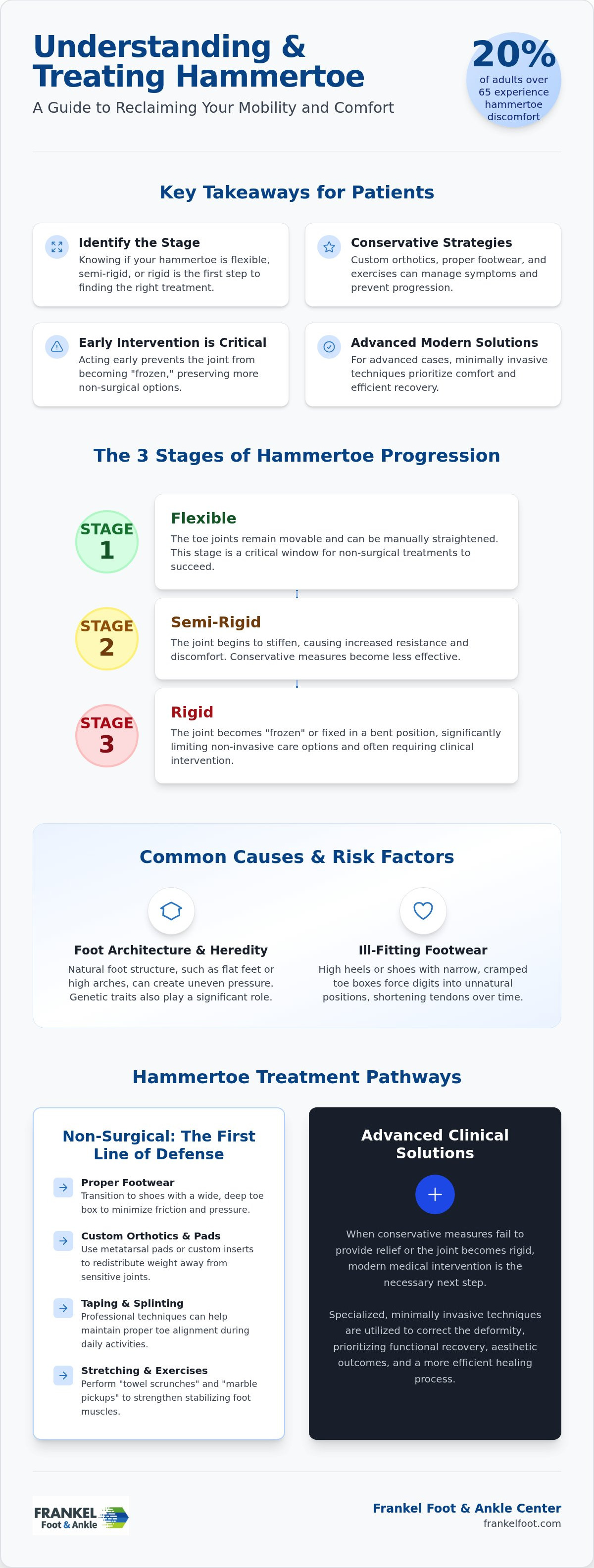
- Identifying whether your condition is flexible, semi-rigid, or rigid is the first step in selecting the most appropriate medical response.
- You'll learn how conservative strategies, such as custom orthotics and proper footwear, can effectively manage symptoms and redistribute pressure away from sensitive joints.
- For more advanced cases, modern hammertoe treatment utilizes specialized, minimally invasive techniques that prioritize your comfort and facilitate a more efficient recovery process.
- Early intervention is critical to prevent the joint from becoming frozen, ensuring you have access to a wide range of non-surgical and clinical options.
Understanding Hammertoe Progression: Why Early Treatment is Critical
Early hammertoe treatment focuses on preserving joint flexibility before the deformity advances. A hammertoe is a contracture of the toe joints caused by a muscle and tendon imbalance, frequently resulting in a permanent, painful bend. View this not as a static issue but as a progressive deformity that evolves from a flexible state to a rigid position. You can reference a Hammer toe overview to understand the underlying pathophysiology of this condition.
The progression typically moves through these three clinical phases:
- Flexible: The toe joints remain movable and can be straightened by hand.
- Semi-Rigid: The joint begins to stiffen, causing increased resistance and discomfort.
- Rigid: The joint becomes "frozen" or fixed, significantly limiting your options for non-invasive care.
This flexible stage represents a critical window of opportunity where non-surgical hammertoe treatment can still successfully realign the joint before it becomes permanently fixed. Symptoms frequently extend beyond the visible curl. Many patients experience painful corns on the top of the toe or a burning sensation in the ball of the foot due to altered weight distribution and friction.
Common Causes and Risk Factors for Toe Deformities
The development of a deformity often stems from a combination of hereditary traits and environmental triggers. Ill-fitting footwear, particularly high heels or shoes with narrow toe boxes, forces the digits into a cramped position that shortens tendons over time. Beyond shoes, your foot's natural architecture plays a significant role. Mechanical issues, such as flat feet or excessively high arches, create uneven pressure that leads to chronic tendon strain. Identifying these factors is a cornerstone of Comprehensive Foot Pain Relief. Addressing these structural imbalances early helps prevent the progression toward more invasive clinical needs.
Non-Surgical Hammertoe Treatment: The First Line of Defense
Effective hammertoe treatment begins by addressing the mechanical forces that exacerbate the deformity. Transitioning to footwear with a wide toe box is a foundational step. This change minimizes the friction and pressure that often lead to painful corns and calluses. We frequently recommend custom orthotics or metatarsal pads to redistribute weight away from the sensitive joints in the ball of the foot. These clinical tools, combined with professional taping and splinting techniques, help maintain proper toe alignment during your daily activities. For acute flare-ups, over-the-counter anti-inflammatories provide temporary relief, though they don't address the underlying tendon imbalance. To read more about how advanced laser and shockwave therapies can assist in foot recovery, you can explore specialized medical resources.
Stretching and Strengthening Exercises for Flexible Toes
Targeting the intrinsic muscles of the foot helps stabilize the digit and prevents the contracture from worsening. To perform the "towel scrunch," place a towel on the floor and use your toes to pull it toward you. For "marble pickups," use your toes to lift small objects and place them in a container. These exercises strengthen the muscles that counteract the pull of the larger tendons, which is a vital part of early hammertoe treatment. Manual stretching of the extensor and flexor tendons further improves flexibility and range of motion.
Consistency is key to seeing results, but you must recognize when conservative measures have reached their limit. If you experience persistent pain or notice the joint is becoming stiff, it's time to explore more specialized foot pain relief options. While these methods are effective for flexible joints, rigid cases may eventually require advanced surgical correction to restore long-term function and mobility. This transition ensures your care evolves alongside the needs of your feet.
Advanced Clinical Solutions and Surgical Correction in Middletown
When conservative measures no longer mitigate discomfort or prevent the progression of a deformity, clinical medical intervention becomes the necessary next step. Modern hammertoe treatment has evolved to prioritize both functional recovery and aesthetic outcomes. Hammertoes rarely exist in isolation; they're frequently linked to other structural misalignments. For instance, many patients seeking Scarless Bunion Surgery in Middletown also require correction for adjacent hammertoes caused by the same mechanical imbalances. Understanding hammertoe symptoms and causes is essential for determining when a joint has become too rigid for non-surgical methods.
Led by Dr. Marc Frankel, our practice applies "scarless and painless" principles to every corrective procedure. We utilize minimally invasive techniques that require significantly smaller incisions than traditional open surgery. This specialized approach reduces trauma to the surrounding tissue, which facilitates a faster recovery and superior cosmetic results. We focus on restoring your mobility without the long, painful downtime often associated with older surgical methods. It's a precise, forward-thinking methodology designed for lasting health improvements.
What to Expect During and After Surgical Correction
Most corrective procedures are performed on an outpatient basis using local anesthesia, allowing you to return home the same day. Your recovery begins with a period of protected weight-bearing in a specialized surgical shoe. While the initial healing phase is efficient, returning to your preferred footwear typically occurs within a few weeks. To ensure long-term success and prevent recurrence, we emphasize ongoing maintenance through custom orthotics and proper shoe selection. This comprehensive approach ensures your toes remain straightened and your gait remains pain-free for years to come.
Step Into a Future of Pain-Free Mobility
Addressing a deformity early is the most effective way to preserve joint flexibility and avoid the limitations of rigid contractures. We've highlighted how effective corrective care ranges from simple footwear adjustments to sophisticated clinical interventions. You don't have to settle for persistent discomfort or the frustration of ill-fitting shoes. Our practice prioritizes your long-term mobility and aesthetic goals through precision and compassionate care.
Dr. Marc Frankel specializes in minimally invasive, scarless, and painless surgical techniques at our convenient locations in Middletown, Katonah, and Milford. We invite you to Schedule a consultation at Frankel Foot & Ankle Center to discuss your hammertoe treatment options. It's time to reclaim the confidence of walking without pain and wearing the footwear you love. We're dedicated to guiding you through every step of your recovery journey with expertise and genuine care.
Frequently Asked Questions
Can a hammertoe be straightened naturally without surgery?
A flexible hammertoe can often be managed or its progression slowed through non-surgical methods, though a permanent structural change usually requires clinical intervention. Early hammertoe treatment in our Middletown office focuses on using custom orthotics and specific exercises to balance muscle pull. While these methods alleviate pain and improve function, they don't typically straighten a rigid bone structure once the joint has become fixed.
What is the difference between a hammertoe, mallet toe, and claw toe?
These conditions are defined by which joint in the toe is affected by the contracture. A hammertoe involves a bend in the middle joint, while a mallet toe affects the joint closest to the toenail. Claw toes involve bends in both joints and often pull the toe upward at the ball of the foot. We provide specialized diagnostics for all three at our Katonah and Milford locations.
Is hammertoe surgery covered by insurance in New York and Pennsylvania?
Most insurance providers in New York and Pennsylvania cover corrective surgery when it's deemed medically necessary to alleviate chronic pain or restore function. Routine foot care is often excluded, but procedures for painful deformities typically qualify for coverage. We recommend contacting our Middletown or Milford offices so our team can help you verify your specific plan's benefits and requirements before beginning your clinical care.


