

What if the chronic ache in your lower back and the rapid wear on your favorite shoes aren't just signs of aging, but symptoms of a structural collapse that retail insoles simply can't fix? You likely understand the frustration of starting your day with a sharp pang in your arches or feeling your knees buckle under the strain of a long walk. It's exhausting to feel like your own anatomy is working against your mobility. In this 2026 guide, you'll discover why medical-grade custom orthotics for flat feet represent the definitive turning point for your health and how they restore the pain-free movement you deserve.
From stabilizing your internal gait to realigning your entire kinetic chain, these precision-engineered devices offer a level of clinical correction that store-bought alternatives lack. We'll examine how expert podiatric intervention provides long-term relief, improves your standing stamina, and protects your future mobility.
Key Takeaways
- Learn why generic arch supports often fail to stabilize the foot's internal structure and how medical-grade devices provide essential biomechanical recalibration.
- Understand the clinical differences between flexible and rigid flat feet to ensure your treatment effectively supports the posterior tibial tendon.
- Discover how custom orthotics for flat feet provide a superior medical investment, offering precise correction and durability for three to five years.
- Explore how professional orthotic therapy serves as a proactive measure to preserve your mobility and potentially reduce the need for future bunion surgery.
Understanding Flat Feet and Why Generic Arch Supports Often Fail
Flat feet, clinically known as pes planus, isn't a single condition but a spectrum of structural alignment issues. Flexible flat feet show a visible arch when non-weight bearing, whereas rigid flat feet remain flat regardless of position. This distinction is vital because it determines how your posterior tibial tendon manages the stress of every step. When this tendon is overworked due to overpronation, the internal architecture of your foot begins to collapse, leading to a cascade of biomechanical failures.
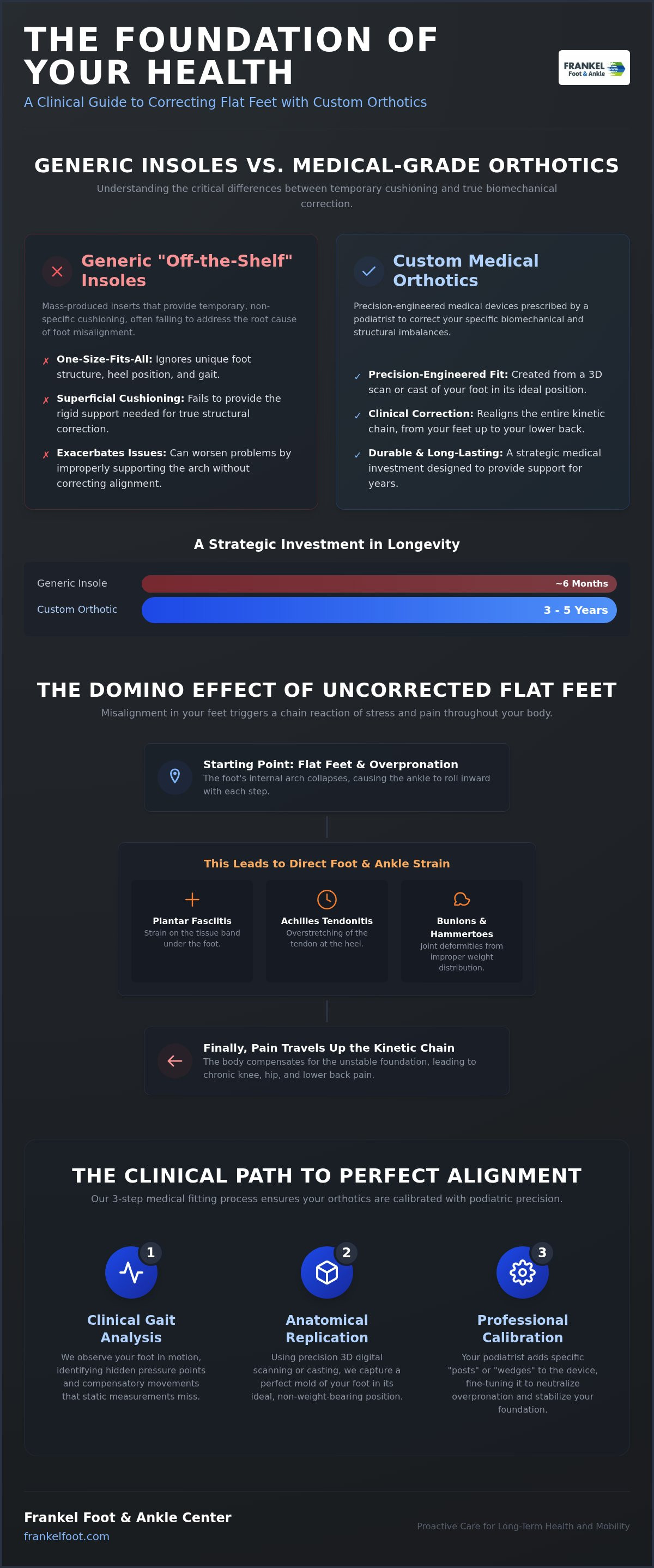
Many people turn to "one-size-fits-all" retail inserts, yet these mass-produced products often exacerbate the problem. They focus almost exclusively on arch height while ignoring critical factors like heel eversion, where the heel bone tilts outward, or forefoot varus. A generic cushion cannot recalibrate these complex angles. In contrast, custom orthotics for flat feet are precision-engineered to address your specific bone structure, providing the exact degree of medical-grade support needed to stabilize your gait.
Ignoring these alignment issues creates a "domino effect" that extends far beyond your arches. Persistent misalignment is a primary driver of chronic foot and ankle pain and can even lead to permanent bony changes. Over time, the constant shifting of weight can accelerate the development of painful bunions as the big toe joint is forced out of its natural position.
The Risks of Leaving Flat Feet Uncorrected
Leaving your arches unsupported increases your vulnerability to inflammatory conditions like plantar fasciitis and Achilles tendonitis. As the foot continues to flatten, you may experience structural shifts including hammertoes and widened foot profiles. This chronic misalignment eventually travels up the kinetic chain, manifesting as persistent knee strain or lower back discomfort. If you are seeking relief for resulting spinal issues, you can visit Coral Way Disc Center to learn about their non-surgical treatment options. Investing in custom orthotics for flat feet serves as a proactive defense, realigning your body from the ground up to ensure long-term health and mobility.
The Clinical Advantage: How Custom Orthotics Recalibrate Your Gait
While retail kiosks offer a convenient snapshot of your footprint, they lack the clinical depth required to address complex biomechanical issues. Custom orthotics for flat feet provide true structural correction rather than temporary, superficial cushioning. These medical-grade devices are designed to influence the way your joints move during the entire gait cycle, preventing the inward collapse that causes chronic strain. Depending on your specific needs, materials range from ultra-lightweight, semi-rigid graphite for high-impact athletes to flexible polymers that offer supportive comfort for those standing all day. This customization ensures that the device works with your body, not against it.
Professional calibration is the bridge between simple arch support and long-term recovery. This precise alignment is particularly beneficial when addressing secondary complications, such as foot pain from arthritis, where reducing joint friction is paramount. By neutralizing the foot's position, we alleviate the excessive load on the midfoot and ankles. If you're ready to stop guessing with store-bought inserts, consider a professional consultation to find your ideal fit.
The 3-Step Medical Fitting Process
- Clinical gait analysis: We observe your foot in motion to identify compensatory movements and hidden pressure points that static measurements miss.
- Anatomical replication: Using precision 3D digital scanning or non-weight-bearing casting, we capture your foot in its ideal subtalar neutral position.
- Professional calibration: Your podiatrist adds specific "posts" or "wedges" to the device to neutralize overpronation and stabilize your foundation from heel-strike to toe-off.
Investing in Your Mobility at Frankel Foot & Ankle Center
Selecting a local specialist in Middletown, Katonah, or Milford ensures your recovery is guided by clinicians who prioritize your unique physiological needs. While retail inserts often lose their structural integrity within six months, medical-grade custom orthotics for flat feet are engineered for exceptional longevity, often serving you for three to five years. This durability transforms a simple purchase into a strategic investment in your foundation. By correcting your alignment now, you create a powerful defense against progressive damage. This proactive approach effectively minimizes the need for future ankle pain relief treatments or more invasive corrective procedures.
Dr. Frankel ensures your orthotic therapy isn't limited by your choice of footwear. We provide specialized designs that transition from rugged hiking boots to refined professional dress shoes without sacrificing clinical efficacy. This versatility allows you to maintain consistent correction throughout your entire day, regardless of your environment. You don't have to choose between style and stability.
What to Expect During Your Consultation in Middletown or Milford
Your initial visit is a methodical exploration of your foot health designed to instill confidence in your treatment plan. We prioritize a patient-centered approach that addresses both your clinical needs and your lifestyle goals through a structured process.
- Comprehensive medical review: We analyze your history and current pain points to understand the specific triggers of your discomfort.
- Structural assessment: This involves a physical examination of joint mobility and muscle strength to evaluate the degree of arch collapse.
- Collaborative planning: We discuss the best path forward, ranging from custom orthotics for flat feet to advanced interventions like scarless bunion surgery.
Reclaim Your Foundation and Move with Confidence
Restoring your mobility begins with a foundation that supports your unique anatomy. We've explored how medical-grade custom orthotics for flat feet provide the necessary structural recalibration that retail inserts simply can't match. By addressing the root cause of overpronation, you protect your entire kinetic chain from future instability and chronic discomfort. Our team remains dedicated to providing non-invasive relief through precision 3D gait analysis and custom-molded designs tailored to your specific lifestyle. Whether you visit us in Middletown, Katonah, or Milford, your journey toward recovery is met with both clinical expertise and genuine care. You don't have to accept persistent foot pain as a permanent part of your life. Schedule your clinical gait analysis and orthotic consultation with Dr. Frankel today. We look forward to helping you step into a more comfortable, active future.
Frequently Asked Questions
How long does it take to get used to custom orthotics for flat feet?
It typically takes two to four weeks to fully adjust to custom orthotics for flat feet. We recommend a break-in period where you wear them for only two hours on the first day. You'll increase this by one hour each subsequent day. This gradual transition allows your muscles to adapt to the new alignment without causing undue strain.
Do custom orthotics for flat feet actually fix the arch permanently?
These devices don't permanently change the bone structure, but they provide essential biomechanical correction while you're wearing them. Think of them like prescription eyeglasses; they correct your alignment to prevent pain and further damage. By stabilizing your foundation, they help you avoid long-term complications and the eventual need for surgical intervention to address structural collapse.
Will insurance cover the cost of my custom orthotics?
Insurance coverage for medical-grade orthotics varies significantly depending on your specific provider and plan details. Many plans offer partial or full reimbursement when the devices are deemed medically necessary for chronic pain relief. Our staff in Middletown, Katonah, and Milford can help you navigate your policy requirements, so you'll understand the steps to maximize your available benefits.
Can I move my custom orthotics between different pairs of shoes?
You can generally move your custom orthotics for flat feet between different pairs of shoes if the footwear has a similar shape and depth. Most patients easily swap their devices between athletic sneakers and casual work shoes. However, specialized footwear like slim dress shoes may require a lower-profile design. We'll ensure your devices are versatile enough for your daily activities.


