


What if the persistent discomfort in the ball of your foot isn't just a sign of a long day, but a signal that your foot's structure is fundamentally shifting? You've likely noticed a toe beginning to curl upward or felt the sharp, repetitive sting of a callus forming where your shoe rubs. It's common to feel a sense of frustration when simple activities like walking or finding comfortable footwear become daily challenges. At Frankel Foot & Ankle, we understand that seeking effective hammertoe treatment is about more than aesthetics; it's about preserving your mobility and preventing a flexible bend from becoming a permanent, rigid deformity.
You deserve to walk without pain and feel confident in the appearance of your feet. This article will help you discover the progressive stages of hammertoes and the comprehensive treatment options available to restore your mobility and comfort. We'll outline a clear path from initial diagnostics to advanced, patient-centered solutions that ensure your toes lie flat and your stride remains strong. By understanding the biomechanical imbalances at play, you can take proactive steps toward a future free from friction and foot pain.
Key Takeaways
- Identify the underlying biomechanical imbalances that lead to the characteristic "claw-like" appearance of progressing toe contractures.
- Implement non-invasive management strategies, such as specialized padding and taping, to immediately shield joints from painful friction and shoe pressure.
- Evaluate specialized hammertoe treatment options that transition from conservative care to clinical excellence for lasting relief from chronic foot pain.
- Learn about advanced surgical techniques, including joint fusion and tendon transfers, that aim to restore natural alignment and mobility.
- Understand the importance of a comprehensive foot health strategy to avoid the progression of flexible toes into rigid, painful deformities.
Understanding Hammertoes: From Mild Discomfort to Rigid Deformity
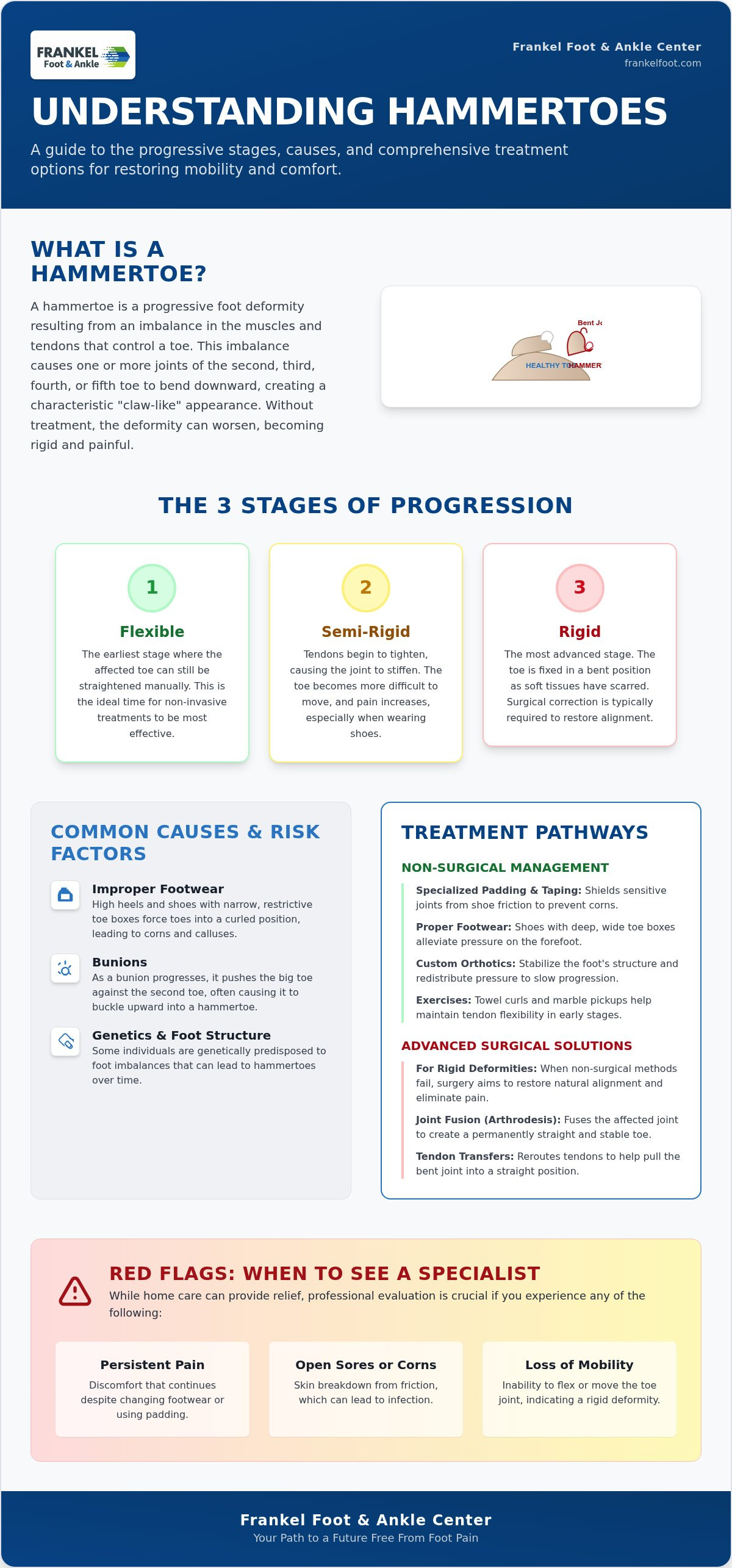
A hammertoe is a progressive deformity resulting from mechanical or neurological changes in the foot. It typically involves a contracture or bending of one or both joints in the second, third, fourth, or fifth toes. When the delicate balance between muscles and tendons is disrupted, the toe is pulled into a characteristic "claw-like" appearance. This structural shift is progressive, meaning it won't resolve on its own. Gaining a deep Understanding Hammertoes: From Mild Discomfort to Rigid Deformity is the first step toward effective clinical intervention. Early hammertoe treatment is essential to prevent the joint from becoming permanently fixed and painful.
The Three Stages of Hammertoe Progression
Clinical care at Frankel Foot & Ankle focuses on identifying your specific stage of progression to provide the most effective relief. These stages reflect the transition from manageable flexibility to rigid structural changes:
- Flexible Hammertoes: This early stage is characterized by a joint that can still be straightened manually. It's the ideal time for conservative hammertoe treatment to succeed before the deformity worsens.
- Semi-Rigid Hammertoes: The joint begins to lock into place as tendons tighten. You'll notice increased stiffness and sharp pain when attempting to move the toe or find comfortable footwear.
- Rigid Hammertoes: This is the advanced stage where the toe is frozen in a bent position. Soft tissues have scarred and shortened, typically requiring surgical correction to restore flat alignment and eliminate friction.
Common Causes and Risk Factors
While some patients are genetically predisposed to foot imbalances, external factors often accelerate the deformity. High heels and shoes with narrow toe boxes create constant pressure that forces toes into a curled state, leading to persistent corns and calluses. There is also a strong clinical link between bunions and toe contractures. As a bunion progresses, it pushes the big toe against the second toe, often causing it to buckle upward. In these cases, achieving lasting comfort might involve addressing the root cause through bunion surgery alongside toe realignment. From trauma to inherited mechanics, identifying these triggers is vital for a successful recovery plan.
Non-Surgical Hammertoe Management: How to Find Relief Today
Managing a hammertoe at home begins with reducing the constant friction that triggers inflammation and discomfort. You can find immediate comfort by utilizing specialized padding or buddy-taping techniques to shield sensitive joints from abrasive shoe surfaces. These methods are foundational to Non-Surgical Hammertoe Management, as they help prevent the formation of painful corns and calluses that often accompany a curled toe. It's essential to understand that non-surgical treatments aim to manage symptoms rather than reverse the underlying bone deformity. While these interventions offer significant relief, they don't straighten the toe permanently.
Choosing the Right Footwear and Orthotics
Your choice of footwear is your first line of defense against worsening contractures. Look for shoes with deep toe boxes and soft, flexible materials that don't pinch or bind the forefoot. Custom orthotics are another vital tool; they stabilize the foot's structure and can slow the progression of toe curling by redistributing pressure more evenly across the ball of the foot. For those in the flexible stage, simple daily exercises like towel curls or marble pickups help maintain tendon flexibility and joint range of motion.
When Home Remedies Are No Longer Enough
Home care has its limits, and ignoring "red flags" can lead to more complex issues down the road. If you experience persistent pain, develop open sores, or notice a total loss of joint mobility, it's time to seek a professional evaluation. At our Middletown office, we utilize advanced diagnostics, including digital X-rays, to assess the precise severity of the contracture. If you find yourself searching for broader foot pain relief because daily activity has become a chore, a clinical consultation is the next logical step. Our team is dedicated to helping you determine if your current hammertoe treatment plan needs an upgrade to restore your active lifestyle. If you're ready to address the root cause of your discomfort, scheduling a professional assessment can provide the clarity you need to move forward with confidence.
Advanced Hammertoe Treatment and Surgical Excellence in Middletown
When chronic pain persists despite conservative measures, transitioning to specialized clinical care at Frankel Foot & Ankle is the logical next step for restoring your quality of life. Our practice provides Advanced Hammertoe Treatment and Surgical Excellence for patients who require more than just symptomatic management. We offer a sophisticated range of modern surgical options, from tendon transfers that rebalance muscle pull to joint arthroplasty and fusion for advanced rigid deformities. Modern surgical techniques allow for faster recovery and improved mobility compared to traditional methods. By focusing on the root biomechanical cause, we ensure your hammertoe treatment results in a foot that is both functionally strong and aesthetically pleasing.
What to Expect During Hammertoe Surgery
Most corrective procedures are performed as outpatient services under local anesthesia combined with light sedation, ensuring you remain comfortable throughout the process. We prioritize the same scarless and painless philosophies that define our specialized ankle pain relief and bunion treatments. Recovery timelines have improved significantly; many patients are able to walk in a specialized boot almost immediately after the procedure. This methodical approach allows for a steady transition back to your favorite athletic shoes while minimizing the downtime typically associated with foot surgery.
Your Path to Recovery at Frankel Foot & Ankle
Our team develops personalized treatment plans tailored to your specific activity level and lifestyle goals, whether you are a busy professional in Middletown or an active resident in Katonah or Milford. We provide comprehensive post-operative support and precise guidance to ensure long-term success and prevent the recurrence of the deformity. Our dedicated focus on precision and patient-centered care helps you return to a life of pain-free movement. Schedule your consultation at Frankel Foot & Ankle Center to discuss your hammertoe treatment options and take the first step toward lasting relief.
Take the Next Step Toward Lasting Foot Health
Addressing a hammertoe is a vital investment in your long-term mobility and daily comfort. You've seen how these contractures progress from flexible imbalances to rigid, frozen deformities, and why early clinical intervention is the key to avoiding complex complications. Whether your journey begins with custom orthotics to stabilize your gait or requires the precision of reconstructive surgery, we provide a path forward that prioritizes your unique lifestyle goals. Our objective is to ensure you can walk, run, and wear your favorite shoes without the burden of persistent friction or pain.
At Frankel Foot & Ankle, we specialize in scarless and painless surgical techniques designed to minimize downtime and optimize functional outcomes. Our board-certified expertise in foot and ankle reconstructive surgery ensures that your hammertoe treatment is handled with the highest level of clinical skill and compassionate care. With convenient locations in Middletown, Katonah, and Milford, our team is dedicated to helping you achieve toes that lie flat and a stride that is entirely pain-free. Schedule Your Hammertoe Evaluation at Frankel Foot & Ankle to begin your personalized recovery plan today. We look forward to supporting you on your journey back to an active, comfortable lifestyle.
Frequently Asked Questions
Can a hammertoe be straightened naturally without surgery?
While non-surgical methods like splinting, custom orthotics, and targeted stretching can manage symptoms and slow progression, they cannot permanently straighten the underlying bone deformity once it has developed. These conservative efforts focus on alleviating pressure and maintaining joint flexibility during the earlier, more flexible stages of the condition. If the toe has already become rigid, clinical intervention is typically required to restore flat alignment and functional balance.
What happens if a hammertoe is left untreated for too long?
Leaving a hammertoe untreated usually results in the condition progressing from a flexible state to a fixed, rigid deformity. Over time, the constant friction against footwear leads to the development of painful corns, calluses, and even open ulcerations that increase the risk of infection. This structural decline often causes a significant shift in your gait, potentially leading to secondary issues like ball-of-foot pain or complex joint instability.
Is hammertoe surgery painful and what is the recovery time?
Modern surgical techniques at Frankel Foot & Ankle prioritize a scarless and painless philosophy, utilizing local anesthesia and light sedation to ensure your comfort throughout the procedure. Most patients are able to begin weight-bearing in a specialized post-operative boot almost immediately after the correction. While individual healing varies, many individuals transition back to roomy athletic shoes within four to six weeks, reflecting the efficiency of advanced hammertoe treatment protocols.
Will insurance cover hammertoe treatment and surgery?
Most health insurance providers, including Medicare, provide coverage for hammertoe treatment and surgery when it's deemed medically necessary due to chronic pain or functional impairment. Insurers generally require documentation of conservative treatments, such as orthotics or padding, that have failed to provide relief over a period of at least three months. We recommend verifying your specific plan's requirements, as radiographic confirmation of the deformity is often a prerequisite for surgical authorization.


