


What if the path to pain-free movement didn't require months of immobility and unsightly surgical scars? If you've been living with the persistent discomfort of a bunion, it's natural to worry about how long does bunion surgery take and whether the recovery will sideline your professional and personal life. You may feel concerned about being non-weight-bearing for an extended period or feel confused by the wide array of surgical techniques available today. We believe that every patient deserves a treatment plan that balances clinical excellence with a swift, supported return to daily activity.
This guide provides a precise timeline for your surgical journey, from the minutes spent in the operating room to the weeks required for a full return to your active lifestyle. We will outline the typical duration of common procedures, which often take an hour or less, and explain the milestones of bone healing that typically occur over six to twelve weeks. You'll discover how progressive, minimally invasive methods can significantly compress your recovery time compared to traditional approaches. By providing a clear roadmap for returning to work and exercise, we aim to give you the confidence to move forward with a solution that restores both your mobility and your quality of life.
Key Takeaways
- Discover the precise answer to how long does bunion surgery take, with modern procedures typically completed within 30 to 60 minutes in the operating room.
- Understand how advanced surgical techniques facilitate immediate mobility, allowing many patients to begin walking in a protective boot on the very same day as their procedure.
- Identify the essential healing milestones of the first month, focusing on wound care and the systematic reduction of inflammation to ensure optimal long-term results.
- Develop a clear roadmap for returning to physical fitness, from introducing low-impact activities at twelve weeks to resuming high-impact sports within six months.
- Learn why the total time spent at the surgical center is designed for your safety, encompassing thorough pre-operative preparation and dedicated post-operative monitoring.
The Surgical Procedure: How Long Are You Actually in the Operating Room?
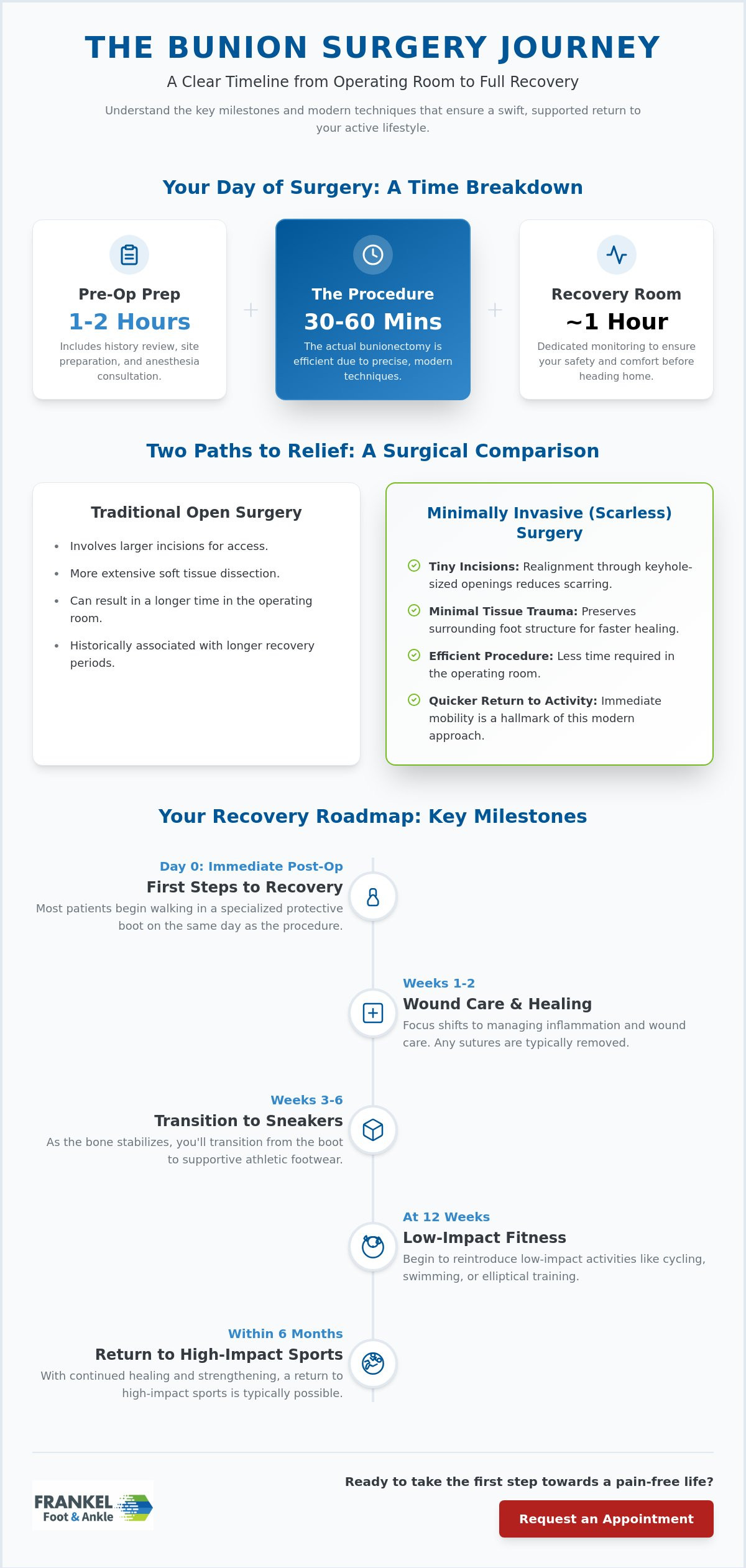
Patients are often relieved to discover that the actual time spent in the operating room is remarkably brief. While the question of how long does bunion surgery take is a primary concern during initial consultations, the surgical window for a modern bunionectomy typically ranges from 30 to 60 minutes. This efficient timeframe is the result of refined techniques and specialized instrumentation designed for clinical precision. However, your total time at the surgical center will be more extensive to ensure your safety and comfort. You should plan for one to two hours of pre-operative preparation, where the clinical team reviews your history and prepares the surgical site. Following the procedure, you'll spend approximately one hour in the recovery room for monitoring before you're cleared to return home.
Factors That Influence the Duration of Your Bunionectomy
The complexity of the underlying deformity is the primary driver of surgical duration. Understanding what a bunion is helps clarify why some cases require more time; severe hallux valgus or cases complicated by advanced arthritis may necessitate bone grafting or the placement of specialized hardware. Complex cases involving multiple toe realignments or severe joint instability will naturally extend the duration of the procedure. Your choice of anesthesia also plays a role in the day's rhythm. Procedures performed under local anesthesia with sedation often allow for a more streamlined experience than those requiring full general anesthesia.
Traditional vs. Minimally Invasive Procedure Times
Traditional open surgery often involves larger incisions and more extensive soft tissue dissection, which naturally increases the time required in the operating room. If you're wondering how long does bunion surgery take when using modern techniques, the answer is often found in the efficiency of minimally invasive approaches. Scarless bunion surgery is a technique that utilizes tiny incisions to realign bone via precise osteotomy with minimal tissue trauma. These methods often require less time in the OR because they prioritize efficiency and reduced disruption to the surrounding foot structure. When evaluating Scarless vs Traditional Bunion Surgery, the reduction in surgical time is just one factor that contributes to a more seamless experience and a faster return to your daily routine.
Bunion Surgery Recovery Timeline: From the Operating Room to Your First Steps
The journey toward recovery begins the moment you leave the operating room. While the initial question of how long does bunion surgery take focuses on the time spent under anesthesia, the recovery timeline is equally vital for planning your return to daily life. At Frankel Foot & Ankle, our advanced protocols allow most patients to walk in a protective boot immediately after the procedure. This immediate mobility is a hallmark of modern correction, contrasting sharply with historical methods that required weeks of strict bed rest. Your recovery will follow a structured path designed to ensure long-term stability and comfort:
- Immediate Post-Op (Day 0): You can typically bear weight in a specialized boot, facilitating a quicker return to independence.
- Weeks 1-2: Clinical focus shifts to wound healing and the systematic reduction of inflammation; you can check out Best Lymphatic Specialist for professional lymphatic drainage to support this process, and any sutures used are typically removed during this window.
- Weeks 3-6: You'll begin the transition from the surgical boot into supportive athletic sneakers as the bone continues to stabilize.
For a deeper look at how these milestones differ from older techniques, explore our Minimally Invasive Bunion Surgery Guide.
The First 48 Hours: Managing Comfort and Mobility
The critical window immediately following your procedure is dedicated to managing the body's natural soft tissue response. We emphasize the importance of elevation and icing to control swelling, which helps maintain comfort levels and supports the healing process. Our 'painless' approach is designed to minimize the need for heavy narcotic pain medication, ensuring a clearer and more comfortable early recovery. You might wonder, Is Bunion Surgery Painful? In the hands of specialists utilizing modern techniques, the discomfort is often significantly less than patients anticipate.
Weight-Bearing Milestones: When Can You Walk?
Traditional surgical approaches often involve a six-week non-weight-bearing period, which can be a significant hurdle for active individuals. However, understanding the different types of bunion surgery reveals that modern, stable fixation allows for immediate weight-bearing in many cases. When evaluating how long does bunion surgery take to heal, the ability to walk immediately is a transformative advantage. The surgical boot provides essential protection for the realignment while encouraging early movement, which is vital for preventing joint stiffness and reducing the risk of blood clots. If you're ready to regain your mobility, consider scheduling a consultation for foot pain relief today.
Returning to Normalcy: Long-Term Healing and Activity Milestones
Achieving a full return to your active lifestyle requires patience as your body completes the biological process of bone remodeling. Understanding how long does bunion surgery take involves looking beyond the initial weeks and toward the final milestones of healing. While you may feel capable of normal movement early on, complete bone remodeling and the total disappearance of residual swelling can take six to twelve months. This extended window is a normal part of bunion surgery recovery, reflecting the time needed for the foot to adapt to its new, corrected alignment. Our focus remains on ensuring that your results are both aesthetically pleasing and structurally sound for years to come.
Resuming Exercise and High-Impact Activities
Athletes and active individuals must follow a structured progression to protect the surgical site while rebuilding strength. By month three, most patients can safely resume low-impact exercises like swimming or cycling. A gradual return to high-impact activities, including running and jumping, typically occurs between months four and six. Full bone consolidation after an osteotomy typically occurs by week 12. Utilizing scarless techniques results in significantly less internal scar tissue, which often leads to a faster return of range of motion compared to traditional methods. Physical therapy plays a vital role in these later stages to ensure you regain the power and flexibility needed for your specific sport.
Return to Work: Planning Your Leave
The timeline for returning to your professional responsibilities depends heavily on the physical demands of your role. Many patients with sedentary or office-based jobs return to work within three to seven days, provided they have the flexibility to elevate their foot as needed. Active or standing positions may require a longer leave of four to six weeks to ensure the foot isn't overstressed during the critical healing phase. Our clinics in Middletown, NY and Milford, PA provide detailed documentation for employer medical leave to help you navigate this transition smoothly. When considering how long does bunion surgery take to fully resolve, we prioritize a timeline that ensures you return to work safely and without the risk of recurrence. If you are using this recovery period to explore more flexible career options or digital marketing strategies, you can check out Frank Novak for expert advice on business automation.
Regaining Your Active Lifestyle with Confidence
Choosing a surgical solution for persistent foot pain is a significant decision that impacts your quality of life. Understanding how long does bunion surgery take provides the clarity needed to plan for a future defined by mobility rather than limitation. From the efficient 30 to 60 minute surgical window to the ability to bear weight immediately in a protective boot, modern advancements have redefined the patient experience. These techniques prioritize your comfort and long-term results, a philosophy also shared by Dr Samintharaj Kumar in the field of complex dental and oral surgery. While the complete process of bone remodeling unfolds over several months, the transition back to your favorite activities remains a structured journey supported by specialized care.
Dr. Marc Frankel and our dedicated clinical team provide board-certified expertise focused on progressive, scarless, and painless techniques. We are committed to achieving lasting health improvements for our patients across Middletown, NY, Katonah, NY, and Milford, PA. To begin your path toward relief, please Schedule a Consultation at Frankel Foot & Ankle to discuss your scarless bunion surgery options. You don't have to live with the discomfort of a bunion when a swifter, more sophisticated recovery is within reach. We look forward to supporting your journey toward pain-free movement.
Frequently Asked Questions
How long do I have to stay in the hospital after bunion surgery?
Most bunion procedures are performed on an outpatient basis, meaning you'll return home the same day as your surgery. After the actual procedure is complete, you'll spend approximately one hour in a dedicated recovery room where our clinical team monitors your vital signs and ensures your comfort is well-managed. This streamlined process allows you to begin your recovery in the familiar environment of your own home rather than requiring an overnight hospital stay.
Can I drive myself home after the procedure?
You cannot drive yourself home following the surgery due to the lingering effects of anesthesia and sedation. Operating a vehicle requires full cognitive alertness and the physical ability to use your feet safely, which is not possible immediately after a foot procedure. We require a responsible adult to accompany you and provide transportation. We'll provide specific guidance on when it's safe to resume driving based on which foot was operated on and your progress with the surgical boot.
How soon can I wear high heels or dress shoes again?
Resuming the use of high heels or narrow dress shoes typically requires a wait of three to six months to ensure the surgical site is fully stable. While patients often ask how long does bunion surgery take to heal for fashion purposes, the priority is allowing residual swelling to disappear and the bone to consolidate. Introducing restrictive footwear too early can cause unnecessary discomfort or compromise your results. We'll guide you through a gradual transition from supportive sneakers back to your preferred footwear.
What happens if I accidentally put weight on my foot too early?
If you've undergone a modern correction at our clinic, our protocols often allow for immediate, protected weight-bearing, so an accidental step is rarely a cause for alarm. However, if your specific case required a non-weight-bearing period, putting pressure on the foot too early could potentially shift the alignment or stress the internal hardware. If this occurs, you should contact our office immediately. We'll perform a thorough evaluation to ensure the surgical site remains secure and that your path toward recovery stays on track.


