


What if you could permanently correct your hallux valgus deformity and walk the same day, all through an opening no larger than a grain of rice? For many, the decision to seek relief is often stalled by the fear of a grueling six-month recovery or the anxiety of managing post-surgical pain. You likely believe that surgery necessitates a long, unsightly scar or a major disruption to your work and family life. These concerns are valid, as traditional methods often involve significant tissue trauma. However, modern minimally invasive bunion surgery offers a sophisticated alternative that prioritizes both your clinical outcome and your aesthetic comfort.
This guide explores how progressive micro-incision techniques provide a permanent solution with minimal downtime and less pain. We'll walk you through the entire process, from the initial surgical correction to the moment you step back into your active lifestyle with confidence and ease. It's time to move toward a future where your foot health and your personal style are no longer in conflict.
Key Takeaways
- Understand the mechanical shift from traditional open surgery to a percutaneous approach that utilizes 3mm micro-incisions and specialized medical burrs.
- Learn how modern techniques significantly shorten recovery milestones, allowing many patients to transition from surgical boots to comfortable sneakers in just weeks.
- Explore the "painless" protocol that leverages long-acting local anesthetics to minimize discomfort and reduce the reliance on post-operative narcotics.
- Identify the critical qualifications to look for when selecting a specialist for minimally invasive bunion surgery, including board certification and advanced fellowship training.
- Discover why convenient access to specialized care at the Frankel Foot & Ankle Center is essential for comprehensive post-operative monitoring and long-term success.
Understanding Minimally Invasive Bunion Surgery: The Modern Standard of Care
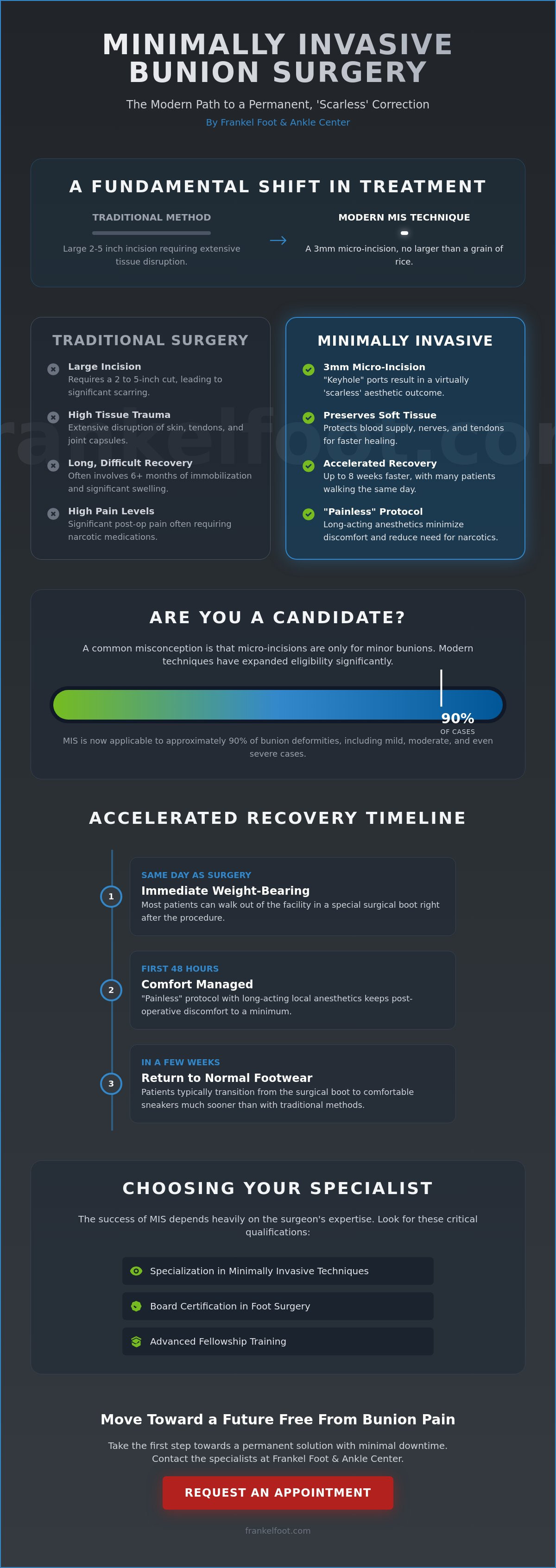
For decades, the standard approach to correcting a bunion involved a long, invasive incision along the top or side of the foot. This traditional method often required extensive soft tissue disruption just to reach the bone. Modern minimally invasive bunion surgery represents a fundamental shift in podiatric medicine. It moves the focus from prioritizing the surgeon's visibility through a large opening to focusing on the patient's biological recovery. Rather than wide exposure, this technique utilizes specialized instruments through tiny, 3mm "keyhole" ports.
Understanding what a bunion is helps clarify why this approach is so effective. A bunion, or hallux valgus, is a complex structural deformity where the first metatarsal bone leans outward while the big toe leans inward. Simply "shaving the bump" fails to address the underlying skeletal alignment. True correction requires precise bone realignment to restore the foot's natural architecture and prevent recurrence. This progressive methodology ensures that the root cause is treated, moving the patient from a state of chronic discomfort to lasting relief.
The Shift from Traditional Open Procedures
Traditional open surgeries typically require a 2 to 5 inch incision, which necessitates cutting through skin, tendons, and joint capsules. This extensive trauma is the primary cause of significant post-operative swelling and long-term stiffness. In contrast, minimally invasive bunion surgery replaces large bone saws with high-torque, low-speed specialized burrs. These tools allow for precise bone reshaping without the need for wide exposure. By preserving the surrounding soft tissue and blood supply, patients experience a dramatic reduction in inflammation. This precision ensures faster healing. It allows for a more aesthetic, "scarless" result that avoids the heavy scarring associated with older methods.
The Science of the Scarless Technique
The percutaneous approach is a specialized method that allows the surgeon to perform the entire correction through micro-incisions that bypass major nerves and blood vessels. Modern internal fixation has also evolved, utilizing low-profile screws that provide immediate stability within the bone. These advanced implants allow for a secure correction that doesn't rely on bulky external casts. This immediate stability is why many patients can bear weight shortly after the procedure, facilitating a seamless transition from the operating room back to daily life.
Evaluating Your Options: Is MIS Bunion Correction Right for You?
Choosing a surgical path is a significant decision that requires a balance of clinical evidence and personal lifestyle goals. For many patients, the primary hesitation stems from the legacy of traditional surgery, where heavy narcotics and months of immobilization were the norm. Modern protocols have redefined this experience. By utilizing long-acting local anesthetics during the procedure, we can often eliminate the need for post-operative narcotics. This "painless" approach ensures you remain comfortable during the critical first 48 hours without the systemic side effects of heavy pain medication.
Key Benefits: Recovery, Pain Management, and Aesthetics
The transition from a surgical boot to standard sneakers occurs much sooner with a percutaneous approach. Industry data indicates that patients undergoing minimally invasive bunion surgery typically experience a recovery period that is 8 weeks faster than those choosing traditional open methods. This accelerated timeline is largely due to the reduction in "post-op throbbing." Because specialized burrs cause less bone interference and thermal damage than traditional saws, the inflammatory response is significantly muted. Beyond the physical comfort, the aesthetic result is a primary driver for many, as the micro-incisions heal with virtually no visible trace.
Determining Candidacy: From Mild to Severe Deformities
A common misconception is that "keyhole" surgery is only for minor corrections. Dr. Frankel performs a comprehensive evaluation of the degree of bone rotation and metatarsal angulation to determine the best path forward. It's now estimated that minimally invasive bunion surgery is applicable to 90% of bunion cases. This includes moderate and even some severe deformities that were previously restricted to open procedures. A Systematic Review of Minimally Invasive Bunion Surgery confirms that these modern techniques provide high patient satisfaction and stable, long-term outcomes. If you're ready to explore how these advancements can restore your mobility, you can schedule a consultation to review your specific needs.
Choosing a Specialist in Middletown, Katonah, or Milford
Selecting a surgeon for minimally invasive bunion surgery involves more than just finding a nearby clinic. It requires identifying a professional with specific board certification and advanced fellowship training in foot and ankle reconstruction. This level of specialization ensures your provider understands the nuanced biomechanics of the foot. Having local access in Middletown, NY or Milford, PA is equally critical for your long-term success. Proximity simplifies the post-operative check-ups that are vital for monitoring bone healing and ensuring your recovery remains on schedule. You deserve a partner who is accessible throughout every phase of your healing.
To prepare for your first consultation, we recommend bringing your most frequently worn shoes. This allows us to analyze wear patterns and gain insight into your foot's unique mechanics. We'll perform a detailed gait analysis and take weight-bearing X-rays to map the precise angulation of your deformity. This data-driven approach ensures your surgical plan is tailored to your specific anatomy and lifestyle goals.
The Frankel Foot & Ankle Advantage
Dr. Marc Frankel has dedicated his career to mastering percutaneous surgical technology. This commitment has led to a clinical philosophy centered on "Scarless and Painless" results. Unlike large hospital systems where you might feel like just another number, the Frankel Foot & Ankle Center prioritizes a personalized, patient-centered journey toward recovery. We focus on achieving permanent correction while ensuring your foot looks as good as it feels. Our expertise allows us to treat the person, not just the deformity, ensuring you feel supported from the first visit to the final follow-up.
What to Expect During Your Recovery Journey
Your path to relief follows a structured, methodical timeline designed to maximize stability and comfort:
- Step 1: The walking boot phase (Days 1-14). You'll be able to bear weight immediately after the procedure. The boot provides necessary protection for the micro-incisions while the bone begins its initial healing process.
- Step 2: Transitioning to wide-toe-box sneakers (Weeks 3-6). As swelling subsides, you'll move into comfortable athletic shoes. This phase focuses on restoring a natural gait and increasing your daily activity levels.
- Step 3: Returning to full activity and fashion footwear (Month 3+). Most patients return to their favorite shoes and high-impact exercise during this period. Your foot is now structurally sound and ready for the demands of an active life.
Step Into a Future of Pain-Free Mobility
The evolution of podiatric care means you no longer have to choose between surgical success and your aesthetic goals. By addressing the hallux valgus deformity through 3mm micro-incisions, minimally invasive bunion surgery provides a permanent solution that respects your body's natural healing timeline. You've learned how specialized burrs and advanced internal fixation allow for immediate stability, moving you from the walking boot to your favorite sneakers in a fraction of the time required by traditional methods.
Dr. Marc Frankel and the team at Frankel Foot & Ankle are dedicated to providing this specialized "Scarless and Painless" clinical philosophy. With convenient access across Middletown, NY, Katonah, NY, and Milford, PA, expert care is always within reach. Don't let the fear of a long recovery or visible scarring keep you from the relief you deserve. It's time to reclaim your active lifestyle and feel confident in every step you take.
Schedule your scarless bunion consultation at Frankel Foot & Ankle today and begin your journey toward lasting foot health.
Frequently Asked Questions
Is minimally invasive bunion surgery painful during or after the procedure?
The procedure is performed under anesthesia to ensure you feel no pain during the correction. Afterward, we utilize a specialized protocol involving long-acting local anesthetics that numb the surgical site for the first 48 hours. This methodical approach to pain management significantly reduces the need for post-operative narcotics. Most patients report a feeling of pressure rather than the sharp, throbbing pain common with traditional open surgeries.
How long do I need to stay off my feet after bunion surgery?
Most patients are able to bear weight immediately after the procedure using a protective walking boot. Unlike traditional surgery that may require weeks of non-weight-bearing, this technique allows you to move from the operating room to your home with minimal disruption. You'll typically transition into wide-toe-box sneakers within three to six weeks. This rapid return to activity helps maintain muscle tone and prevents the stiffness often seen with prolonged immobilization.
Will I have a visible scar after the "scarless" bunion operation?
Scarring is minimal because the incisions used in minimally invasive bunion surgery are only about 3 millimeters in length. These tiny "keyhole" ports are strategically placed and usually heal to be virtually invisible to the naked eye. By avoiding the 4 to 6 centimeter incisions required for traditional methods, we preserve the aesthetic integrity of your foot. This result is particularly beneficial for individuals who feel self-conscious about surgical marks on their feet.
Does insurance cover minimally invasive bunion surgery in New York and Pennsylvania?
Insurance providers, including Medicare, typically cover the procedure when it's deemed medically necessary due to persistent pain or functional limitations. For 2026, the Medicare Part B annual deductible is $283, and patients generally pay 20% of the approved amount once that is met. It's essential that your medical record documents at least 12 weeks of failed conservative treatments like footwear changes or orthotics. Surgery performed for purely cosmetic reasons is generally not a covered benefit.
Can I drive myself home after the procedure?
You cannot drive yourself home because the sedation and local anesthetics used during the operation can impair your reflexes and judgment. We require that a responsible adult accompanies you to the facility and provides transportation after your discharge. Most patients find they can return to driving within a few weeks, provided they're no longer using pain medication and can safely operate the vehicle's pedals. We'll provide a specific timeline based on which foot was treated and your unique healing progress.
What is the success rate for minimally invasive bunion correction?
Modern techniques for minimally invasive bunion surgery boast an overall success rate between 85% and 95%. Data from early 2026 shows a patient satisfaction rate of approximately 89.6%, reflecting the effectiveness of these advanced protocols. Additionally, the recurrence rate for bunions using these modern methods has dropped to as low as 5%. This high level of precision ensures that the skeletal realignment is stable and provides lasting relief from chronic foot pain.


