

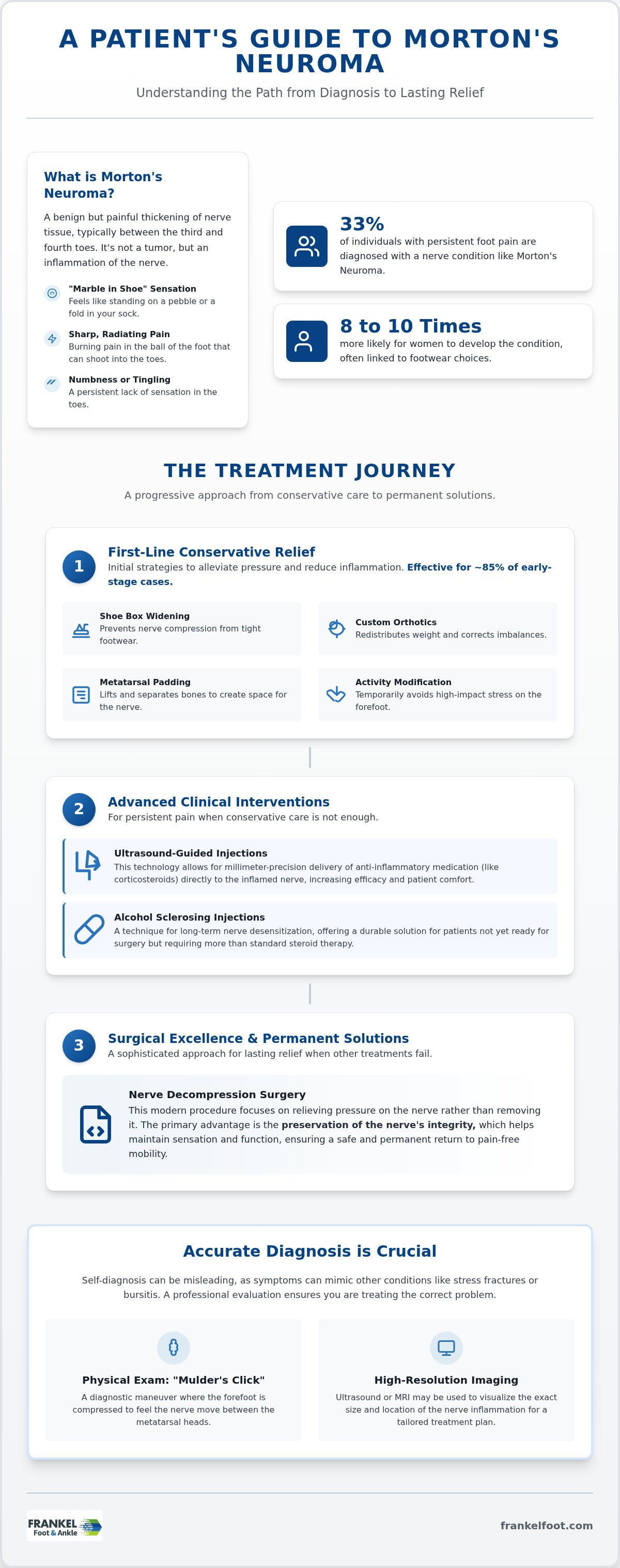
Did you know that approximately 33% of individuals seeking relief for persistent foot pain are actually diagnosed with a specific nerve condition? This prevalence makes the search for effective Morton's neuroma treatment a priority for many, especially for women who are eight to ten times more likely to develop this painful thickening of tissue. You might recognize the sensation as a sharp, burning pain in the ball of your foot or a persistent numbness that makes every step feel precarious. It's exhausting to manage the physical discomfort while also losing the freedom to wear your favorite shoes or enjoy your daily exercise routine.
We understand that you're looking for more than just a temporary fix; you want a return to a life defined by movement rather than limitation. This guide provides a comprehensive roadmap for your recovery, bridging the gap between initial at-home care and the advanced clinical solutions required for permanent relief. We'll examine the progression from structural support and ultrasound-guided injections to modern, minimally invasive surgical options. By understanding the full spectrum of care, you can make an informed decision that protects your long-term nerve health and restores your ability to walk without pain.
Key Takeaways
- Identify the hallmark "marble in the shoe" sensation and sharp, radiating pain that indicates a thickening of the nerve tissue.
- Discover the essential bridge between failed at-home remedies and the advanced clinical solutions necessary for lasting foot pain relief.
- Understand how professional Morton's neuroma treatment utilizing targeted corticosteroid injections can effectively address persistent inflammation and discomfort.
- Learn about the advantages of nerve decompression surgery, a sophisticated approach that relieves pressure while preserving the integrity of the nerve.
- Follow a methodical path from initial diagnosis to specialized intervention to ensure a safe and permanent return to pain-free mobility.
Diagnosing and Initial Management of Morton’s Neuroma
A Morton's neuroma isn't actually a tumor; it's a benign thickening of the nerve tissue that typically develops between your third and fourth toes. Most patients describe a sensation that feels like standing on a pebble or having a permanent fold in their sock. This irritation leads to sharp, radiating pain and numbness that can quickly derail your active lifestyle. Understanding the nuances of this condition is the first step toward effective Morton's neuroma treatment.
It's vital to seek a professional clinical diagnosis early. Self-diagnosis often leads to confusion, as the symptoms can easily be mistaken for stress fractures or bursitis. For those seeking a comprehensive medical foundation, this Morton's neuroma overview details the pathology and clinical signs associated with the condition. Getting an accurate assessment ensures you aren't treating the wrong problem while the nerve damage potentially worsens.
What to Expect During Your Consultation
Your journey toward relief at Frankel Foot & Ankle Center begins with a methodical physical exam. We focus on identifying the "Mulder’s click," a diagnostic maneuver where we compress the forefoot to feel the nerve move between the metatarsal heads. We also assess your range of motion and gait. While a physical exam is often sufficient, we may utilize high-resolution ultrasound or MRI to visualize the exact size and location of the nerve inflammation, ensuring our Morton's neuroma treatment approach is tailored to your specific needs.
First-Line Conservative Relief Strategies
Research indicates that approximately 85% of neuromas respond well to conservative care when caught in the early stages. We prioritize non-invasive methods to alleviate pressure on the nerve and reduce inflammation. These strategies include:
- Shoe Box Widening: Transitioning to footwear with a wider forefoot to prevent bone-on-nerve compression.
- Metatarsal Padding: Placing specialized pads behind the ball of the foot to lift and separate the metatarsal bones.
- Custom Orthotics: Designing inserts that redistribute weight and correct structural imbalances.
- Activity Modification: Temporarily avoiding high-impact exercises that place excessive stress on the forefoot.
These initial interventions aim to provide immediate comfort while we monitor your progress toward lasting recovery.
Advanced Clinical Interventions for Persistent Nerve Pain
When primary adjustments like wider footwear and metatarsal padding don't provide sufficient relief, it's time to move toward specialized clinical interventions. These steps aren't just about masking symptoms; they're designed to address the underlying physiological distress of the nerve. Effective Morton's neuroma treatment at this stage involves a strategic combination of localized therapies to reduce the size of the neuroma and quiet the surrounding tissue.
We prioritize accuracy by utilizing high-resolution ultrasound guidance for all therapeutic injections. This technology allows us to visualize the nerve and the surrounding metatarsal heads in real time, ensuring that medication is delivered with millimeter precision. According to research on advanced clinical interventions for Morton's neuroma, this targeted approach significantly increases the efficacy of the treatment while enhancing patient comfort. By placing anti-inflammatory agents exactly where they are needed, we can achieve more profound results with lower dosages.
Precision Injections and Nerve Blocks
Targeted injections do more than provide temporary numbing. They work to break the cycle of chronic inflammation that keeps the nerve in a state of hyper-irritability. For patients experiencing persistent discomfort, we may also explore alcohol sclerosing injections. This technique is designed for long-term nerve desensitization, offering a durable solution for those who aren't yet ready for surgical options but require more than standard steroid therapy.
Custom Orthotic Solutions in Middletown
While store-bought inserts offer generic cushioning, they often lack the structural integrity required to truly offload a neuroma. Medical-grade orthotics are custom-molded to your foot's unique architecture. They provide a specific metatarsal lift that over-the-counter options simply cannot replicate. You can learn more about how these specialized tools fit into a broader plan for comprehensive foot pain relief to see which path is right for you. If your current routine isn't stopping the burning sensation in your toes, a professional evaluation at one of our offices can help determine the next logical step in your recovery.
Surgical Excellence and Permanent Solutions for Neuromas
When conservative measures and precision injections no longer provide the quality of life you deserve, surgical intervention becomes the most compassionate and effective path forward. For many patients, moving beyond temporary relief toward a permanent Morton's neuroma treatment is the only way to reclaim total mobility. We view surgery not as a last resort to be feared, but as a sophisticated tool designed to eliminate chronic nerve distress once and for all.
The surgical philosophy at Frankel Foot & Ankle Center prioritizes minimally invasive techniques to ensure faster recovery times and durable results. We typically consider two primary pathways. Nerve decompression involves releasing the intermetatarsal ligament to create space, effectively removing the physical pressure without excising the nerve itself. In more severe or persistent cases, a neurectomy may be necessary. This procedure involves the careful removal of the affected nerve segment to ensure the sharp, radiating pain cannot return. As noted in professional guidelines for diagnosing and managing Morton's neuroma, selecting the right surgical path depends on the size of the neuroma and the patient's specific activity goals.
The Recovery Journey: What to Expect Post-Surgery
Recovery is a methodical process focused on protecting the surgical site while gradually restoring function. Patients in our Middletown and Katonah offices typically transition back into supportive footwear within two to four weeks. While you may experience some localized numbness between the toes, this is a standard trade-off for the total elimination of the debilitating burning pain you previously endured. Most individuals return to their favorite exercises and daily routines with a renewed sense of freedom.
Choosing the Right Specialist in NY and PA
Entrusting your mobility to a surgeon is a significant decision. It requires a provider who focuses exclusively on foot and ankle pain relief and understands the intricate mechanics of the lower extremities. Dr. Marc Frankel’s extensive surgical experience and commitment to advanced medical interventions provide patients with the reassurance that their path to recovery is guided by seasoned, specialized expertise. By choosing Frankel Foot & Ankle Center, you're opting for a forward-thinking approach to medicine that places your individual needs at the center of every interaction.
Reclaiming Your Foundation for Active Living
Your journey toward lasting foot health requires a methodical approach that respects both the complexity of your anatomy and your personal goals for mobility. We've explored the progression from initial clinical diagnosis and conservative support to the advanced precision of ultrasound-guided injections. For those who require a permanent solution, our specialized surgical techniques offer a path to recover without the burden of chronic nerve distress. Choosing the right Morton's neuroma treatment means moving beyond temporary fixes toward a comprehensive plan that protects your long-term nerve health.
Dr. Marc Frankel and the dedicated team at Frankel Foot & Ankle Center are committed to providing the specialized focus required for advanced foot pain relief. With convenient locations in Middletown, Katonah, and Milford, we bridge the gap between failed at-home care and professional medical excellence. When you're ready to walk, run, and live without the sharp, burning sensations of a neuroma, we're here to guide you. Schedule a consultation at Frankel Foot & Ankle Center for expert Morton’s neuroma care and take the first step toward a future defined by movement rather than limitation. You don't have to manage this pain alone; permanent relief is within reach.
Frequently Asked Questions
Can Morton’s neuroma go away on its own without treatment?
Morton’s neuroma is a structural thickening of the nerve tissue that won't regress or disappear without professional intervention. While periods of rest or switching to open-toed shoes might temporarily alleviate the burning sensation, the underlying nerve irritation remains. Leaving the condition unaddressed often leads to progressive nerve damage and more frequent pain cycles over time.
How do I know if I need surgery for my Morton’s neuroma?
You may require surgical intervention if conservative measures like custom orthotics and clinical treatments fail to provide lasting relief. We typically consider surgery when persistent pain prevents you from walking comfortably or participating in daily activities. A professional evaluation helps determine if decompression or a neurectomy is the most effective path toward permanent Morton's neuroma treatment.
Are steroid injections for foot pain safe in the long term?
Corticosteroid injections are safe and highly effective for managing acute inflammation when utilized as part of a structured treatment plan. However, repetitive use in the same location must be carefully monitored by a specialist to avoid potential tissue weakening. We prioritize precision through ultrasound guidance to ensure the medication is delivered exactly where it's needed while protecting the integrity of the foot's protective fat pad.
What kind of shoes are best for someone with Morton’s neuroma?
The most supportive footwear for those seeking Morton's neuroma treatment features a wide, anatomical toe box that allows the metatarsal bones to spread naturally. You should prioritize shoes with a low heel and firm, cushioned soles to reduce the mechanical pressure placed on the forefoot. Avoiding narrow, pointed shoes or high heels is essential to prevent the compression that causes the nerve to thicken and inflame.


