


With more than 51 million U.S. adults living with chronic pain, you aren't alone if a persistent ache has started to dictate your daily life. It’s exhausting to move from the initial frustration of a morning limp to the genuine anxiety of a canceled workout, never knowing when a flare-up will occur. You likely feel stuck in a cycle of temporary fixes, worrying that the only alternative to this chronic ankle pain is a complex surgery. We understand that this uncertainty is taxing, especially when you're struggling to distinguish between a manageable tendon ache and a more serious structural injury.
This guide provides the professional clarity you need by offering a specific roadmap to identify, manage, and treat your condition. You'll learn how to transition from passive rest to active recovery, utilizing everything from specialized home care techniques to advanced clinical interventions. We'll explore the diagnostic tools that provide definitive answers and highlight the expert care available to residents in Middletown and Milford. This structured approach is designed to replace your confusion with a clear path toward lasting relief and restored mobility.
Key Takeaways
- Identify the critical "Six-Week Rule" to recognize when a lingering injury has transitioned into a condition requiring specialized medical attention.
- Learn how to perform a footwear audit to ensure your shoes provide the lateral support and arch stability essential for protecting the ankle joint.
- Discover the benefits of transitioning from total rest to controlled mobility to maintain joint flexibility and prevent long-term stiffness.
- Understand how advanced clinical interventions for chronic ankle pain, such as specialized laser therapy, work to reduce deep-tissue inflammation and accelerate repair.
- Establish a clear roadmap for your recovery journey, helping you choose between home-based management and professional clinical pathways.
Defining Chronic Ankle Pain: When Does an Injury Become Persistent?
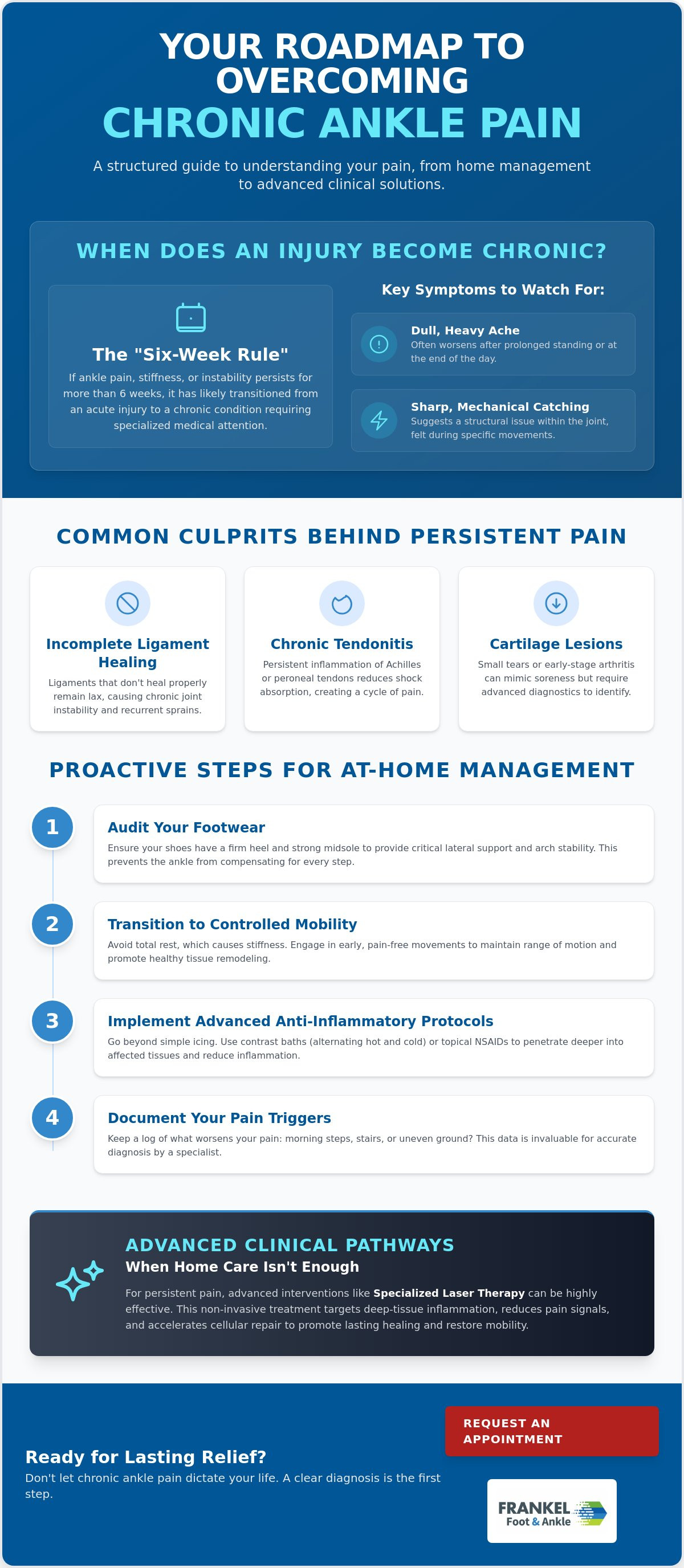
Most patients expect a standard injury to resolve within a few weeks of rest. However, when discomfort lingers, it signals a transition from an acute event to chronic ankle pain. We typically apply the 'Six-Week Rule' in a clinical setting. If your symptoms persist beyond this window, the body’s natural inflammatory response has likely shifted into a degenerative or maladaptive state. This requires a transition in strategy from passive waiting to active clinical management. From the initial ligament damage to the long-term cellular changes in the joint, the window for simple recovery often closes after those first forty-two days.
Symptoms of persistent conditions often manifest in two distinct ways. You might experience a dull, heavy ache that worsens after a long day of standing, or you might feel a sharp, mechanical catching that suggests a structural impediment within the joint. These sensations are frequently exacerbated by 'micro-trauma,' which occurs when routine daily activities continuously irritate a site that hasn't fully recovered. For those seeking a broader look at ankle pain relief, understanding these distinctions is the first step toward a targeted treatment plan.
Common Culprits Behind Long-Term Discomfort
Long-term discomfort is rarely a result of bad luck. It is usually the consequence of specific physiological factors that prevent the joint from resetting:
- Incomplete ligament healing: Foundational to understanding ankle sprains is the realization that ligaments without proper rehabilitation often remain lax, leading to permanent joint instability.
- Chronic Tendonitis: When the Achilles or peroneal tendons remain inflamed, they lose their ability to absorb shock, creating a cycle of pain that simple rest can't break.
- Cartilage Lesions: Early-stage arthritis or small cartilage tears can mimic simple soreness but require sophisticated diagnostics to identify correctly.
The Impact of Foot Alignment
Mechanical imbalances often originate elsewhere in the foot. High arches or bunions can create a 'malalignment' that forces the ankle joint to compensate, leading to premature wear. In some cases, addressing the root cause through modern bunion surgery can resolve secondary ankle issues. By restoring a neutral gait and reducing unnecessary stress on the surrounding ligaments, we can achieve results that range from improved mobility to total symptom resolution.
A Step-by-Step Guide to Managing Chronic Ankle Pain
Managing chronic ankle pain requires a shift from reactive care to proactive, structured habits. While the traditional RICE method (rest, ice, compression, and elevation) serves acute injuries well, it often fails to address the underlying mechanical issues of long-term discomfort. To find lasting relief, you must implement a strategy that addresses both the structural support of your foot and the functional mobility of the joint.
- Step 1: Audit your footwear. Shoes that lack lateral support or arch stability force the ankle joint to compensate for every step, which often results in increased ankle bone pain. Look for a firm heel counter and a midsole that doesn't twist easily under pressure.
- Step 2: Transition to controlled mobility. Total immobilization often leads to joint stiffness and muscle atrophy, which only complicates the recovery process. Evidence-based clinical management of ankle injuries suggests that early, pain-free movement helps maintain range of motion and promotes essential tissue remodeling.
- Step 3: Implement advanced anti-inflammatory protocols. Move beyond simple icing by incorporating contrast baths or topical non-steroidal treatments that penetrate deeper into the affected tissues.
- Step 4: Document your specific pain triggers. Note whether your symptoms peak during morning steps, while navigating stairs, or after walking on uneven ground. This data is invaluable for your specialist.
Optimizing Your Daily Environment
Choosing the right footwear is a technical decision rather than an aesthetic one. Ensure your shoes match your specific foot type, whether you have high arches or flat feet, to distribute weight evenly across the joint. If you aren't sure where to start, getting a professional evaluation for ankle pain relief can provide the precise clarity you need to move forward safely.
When Home Care Reaches Its Limit
If you experience "giving way" sensations or if the pain consistently prevents you from completing basic daily tasks, home care has likely reached its threshold. In our Middletown and Milford clinics, we utilize advanced diagnostic imaging, such as high-resolution X-rays or MRIs, to identify structural issues that aren't visible to the naked eye. Recognizing these red flags early can prevent permanent joint damage and lead to a more effective, specialized treatment plan.
Advanced Clinical Pathways for Lasting Ankle Relief
When conservative measures fail to yield results, the focus must shift to advanced clinical interventions that address the root cause of chronic ankle pain. Modern podiatric medicine offers a range of sophisticated options that move beyond simple symptom management. These pathways range from regenerative technologies that stimulate the body's natural healing processes to precision-engineered mechanical corrections. By transitioning from general care to highly specialized treatments, we can provide a definitive solution for even the most persistent discomfort.
One of the most effective non-invasive tools available is specialized laser therapy. This technology utilizes specific wavelengths of light to penetrate deep into the joint, reducing inflammation and accelerating cellular repair at a mitochondrial level. It's an ideal solution for patients who wish to avoid injections or surgery while still achieving significant functional improvement. Additionally, mechanical imbalances often manifest as back of ankle pain, which can be addressed through custom orthotics. These precision inserts are designed to redistribute pressure and correct the gait abnormalities that keep the joint in a state of constant irritation.
For structural issues that cannot be resolved through conservative means, minimally invasive surgical options provide a path toward recovery with reduced downtime. Understanding the causes and symptoms of ankle sprains is vital here, as previous injuries often leave behind scar tissue or ligament laxity that requires surgical stabilization. The Frankel Approach integrates these advanced methodologies into a patient-centered recovery plan, ensuring that every treatment is tailored to the individual's specific mobility goals.
The Role of Laser Therapy in Pain Management
At Frankel Foot & Ankle Center, our laser treatments are unique because they can target inflammatory pain and fungal issues simultaneously. This dual-action approach is particularly beneficial for patients whose chronic ankle pain is complicated by secondary foot health concerns. During a typical consultation in our Milford or Katonah offices, we perform a detailed diagnostic assessment to determine the optimal frequency and intensity of the laser application for your specific tissue density.
Coordinating Your Care in the Tri-State Area
Finding a specialist who understands the demands of an active Tri-State lifestyle is essential for long-term success. Whether you're navigating the streets of Middletown or the trails of Milford, your recovery plan must account for your daily environment. To prepare for your first appointment at Frankel Foot & Ankle Center, we recommend documenting your pain history and bringing the footwear you wear most often. This allows us to provide an accurate diagnosis and a clear roadmap for your journey from persistent ache to total relief.
Reclaiming Your Mobility and Peace of Mind
Living with chronic ankle pain shouldn't be a permanent state. By moving from passive rest to a structured clinical strategy, you can address the root causes of your discomfort rather than just managing the symptoms. We've discussed the importance of identifying structural imbalances, conducting footwear audits, and the transformative potential of modern pathways like laser therapy and precision orthotics. These evidence-based tools are designed to restore function and prevent the long-term joint wear that often follows untreated injuries.
Led by Dr. Marc Frankel, a specialist in advanced podiatric surgery, our team is dedicated to achieving scarless and painless clinical outcomes for every patient. Whether you're visiting our convenient locations in Middletown, Katonah, or Milford, you'll receive care that prioritizes your unique recovery journey and long-term well-being. Don't let persistent pain dictate your lifestyle or limit your activity any longer. We invite you to schedule a consultation at Frankel Foot & Ankle Center for expert relief today. Your path to a stronger, pain-free future begins with a single, professional evaluation that puts your health first.
Frequently Asked Questions
How do I know if my ankle pain is chronic or just a long-healing sprain?
Ankle pain is typically classified as chronic when symptoms persist beyond the standard six-week healing window. While a standard sprain should show significant improvement within a month, persistent swelling, stiffness, or instability past forty-two days indicates a transition to a long-term condition. This shift requires a change in management from passive rest to active clinical evaluation to prevent permanent joint changes.
Can chronic ankle pain be cured without undergoing major surgery?
Yes, many structural and inflammatory issues can be successfully managed through non-invasive clinical pathways. Advanced options like specialized laser therapy and precision-engineered orthotics address the root causes of chronic ankle pain without the risks associated with major surgery. These interventions focus on accelerating cellular repair and correcting mechanical imbalances to restore function naturally.
What is the most common cause of pain on the outside of the ankle?
The most frequent cause of pain on the lateral aspect of the ankle is chronic ligament laxity or peroneal tendonitis. These issues often stem from an initial injury that didn't heal correctly, leaving the outer joint structures vulnerable to repetitive micro-trauma. Identifying these specific mechanical failures is essential for choosing the right supportive footwear or clinical treatment to stabilize the joint.
Is it safe to walk through the pain if my ankle has been hurting for months?
It's generally unsafe to push through sharp or mechanical pain that has persisted for months. While low-impact movement is necessary to prevent stiffness, ignoring signals like catching or "giving way" can cause secondary damage to the cartilage or surrounding tendons. Persistent discomfort is a signal that the joint's integrity is compromised and requires a professional assessment to ensure your activity doesn't exacerbate chronic ankle pain.


