


What if the most effective way to realign your foot didn't require a three-inch incision or months of total immobility? Many patients find themselves caught between the persistent ache of a bunion and the daunting prospect of a traditional "open" surgery. You likely want the relief of a straight, pain-free toe, but the fear of permanent scarring and a long, difficult recovery often creates a cycle of hesitation. Understanding the fundamental differences in scarless vs traditional bunion surgery is the first step toward reclaiming your active lifestyle and your confidence.
This choice is no longer just about aesthetics; it's about a structural evolution that prioritizes biological preservation for superior functional recovery. By the end of this article, you'll discover the critical differences between these procedures to determine which one offers the fastest recovery and best results for your lifestyle. We'll examine the shift toward minimally invasive techniques in 2026, comparing everything from immediate weight-bearing capabilities to long-term surgical outcomes, ensuring you feel fully informed and supported in your decision.
Key Takeaways
- Understand that a bunion is a progressive joint misalignment rather than a simple bone growth, requiring a structural correction to restore proper foot function.
- Evaluate the primary differences between scarless vs traditional bunion surgery, focusing on how minimal incisions and tissue preservation lead to faster recovery times.
- Learn how advanced minimally invasive techniques protect the foot's delicate soft tissue, resulting in less post-operative discomfort and minimal visible scarring.
- Discover the role of modern internal fixation in providing the necessary structural stability to support immediate weight-bearing after a corrective procedure.
- Identify the specific clinical criteria, such as bunion severity and bone health, that determine the most effective surgical path for your unique lifestyle needs.
Understanding the Primary Types of Bunion Surgery: From Open to Scarless
A bunion, clinically known as hallux valgus, is frequently misunderstood as a simple bony growth on the side of the foot. In reality, it's a complex, progressive joint misalignment where the first metatarsal bone shifts outward while the big toe leans inward. For a comprehensive overview of bunion surgery and the underlying pathology, medical literature emphasizes that effective correction requires addressing this structural instability. When patients evaluate the benefits of scarless vs traditional bunion surgery, they're essentially choosing between two distinct philosophies of anatomical realignment and recovery.
At Frankel Foot & Ankle Center, our methodology for a painless correction begins long before the procedure. We utilize advanced diagnostics to map the precise degree of rotation and displacement in your foot. This level of precision allows us to refine the surgical plan to your specific anatomy, ensuring the correction is both structurally sound and minimally disruptive to your daily life.
The Mechanics of Traditional Open Procedures
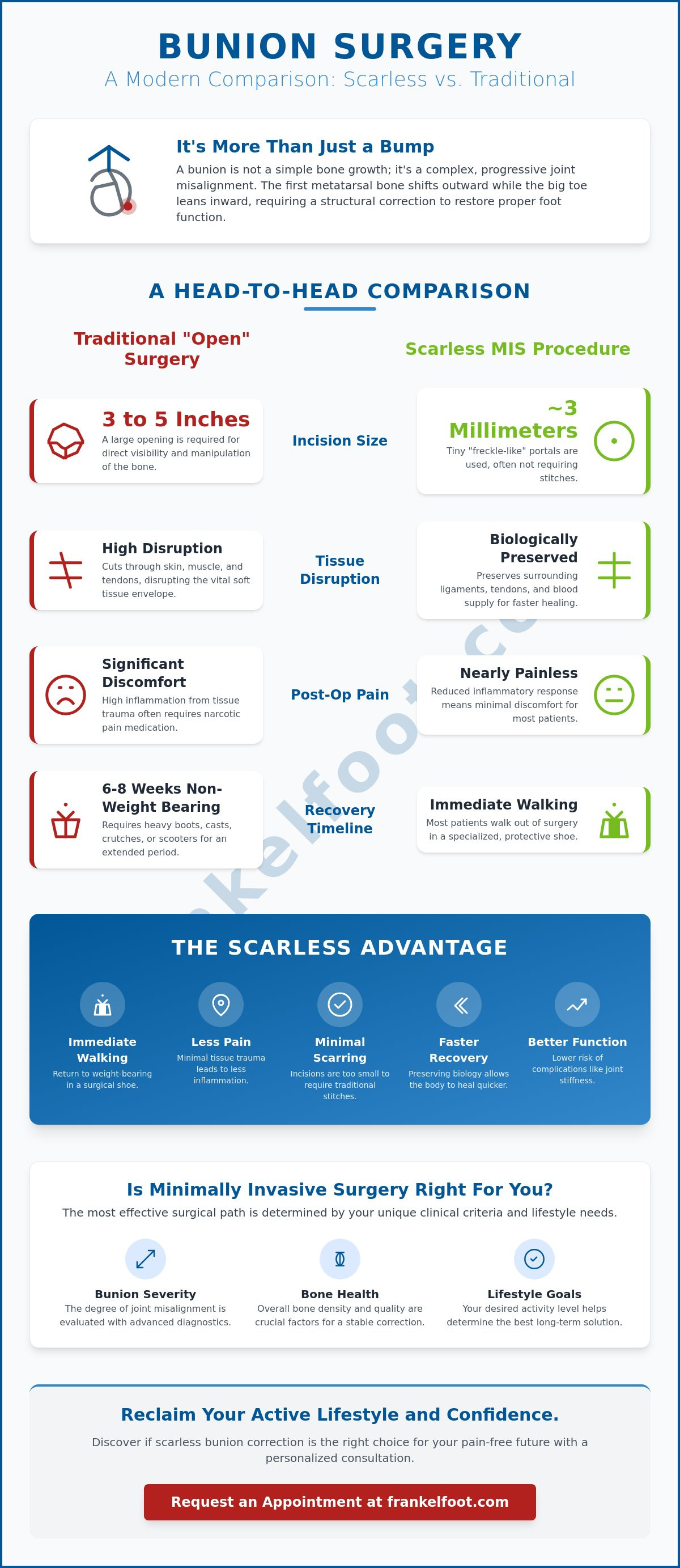
For decades, the standard approach involved "open" surgery. This method requires a surgeon to make a three to five-inch incision to gain direct visibility of the joint. To reach the bone, the surgeon must cut through the skin, displace tendons, and open the joint capsule. This significant disruption of the soft tissue envelope often necessitates the use of larger hardware, such as bulky plates and screws, to maintain the new alignment during a lengthy healing process. While effective at straightening the toe, the extensive trauma to surrounding tissues is what typically leads to the long recovery times and significant post-operative swelling associated with older methods.
The Innovation of Scarless Bunion Correction
Modern advancements have introduced a more refined methodology. Scarless, or minimally invasive surgery, utilizes tiny percutaneous portals that are often only 3mm in diameter. Instead of large surgical saws, specialized micro-tools and high-torque burrs allow the surgeon to realign the bone without stripping the periosteum, which is the vital lining that provides the bone's blood supply. These tiny portals are so small they don't require traditional stitches. By preserving the surrounding ligaments and tendons, this technique facilitates a much faster return to weight-bearing activities.
Scarless vs. Traditional Bunion Surgery: A Head-to-Head Comparison
When comparing scarless vs traditional bunion surgery, the most visible difference is the incision size. A traditional bunion removal surgery typically requires a three to five-inch opening along the side or top of the foot. This large access point is necessary for the surgeon to manually manipulate the bone, but it causes significant disruption to the "soft tissue envelope." In contrast, scarless techniques utilize portals so small they're often compared to the size of a freckle. By leaving the surrounding skin, nerves, and blood vessels largely intact, we minimize the biological trauma to the foot.
This preservation of tissue directly impacts the level of post-operative discomfort. Many patients ask, "Is bunion surgery painful?" Historically, the answer was often yes, due to the high levels of inflammation following extensive tissue trauma. However, modern minimally invasive paths significantly reduce this inflammatory response. Because there's less damage for the body to repair, patients often report a nearly painless experience and require far fewer narcotic medications compared to those undergoing open procedures.
Recovery Timelines: Walking Sooner vs. Extended Casting
The recovery period marks perhaps the most dramatic shift in patient experience. Traditional methods often mandate six to eight weeks of non-weight bearing, frequently requiring heavy boots, casts, or even knee scooters. Conversely, scarless correction allows most individuals to walk immediately in a specialized surgical shoe. For a deeper look at what to expect, you can explore our Recovery Timeline: How Long Does Bunion Surgery Take? guide. If you're ready to discuss your specific needs, our team is here to help you explore your surgical options.
Aesthetic and Functional Long-Term Results
Functional outcomes are just as critical as the visual results. Traditional open surgery carries a higher risk of "stiff joint syndrome" because the extensive scarring can limit the big toe's range of motion. Scarless procedures mitigate this risk by avoiding the joint capsule disruption that leads to such stiffness. Beyond the physical benefits, there's a powerful psychological advantage to having no visible surgical reminder. You can wear sandals or walk barefoot without a long scar serving as a permanent record of your procedure.
Choosing the Right Procedure: Candidacy and Local Expertise in the Tri-State Area
Selecting the appropriate surgical path requires a careful evaluation of your unique foot structure and lifestyle goals. While the debate between scarless vs traditional bunion surgery often focuses on the recovery window, the decision ultimately rests on clinical factors like bunion severity, bone density, and your previous surgical history. Modern clinical research, including comparative studies on minimally invasive vs open surgery, confirms that both methods can achieve excellent correction when applied to the right candidate. At Frankel Foot & Ankle Center, we prioritize a thorough diagnostic phase to ensure the chosen technique aligns with your long-term health.
One of the most frequent questions we hear involves the structural integrity of a "scarless" correction. Patients often worry that a smaller incision means a weaker result. This is a common misconception. The stability of a scarless procedure comes from advanced internal fixation. We use specialized, low-profile titanium screws that provide the same, if not superior, structural support as the bulkier hardware used in traditional methods. This allows for the immediate weight-bearing that our patients value so highly.
When Traditional Surgery Might Still Be Recommended
While our goal is always the least invasive path, certain rare and complex cases still benefit from an open approach. If a patient presents with extreme bone instability or advanced, end-stage arthritis within the joint, the increased visibility of a traditional incision may be necessary to ensure a successful realignment. The best surgery isn't the most popular one; it's the one tailored specifically to your anatomy. We take the time to explain why a specific path is recommended for your unique situation.
The Frankel Foot & Ankle Center Advantage
Dr. Marc Frankel has dedicated his practice to perfecting "scarless and painless" outcomes, offering a level of specialization that is unique in our region. We provide the convenience of local, high-tier medical care across Middletown NY, Katonah NY, and Milford PA. From your initial Scarless Bunion Surgery consultation to long-term orthotic support, the team at Frankel Foot & Ankle Center manages every detail of your journey. Your next step toward pain-free walking begins with a digital x-ray and a comprehensive structural mapping of your foot at one of our Tri-State offices.
Reclaiming Your Active Lifestyle with Confidence
Deciding between scarless vs traditional bunion surgery is the final hurdle before returning to the activities you love. This comparison has highlighted how the shift toward minimally invasive techniques prioritizes the preservation of your foot's natural anatomy while ensuring structural stability through modern fixation. By choosing a path that minimizes tissue trauma, you aren't just opting for a better aesthetic outcome; you're investing in a faster, more functional return to your daily routine without the burden of a long recovery.
At Frankel Foot & Ankle Center, we combine this progressive methodology with a deep commitment to patient comfort. Under the expert guidance of Dr. Marc Frankel, our offices in Middletown, Katonah, and Milford provide the advanced diagnostics and specialized care necessary for a truly "scarless and painless" experience. We focus on achieving lasting results that align with your lifestyle, ensuring that your physical concerns are met with both high-level expertise and genuine care.
Schedule Your Scarless Bunion Consultation at Frankel Foot & Ankle Center
Your journey to pain-free movement is a shared one, and we're here to ensure every step is met with precision, skill, and a dedicated path to recovery.
Frequently Asked Questions
Is scarless bunion surgery as effective as traditional open surgery?
Scarless surgery is highly effective and offers a structural correction that is clinically equivalent to traditional methods. Modern research indicates that minimally invasive techniques can achieve recurrence rates as low as 5%, which is a significant improvement over the 15% seen in some older methods. By utilizing specialized micro-tools for precise bone realignment, we achieve a stable result that supports long-term foot health. This approach ensures the correction is a lasting functional improvement.
How long is the recovery for minimally invasive bunion surgery compared to the traditional method?
The recovery for minimally invasive surgery is significantly faster, with most patients bearing weight on the foot almost immediately in a specialized surgical shoe. In contrast, traditional methods often require six to eight weeks of non-weight bearing or the use of heavy boots and scooters. This difference in scarless vs traditional bunion surgery recovery is due to the preservation of the soft tissue envelope, which reduces post-operative swelling and facilitates a quicker return to work.
Will I have a visible scar after a minimally invasive bunion procedure?
You won't have a large, visible scar after a minimally invasive procedure because the incisions are typically only 3mm in size. These tiny portals are so small they often don't require traditional stitches to close. Once the healing process is complete, the marks are often virtually indistinguishable from the surrounding skin. This offers a significant aesthetic advantage for patients who wish to avoid the prominent three-inch scars associated with open surgical techniques.
Can severe bunions be treated with the scarless technique?
Severe bunions can indeed be treated with scarless techniques thanks to advancements in real-time imaging and modern internal fixation. While older minimally invasive methods were sometimes limited to mild cases, 2026 standards allow us to address significant joint misalignments through small portals. We use high-torque burrs and specialized titanium screws to ensure the bone is securely realigned. We evaluate each case individually to confirm this path provides the necessary structural stability.
Is the "painless" bunion surgery real, or will I still need heavy pain medication?
The "painless" experience is a result of significantly reduced tissue trauma and advanced local anesthetic protocols. Because we don't cut through major tendons or joint capsules, the body's inflammatory response is much lower than in traditional surgery. Most of our patients find they don't need heavy narcotic pain medication and can manage their recovery with simple over-the-counter options. Our goal is to provide a supportive environment where your comfort is a priority.
Does insurance cover scarless bunion surgery in New York and Pennsylvania?
Most major insurance plans in New York and Pennsylvania cover bunion surgery when it's deemed medically necessary to relieve persistent pain. If your bunion limits daily activities and hasn't responded to conservative treatments, it's typically a covered procedure. While cosmetic-only corrections are generally excluded, our team works closely with providers to document the functional necessity of your care. We recommend checking your specific deductible and coinsurance rates for your current plan year.


