


What if the sharp, nagging pain you feel with every step isn't something you simply have to endure? You might worry that sore ankles are a permanent setback or a sign that surgery is inevitable, but understanding the mechanics of your discomfort is the first step toward relief. Your pain is a signal. It's frustrating to feel your world shrinking because walking or exercising has become a source of anxiety rather than joy, especially when conflicting home remedies fail to provide a clear solution.
We believe that every individual deserves clinical clarity and a compassionate path to recovery. This article provides a methodical checklist to help you identify the specific cause of your pain and determine whether home care or professional intervention is necessary. From identifying subtle ligament instability to exploring modern, non-invasive methodologies, we provide a thorough overview of your journey toward lasting relief and restored mobility.
Key Takeaways
- Differentiate between the dull, systemic ache of arthritis and the sharp, localized pain of overuse by assessing the specific timing and sensation of your symptoms.
- Apply the 48-hour RICE protocol and functional weight-bearing tests to determine if your sore ankles require professional clinical intervention.
- Learn why advanced diagnostic imaging is essential for identifying soft tissue injuries or structural issues that standard X-rays may fail to detect.
- Discover how biomechanical analysis and custom orthotics can correct underlying structural imbalances to provide a long-term solution for chronic discomfort.
- Transition from temporary relief to restored mobility by following a structured, evidence-based approach to comprehensive ankle health and recovery.
The Sore Ankles Diagnostic Checklist: Identifying the Root Cause
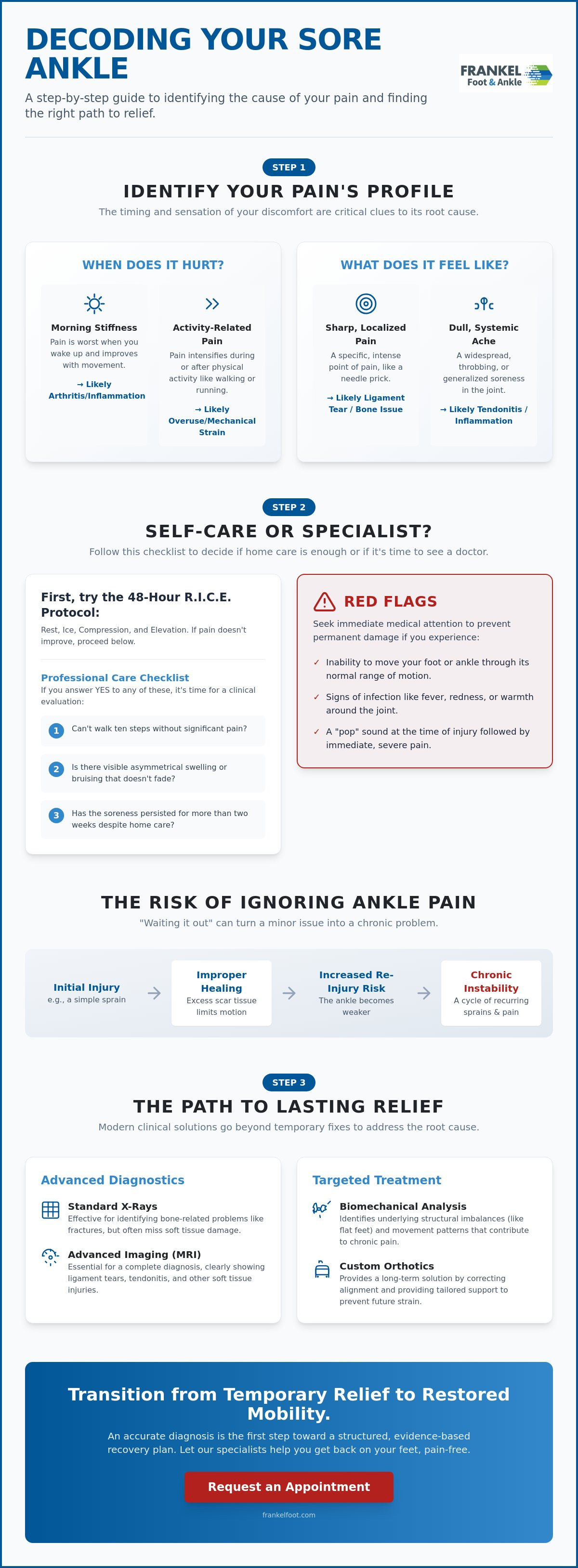
The nature of the sensation provides further clinical clues. A sharp, localized pain often indicates a specific structural issue, such as a ligament tear or a bone-related problem. A dull, systemic ache throughout the joint may suggest broader common causes of ankle pain like tendonitis or generalized inflammation. It's also vital to consider "no-injury" triggers. Conditions such as gout or structural abnormalities like flat feet can cause significant soreness without a single traumatic event or accident. By pinpointing whether the pain resides on the bone or within the soft tissue, we can narrow down the potential culprits with precision.
Checklist: Common Symptoms and Likely Culprits
- Morning stiffness and swelling: Often indicative of osteoarthritis or rheumatoid arthritis, where joint fluid hasn't yet lubricated the area.
- Instability or "giving way": Suggests chronic lateral ankle pain or previous ligament damage that hasn't healed correctly.
- Burning or tingling: May point to nerve compression or tarsal tunnel syndrome, requiring a different approach than muscular soreness.
When "Soreness" is Actually an Injury
Distinguishing between a minor sprain and a more serious condition is essential for proper recovery. While a sprain involves stretched or torn ligaments, a stress fracture presents differently. A stress fracture is a tiny crack in the bone caused by repetitive force. If you're unsure whether your discomfort stems from a recent twist or long-term wear, Understanding Pain in Ankles and Feet can help you differentiate between these clinical scenarios and guide your next steps.
Self-Care vs. Specialist Care: The Decision-Making Checklist
Determining when to transition from home management to professional care is a critical step in your recovery journey. Most patients begin with the 48-hour RICE test, which prioritizes rest, ice, compression, and elevation. If sore ankles don't show measurable improvement within this window, it's time for a functional assessment. Try to walk ten steps; if you can't bear weight without significant pain, the issue likely extends beyond a simple strain. A visual inspection is equally important. Look for asymmetrical swelling or persistent bruising that doesn't fade. While many resources offer guidance on Ankle pain causes and home care, a duration check is the final factor. If soreness persists for more than two weeks despite consistent home care, professional intervention is necessary to ensure long-term health.
The Red Flag Checklist: Seek Immediate Attention If...
Certain symptoms demand an urgent clinical evaluation to prevent permanent damage. If you experience an inability to move your foot or ankle through its normal range of motion, or if you notice signs of infection such as fever, redness, and warmth around the joint, seek help immediately. To better understand these signals, you may want to review Why Your Ankle Hurts When Walking. These red flags often indicate issues that home remedies cannot resolve.
Why "Waiting It Out" Can Lead to Chronic Instability
The temptation to wait and see is understandable, yet it often leads to a cycle of recurring injury. When a ligament is compromised, the body may produce excessive scar tissue that limits your natural range of motion. This lack of proper rehabilitation increases the risk of repeated sprains, eventually leading to chronic instability. If your self-assessment suggests a deeper issue, reaching out for professional ankle pain relief can prevent minor soreness from becoming a permanent limitation. Addressing the root cause early ensures that your mobility remains intact for years to come.
Clinical Solutions Checklist: Advanced Relief in Middletown, Katonah, and Milford
When home care protocols fail to produce results, advanced diagnostics become the next logical step in your recovery. We utilize comprehensive diagnostic imaging to visualize what standard X-rays often miss, such as subtle ligament tears, cartilage damage, or early-stage stress fractures. Understanding the Common causes of ankle pain from a clinical perspective allows us to identify structural deformities with precision. For many patients, sore ankles are the result of poor mechanics. Custom orthotics and biomechanical analysis allow us to correct these underlying issues, redistributing pressure to eliminate the root cause of overuse soreness.
We also prioritize progressive, non-invasive treatments that align with modern medical advancements. Advanced laser therapy offers a sophisticated solution for inflammation reduction and accelerated tissue repair without the need for downtime or invasive measures. In specific cases where chronic conditions fail to respond to conservative care, we provide minimally invasive surgical options. These specialized techniques utilize smaller incisions to promote faster healing and reduced post-operative discomfort, ensuring you can return to your daily activities with confidence.
Specialized Care at Frankel Foot & Ankle Center
Dr. Marc Frankel leads our practice with a deeply compassionate, patient-centered approach to recovery. We understand that every individual's journey is unique, and our goal is to provide a supportive environment where your concerns are met with high-level expertise. Our offices in Middletown, NY, Katonah, NY, and Milford, PA, are equipped to provide localized, expert care that addresses everything from minor strains to complex reconstructions. We believe in offering Comprehensive Ankle Pain Relief that bridges the gap between home management and specialized clinical intervention.
Your Road to Recovery Checklist
- Precision Diagnosis: An initial consultation to identify the exact source of your sore ankles.
- Tailored Treatment Plan: A customized strategy that combines structured at-home exercises with advanced clinical therapies.
- Long-Term Prevention: Proactive follow-up care and biomechanical adjustments to ensure permanent relief and prevent future injury.
Reclaiming Your Mobility and Comfort
Living with sore ankles shouldn't be your daily reality. By identifying whether your discomfort stems from inflammatory conditions or mechanical overuse, you've already begun the essential process of recovery. Whether you're currently managing a minor strain with the RICE protocol or evaluating the need for professional diagnostics, having a structured plan ensures that you don't settle for chronic instability or limited movement. From precision biomechanical analysis to advanced tissue repair, the path to relief is built on clinical expertise and a deep commitment to your long-term well-being.
At Frankel Foot & Ankle Center, Dr. Marc Frankel and our dedicated team have spent over a decade helping patients move from persistent pain to peak performance. We specialize in sophisticated, patient-centered care, offering everything from non-invasive laser treatments to modern, scarless surgical techniques. Our offices in Middletown, Katonah, and Milford are designed to provide the high-level expertise you deserve in a supportive, welcoming environment. You don't have to navigate this journey alone. Schedule your consultation at Frankel Foot & Ankle Center today and take the first step toward a future of pain-free movement. We're here to guide you every step of the way toward a full and active recovery.
Frequently Asked Questions
Why are my ankles sore for no reason?
Discomfort that appears without a specific injury is usually caused by underlying mechanical issues or systemic conditions. Chronic sore ankles can stem from overpronation due to flat feet, early-stage osteoarthritis, or even inflammatory conditions like gout. Overuse from unsupportive footwear or a sudden increase in daily activity can also create cumulative stress that feels like it appeared for no reason but is actually a structural response to repetitive strain.
How do I know if my ankle soreness is serious?
Ankle soreness is considered serious if you are unable to bear weight or if you experience neurological symptoms like numbness and tingling. If you cannot walk more than a few steps without intense pain, or if you notice significant asymmetrical swelling and bruising, you should seek a professional evaluation. Discomfort that persists for more than two weeks despite consistent rest often indicates a deeper issue, such as a stress fracture or ligament tear, that requires clinical intervention.
Can flat feet cause my ankles to be sore?
Yes, flat feet are a very common cause of chronic ankle pain because they force the joint into an unnatural alignment. When the arches collapse, the ankle rolls inward, which places excessive tension on the posterior tibial tendon and surrounding ligaments. This biomechanical imbalance leads to persistent inflammation and sore ankles. Addressing this through custom orthotics or biomechanical analysis is often the most effective way to restore proper function and eliminate the discomfort permanently.
What is the fastest way to relieve sore ankles at home?
The most effective immediate treatment for home relief is the RICE method, which stands for rest, ice, compression, and elevation. You should apply ice for 15 to 20 minutes every few hours and use a compression bandage to stabilize the joint and reduce swelling. While these steps are excellent for managing symptoms, they work best when combined with activity modification. If the soreness doesn't show measurable improvement within 48 hours, it's a signal that your body needs specialized care to heal correctly.


