


What if the reason your ankle feels perpetually weak isn't just a lack of rest, but an "incomplete healing cycle" that your body simply can't restart on its own? You've likely spent months or even years navigating the frustration of an ankle that gives out during simple daily walks. It's natural to worry that permanent joint damage is inevitable when standard recovery steps fail to deliver the chronic ankle pain relief you deserve. We understand that this persistent discomfort isn't just a physical hurdle; it's a barrier to the active life you want to lead.
In this guide, we'll examine why these injuries often fail to resolve and how advanced medical paths can finally restore your mobility. You'll learn about sophisticated diagnostic tools that identify the exact source of your pain. We also detail a range of non-invasive, restorative therapies that focus on long-term health rather than temporary fixes. Whether you're seeking care in Middletown or Katonah, this information provides a clear roadmap for returning to the activities you love with confidence, precision, and comfort.
Key Takeaways
- Recognize that ankle discomfort persisting beyond the typical six-week healing window often signals an underlying issue that rest alone cannot resolve.
- Identify how an "incomplete healing cycle" leaves ligaments lax or tendons inflamed, preventing the joint from stabilizing properly after an initial injury.
- Learn how to map your symptoms based on location, as pain on the outer ankle often indicates peroneal issues while pain in the back typically involves the Achilles tendon.
- Discover advanced medical paths to chronic ankle pain relief, including professional imaging to rule out cartilage lesions and specialized laser treatments to reduce deep-tissue inflammation.
Understanding Chronic Ankle Pain: Why Discomfort Becomes Persistent
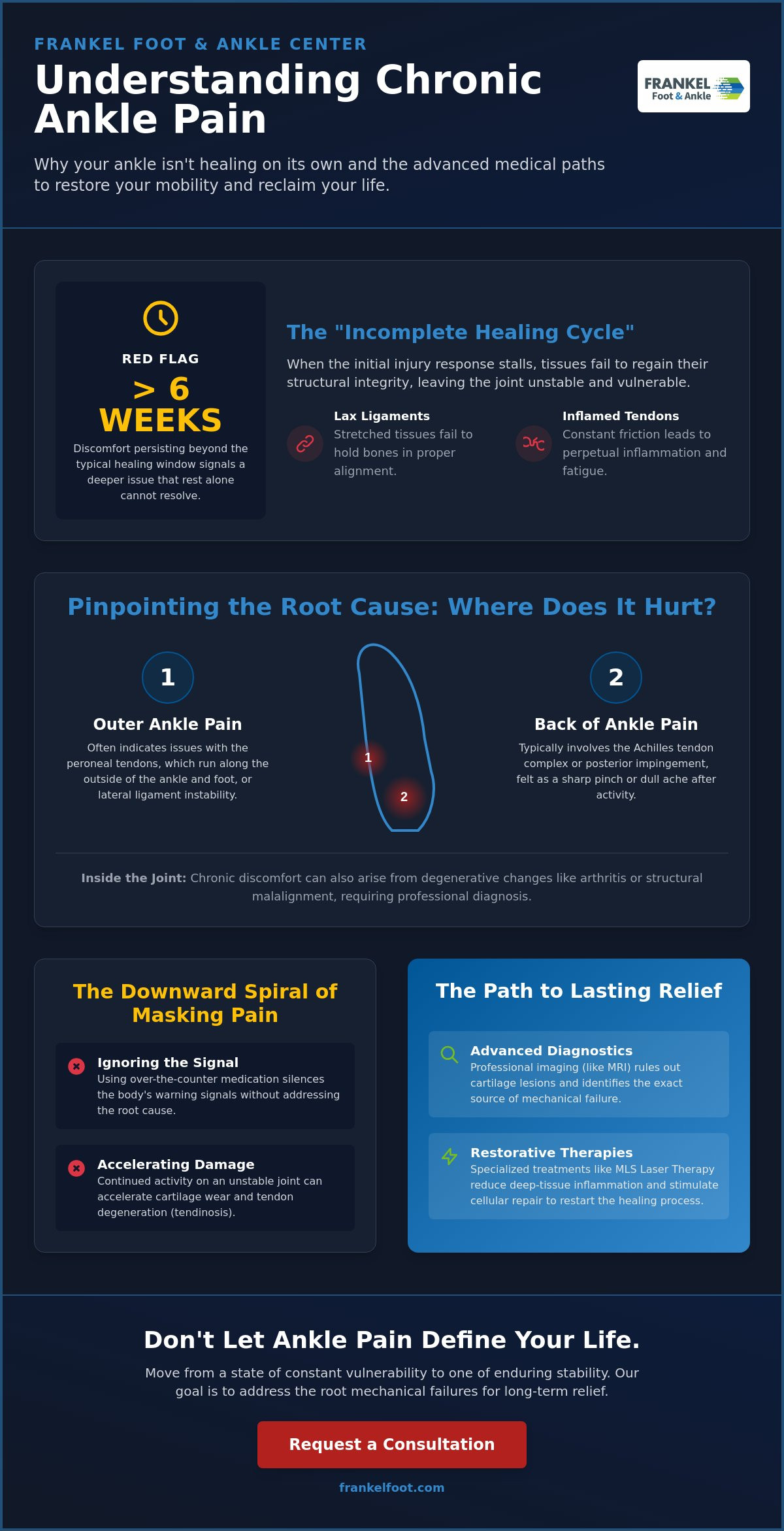
While most minor sprains resolve within a month, true chronic ankle pain is defined as discomfort that persists beyond the typical six-week healing window. At this stage, the body has often entered what we call an "incomplete healing cycle." This occurs when the initial biological response stalls, leaving ligaments in a lax state or allowing tendons to remain perpetually inflamed. Seeking professional chronic ankle pain relief becomes essential when these tissues fail to regain their structural integrity, as the joint is no longer operating within a healthy, stable range of motion.
Many patients find that their instability stems from a previous injury that was never professionally rehabilitated. Without targeted exercise and clinical oversight, the body adapts to the weakness by altering its gait, which creates a cascade of secondary issues. Our goal is to move patients from a state of constant vulnerability to one of enduring stability by addressing the root mechanical failures rather than just the surface-level symptoms.
The Anatomy of Persistent Discomfort
The ankle joint relies on a delicate equilibrium between the talus, tibia, and fibula. These bones must move in perfect concert to distribute your weight effectively during every step. When ligaments are weakened, the talus can shift improperly, creating repetitive micro-trauma. This constant friction prevents soft tissues, particularly the peroneal tendons on the outer side, from reaching a state of full recovery. These common ankle problems are often compounded by several factors:
- Structural Misalignment: Biomechanical issues, such as poor arch support, place excessive strain on the joint.
- Ligamentous Laxity: Stretched or torn ligaments that fail to hold the bones in their proper orientation.
- Tendon Fatigue: Overworked tendons that become thick and less flexible over time.
When "Soreness" Becomes a Chronic Condition
The transition from acute inflammation to a chronic condition represents a significant physiological shift. While acute pain is a warning signal, chronic discomfort often indicates tendinosis; this is a degenerative state where the tendon's collagen begins to break down. Relying on over-the-counter medications to mask these signals can be counterproductive. By silencing the pain without addressing the underlying instability, you may inadvertently accelerate joint degradation. Advanced strategies for chronic ankle pain relief prioritize structural repair and the restoration of natural biomechanics to ensure you can return to an active lifestyle without the fear of recurring injury.
Identifying the Root Cause: Mapping Your Ankle Pain Symptoms
Achieving chronic ankle pain relief begins with a precise understanding of where the discomfort originates. The location of your pain serves as a primary diagnostic roadmap, allowing clinicians to distinguish between various mechanical and structural failures. Pain on the outer side of the ankle often points to peroneal tendonitis or lateral instability, while pain in the back usually involves the Achilles tendon. For residents in Middletown or Milford, accessing precision diagnostics is the first step toward moving from a cycle of recurring "weakness" to a state of restored function. This thorough approach guides you from identifying the specific origin of your discomfort to implementing a personalized recovery plan. You can explore more about these recovery pathways in our comprehensive guide on managing chronic ankle pain.
Back of Ankle and Bone Pain
Discomfort localized at the rear of the joint often stems from posterior impingement or issues within the Achilles complex. This can feel like a sharp pinch when you point your toes or a dull, persistent ache after a long walk. If you're experiencing these specific sensations, you might find our detailed resources on back of ankle pain and ankle bone pain relief helpful for understanding your symptoms. These conditions require a careful clinical approach to ensure the soft tissue isn't undergoing further degradation.
Arthritis and Structural Malalignment
While soft tissue injuries are common, chronic discomfort can also arise from degenerative changes within the joint itself. According to the American Academy of Orthopaedic Surgeons, Arthritis of the Foot and Ankle presents as a deep, stiff ache that often worsens with changes in weather or prolonged activity. This feels distinct from the localized soreness of a strain. Biomechanical factors, such as flat feet or high arches, can further complicate this by creating "hot spots" of pressure. These structural malalignments shift weight distribution, leading to accelerated wear and tear. Seeking professional chronic ankle pain relief through personalized clinical assessments can help you move from the frustration of limited mobility to the freedom of an active lifestyle.
Advanced Strategies for Chronic Ankle Pain Relief and Recovery
While previous sections detailed the mechanical triggers of instability, this final stage focuses on the clinical roadmap to recovery. Finding lasting chronic ankle pain relief requires a transition from passive management to active intervention. Pushing through discomfort on an unstable joint can often exacerbate deep-tissue damage. Our methodology follows a structured progression designed to eliminate the root causes of your pain through four critical steps:
- Professional diagnostic imaging: We utilize precise imaging techniques to rule out occult fractures or cartilage lesions that standard physical exams might overlook.
- Advanced non-invasive therapies: Specialized laser treatments are employed to penetrate deep into the joint, effectively reducing the inflammation that halts the natural healing process.
- Biomechanical correction: Custom orthotics are crafted to offload stressed areas of the ankle, providing the structural support necessary for healthy daily mobility.
- Regenerative approaches: We prioritize modern techniques that stimulate the body's repair mechanisms, ensuring you return to your routine with minimal downtime.
Why Specialist Intervention Trumps Home Care
It's a common misconception that rest and elevation can solve long-term instability. While these steps are helpful for the first 48 hours after an injury, they don't fix structural laxity or degenerative changes in the tendons. A patient-centered approach ensures that your treatment isn't a "one-size-fits-all" suggestion but a tailored response to your specific anatomy. If you aren't sure where to start, our guide on what to do if your ankle hurts offers a helpful starting point for immediate care and recovery steps.
Accessing Care in the Tri-State Area
Restoring your quality of life is our primary focus. Dr. Marc Frankel provides specialized expertise across Middletown, Katonah, and Milford, ensuring that advanced podiatric care is accessible to the local community. At Frankel Foot & Ankle Center, we combine clinical precision with compassionate care to get you back to your active life quickly. For a deeper look at the full spectrum of options available to you, visit our comprehensive ankle pain relief pillar, which details everything from at-home care to advanced clinical solutions.
Taking the Final Step Toward Lasting Mobility
Living with an ankle that feels perpetually weak or unstable doesn't have to be your permanent reality. You've learned that discomfort persisting beyond the initial healing window often signals a need for clinical intervention rather than just continued rest. By identifying the specific origin of your pain and utilizing advanced, non-invasive therapies, you can finally break the cycle of recurring injury and restore your joint's natural equilibrium. From diagnostic precision to regenerative recovery, our approach ensures that no detail of your health is overlooked.
Dr. Marc Frankel brings extensive expertise in advanced podiatric medicine to every patient interaction, focusing on sophisticated, minimally invasive solutions that prioritize your long-term health. With three convenient locations serving New York and Pennsylvania, our team is dedicated to providing the specialized care necessary for true chronic ankle pain relief. We're here to guide you from the frustration of limited movement to the confidence of a fully active life. Schedule Your Consultation for Chronic Ankle Pain Relief at Frankel Foot & Ankle Center and take the first step toward a pain-free future today.
Frequently Asked Questions
How do I know if my chronic ankle pain requires surgery?
Surgery is typically reserved for cases involving advanced arthritis or severe structural damage that has failed to respond to comprehensive conservative treatments. We prioritize non-invasive methods first, using precision diagnostics to evaluate the integrity of your joint. If diagnostic imaging reveals significant cartilage lesions or complex fractures, a surgical path may be discussed to restore long-term stability and comfort.
Can I treat chronic ankle pain at home effectively?
While home care techniques such as rest and elevation are effective for managing acute injuries in the first 48 hours, they rarely address the root causes of long-term discomfort. Chronic conditions often involve structural changes or mechanical failures that require clinical intervention. Professional guidance ensures that you aren't simply masking symptoms but are actively pursuing lasting chronic ankle pain relief through targeted, medically supervised therapies.
Why does my ankle hurt years after a previous sprain?
Persistent pain years after an injury often stems from ligamentous laxity or internal scar tissue that prevents the joint from functioning correctly. When an initial sprain isn't fully rehabilitated, the ankle remains in a state of weakness, leading to repetitive micro-trauma during daily activities. This ongoing stress keeps the soft tissues in a state of chronic inflammation, making it difficult for the body to complete its natural repair process without specialized assistance.
What are the most common non-surgical treatments for chronic ankle pain?
Modern clinical strategies include a diverse range of non-surgical options, moving from custom orthotics that correct biomechanical alignment to advanced laser therapies that reduce deep-tissue inflammation. Regenerative medicine and specialized physical therapy programs also play a vital role in restoring joint function. These progressive methodologies focus on strengthening the ankle's support structures to provide chronic ankle pain relief without the need for invasive procedures or lengthy recovery times.


