


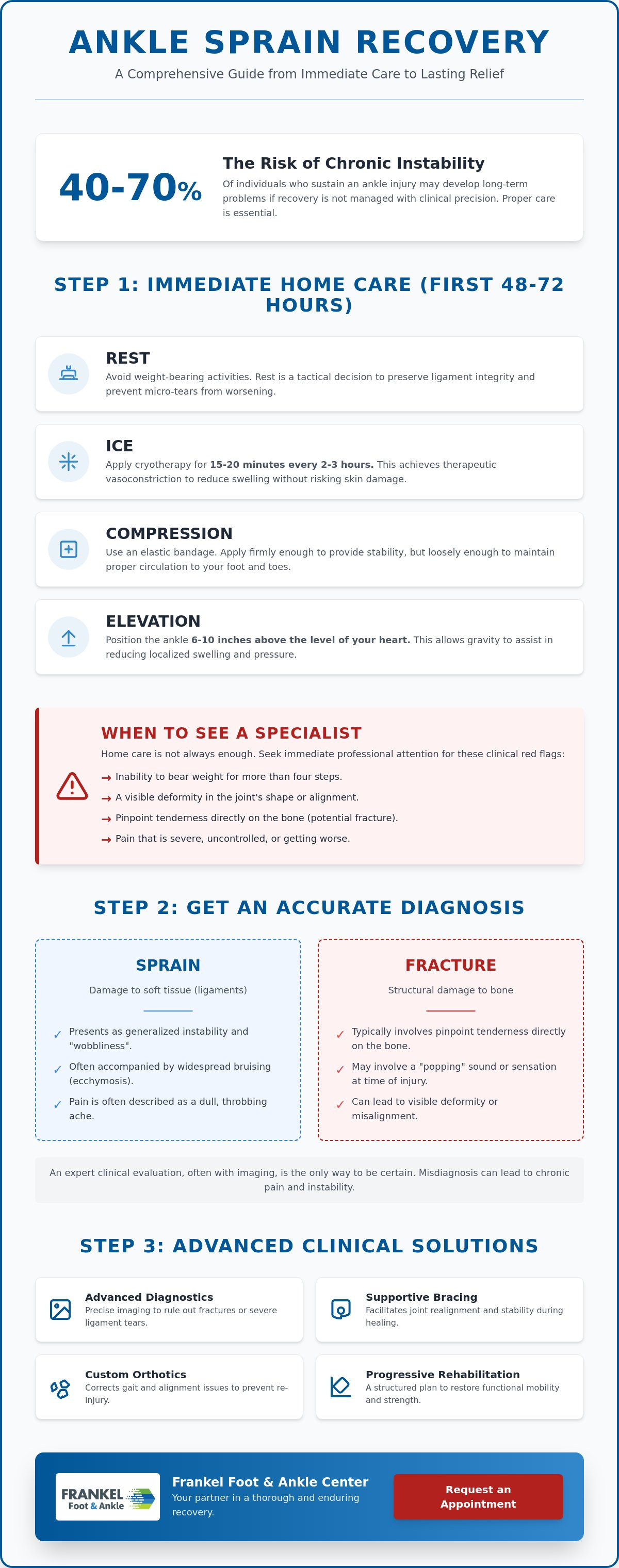
Did you know that between 40% and 70% of individuals who sustain an ankle injury may develop chronic instability if their recovery is not managed with clinical precision? When you're suddenly unable to bear weight or notice significant swelling, the fear of permanent ligament damage is a natural and valid concern. While many rely on basic home care, effective ankle sprain treatment requires a more sophisticated approach than simply resting on the couch. We understand the frustration of limited mobility and the confusion that often arises from conflicting advice regarding traditional recovery protocols.
This guide bridges the gap between immediate pain relief and the advanced diagnostics necessary to rule out fractures or severe ligamentous tears. You'll learn how to navigate the initial stages of recovery, identify the precise moment when professional intervention becomes essential, and establish a realistic timeline for returning to your favorite activities. We will examine a comprehensive path to wellness that moves from initial stabilization to the restoration of functional mobility. By prioritizing expert diagnosis and progressive rehabilitation, you can ensure your recovery is both thorough and enduring. To see how integrated wellness clinics support long-term joint health, learn more about Fit & Healthy Chiropractic.
- Master the R.I.C.E. protocol to effectively mitigate initial inflammation and understand why it's a vital component in preventing secondary ligament damage.
- Discern the subtle differences between a standard injury and more complex conditions to determine when specialized ankle sprain treatment is required for a safe recovery.
- Identify how the location of your discomfort provides diagnostic clues; it's essential for understanding the integrity of your tendons and bone structure.
- Discover how advanced clinical solutions, including custom orthotics and supportive bracing, facilitate joint realignment and promote lasting relief from chronic pain.
Immediate Steps: Managing Acute Ankle Pain at Home
The moments following a sprained ankle are critical for long-term joint health. Implementing a methodical approach to initial care can significantly shorten your recovery window and mitigate secondary tissue damage. This process begins with the R.I.C.E. protocol, a clinical standard designed to manage inflammatory responses during the first 48 to 72 hours. From initial inflammation management to long-term stabilization, every step counts in preserving your mobility. Rest isn't merely a passive activity; it's a tactical decision to preserve ligamentous integrity by preventing micro-tears from worsening under weight-bearing stress. Compression should involve an elastic bandage applied firmly enough to provide stability but loosely enough to maintain distal circulation. You might consider short-term use of over-the-counter anti-inflammatories like ibuprofen to manage discomfort, provided you don't use them to ignore the body's natural warning signals.
The Role of Ice and Elevation
Effective cryotherapy requires precision. Apply ice for 15 to 20 minutes every two to three hours to achieve therapeutic vasoconstriction without risking skin damage. Simultaneously, elevation is vital for facilitating lymphatic drainage. To be effective, you must position the ankle approximately six to ten inches above the level of the heart, allowing gravity to assist in reducing localized edema and pressure within the joint capsule.
Signs You Should Skip Home Care
While home-based ankle sprain treatment is often the first line of defense, certain clinical red flags demand immediate professional attention. If you're unable to bear weight for more than four steps or if you notice a visible deformity in the joint, you shouldn't delay a diagnostic evaluation. Relying solely on medication to mask symptoms can lead to chronic ankle sprain treatment needs later on. Early clinical intervention ensures that a potential fracture or complete ligament rupture is addressed before it results in permanent instability or long-term gait complications.
Identifying the Source: When to See an Ankle Specialist
Determining the severity of an injury requires more than just assessing the initial level of pain. While many minor injuries resolve with proper Ankle sprain aftercare, more significant trauma involves complex tissues that require clinical evaluation. A simple sprain involves stretched ligaments, but a tendon tear or a stress fracture presents structural risks that home care cannot address. Effective ankle sprain treatment begins with an accurate diagnosis to identify if the injury is limited to soft tissue or involves structural damage. Understanding whether your discomfort is concentrated in the back of the ankle or deep within the joint is the first step toward a successful recovery.
Sprains vs. Fractures
Distinguishing between soft tissue damage and structural bone breaks is essential for preventing malunion. Ligament damage often presents as generalized instability and bruising, whereas a fracture typically involves pinpoint tenderness directly on the bone. Without early imaging, you risk developing chronic ankle pain that persists for years. Proper ankle sprain treatment must rule out these structural issues to ensure the joint heals in its correct anatomical alignment, preventing the cycle of chronic instability often seen with mismanaged injuries.
Understanding Ankle Bone Discomfort
Deep joint pain often requires different ankle bone pain relief strategies than surface-level bruising. Sometimes, the pain you feel in your ankle is actually a secondary symptom of foot pain that has altered your natural gait. When you change how you walk to compensate for discomfort, you place unnatural stress on the ankle joint. This cycle of compensation is why we recommend a professional consultation to address the root cause. If you're struggling with persistent symptoms, the experts at Frankel Foot & Ankle Center can provide the specialized care you need to regain your mobility.
Clinical Solutions for Lasting Ankle Pain Relief
At Frankel Foot & Ankle Center, we provide a sophisticated range of interventions designed to address the root cause of your discomfort. While initial home care is helpful, professional ankle sprain treatment often requires biomechanical correction to prevent recurrence. Precision matters. Custom orthotics and specialized bracing are instrumental in this process because they realign the foot's structure, effectively redistributing weight and taking unnecessary pressure off the vulnerable ankle joint. For those suffering from chronic instability or severe trauma, we offer specialized surgical expertise to repair torn ligaments and restore structural integrity. According to a Clinical review of acute ankle sprains, timely and appropriate clinical management is the most effective way to avoid long-term joint pathology.
Non-Invasive and Minimally Invasive Care
We utilize therapeutic laser technology to accelerate natural healing processes at the cellular level. This painless intervention reduces inflammation and stimulates soft tissue repair without the need for incisions. Regenerative medicine is also transforming the timeline for ankle pain relief, providing patients with innovative options that bridge the gap between traditional physical therapy and invasive surgery. These progressive methodologies ensure that your ankle sprain treatment is as efficient and effective as possible. You'll spend less time in recovery and more time pursuing your daily goals.
Part of returning to your routine involves reclaiming your sense of wellness; for those interested in professional skin health as part of their self-care regimen, you can visit Skin Care Pro Group to discover specialized facial treatments.
Expert Podiatric Consultation in Middletown
Our patient-centered approach ensures that your specific lifestyle and mobility goals guide every decision we make. We believe that an informed patient is a confident one. Our methodology prioritizes long-term results through precise diagnostic insights and specialized treatment plans. Whether you visit us at our Middletown, Katonah, or Milford locations, you'll receive the same high level of expertise and compassionate care. Don't let a past injury dictate your future mobility. Regain your independence and move forward with confidence. Schedule your ankle evaluation at Frankel Foot & Ankle Center today.
Step Forward Toward Lasting Mobility
Recovery from an ankle injury requires a deliberate transition from passive home care to active clinical intervention. While the R.I.C.E. protocol effectively manages initial inflammation, a comprehensive ankle sprain treatment plan ensures your ligaments heal correctly and your joint remains stable. Ignoring persistent pain or relying solely on temporary relief can lead to long-term structural issues that compromise your active lifestyle. We're here to help you navigate this process with precision and care, often recommending holistic support like that provided by an upper cervical chiropractor Omaha to maintain overall postural balance during rehabilitation.
Led by Dr. Marc Frankel, a specialist in advanced podiatric surgery, our practice is dedicated to providing specialized care through scarless and minimally invasive techniques. We're proud to serve the communities of Middletown, NY, Katonah, NY, and Milford, PA, ensuring high-level expertise is always within your reach. Don't let a temporary setback become a permanent limitation on your movement. Book an Appointment for Expert Ankle Pain Relief today. Your path to a pain-free future begins with an expert evaluation, and we look forward to supporting your journey toward full recovery.
Frequently Asked Questions
How can I tell if my ankle is sprained or broken?
Differentiating between a severe sprain and a fracture often requires professional imaging, but certain clinical signs are indicative of structural damage. A break typically presents with pinpoint tenderness directly over the bone and an immediate inability to bear weight. Conversely, a sprain involves more generalized swelling and bruising around the soft tissues. If you notice visible deformity or hear a distinct "crack" at the time of injury, you should seek an expert evaluation immediately.
How long should I wait for ankle pain to go away before seeing a doctor?
You should consult a specialist if your symptoms don't show significant improvement within 48 to 72 hours of implementing home care. While minor strains may resolve quickly, persistent instability or swelling indicates that professional ankle sprain treatment is necessary to prevent long-term complications. Early intervention is the most effective way to ensure that ligaments heal in their correct anatomical alignment, preserving your future mobility and joint health.
Can I walk on an ankle that hurts without making it worse?
Walking on an injured ankle can be detrimental if the activity causes sharp pain or forces you to alter your natural gait. Premature weight-bearing often exacerbates micro-tears in the ligaments and can lead to secondary issues in the foot or knee. If you're unable to walk without a limp, it's vital to rest and stabilize the joint until a clinician determines that it's safe to resume activity without risking further injury.
What are the most effective treatments for chronic ankle instability?
Managing chronic instability requires a multi-faceted approach that often includes custom orthotics, proprioceptive exercises, and advanced ankle sprain treatment options. We focus on correcting biomechanical imbalances that place excessive strain on the lateral ligaments. In cases where conservative measures aren't sufficient, minimally invasive surgical techniques can tighten overstretched tissues, effectively restoring the joint's structural integrity and providing the stability needed for an active, confident lifestyle.


